


When you hear the term "civic engagement," it’s easy to think of big, formal things like voting or running for office. And while that's part of it, the real picture is much broader and, frankly, more personal.
At its heart, civic engagement is simply the collection of actions we all take to improve the quality of life in our communities. It's about contributing to the common good and strengthening the very foundation of our democracy, one small act at a time.
Understanding Civic Engagement Beyond the Definition

Think of our community as a shared garden. Civic engagement is everything that goes into tending it—watering the plants, pulling the weeds, and enriching the soil so everything can thrive. A garden doesn't flourish on its own, and neither does a community. It needs the active, hands-on participation of its residents to become a vibrant, healthy, and supportive place to live.
It's about showing up. For your neighbours, for your neighbourhood, for the city you call home.
This participation isn't always about grand, political gestures. More often, it’s found in the everyday actions that build connections between people and help solve local problems. The answer to "what is civic engagement?" can feel complicated, but it's often much simpler than we make it out to be.
To help break it down, here’s a quick overview of the core pillars that make up civic engagement. This table outlines the fundamental components, giving you a clearer picture of the full scope of the concept.
The Core Pillars of Civic Engagement
| Pillar | Description | Real-World Example |
|---|---|---|
| Civic Action | Direct involvement in community life through non-political activities. This is about hands-on work that addresses immediate needs and builds social ties. | Volunteering at the Ottawa Food Bank or joining a neighbourhood cleanup. |
| Political Voice | Making your opinions known to decision-makers and participating in the political process to influence public policy. | Contacting your city councillor about a local issue or attending a town hall meeting. |
| Electoral Participation | Engaging directly with the machinery of democracy, primarily through voting and related activities. | Casting your ballot in municipal, provincial, and federal elections. |
| Social Connectedness | Building relationships and trust within your community. This forms the social fabric that underpins all other forms of engagement. | Organizing a block party, joining a local sports league, or participating in a community garden. |
As you can see, these pillars cover a lot of ground—from direct service to political action. They all work together to create a stronger, more resilient community.
The True Scope of Community Involvement
Civic engagement isn't just about casting a ballot every few years. It's a whole spectrum of activities, ranging from individual efforts to collective movements, all aimed at tackling public concerns. Let's look at how this plays out:
- Political Participation: This is the classic form. It includes voting, yes, but also things like contacting your elected officials or showing up at a town hall meeting to make your voice heard on a local issue.
- Community Service: This is about rolling up your sleeves and dedicating your time and skills. Think serving meals at a shelter, helping clean up a local park, or mentoring a young person in your community.
- Social Action: This is about raising awareness and pushing for broader social change. It could be organizing a peaceful protest, starting a petition for a cause you believe in, or running an advocacy campaign on social media.
On their own, these actions might feel small. But together, they are the building blocks of a responsive and healthy society. They’re the individual threads that, when woven together, create the strong, vibrant fabric of a community.
Civic engagement is the belief that your voice matters, combined with the action to make it heard. It’s the understanding that a healthy democracy isn't a spectator sport; it requires everyone to get on the field and play their part, no matter how small it may seem.
Ultimately, every act—from joining a neighbourhood watch meeting to helping with a city-wide food drive—reinforces the idea that we all have a stake in our community's success. It's about recognizing that we share a responsibility to one another and taking tangible steps to build a better future for everyone.
The Many Ways You Can Participate
When people hear the term civic engagement, they often jump to formal politics, and for good reason. But participation isn’t a one-size-fits-all deal. Think of it less as a formal duty and more like finding a meaningful way to plug into your community. There are countless paths to making a difference, each suited to different passions, skills, and schedules.
The key is finding an avenue that genuinely clicks with you. When that happens, community involvement stops feeling like an obligation and starts feeling like a rewarding part of your life.
Going Beyond the Ballot Box
Formal political action is definitely a huge piece of the puzzle. It’s the bedrock of a healthy democracy. This goes beyond just casting a vote every few years. It means staying in the loop on local issues, picking up the phone to call your city councillor, or showing up to a town hall meeting to make your voice heard. These actions are how we directly influence policy and remind decision-makers who they’re working for.
But the real magic of civic engagement happens when we look beyond the political arena. This is where community-focused service comes in, offering a direct, hands-on way to see your impact.
- Volunteering: Dedicating your time to a local food bank or animal shelter tackles immediate needs right where they exist.
- Neighbourhood Projects: Ever thought about organizing a park cleanup? Or maybe starting a community garden? These small-scale projects build stronger, safer, and more connected local communities from the ground up.
- Supporting Local Groups: Even something as simple as coaching a kid's soccer team or helping set up for a local festival is a powerful form of engagement. You're not just helping out; you're building community spirit and investing in the next generation.
Civic engagement is fundamentally about showing up for your community in whatever capacity you can. Whether you have one hour a month or several hours a week, there is a role for you to play in creating a better, more connected society.
Driving Change Through Social Action
Then there’s social action, which is all about advocacy and shining a spotlight on specific causes. This is the stuff that sparks big conversations.
It could mean joining a peaceful protest for something you believe in, signing (or starting!) a petition to change a local bylaw, or even just using your social media to share reliable information and rally others around an issue.
These actions can ignite public debate and put real pressure on institutions to tackle systemic problems. For example, a successful campaign for better accessibility at public facilities, like the ones you can read about in our guide to community swimming pools in the NCR, often starts with just a small group of passionate citizens.
It’s a perfect reminder that you don't need a formal title or a fancy position to be a catalyst for real, meaningful change in your community. You just need to start.
Why Your Involvement Is So Important
It’s one thing to know what civic engagement is, but it’s another thing entirely to understand why it matters. This is where intention turns into action. Your involvement, no matter how small it seems, sends ripples through your community and even comes back to benefit you.
When people check out, a community starts to fray at the edges. Problems pile up, public spaces might get neglected, and a general sense of disconnection sets in. Your voice and your actions are the glue that holds everything together, making sure your neighbourhood is a place where people feel they belong.
The Power of Collective Action
Picture this: a handful of neighbours are worried about cars speeding down their street. One person complaining might not get much traction. But when they team up, start a petition, and show up at a city council meeting, they suddenly have a unified voice that’s tough to ignore.
Just like that, they’ve become a force for change. Their effort could lead to a new crosswalk or speed bumps, making the street safer for everyone. This is the real, tangible impact of civic engagement. It takes our individual worries and transforms them into collective solutions.
Your involvement is the bridge between the community you have and the community you want. It's the practical application of the idea that we are stronger together, proving that dedicated citizens can achieve concrete results.
When people participate, governments pay attention. It's that simple. Officials are far more likely to listen and act when they know their community is watching. This creates a loop of accountability that’s absolutely essential for a healthy democracy, ensuring decisions actually reflect the needs of the people.
Personal Growth and Community Connection
The perks of getting involved don’t stop at policy changes. On a personal level, civic engagement is a massive opportunity for growth. It can help you:
- Build new skills: You’ll learn everything from public speaking and project management to teamwork and fundraising—practical skills you can use anywhere in life.
- Expand your network: You get to meet neighbours and local leaders who care about the same things you do, growing your social and professional circles. You can even check out programs like the CommunityVotes Ottawa awards to see which local groups are making waves.
- Foster a sense of purpose: There’s a deep satisfaction that comes from contributing to something bigger than yourself. It strengthens your roots and your connection to the place you call home.
That connection is vital. When trust in government erodes, it can lead to widespread cynicism. For instance, a Public Policy Institute of California survey from June 2024 found that while a majority of Californians (58%) are optimistic about the direction of the state, only 34% approve of the state legislature's performance. You can explore more data on Californians and their government to see how these dynamics play out.
Getting involved is a direct way to build trust and drive better outcomes, right here where we live.
Getting the Next Generation Involved
A healthy democracy isn’t just about what’s happening today—it’s about who shows up tomorrow. Making sure young people understand and value their role in society is absolutely essential for its long-term health. That work starts with solid civic education, both in the classroom and around the dinner table.
Teaching kids and teens about their rights, their responsibilities, and how their government actually works is so much more than a history lesson. It’s laying the groundwork for a lifetime of participation. Without this foundation, you risk a whole generation feeling disconnected from the very systems meant to serve them, leaving a vacuum where apathy can easily take root.
From the Classroom to the Community
The best civic education doesn’t just live in textbooks. It’s all about creating hands-on experiences that turn abstract ideas like "democracy" and "community" into real skills and lasting habits. When a student can see the direct impact of their own involvement, the question “what is civic engagement?” suddenly becomes personal and powerful.
Schools and communities can make this happen by offering real-world opportunities:
- Student Government: This is democracy in miniature. It’s a direct, small-scale lesson in everything from campaigning and representing your peers to making tough decisions that affect everyone.
- Debate Clubs: These programs are fantastic for teaching critical thinking, how to disagree respectfully, and the art of building a solid argument—all crucial skills for any engaged citizen.
- Service-Learning Projects: By finding a need in the community and working together to fix it, students learn a powerful lesson: their actions matter and they can create real, positive change.
Experiences like these show that being engaged isn’t just for adults. It’s for everyone.
When we give young people the knowledge and tools to get involved, we aren’t just teaching them about democracy—we’re investing in its future. They learn that their voice has power and that they have a right to be heard.
Building a Culture of Participation
Of course, this effort can't be confined to school grounds. Parents and guardians play a huge part in modelling what an engaged citizen looks like. This can be as simple as talking about current events at home, taking your kids with you when you vote, or volunteering together for a local cause. These small acts make participation feel like a normal, important part of life.
Many places formally recognize the importance of these programs. In California, the Civic Learning Awards, co-sponsored by the State Superintendent of Public Instruction and the Chief Justice of California, have celebrated schools with outstanding civics programs since 2013. In 2024, 21 schools received these awards, highlighting their work in shaping future leaders through hands-on civic learning.
Your Practical Guide to Getting Involved
Alright, so you’re ready to make a difference but aren’t quite sure where to begin? This is your roadmap. It’s one thing to understand the concept of civic engagement, but it’s another thing entirely to put that knowledge into action. The good news? It’s probably easier than you think, and every single contribution, big or small, helps weave a stronger community fabric.
The journey doesn't start with a massive time commitment or a specific skillset. It just starts with a spark of passion and a little bit of digging.
Step 1: Find What Fires You Up
First things first: what do you actually care about? What issues in our community get you talking, thinking, or even a little bit angry? Is it protecting our green spaces, ensuring everyone has enough to eat, supporting local artists, or advocating for animal welfare?
Your passion is your compass. It’s what will make getting involved feel energizing and meaningful, not like another item on your to-do list. Don't overthink it—just jot down a few things that matter to you.
Step 2: Research Who's Doing the Work
Once you have a sense of your "why," it’s time to find the "who." A quick search for volunteer opportunities in the National Capital Region will open up a whole world of organizations already making an impact in areas you care about. This is where your passion connects with a real-world mission.
Here are a few great places to start your search in Ottawa and the NCR:
- Volunteer Ottawa: Think of this as the city’s central hub for do-gooders. It connects volunteers with hundreds of non-profits, and you can filter your search by cause, the skills you have to offer, or how much time you can spare.
- City of Ottawa: The city's official website is a great resource for opportunities to join community boards, advisory committees, or take part in city-led consultations and initiatives.
- Community Associations: Your local community association is the perfect entry point for neighbourhood-level projects. This is ground zero for everything from park cleanups to organizing local festivals.
Sometimes, the opportunities are very specific. For instance, if you're an outdoorsy type, you might be interested in learning more about the Ontario trail grants for volunteers that help keep our region's beautiful natural spaces accessible for everyone.
This is what our collective effort looks like in numbers:
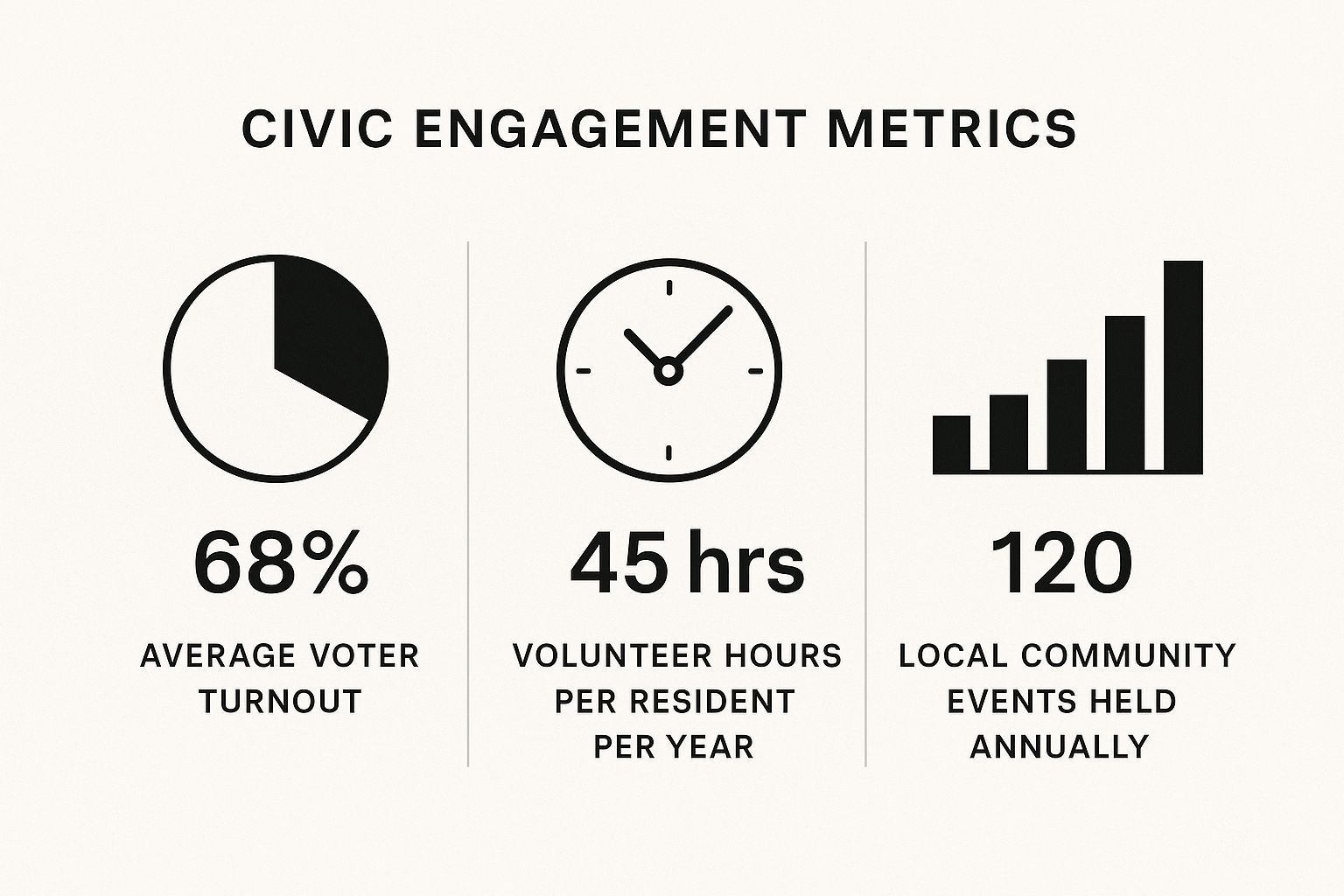
These figures tell a powerful story. While many of us vote, it's the hours spent volunteering and the sheer number of community events that really show the deep, hands-on impact we can have.
Find Your Civic Engagement Style
Not sure what kind of involvement fits your life? Everyone's capacity is different, and that's okay! This table breaks down a few options to help you find an activity that aligns with your schedule and the kind of impact you want to make.
| Activity Type | Typical Time Commitment | Primary Impact Area |
|---|---|---|
| Signing Petitions | Low (Minutes) | Advocacy & Policy |
| Attending a Protest | Low (A few hours) | Public Awareness & Advocacy |
| Volunteering at an Event | Medium (Half-day to a weekend) | Community Building & Support |
| Joining a Committee | High (Monthly meetings) | Governance & Long-Term Strategy |
| Running for Office | Very High (Months to years) | Systemic Change & Representation |
Whether you have five minutes or five hours a week, there’s a meaningful way for you to contribute. The key is to find the right fit for you.
Step 3: Start Small, Build Momentum
One of the biggest mental blocks is feeling like you don't have enough time or expertise. The secret? Just start small. You don't need to chair a major committee on your first day.
Your first step doesn’t have to be a giant leap. It can be a simple, manageable action that fits into your life right now. The goal is to begin, build confidence, and create a habit of participation.
Think about committing just one or two hours a month. That could mean showing up for a single community meeting, helping out at one event, or even just signing up for an organization’s newsletter to stay in the loop. Once you take that first small step, you'll find it's much easier to keep the momentum going.
The Future of Civic Engagement in a Digital World

Let's be honest, the way we participate in our communities is changing right under our feet. Technology has completely rewired how we connect, share what’s on our minds, and rally together for a cause. Digital platforms and social media have become the new town squares, acting as powerful engines for mobilizing citizens, shining a light on local issues, and coordinating action on a scale we’ve never seen before.
This shift has opened up some incredible doors. A single, well-timed post can spark a neighbourhood cleanup. A petition that once took weeks of door-knocking can now gather thousands of signatures in a matter of hours. And virtual town halls? They allow more people than ever to look their elected officials in the eye—even if it’s through a screen. This level of accessibility is tearing down many of the old barriers that kept people from getting involved.
But it’s not all smooth sailing. This new digital world comes with its own set of serious challenges. Misinformation can go viral just as fast as factual news, sowing confusion and chipping away at the public’s trust. Then there's the digital divide—the very real gap between those with reliable internet and those without. This gap threatens to silence the voices of some of our most vulnerable neighbours, effectively excluding them from the conversations that shape their lives.
Navigating the New Landscape
To make our way through this complicated new reality, we need a new kind of literacy. This is where solid civic education isn’t just a nice-to-have; it's absolutely essential. We need to equip people with the skills to tell fact from fiction and to engage in online discussions constructively.
In this era, being a good citizen means being a smart digital citizen. It involves understanding not just how to participate, but how to do so responsibly, ethically, and effectively in an increasingly crowded information space.
We’re already seeing initiatives pop up to tackle this head-on. In the United States, for example, national organizations and state programs are arming citizens with fact-based information and critical thinking skills to help them participate in democracy in a meaningful way. There is a growing focus on media literacy education in schools to ensure young people can navigate complex information environments and get actively involved.
When you boil it all down, the future of civic engagement is a story about empowerment. From voting and volunteering to online advocacy, the ways you can contribute are more diverse than ever. Every small, consistent effort you make helps build a more connected, responsive, and resilient community. Your voice, your actions, and your commitment truly matter—both now and for the future.
Got Questions About Getting Involved? We Have Answers.
Thinking about jumping into civic life? It's natural to have a few questions before you start. We’ve put together some straightforward answers to the things people often ask, helping you clear any hurdles and get started with confidence.
Do I Have to Be Political to Get Involved?
Not at all. While things like voting are a key part of being an engaged citizen, they’re just one piece of the puzzle. Some of the most powerful ways to contribute are completely non-political.
Think about it: volunteering at a local food bank, joining a neighbourhood cleanup, or tending to a community garden all build a stronger, more connected community without ever touching politics. The real goal is to find a way to contribute that feels authentic and meaningful to you.
The heart of civic engagement isn't about picking a political side; it's about showing up for your community. Whether through service, advocacy, or participation, every action contributes to our collective well-being.
I Have Almost No Free Time. How Can I Still Participate?
Life is busy. We get it. But civic engagement is wonderfully flexible and doesn't demand a huge time commitment. You can start incredibly small and still make a real difference, weaving meaningful actions into even the tightest of schedules.
Here are a few ideas that take just minutes:
- Sign an online petition for a local cause you care about.
- Share reliable info from the city or a trusted non-profit on your social media.
- Dedicate just one or two hours a month to a single volunteer event.
Every little bit helps. These small efforts build momentum and add up to create much larger change.
Does My One Action or Vote Really Make a Difference?
Absolutely. It’s easy to feel like a tiny drop in a huge ocean, but history proves time and again that massive change often starts with the dedicated actions of a few people.
Local elections, for instance, have been won or lost by just a handful of votes, making your single ballot incredibly powerful. In the same way, one person speaking up at a town hall meeting can shine a light on a critical issue that everyone else missed. Your individual action is a vital piece of the puzzle—when it joins with others, it creates the collective force needed to make real change happen.
At ncrnow, we believe an informed and engaged community is a strong community. We're dedicated to bringing you the news and stories that matter to the National Capital Region, helping you stay connected and find your own way to get involved. Learn more at https://ncrnow.ca.
Article created using Outrank
About The Author