


For Canadian entrepreneurs, figuring out small business tax deductions is less about finding secret loopholes and more about mastering the rules of the game. A powerful tool in your playbook is the Small Business Deduction (SBD), a special tax rate designed to help your business thrive. It’s a foundational concept that can dramatically lower your tax bill right from the start.
How the Small Business Deduction Reduces Your Tax Rate
When you hear "deduction," you probably think of subtracting an expense from your income, like office supplies or rent. But the Small Business Deduction works a bit differently. It isn't a deduction for a specific cost; instead, it's a special, much lower corporate tax rate applied to your first $500,000 of active business income each year.
Think of it as a VIP lane for your business taxes. While larger corporations pay the general corporate rate, qualifying small businesses get to use this faster, more efficient lane, paying significantly less tax on a huge chunk of their earnings. This preferential treatment is a cornerstone of Canadian tax policy, designed to leave more money in your hands to reinvest, hire, and grow.
This is exactly why your business structure is so critical. The SBD is only available to Canadian-Controlled Private Corporations (CCPCs), making incorporation a key strategy for tax efficiency. Sole proprietorships and partnerships don’t get this perk—their income is taxed at personal rates, which can climb much higher.
SBD Savings At a Glance: General vs. Small Business Tax Rates
To see the SBD's impact in black and white, let's compare the tax owed on $100,000 of active business income under both scenarios. The difference is stark and shows just how much you can save by qualifying. Provincial rates vary, but this gives a clear picture.
| Tax Scenario | Applicable Tax Rate (Approx.) | Taxes Owed on $100,000 | Potential Savings |
|---|---|---|---|
| With Small Business Deduction | 9%-12% | $9,000 – $12,000 | – |
| General Corporate Rate | 26.5% (average) | $26,500 | $14,500 – $17,500 |
As you can see, the savings aren't just a few dollars here and there. We're talking about thousands of dollars left in your company's bank account, ready to be put back to work.
The Small Business Deduction fundamentally changes your tax liability. It’s not just about saving a few dollars; it's about creating a financial foundation that allows your business to retain more of its hard-earned capital for future growth and stability.
This chart visualizes how small businesses are putting tax deductions to work, highlighting average savings and participation rates.
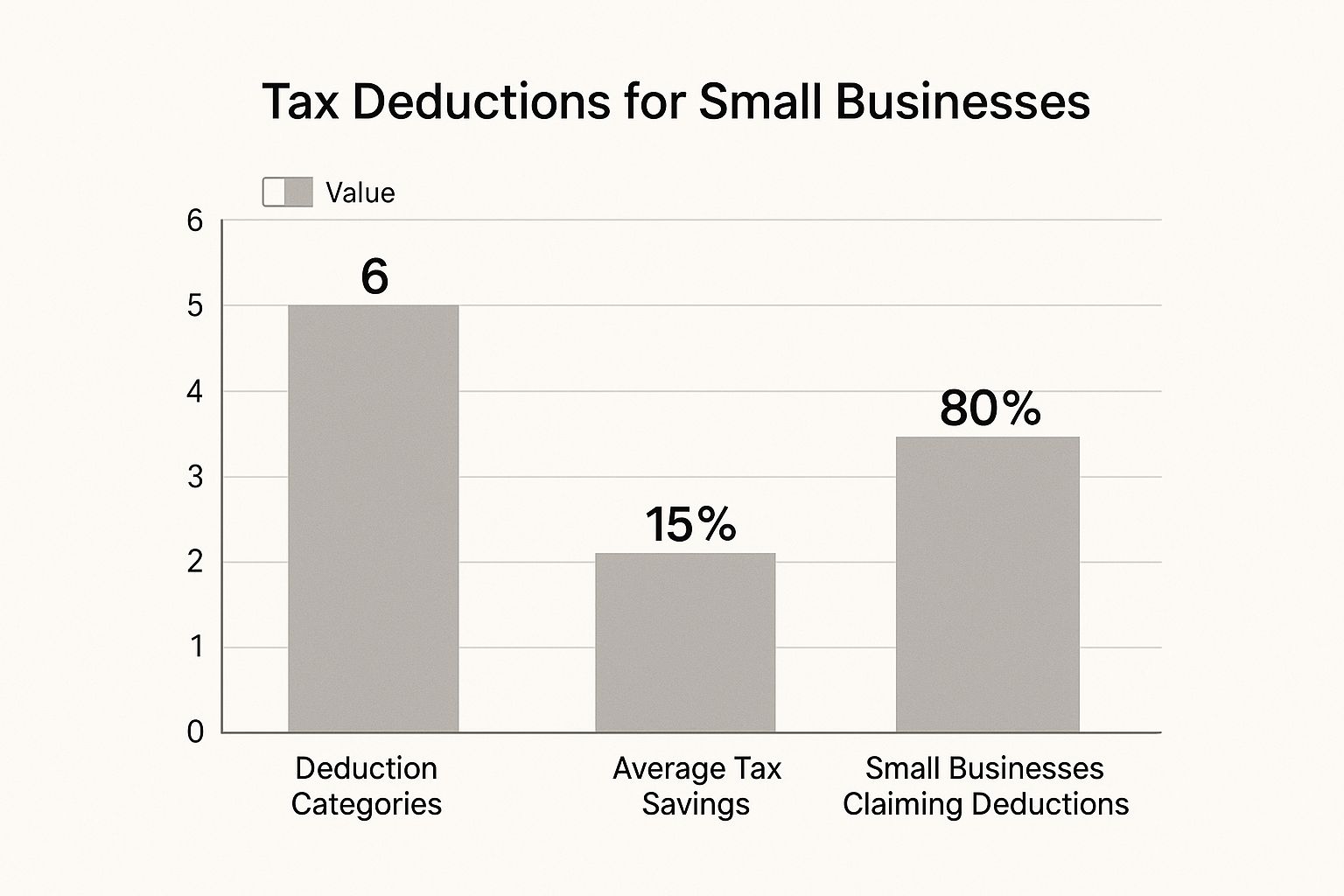
The data is clear: the overwhelming majority of small businesses are using deductions like the SBD to achieve significant tax savings.
Why Your Business Structure Matters
Choosing to incorporate is the first step toward unlocking these powerful tax advantages. By operating as a CCPC, you create a separate legal entity from yourself, which is then taxed at that much lower corporate rate.
This separation opens up a world of strategic benefits:
- Tax Deferral: You can leave profits inside the corporation to be taxed at the low SBD rate. You only pay personal income tax when you decide to pay yourself a salary or dividends from the company. This gives you incredible control over your personal tax situation.
- Reinvestment Capital: The money saved through the lower tax rate is fuel for your business. It can be used to purchase new equipment, expand marketing efforts, or build a cash reserve for unexpected opportunities or downturns.
- Liability Protection: One of the most significant benefits of incorporation is limited liability. This means your personal assets, like your home and savings, are generally protected from business debts and lawsuits.
By understanding and using the Small Business Deduction, you're not just filing taxes—you're strategically managing your company’s financial health from the ground up. It truly sets the stage for every other deduction and credit you can claim.
Deducting Home Office Expenses The Right Way

As more and more entrepreneurs build their empires from kitchen tables and spare rooms, mastering the home office deduction has become a game-changer. This isn't just some minor perk; it's a huge opportunity to turn a slice of your everyday household costs into valuable small business tax deductions in Canada. But, as you'd expect, the Canada Revenue Agency (CRA) has some very specific rules you need to follow.
To even qualify, your home office has to meet one of two key conditions. Think of them as gatekeepers. You only need to get past one to be in the clear.
- The Principal Place of Business Test: Is your home office the main hub of your business? If this is where you spend the majority of your working hours, you’ll likely pass this test with flying colours.
- The Regular and Continuous Use Test: Do you use the space only for your business and to meet with clients, customers, or patients on a regular basis? This one is for folks who might have another primary work location but use their home office specifically for these client-facing meetings.
Once you meet either of these criteria, you've unlocked the ability to deduct a portion of your home-related costs. This is where a little bit of math becomes your best friend.
Calculating Your Deductible Percentage
The whole idea behind the home office deduction is proportionality. You can't just write off your entire hydro bill. You can only deduct the portion of your household expenses that directly relates to your workspace. The CRA wants you to calculate this based on the square footage of your office compared to the total size of your home.
Let's walk through a simple example:
- Say your home is 1,800 square feet in total.
- Your dedicated home office takes up a spare room that measures 200 square feet.
- To find your business-use percentage, you just divide the office area by the total home area: (200 sq. ft. / 1,800 sq. ft.) = 11.1%.
That 11.1% is your magic number. You can now apply this percentage to all your eligible household expenses to figure out your total deduction. It’s a clean formula that takes the guesswork out and keeps your claim on the right side of the CRA.
What Home Office Expenses Can You Claim?
Once you have your business-use percentage, you can start applying it to a whole range of household running costs. Keeping detailed records and all your bills is absolutely non-negotiable here. You'll need them to back up your claim if the CRA ever comes knocking.
Eligible expenses usually include:
- Utilities: A portion of your electricity, heat, and water bills.
- Rent: If you're a renter, you can claim a percentage of your monthly rent.
- Maintenance and Minor Repairs: Think costs that benefit the whole home, like getting the furnace repaired or painting.
- Home Insurance: The business-use percentage of your home insurance premiums.
- Property Taxes: A portion of the property taxes you pay on your home.
The home office expense deduction is a fantastic tax break, especially for small businesses run out of a residence. For example, if your office takes up 15% of a home with $20,000 in total eligible expenses for the year, you can legally deduct $3,000 from your business income. You can learn more about how to maximize your small business tax deductions and stay compliant with CRA guidelines.
Crucial Clarification: You cannot use home office expenses to create or increase a business loss. Your deduction is capped at the net income your business earns before you make this claim. Any leftover amount can be carried forward to the next year.
By understanding the rules, accurately calculating your percentage, and tracking your expenses like a hawk, you can confidently turn your home office into a powerful tool for lowering your tax bill.
A Guide to Everyday Business Expense Deductions

Beyond the big-ticket items like your home office or the Small Business Deduction, your day-to-day operations are absolutely packed with opportunities to lower your taxable income. The simple rule is this: every dollar you spend to earn a dollar is a potential write-off.
The trick is learning to see these everyday costs for what they are—legitimate small business tax deductions in Canada—and then tracking them like a hawk.
Of course, the Canada Revenue Agency (CRA) has a crucial filter for every claim: the reasonableness test. This just means that any expense you deduct has to be a sensible amount that's directly tied to earning income for your business. Claiming a Lamborghini as a delivery vehicle for your local flower shop? That’s not going to fly. The expense has to make practical sense.
Let's break down the most common everyday expenses so you can spot and claim what you're owed with confidence.
Digital Tools and Office Supplies
In today's world, your digital toolkit is just as vital as your pens and paper. So many entrepreneurs completely forget about the recurring costs of software and online services, but these are 100% deductible business expenses.
Just think about all the subscriptions that keep your business humming along. These aren't personal luxuries; they're the cost of doing business.
Here's what this category typically includes:
- SaaS Subscriptions: Those monthly or annual fees for tools like Slack, Adobe Creative Cloud, or project management software like Asana.
- Accounting Software: Your subscription to QuickBooks, Xero, or whatever you use to keep your books in order is a direct business cost.
- Website and Hosting: The fees for your domain name, website hosting, and any premium themes or plugins you buy all count.
- Traditional Office Supplies: And yes, don't forget the basics! Stationery, printer ink, postage, and business cards all add up.
My best advice? Keep a dedicated folder for all your digital receipts. It makes tallying these costs at tax time ridiculously easy.
An expense is deductible if it was incurred for the purpose of earning business income. The CRA's focus is on the intent behind the purchase, not just the item itself. Always ask: "Did I buy this to help my business make money?"
Marketing and Client Acquisition
Getting new customers in the door is the lifeblood of any small business. Thankfully, pretty much everything you spend to do that is deductible. From running a Facebook ad campaign to printing a stack of brochures, every dollar spent on promotion can shrink your tax bill.
This is a broad category, covering everything from cutting-edge digital strategies to old-school outreach. If you're spending money to get your name out there, it's almost certainly a valid deduction.
A few examples of deductible marketing expenses:
- Online Advertising: This covers your spend on Google Ads, social media campaigns on platforms like Facebook or Instagram, and any sponsored content.
- Website Development: The initial cost to design and build your business website is a write-off.
- Promotional Materials: Expenses for creating flyers, brochures, business cards, and other physical marketing assets.
- Sponsorships: Sponsoring a local kids' soccer team or a community event can be deducted, as long as your business gets clear brand exposure in return.
And remember, even taking clients out for meals or entertainment falls under this umbrella, though these are typically only 50% deductible. Just be sure to keep detailed records of who you met with and what business you discussed. Speaking of which, you can learn more about making valuable connections by checking out the top business networking events in Ottawa.
Professional Fees and Development
You don't have to be an expert in everything to run a business. The fees you pay to other pros for their services are deductible, and so are the costs of sharpening your own skills. Investing in expertise—whether it's someone else's or your own—is a deductible business activity.
Think of these expenses as investments in your business's health and your own professional growth. They help ensure your company operates correctly and that you stay competitive.
Here are some common professional expenses to look out for:
- Legal and Accounting Fees: The money you pay your lawyer, accountant, or bookkeeper is fully deductible. This includes the fees for getting your taxes done!
- Bank Charges: Those pesky monthly account fees, transaction charges, and the interest on your business loans are all deductible.
- Professional Memberships: Your annual dues for industry associations or professional organizations related to your work.
- Training and Education: The cost of courses, seminars, and workshops that upgrade your skills or help you maintain a required professional standing.
By simply categorizing and tracking these everyday costs, you turn them from simple outflows into powerful tools for tax reduction. Diligent record-keeping is your best friend here, ensuring every claim is reasonable, justified, and ready for the CRA's eyes.
How to Claim Vehicle and Travel Expenses

For just about any business that isn’t chained to a single desk, the costs of getting around can be a goldmine for tax savings. We’re talking about everything from daily client visits across town to that big industry conference on the other side of the country. All of those expenses can become powerful small business tax deductions in Canada.
But here’s the catch: the Canada Revenue Agency (CRA) is notoriously strict about these claims. They demand meticulous, undeniable proof for every dollar you deduct. Understanding how to track and claim these costs the right way isn’t just about stuffing receipts in a shoebox—it’s about choosing the right method and building the iron-clad documentation the CRA expects.
Choosing Your Method for Vehicle Expenses
When it comes to writing off the costs of using your car for business, the CRA gives you two roads to take. Each has its own rules and record-keeping demands, so picking the one that actually fits how you work is the first step.
1. The Full Logbook Method (Actual Expenses)
This is the classic, most direct approach. You track every single kilometre you drive for business and every last cent you spend on your vehicle. At the end of the year, you figure out what percentage of your total driving was for business and apply that same percentage to all your vehicle costs.
Let's say you drove 20,000 kilometres in total last year, and your logbook shows 15,000 km of that was for business meetings and site visits. Simple math: your business-use percentage is 75%. You can then deduct 75% of all eligible vehicle expenses.
What counts as an eligible expense?
- Fuel and oil changes
- Insurance and registration fees
- Maintenance and repairs
- Lease payments or capital cost allowance (that's the fancy term for depreciation)
- Interest on your car loan
This method usually pays off big time for people who are constantly on the road for work. The trade-off? You have to be incredibly diligent. It means logging every trip and saving every single receipt.
2. The Simplified Logbook Method
The CRA knows that keeping a logbook for 365 days a year can be a massive headache. So, they created a shortcut. To use it, you first need to keep a complete, detailed logbook for one full year. This establishes your "base year" percentage of business use.
After that first year, you only need to keep a logbook for a three-month sample period. As long as the business-use percentage from that sample period is within 10% of your original base year percentage, you can go ahead and apply the base year's percentage to your full year's expenses. It’s a huge time-saver that keeps you on the right side of the CRA.
No matter which method you pick, your mileage log is the most critical piece of evidence you have. It has to show the date, destination, purpose of the trip, and the start and end odometer readings for every business drive. No exceptions.
Claiming Business Travel Expenses
When your work takes you away from your usual home base, a whole different set of deductions comes into play. The CRA generally considers a trip a business expense if your main reason for going is to earn income. Think visiting clients in another province, attending a trade show, or meeting with suppliers.
To make sure your travel claims are audit-proof, you need to prove the trip's business purpose. Keep everything: conference agendas, meeting notes, and even the email chains you had with clients confirming your appointments.
What Travel Expenses Are Deductible?
When you're travelling for business, you can claim a range of reasonable expenses to offset your costs.
- Transportation: This covers the obvious stuff like flights, train tickets, bus fares, and taxi rides.
- Accommodation: The cost of your hotel or other lodging is fully deductible.
- Meals and Entertainment: This is where things get tricky, and it's a common point of confusion. You can only deduct 50% of the cost of food, drinks, and entertainment while travelling for business.
For every single travel expense, you need a receipt and a record detailing the date, the location, the amount, and exactly what business purpose it served. Confidence in claiming vehicle and travel expenses comes from one thing: organized, diligent record-keeping from day one.
Understanding Capital Cost Allowance for Large Purchases
Making big purchases is a sign your business is growing. That shiny new computer, the essential piece of machinery, or the office furniture that finally makes your space feel legit—these are exciting milestones. But when it comes to taxes, you can’t deduct the entire cost in the year you buy them.
Instead, the Canada Revenue Agency (CRA) has a system called Capital Cost Allowance (CCA). Think of it as “tax depreciation.” Just as a major asset loses value over time, the CRA lets you write off a piece of its cost each year. It’s a way of spreading a large expense over several years, giving you a predictable and valuable tax deduction year after year.
Getting your head around CCA is the key to making smart, tax-efficient investments. It turns a one-time cash hit into a multi-year tax-saving strategy.
How CCA Classes Work
The CRA sorts capital assets into different “classes,” and each class has its own annual deduction rate. You don't get to choose; the rate is set based on the type of asset you bought. Luckily, for most small business owners, you only need to know a handful of them to get by.
Here are a few of the most common ones you'll run into:
- Class 50 (55% rate): This is a big one. It covers general-purpose electronic equipment like desktop computers, laptops, and tablets. That high rate means you get to write off its value pretty quickly.
- Class 8 (20% rate): This is the catch-all category for things that don’t fit neatly elsewhere. It’s where you’ll find office furniture (desks, chairs), fixtures, and some types of equipment.
- Class 10 (30% rate): This class is for motor vehicles, like the car or light-duty truck your business uses for deliveries or client visits.
Putting your purchase in the right class is the first step to claiming your deduction. It's a common mistake to misclassify an asset, which can lead to incorrect claims and headaches with the CRA down the road.
The Power of the Accelerated Investment Incentive
To give businesses a nudge to invest in new assets, the government rolled out the Accelerated Investment Incentive (AII). This program is a game-changer because it gives your CCA claim a major boost in the very first year you own an asset. For most classes, it effectively triples the normal first-year deduction. This incentive is available for property acquired after November 20, 2018, and became available for use before 2028.
The Accelerated Investment Incentive is a strategic tool that boosts your first-year deduction, freeing up cash flow when you need it most—right after a major purchase. It effectively lets you "front-load" your tax savings.
This incentive is designed to soften the financial blow of a large purchase. By taking a bigger deduction in year one, you lower your taxable income more significantly, freeing up cash you can pour right back into your business. Making savvy decisions about big buys is a huge part of finding the right small business tax deductions in Canada.
To make it simple, here’s a quick look at the most common CCA classes that small businesses deal with.
Common CCA Classes for Small Businesses
This table breaks down some of the typical assets you might buy and shows which class they belong to, along with their annual depreciation rate.
| Asset Type | CCA Class | Depreciation Rate |
|---|---|---|
| Computers & System Software | Class 50 | 55% |
| Office Furniture & Fixtures | Class 8 | 20% |
| Most Vehicles (Cars, Vans) | Class 10 | 30% |
| Buildings Acquired After 2007 | Class 1 | 4% |
While this covers the basics, always refer to the CRA’s official list for a complete breakdown or consult with a tax professional to make sure your assets are classified correctly.
Answering Your Top Tax Deduction Questions
Diving into the world of small business tax deductions in Canada can sometimes feel like you’re learning a whole new language. You get the big picture, but then a specific situation pops up and you’re left scratching your head. This section is here to cut through the jargon and give you clear, straightforward answers to the questions we hear most from entrepreneurs just like you.
Think of this as your practical playbook. It’s designed to clear up confusion and help you confidently apply everything you've learned. Let’s tackle the questions that always seem to come up once you start digging into your expenses.
Can I Deduct My Business Startup Costs?
Yes, absolutely—but how you deduct them is what really matters. The Canada Revenue Agency (CRA) sees startup costs in two different ways, and each gets handled differently when you file your taxes. Getting this right from day one is crucial.
Many of your initial operating expenses can be deducted in the same year you spend the money. These are the costs you rack up before you officially open for business but were necessary to get everything off the ground.
- Examples of Immediately Deductible Costs: Things like market research, running a few early ads to test the waters, or fees you paid for pre-launch advice.
On the other hand, bigger purchases that provide a lasting benefit to your business are considered capital expenses. You don’t deduct these all at once. Instead, you claim a piece of their cost over several years using the Capital Cost Allowance (CCA) system.
- Examples of Capital Startup Costs: This includes legal fees for incorporation, the cost of securing patents or trademarks, or the money spent renovating your new office space.
The golden rule here is meticulous record-keeping. Keep these two types of expenses separate right from the start to make sure your claims are accurate and audit-proof.
What Is the Difference Between a Tax Deduction and a Tax Credit?
This is easily one of the most important distinctions in the tax world. Understanding it can seriously change how you plan your finances. While both are great for your bottom line, they work in completely different ways.
A tax deduction lowers your taxable income. Let’s say your business brings in $80,000. If you have $10,000 in eligible deductions, you only have to pay income tax on $70,000. The deduction shrinks the pile of money the government gets to tax in the first place.
A tax credit, however, is a direct, dollar-for-dollar reduction of the final tax bill you owe. If you owe the CRA $5,000 in taxes but qualify for a $1,000 tax credit, your bill drops straight down to $4,000. It's like having a gift card from the government that you can apply directly to what you owe.
Because tax credits reduce your actual taxes owed—not just your taxable income—they often provide a much bigger financial punch than a deduction of the same amount.
Are Business Meals and Entertainment Fully Deductible?
This is a classic point of confusion and, honestly, where a lot of people make mistakes. The answer is a firm no—there’s a major limit you need to know about. You can only deduct 50% of what you spend on business-related meals and entertainment.
This "50% rule" applies whether you're taking a client out for lunch, hosting a dinner to promote your business, or just grabbing a coffee during a meeting. The key is that the expense must have been made for the purpose of earning income.
To make a valid claim, your records have to be perfect. For every single meal or event, you need to document:
- The date and total cost of the expense.
- The name and location of the restaurant or venue.
- The names of everyone who was there.
- The specific business reason for the meeting or event.
What Records Does the CRA Require Me to Keep?
The CRA’s rule here is simple and strict: you must keep complete and organized records for a minimum of six years from the end of the last tax year they relate to. This isn’t just a friendly suggestion; it’s a legal requirement. Being ready for a potential audit means having everything neatly in order.
Your record-keeping system needs to cover all the financial paperwork tied to your business.
- Core Financials: Every sales invoice, expense receipt, bank statement, and credit card statement.
- Supporting Documents: Any contracts, lease agreements, and other legal documents.
- Specific Claim Proof: For vehicle expenses, that means a detailed mileage log. For home office claims, you’ll need utility bills and documents proving the square footage of both your home and your workspace.
Using modern accounting software is really the best way to stay organized, make your life easier, and ensure you’re always prepared. For a deeper look into the filing process itself, check out our detailed guide on how to file taxes in Canada.
At ncrnow, we're committed to bringing you the news and insights that matter to businesses and residents in Ottawa and the National Capital Region. Stay informed with us at https://ncrnow.ca.
About The Author