
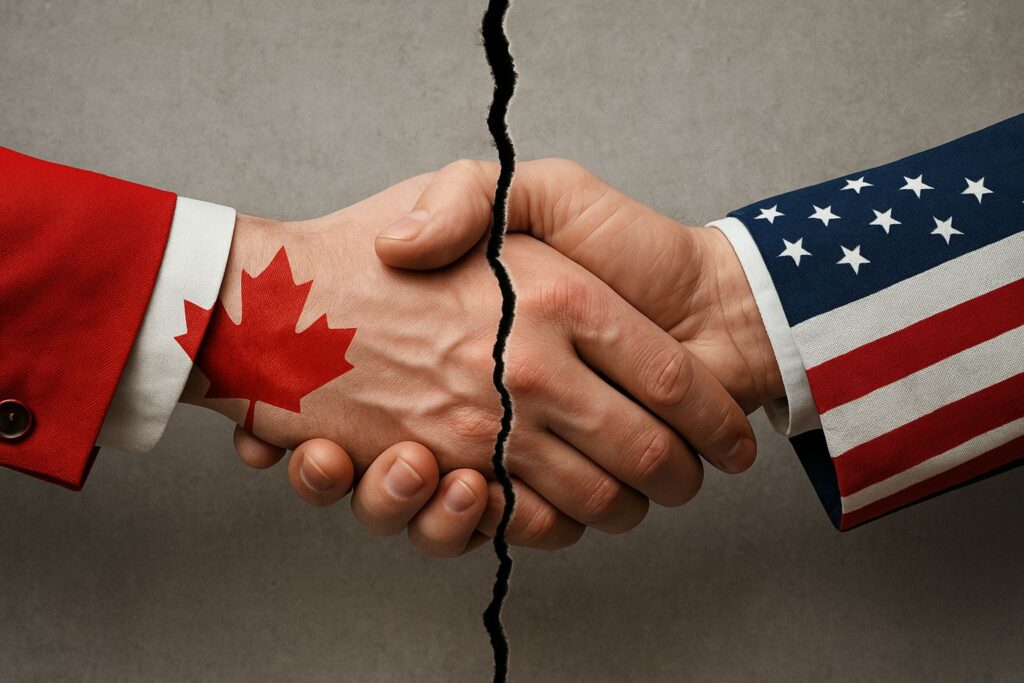
Doug Ford’s latest ad was exactly the kind of thing provincial politicians should not be spending public money on. It was flashy, unnecessary, and completely outside his role as premier, and it dragged Canada into another pointless controversy over our trade relations with the United States. But while everyone’s busy pointing the finger at Ford, we’re missing the real issue. It’s not him – it’s Trump. It was always Trump.
Trade negotiations fall under federal responsibility, and Ford had no business getting involved. The ad may have been a poor decision, but the real story isn’t about Ford. It’s about what Donald Trump’s reaction says about how fragile those trade relations really are.
Trump’s Ego and the Collapse of Trade Relations
Trump cancelled talks almost immediately after the ad aired. Not because it changed anything in the so-called “negotiations”, but because it bruised his fragile ego. Trump reacts impulsively, and his sense of power depends on keeping others off balance. That’s what makes Canada–U.S. trade relations so unstable: every decision turns into a test of loyalty instead of a search for solutions.
People now believe that Ford’s ad “killed” the trade talks. It didn’t. Ford handed Trump an excuse, but Trump made the choice. The truth is, the talks weren’t progressing much before this. Trump was never serious about negotiating in good faith. He’s always treated trade relations as leverage, never as a partnership. This latest episode simply exposed that dynamic again.
When Politics Turns Into Performance
The bigger issue is how Canadian leaders respond. Ford’s posturing played directly into Trump’s tactics, where headlines matter more than substance. He tried to look tough, but Trump doesn’t respect grandstanding. The bigger the performance, the more he needs to prove he’s on top.
This is what happens when politics becomes theatre. Reaction replaces substance. And while the cameras fixate on the drama, the real damage is not only a poor economic situation; it’s a social one. Episodes like this divide Canadians unnecessarily. They turn our problems with the trade talks into a partisan fight, confuse the issues, and invite people to blame the wrong targets. Instead of seeing that Trump’s unpredictability is the problem, people end up arguing about Ford’s ad or Carney’s tone. The noise drowns out the reality that Canada’s position was already difficult, and the spectacle only makes it harder to respond with focus and unity.
And that’s the point we keep missing. We’re blaming the wrong person. It’s Trump. It was always Trump. Everything else – Ford’s expensive ad, the headlines, the partisan noise – is a distraction. Trump’s strategy is to make us turn on each other while he pulls the strings. The more divided we are, the less capable we are of seeing the bigger game. And that makes us weak.
Trade Relations Were Already Stalled
We have already seen a lot of on-and-off with the talks, and I don’t think the Canadian government was making significant progress before this happened. That’s not a reflection on Mark Carney’s leadership or anyone else’s; it’s simply the difficulty of dealing with an unreliable and capricious partner who values disruption over cooperation. Trump is using trade relations as manipulation, not cooperation.
Blaming Carney, Ford, or even Smith misses the larger picture. Canada is stuck in a no-win situation, trying to function in a system built for short-term advantage, not mutual strength. I’m no fan of modern capitalism, but if we’re going to function inside it, then Carney’s approach makes sense. He’s diversifying trade relationships and building ties with Europe, Asia, and emerging economies. In a volatile global economy, that approach builds resilience rather than retreat.
What Canada Can Learn from This
Trump’s tantrum didn’t derail progress; it confirmed yet again that there was none. Canada can’t keep anchoring its economic strategy to the impulses of a man who treats the presidency like his own personal fiefdom. Ford’s ad wasted money, and Trump’s reaction wasted whatever goodwill we had left. But it might ultimately prove useful if it pushes Canada to adopt a broader and more independent vision of its global economic role. From here on in, we must remember: our real power isn’t in appeasing him — it’s in moving on.
About The Author