


So, you are thinking about taking someone to Small Claims Court in Ontario. Before you start filling out forms or paying any fees, the first step is to figure out if this is the right place for your dispute. It is a crucial move that can save you a lot of time, money, and headaches.
Small Claims Court is designed to be the most approachable part of Ontario’s civil justice system. It is meant to be quicker and less expensive than Superior Court, specifically for conflicts where the main goal is getting back money you are owed or recovering personal property.

What Kinds of Cases End Up Here?
The court handles a huge range of disputes that people in Ottawa and across the province face every day. You are probably in the right place if your situation sounds like one of these:
- Unpaid Invoices: You are a freelancer or small business owner, and a client has ghosted you without paying for your work.
- Breach of Contract: You hired a local contractor for a kitchen renovation, paid a hefty deposit, and now they have disappeared without finishing the job.
- Property Damage: Your neighbour’s tree fell and crushed your fence, and they are refusing to cover the repair costs.
- Loans Gone Wrong: You lent money to a friend with a written agreement, and they have not paid it back as promised.
- Wrongful Dismissal: Your former employer owes you unpaid wages, vacation pay, or termination pay.
If your core issue is about suing for a specific dollar amount or getting your property back, Small Claims Court is very likely where you need to be.
To help you decide, here is a quick checklist to see if your situation fits.
Small Claims Court Suitability Checklist
Use this checklist to quickly assess if your case is a good fit for Ontario’s Small Claims Court.
| Consideration | Is Small Claims Court a Good Fit? | Example Scenario in Ottawa |
|---|---|---|
| Monetary Value | Yes, if the claim is for $50,000 or less. | A Kanata homeowner is suing a landscaper for $25,000 for a poorly installed interlock patio. |
| Type of Remedy | Yes, if you are seeking money or the return of property. | An Orléans resident is suing to get back a $5,000 deposit from a wedding venue that cancelled. |
| Legal Issue | No, if it involves slander, libel, land title, or family law. | A dispute over property lines for a house in the Glebe would go to Superior Court, not Small Claims. |
| Defendant | No, if you are suing the federal government. | A claim against a federal department like the CRA cannot be filed in Small Claims Court. |
This checklist should give you a clearer picture. If you are still ticking the “Yes” boxes, you are on the right track.
The All-Important Monetary Limit: $50,000
The biggest rule you need to know is the monetary limit. For years, the cap was stuck at $35,000. In October 2025, Ontario gave the Small Claims Court a major update, boosting the maximum claim limit to $50,000. This was a big deal for folks in the National Capital Region, as it now allows more mid-sized disputes to be resolved without the expense and complexity of heading to Superior Court.
If your claim is for more than $50,000, you cannot file it in Small Claims Court. You have two choices. You can “waive” the excess amount to stay under the limit, or you have to gear up for a more formal, complex, and costly battle in Superior Court.
When Small Claims Court Is Not the Answer
Just as important is knowing what this court cannot do. No matter how much money is involved, certain types of legal issues are simply outside its jurisdiction.
Generally, you cannot use Small Claims Court for:
- Claims involving libel or slander.
- Disputes over who legally owns a piece of land.
- Most family law matters, like divorce or child custody.
- Lawsuits against the federal government.
On top of that, some conflicts are handled by specific tribunals. For instance, if you have a problem with your landlord, your case will almost certainly go to the Landlord and Tenant Board. Similarly, if you are trying to deal with a local issue like a parking ticket, you would be better off checking our guide on how to handle a parking infraction notice in Ottawa.
Taking a few minutes to confirm that your case belongs here is the single most important first step you can take. It ensures you start your journey on the right foot.
Preparing and Filing Your Plaintiff’s Claim
You have done your homework and confirmed Small Claims Court is the right place for your dispute. Now it is time to get the ball rolling officially. This next phase is all about preparing and filing a Plaintiff’s Claim, the legal document that formally starts your case.
Think of it as telling the court your side of the story, but in a structured way it understands.

The key document here is Form 7A, the Plaintiff’s Claim. This is your chance to clearly lay out the facts: who you are, who you are suing, the reasons behind the lawsuit, and what you want the court to do about it.
Telling Your Story Clearly on Form 7A
When you are filling out Form 7A, clarity is everything. You do not need to sound like a lawyer with a bunch of jargon. What you need is a simple, logical story that a judge can follow.
The form has a section called “Reasons for Claim and Details.” This is where you lay out what happened, step by step. Break down the events chronologically, making sure to include important dates, locations, and what each person did or did not do.
For instance, let’s say you are a local Ottawa web designer suing a client for an unpaid invoice. Your story would look something like this:
- The Agreement: When you both agreed on the scope of the project and the price.
- The Work: When you delivered the completed website.
- The Invoice: The date you sent the final invoice and its payment deadline.
- The Follow-Up: A summary of the emails or calls you made trying to get paid.
Stick to the facts. It can be tempting to vent your frustrations, but it will not help your case. Instead of saying the defendant was dishonest, just state the facts: “The defendant failed to complete the contracted work by the agreed-upon deadline of May 15, 2025.”
Calculating What You Are Owed
You need to be precise when calculating the amount you are claiming. You cannot just pull a number out of thin air. Every dollar needs to be justified by your direct losses.
Imagine a local renovator botched a job and damaged your property. Your calculation might include:
- Cost of hiring another contractor to fix the mess: $4,500
- Cost of materials you had to buy again: $1,200
- Cost for a professional to inspect the damage: $300
- Total Claim: $6,000
You can also claim for pre-judgment interest. This is the interest that accumulates on the amount you are owed from the day it was due until the day the court issues a judgment. The rate is set by the government, so you just need to state on your form that you are claiming interest as per the Courts of Justice Act.
Assembling Your Evidence
A claim is only as good as the evidence you have to back it up. While you will not attach all your proof to the initial form, you should have it organized from day one. It will help you write a more accurate claim and get you ready for what comes next.
Your evidence file should include things like:
- Contracts or Written Agreements: The document outlining what was promised.
- Invoices and Receipts: Proof of payment, or lack thereof.
- Emails and Text Messages: Your communication history with the defendant is gold.
- Photographs or Videos: Visual proof of damages, poor workmanship, or a faulty product.
Getting your documents in order early is a massive advantage. If the dispute is related to your company, having solid records is non-negotiable. For anyone new to the business world, our guide on how to register your business in Ontario can be a great starting point for getting organized.
Filing the Claim Online or In Person
Once Form 7A is ready, it is time to file it with the court. In Ontario, you have two main options. You can use the Small Claims Court E-Filing Service portal to do it all online, which is convenient. Or, you can file the papers in person at the Ottawa Courthouse at 161 Elgin Street.
Filing in Ontario has become more straightforward recently. A key change, effective October 1, 2025, is that the claim limit was raised to $50,000, before costs and interest, up from the old $35,000 ceiling. You will need to pay a court fee when you file. It starts at $108 for smaller claims and goes up to $215 for claims between $35,001 and $50,000.
Whether you do it online or in person, the court clerk will stamp your claim, give it a court file number, and officially “issue” it. This is the moment your lawsuit officially begins.
Serving Your Claim and Filing Proof
You have filed your Plaintiff’s Claim and the court has stamped it and given it back to you. That is a huge step, but the work is not over. Now, you have to formally notify the person or business you are suing, the defendant, about the lawsuit.
This critical step is called “serving” the claim, and the court has very specific rules about how it has to be done. Our legal system is built on the idea of fairness. That means everyone has the right to know they are being sued and a fair chance to respond. Serving the claim is how you uphold your end of that bargain. If you do not do it right, your case can grind to a halt.
The Six-Month Clock is Ticking
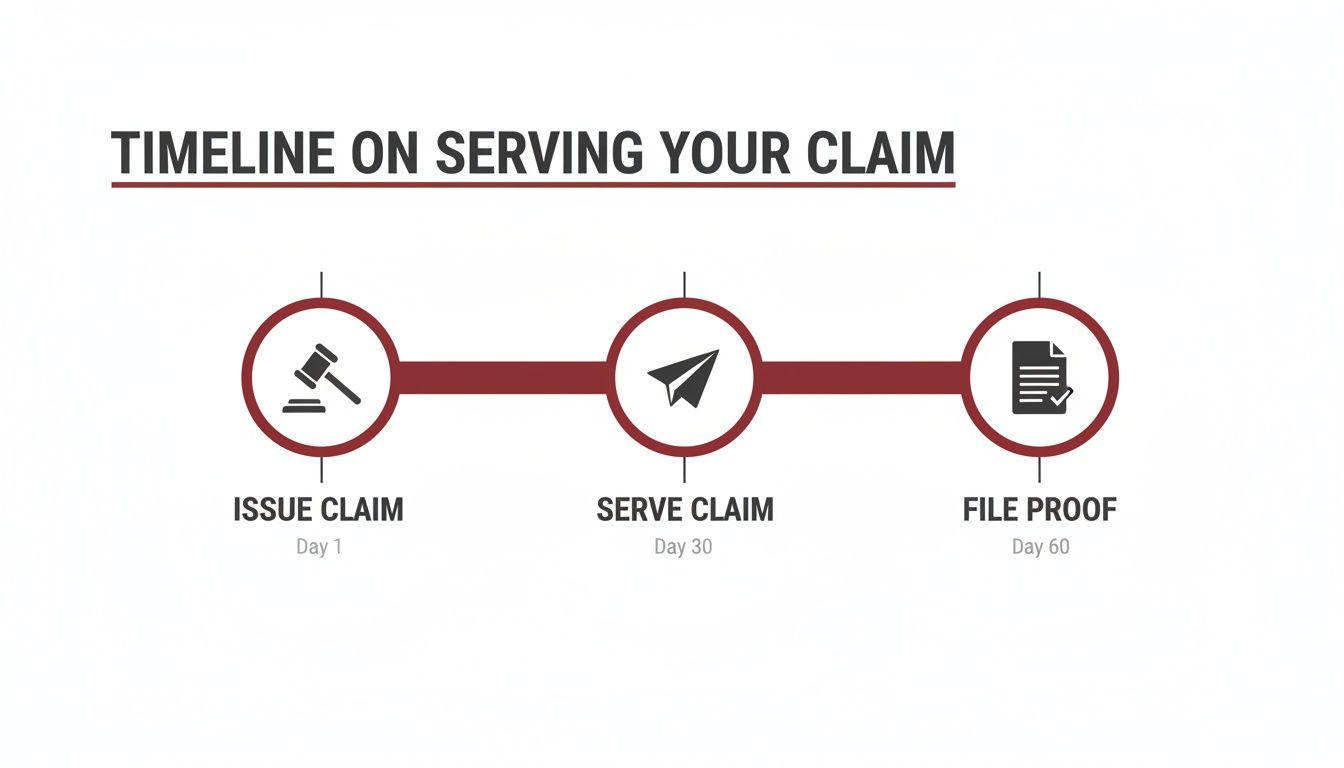
Here is the most important rule. Once the court issues your claim, you have exactly six months to serve it on every defendant you have named. If you miss that deadline, the court can toss out your claim, and you will have to start the entire process again.
This is not a soft deadline. It underscores why you need to act quickly after you file. Plan out how you are going to serve the documents the moment you have them.
How to Properly Serve the Documents
The Rules of the Small Claims Court in Ontario spell out the approved ways to serve a claim. You cannot just toss it in a mailbox or send a quick email. You have to use a method the court officially recognizes.
These are the most common options you have:
- Personal Service: This is the most straightforward method. You, or another adult acting for you, physically hand a copy of the issued claim directly to the defendant.
- Alternative to Personal Service: If you are serving an individual, you can leave a copy with an adult at their home. You must also mail another copy to that same address within five days.
- Mail or Courier: You can send the claim by registered mail, regular mail, or a courier service to the defendant’s last known address. It is simple, but it can be a real headache to prove they received it if they deny it.
- Hire a Professional Process Server: For a fee, usually around $100 to $200 in the Ottawa area, you can hire a professional to handle it all. They know the rules, are skilled at finding people, and provide a reliable way to get it done.
Which method should you choose? It depends on your relationship with the defendant and how easy they are to find. If you believe they might try to dodge being served, your safest bets are personal service or hiring a professional.
A quick online search for “process server Ottawa” will bring up plenty of local paralegal firms and specialized companies. They will not only serve the documents but also provide you with the sworn affidavit you need to prove it to the court. It is money well spent for peace of mind.
Proving It: The Affidavit of Service
Serving the claim is just step one. Step two is proving to the court that you did it correctly. This is where the Affidavit of Service (Form 8A) comes in. This is a sworn legal document where the person who served the claim lays out all the details: exactly how, when, where, and to whom the documents were delivered.
You need to fill out and file a separate Form 8A for each defendant you serve. This form is your official proof. Without it, the court has no record that the defendant was ever notified, and you will not be able to move forward with your case.
The person who did the serving has to sign the affidavit in front of a commissioner for taking affidavits or a notary public. Once it is signed and commissioned, you file the original copy with the court. This final action completes the service process.
So, Your Claim Is Served. What Happens Next?
You have done the hard part. The Plaintiff’s Claim is officially filed, you have served the defendant, and you have filed your proof with the court. It is a huge milestone, but it also kicks off a waiting game. The ball is now in the defendant’s court, and how they respond will determine what happens next.
After being served, the defendant has a strict 20-day deadline to file a Defence (Form 9A) with the court. This is their one formal chance to answer your allegations, present their side of the story, and argue why they should not have to pay what you are asking for.
The process of issuing your claim, serving it properly, and filing your proof is what gets you to this critical juncture. Getting these first steps right is what forces the other side to finally engage.
Possible Moves From the Defendant
Once that claim lands in their hands, the defendant has a few different ways they can respond. Their choice will shape the entire path of your case, so it pays to understand each possibility.
- They File a Defence: This is the most common scenario. The defendant formally disputes your claim and gives their version of events. If this happens, your case is officially contested and will start moving toward a settlement conference and, potentially, a trial.
- They File a Defence and a Defendant’s Claim (Form 10A): This is a counter-punch. Not only do they defend against your claim, but they also sue you back. You see this a lot in contract disputes. For instance, a client might claim your work was shoddy after you have sued them for an unpaid invoice.
- They Offer to Settle: The defendant might pick up the phone and try to make a deal. An offer to settle can come at any time, either directly to you or through your representative, as a way to resolve things without dragging it through the courts.
- They Do Nothing at All: If the defendant completely ignores the claim and the 20-day clock runs out, you are in a good position. You can ask the court to note them “in default” and then move to get a default judgment in your favour.
It is smart to be ready for any of these outcomes. Having all your evidence organized and your facts straight from the get-go puts you on solid ground, no matter which way the case turns.
The All-Important Settlement Conference
If a Defence gets filed, the next stop is almost always a mandatory settlement conference. This is a crucial, less formal meeting that happens in front of a deputy judge who will not be the same judge who hears your trial. The point is to see if everyone can find some middle ground and hash out a deal, saving the time, stress, and cost of a trial.
Think of it as a facilitated negotiation. Both sides give a quick rundown of their case, and the judge will weigh in with their thoughts on the strengths and weaknesses of each argument. They cannot force you to settle, but their opinion often carries a lot of weight.
The settlement conference is not just a box to tick. It is a powerful tool for resolution. The judge will actively push the conversation, explore potential compromises, and make sure both sides understand the real risks and costs of taking the fight all the way to trial.
To get the most out of this meeting, you need to show up prepared:
- Bring Your A-Game Evidence: Have copies of your most important documents, the contract, the bounced cheque, the email chain, ready to go.
- Know Your Bottom Line: Before you walk in the room, decide on the absolute minimum you are willing to accept to walk away.
- Be Ready to Bend: You are there to negotiate. That means being open to compromise and not expecting to get 100% of what you asked for.
Data shows this process is remarkably effective. Court statistics in Ontario reveal that a huge chunk of cases, somewhere between 60-80%, are resolved at this stage. In Ottawa, you can see that efficiency in action. A common $25,000 dispute over a botched home renovation might settle in about 120 days, with legal costs often staying under 5% of the claim’s value. That is a world away from the 500+ days and staggering legal bills you would see in higher courts.
You can find more on the efficiency of Ontario’s legal system in the Tribunals Ontario 2024-2025 Annual Report.
Navigating the Small Claims Court timeline can feel unpredictable. This table provides a general idea of what to expect for a typical case in Ottawa once a Defence has been filed.
| Timeline of a Small Claims Court Case in Ottawa |
| :— | :— | :— |
| Stage | Typical Timeframe | Key Action Required |
| Pleadings Closed | 20-40 days after claim served | The defendant files a Defence. |
| Settlement Conference | 3-6 months after pleadings close | Both parties must attend and negotiate. |
| Trial Scheduling | Immediately after failed conference | Judge sets the matter down for trial. |
| Trial Date | 6-12 months after conference | Hearing date is assigned by the court. |
| Trial | 1-3 days (average) | Presenting evidence and arguments to a judge. |
| Judgment | 1-3 months after trial | Judge delivers a final, binding decision. |
Of course, every case is different. A simple, straightforward dispute might move much faster, while a complex case with multiple parties could take longer.
Onward to Trial
What if the settlement conference ends in a stalemate? If you and the defendant cannot see eye-to-eye, the judge will officially set the matter down for trial. They might also make a few procedural orders, like setting deadlines for sharing documents, to make sure everyone is ready.
In more complicated cases, you might have one last stop: a trial management conference. This is another quick meeting to sort out the logistics, how many witnesses will be called, how much time each side needs, and any other issues to streamline the hearing. From there, your case gets put on the trial list, and you will finally have your day in court to present your full case and get a binding decision from a judge.
Turning Your Court Judgment Into Cash

Winning your case in Small Claims Court feels like the finish line, but sometimes it is just the start of the final lap. A judge’s ruling in your favour, known as a judgment, is a powerful legal document. But it is not a direct order for the other party, now called the debtor, to hand you cash.
If they do not pay up voluntarily, you have to take more steps to enforce the judgment. This is the part where you turn that paper victory into actual money in your account. The court offers several tools to help, but you are the one who has to put them into motion.
The Judgment Debtor Examination
Before you can collect, you need to know what assets the debtor has and where they are. If you are in the dark about their financial situation, your first move should be a judgment debtor examination.
Think of it as a formal hearing where you get to ask the debtor questions under oath about their finances. You can ask about their job, bank accounts, property, and anything else they own. It is a critical information-gathering step that gives you a roadmap for collection.
To kick this off, you will file a Notice of Examination (Form 20H) and have it served on the debtor. They are legally required to show up and give you the information. The prospect of this meeting can be a powerful motivator for them to pay.
Methods for Enforcing Your Judgment
Once you have a clearer picture of what the debtor owns, you can pick the best way to go after it. Each option involves filing more forms and paying more court fees. These costs can usually be added to the total amount the debtor owes you.
Here are the main tools at your disposal in Ontario:
- Garnishment: This is often one of the most effective methods. You get a court order to intercept money that a third party owes to the debtor. This could mean garnishing their wages directly from an employer or seizing funds from their bank account.
- Writ of Seizure and Sale of Personal Property: This allows a court bailiff to seize and sell the debtor’s personal belongings, like a car or equipment, to pay off the debt. It is a big step, but effective if they have valuable assets.
- Writ of Seizure and Sale of Land: If you find out the debtor owns real estate, you can register a writ against their property. This acts like a lien, which means they cannot sell or re-mortgage the property without paying you first.
Enforcing a judgment is an active process. The court does not automatically collect the money for you. It provides the legal mechanisms, but you or your legal representative must take the initiative to use them.
Practical Steps and Strategic Thinking
Choosing the right enforcement tool depends entirely on what you discovered about the debtor’s assets. There is no one-size-fits-all solution here.
Choosing Your Enforcement Path
| If the Debtor… | Your Best Enforcement Option Might Be… | What This Means in Practice |
|---|---|---|
| Has a steady job | Notice of Garnishment (Form 20E) | You can intercept a portion of their wages each pay period until the debt is settled. |
| Owns a valuable car or equipment | Writ of Seizure and Sale of Personal Property (Form 20C) | A court bailiff can seize the asset and sell it at auction to satisfy your judgment. |
| Owns a home or land | Writ of Seizure and Sale of Land (Form 20D) | You place a lien on their property, which secures your debt and must be paid if the property is sold. |
This final chapter of your Small Claims Court journey requires patience and persistence. It is all about systematically using the court’s enforcement powers to make sure the judgment you worked so hard for is respected. For many in Ottawa, successfully navigating this last stage brings a long and often stressful dispute to a satisfying end.
Your Top Questions About Ontario Small Claims Court, Answered
Stepping into the legal world can feel like a big deal, but Small Claims Court is set up to be more straightforward for everyday people. Here are some plain-language answers to the questions we hear most from residents in Ottawa and across the province.
Do I Need to Hire a Lawyer, or Can I Go It Alone?
You can absolutely represent yourself. Small Claims Court is often called the “People’s Court” for a good reason. The rules are simpler and less formal than in higher courts, which makes it entirely possible to manage your own case.
That said, you do not have to go it alone. If your situation feels complicated or you are not comfortable speaking in front of a judge, hiring a lawyer or a licensed paralegal is always an option. The right move comes down to your budget, how confident you feel, and the specifics of your dispute.
What Happens if the Person I’m Suing Just Ignores the Claim?
This happens more often than you would think. If you have properly served your claim and the defendant does not file their Defence within the 20-day deadline, you can ask the court to note them “in default.”
This is a massive advantage for you. When a defendant is noted in default, the court essentially takes your side of the story as fact because the other party did not respond. From there, you can usually ask for a default judgment, and the court might rule in your favour without needing a trial. This is why having solid proof that you served the documents is so important.
How Much Does It Cost to File a Small Claim?
The main court fees are the same everywhere in Ontario. You can expect two main costs from the court itself: one fee to file your Plaintiff’s Claim and another one later if your case needs to go to trial.
The filing fees are on a sliding scale. A smaller claim will cost you about $108 to file. For claims closer to the new $50,000 limit, that initial fee goes up to around $215. It is also wise to budget for other potential costs, like hiring a professional process server, which can run anywhere from $100 to $200.
Keep in mind, these are just the direct court costs. Things like paying for an expert report or covering a witness’s travel can add up, so it is smart to map out a realistic budget.
If I Win, Can I Get My Legal Costs Back?
Yes, you can recover some of your expenses, but it is rare to get 100% of your money back. If the judge rules in your favour, they can order the losing side to pay for a portion of your reasonable costs.
This usually covers things like:
- Court Filing Fees: The money you paid to start the claim and set a trial date.
- Service Costs: What you spent to have a process server deliver the documents.
- Representation Costs: A portion of what you paid your lawyer or paralegal, if you had one.
- Inconvenience Costs: If you represented yourself, the court can award you up to $1,500 for your time and effort.
The goal is fairness, but it is crucial to know you likely will not recover every single dollar you spent. It is also a good idea to stay informed about related legal matters that affect consumers, such as the developments in the Canadian bread price-fixing class action settlement, which is another example of how legal actions can lead to financial remedies.
At NCR Now, our goal is to provide clear, practical guides that help you navigate life in the National Capital Region. For more local news, community stories, and helpful resources, visit us online.
About The Author