

Pierre Poilievre’s decision to publicly congratulate Donald Trump over events in Venezuela should concern Canadians far more than it has. Not because of Venezuela itself, but because of what those congratulations signal about power, vulnerability, and how Canada presents itself in a more dangerous world.
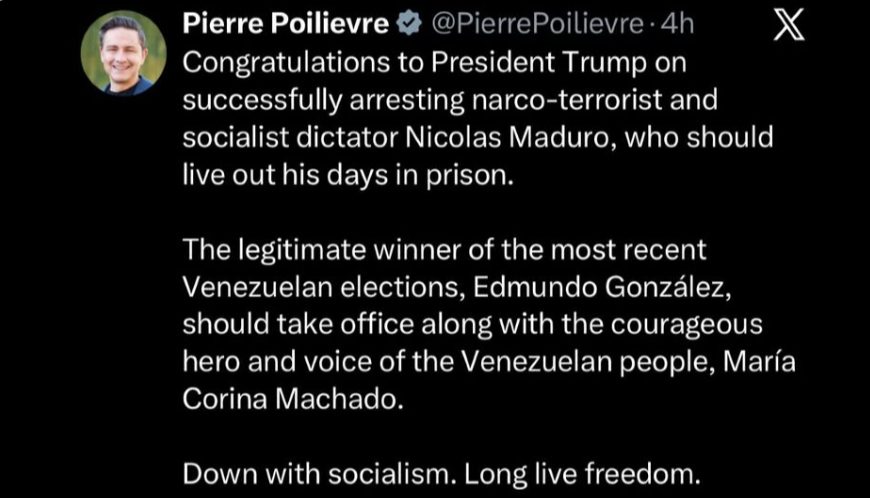
Poilievre’s message was anything but neutral. It did not express caution, concern for international law, or even restraint. It framed Trump’s actions as something to celebrate. That matters because it signals alignment with a way of exercising power that treats rules, international institutions, and evidence as optional. When a major Canadian political leader endorses that approach, it weakens Canada’s position rather than strengthening it.
Power Signals Matter More Than Words
Canada’s security has always depended on more than geography or goodwill. It depends on norms, alliances, and a shared understanding that disputes are handled through rules rather than raw force. When a Canadian leader publicly cheers unilateral actions by powerful states, especially when those actions bypass international law, it sends a signal that Canada itself is divided about those rules. Division is not a shield. It is a signal.
Trump has shown repeatedly that he watches for weakness. He tests boundaries. He looks at what he can get away with and who will push back. He has little patience for constraints, whether they come from courts, legislatures, or international institutions. When he sees allies praising his behaviour instead of questioning it, that does not buy protection. It shows opportunity.
When Power Replaces Rules
The Venezuela operation makes this pattern clear. Under Trump, U.S. forces carried out military strikes inside Venezuela and captured President Nicolás Maduro and his wife. The operation was ordered quickly, without clear authorization from Congress, without approval from the United Nations, and without a broad international consensus. Whatever one thinks of Maduro or his government, this was a unilateral act by a powerful country against a sovereign one.
This fits Trump’s long-standing approach. Act first. Justify later. Treat international institutions as obstacles rather than guardrails. In Venezuela, claims about drugs, corruption, and freedom were used to justify force and to open a discussion about U.S. involvement in a political transition, including access to oil. Whether those claims fully hold up is almost beside the point. Power seems to have filled the gaps where proof would normally be required.
That same logic has already been applied to Canada, just without missiles. Trump imposed punitive tariffs on Canada using the claim that fentanyl was flowing into the United States from Canada. That claim does not stand up to evidence. Canada is not a significant source of fentanyl entering the U.S. Yet the accusation alone was enough to justify economic punishment.
Different scale. Same method.
This is why Venezuela should not be dismissed as a distant problem. It shows what happens when pretext is accepted as justification and when international institutions are ignored. Trump has repeatedly undermined the United Nations and questioned the value of NATO. He treats alliances as transactional and rules as flexible. Being a long-standing ally offers little protection in that framework.
Seen through that lens, Poilievre’s congratulations are not harmless political signalling. They tell the world that Canada may not be unified in defending the rules that protect smaller and middle powers. They suggest that some Canadian leaders are comfortable with a system in which strength determines legitimacy. This does not make Canada safer. It makes us easier to test.
The reaction from some Poilievre supporters reinforces this risk. Many cheer Trump’s actions in Venezuela while assuming Canada would never be treated the same way. That confidence misunderstands how power works. Countries are not targeted because they are morally flawed. They are targeted because they are useful, resource-rich, or strategically convenient.
Venezuela is a real example of how quickly power can override rules. If Canadians support leaders who applaud that behaviour, we should be realistic about what we are signalling and what it may cost us.
About The Author