

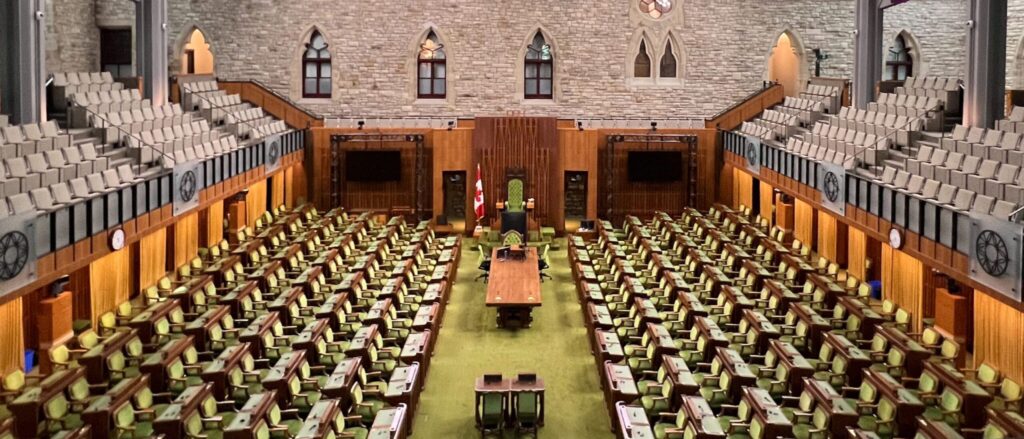
Photo Wikipedia: Hutima
Conservative policy debates emerging ahead of the Conservative Party’s upcoming convention and leadership review have left me scratching my head. They feel disconnected from the realities Canadians are actually living with.
We are in a period defined by strain. Housing costs are punishing. Health care systems are stretched too thin. Food prices continue to soar. Climate events are piling up. We’re feeling tired, anxious, and unsure about what comes next. With all that in mind, I think it’s worth asking, “Are these the debates that matter right now?”
A lot of the conservative policy proposals being put forward for debate do not respond to urgency so much as redirect it. They draw attention toward familiar fault lines around sexuality, immigration, speech, and women’s autonomy. There is nothing new here. We’ve seen this political playbook repeated over and over, especially during moments of economic stress.
That does not automatically make a policy illegitimate, but it does demand scrutiny, especially when these proposals carry consequences for rights, access, and social protections.
Conservative policy and misplaced priorities
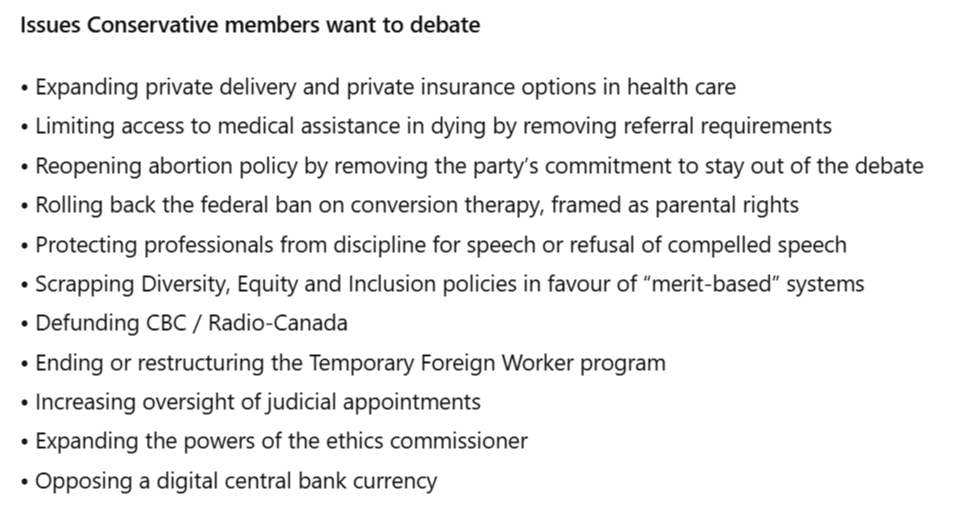
When I look at the conservative policy debates on the table, what stands out to me is how little attention is paid to issues that affect all Canadians, like affordability, housing, and the long-term stability of public systems. Instead, the focus is largely directed toward symbolic or cultural battles that mobilize a voter base without improving daily life for most Canadians.
Time and political attention are finite resources. Every hour spent debating whether to reopen abortion policy, weaken conversion therapy bans, or reframe free speech protections is an hour not spent asking how people will afford rent next year or access a family doctor.
These debates are important. They shape the boundaries of what government is for, and who it is meant to protect.
Rights erosion rarely announces itself
Rights are rarely taken away in one dramatic move. The changes often begin not with laws but with how things are talked about. What was decided yesterday becomes something we are suddenly arguing about again.
Reopening debates on rights like abortion, end-of-life care, and protections for LGBTQ+ people are useful because they are effective at mobilizing a political base, not because they solve pressing problems.
With abortion, the current proposal is not to introduce an immediate ban. It is to remove the party’s commitment to stay out of the issue. It sounds like a procedural change, but it has consequences. Once something is reopened for debate, it no longer feels secure. Even without a single law changing, access can become more fragile.
The same pattern shows up with medical assistance in dying. Removing the requirement that health-care providers refer patients elsewhere does not make MAID illegal. It makes it harder to reach. For people in smaller communities, or already struggling to navigate the system, those added barriers are real. A right that exists on paper becomes uneven in practice.
Conversion therapy is framed as a parental rights issue, which sounds protective unless you consider that children have rights too, including the right to safety and dignity. When policy choices set those rights against each other, the outcome is predictable. The adult retains authority. The child loses protection.
These debates generate heat, but they do not lower living costs, shorten wait lists, or improve public services. What they do is to create a distraction by keeping certain groups anxious about whether their rights will be upheld, while offering few tangible gains to anyone else.
Oversight can protect or it can punish
Some proposals, like changes to judicial appointments and ethics oversight, need careful consideration.
Stronger oversight sounds like a good thing if it ensures judges are well-qualified and public officials are held to clear ethical standards.
But there is a downside we must consider. If ethics rules are broadened in ways that make complaints and reviews easier to trigger, oversight can become a source of pressure rather than accountability. Even when no wrongdoing is found, repeated investigations or hearings can consume time, carry legal and reputational costs, and discourage independent judgment.
The same risk exists with judicial appointments. If “oversight” begins to favour candidates whose views align with the government of the day, courts can shift gradually without any laws changing. Independence weakens through selection, not confrontation.
If proposals for greater oversight begin to appear alongside efforts to limit speech, reopen settled rights, or weaken public institutions, then oversight stops being just about rules and starts becoming about power.
The appeal and the cost of familiar narratives
Concepts like parental rights, conventional ideas of merit, and free speech are powerful political tools because they sound self-evident. They appeal to fairness, autonomy, and liberty, but they are often invoked in ways that obscure who is protected and who is harmed.
Parental rights exist, and so do children’s rights. Working hard matters, but effort alone does not define worth or opportunity. Free speech is essential in a democracy, but it stops being a virtue when it becomes a tool for harm. When policy language elevates one of these values while minimizing its counterbalance, the consequences are real.
These narratives are well understood in policy circles and deeply familiar to the communities affected by the decisions built around them. Repeating them again and again creates conflict, but it does little to solve the problems Canadians are actually facing.
Public systems and who they are for
Healthcare proposals allowing expanded private delivery within a public system are often framed as pragmatic. Choice, efficiency, flexibility. But again, the question is who benefits.
Canada does not have a surplus of doctors or nurses waiting to be deployed. Introducing more private options does not create capacity. It redistributes it. Those with money gain alternatives, and those who can’t pay for private healthcare options lose.
We are already seeing versions of this play out in Alberta, Quebec, and Ontario, where privatization and outsourcing chip away at universal, timely access.
Public systems are expensive because they are inclusive. Weakening them may appear to reduce costs, but it does so because it shifts the financial burden onto individuals, families, and communities least able to absorb it.
Immigration and the mixed signals
Immigration is one area where real problems exist, and it should get serious debate. The temporary foreign worker program has been expanded in ways that strain housing, suppress wages in some sectors, and leave workers vulnerable.
The debate feels unfinished because ending the program outright ignores economic realities. We need temporary workers. Treating them as long-term residents acknowledges labour needs, but sidesteps the strain on housing, health care, and other services that has made this issue politically charged in the first place.
This is an area where conservative policy could offer practical solutions. Instead, the debate is often reduced to slogans like “Canadian jobs for Canadians,” which sound strong but actually sidestep the harder work of addressing labour needs, housing, and public services.
Where do Canadians actually gain?
When I narrow the list of conservative policy debate topics down to its basics, I’m left wondering where Canadians broadly benefit.
Opposition to a digital central bank currency aligns with public unease about surveillance and control. That is a legitimate concern.
Judicial oversight and ethics reform could benefit Canadians, but only if independence is preserved and accountability is applied evenly.
Beyond that, the gains are hard to identify. Many proposals make rights and access feel less secure rather than more reliable. They narrow protections instead of strengthening them. They feel less like solutions to current problems and more like a rehash of familiar ideological battles.
A moment for better questions
I’m not assuming bad faith in every conservative policy proposal. What I am doing is recognizing patterns and asking whether they actually serve the country we are living in right now.
Why this set of priorities, at this moment?
Who feels safer, more secure, or more supported if these changes are adopted?
Who loses access quietly, without headlines or protests?
What problems remain untouched while political energy is spent elsewhere?
And who stands to gain from these changes in practical terms?
When I step back and look at the list as a whole, these proposals don’t feel like bold problem-solving. They simply reopen questions that many Canadians like me assumed were settled, while leaving affordability, housing, health-care capacity, and climate resilience largely unaddressed.
This creates uncertainty in a world that is increasingly unstable. I don’t want to worry anymore about my rights, my access to care, and the reliability of public systems I depend on. It asks me to absorb more risk in my personal life while offering few tangible improvements in return.
This is why these debates feel out of touch in the present moment. Not because they are controversial, but because they do not respond to the pressures Canadians are actually facing. They consume attention without addressing the problems already weighing on people’s daily lives.
About The Author