
1. Introduction: The Paradox of Transparency and the Crisis of Research
The enactment of the Epstein Files Transparency Act (EFTA) in November 2025 was heralded by lawmakers, victim advocacy groups, and the general public as a definitive turning point in the decades-long saga of Jeffrey Epstein’s sex trafficking ring. For years, the investigation into Epstein’s activities—spanning his initial arrest in Palm Beach in 2005, his controversial non-prosecution agreement in 2008, his arrest and subsequent death in federal custody in 2019, and the conviction of his associate Ghislaine Maxwell in 2021—had been characterized by opacity, sealed documents, and persistent allegations of institutional cover-ups. The EFTA, passed by the 119th Congress and signed into law by President Donald Trump, promised to shatter this secrecy by mandating the release of millions of pages of documents, images, and videos held by the Department of Justice (DOJ) and the Federal Bureau of Investigation (FBI).
However, in the wake of the massive disclosures that began on January 30, 2026, the prevailing consensus among legal scholars, investigative journalists, and legislative oversight bodies is that the research effort has been fundamentally “unsuccessful.” This failure is not defined by a lack of volume; indeed, the release of over 3.5 million pages and thousands of multimedia files represents one of the largest single dumps of investigative material in U.S. history. Rather, the failure is epistemic and systemic. The research has failed to produce the clarity, accountability, and closure that the Act intended. Instead, the disclosure process has generated a chaotic information ecosystem characterized by obfuscation, privacy violations, political weaponization, and a profound stagnation of justice.
The central thesis of this report is that the research into the Epstein files has been rendered unsuccessful by a convergence of four distinct but reinforcing factors. First, the logistical execution of the release—specifically the “data dump” strategy employed by the DOJ—created a structural barrier to analysis, burying significant revelations under mountains of irrelevant administrative detritus. Second, the catastrophic failure of redaction protocols led to the re-traumatization of victims and the subsequent legal necessity of withdrawing vast portions of the archive, thereby fragmenting the historical record. Third, the politicization of the files by both the executive and legislative branches transformed the research process into a partisan proxy war, exemplified by the “spying” scandals and theatrics within the House Judiciary Committee. Finally, the disconnect between the public’s expectation of a “client list” and the evidentiary reality of the documents has led to a sense of futility, as the DOJ has confirmed that the millions of pages contain no new grounds for federal prosecution.
This report provides an exhaustive analysis of these failure points. It examines the legislative intent versus the bureaucratic reality, the specific technological interventions by independent archivists like the creators of Jmail, the devastating consequences of the reckless unredaction of names, and the international ripple effects that continue to destabilize corporate and political figures abroad even as American justice remains paralyzed.
2. Legislative Mandate and the Logistics of Disclosure
2.1 The Genesis of the Epstein Files Transparency Act
To understand why the research effort has stalled, one must first analyze the legislative framework that compelled the release. The Epstein Files Transparency Act (H.R. 4405) was born out of a bipartisan frustration with the slow pace of information release regarding Jeffrey Epstein’s network. For nearly two decades, the narrative of the Epstein case had been shaped by selective leaks and sealed court filings, fueling conspiracy theories and eroding public trust in federal law enforcement.
The Act was ambitious in its scope. It directed the Department of Justice to produce, with very limited exceptions for national security and victim privacy, all unclassified records, documents, communications, and investigative materials related to the investigations and prosecutions of Jeffrey Epstein and Ghislaine Maxwell. This included files from the FBI’s Sentinel case management system, evidence from the Southern District of New York (SDNY) and the Southern District of Florida (SDFL), and internal investigations into Epstein’s death.
President Trump signed the bill on November 19, 2025—the House had passed it 427–1, with only Rep. Clay Higgins of Louisiana dissenting, and the Senate passed it unanimously—setting a statutory deadline of December 19, 2025 for release. The fact that the release deadline was missed—the bulk of the files were not published until January 30, 2026—was the first indicator of the logistical and bureaucratic friction that would come to define the research process. The delay sparked immediate skepticism and set the stage for a contentious relationship between the DOJ and the oversight committees charged with reviewing the material.
2.2 The “Data Dump” as an Obstruction Tactic
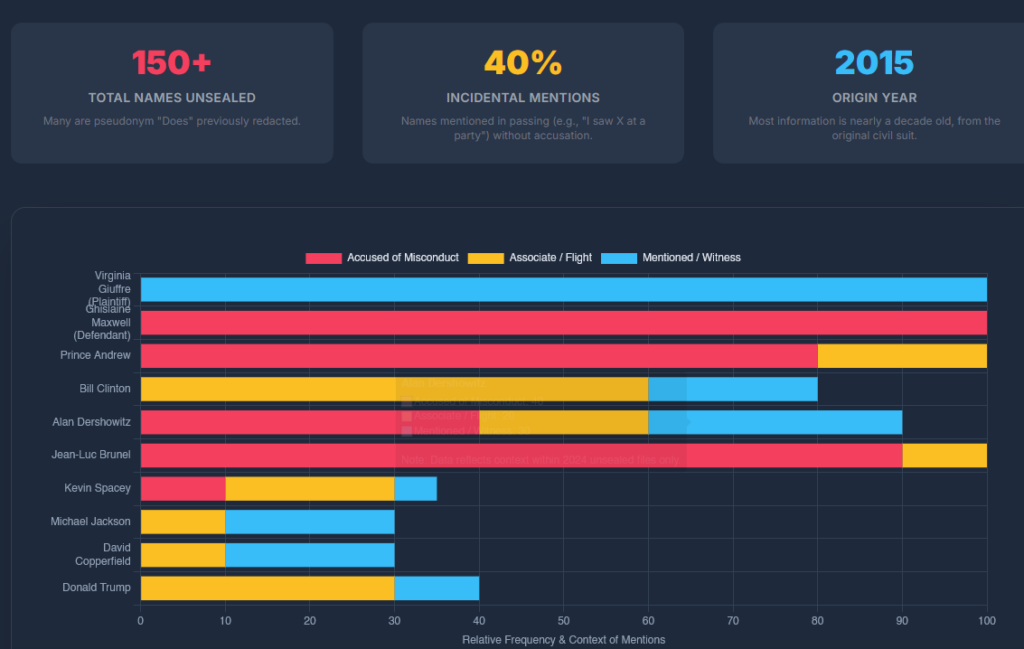
When the files were finally released in late January 2026, the manner of their presentation served as a passive but effective barrier to meaningful research. The Department of Justice released approximately 3.5 million pages of documents, accompanied by over 2,000 videos and 180,000 images. While this satisfied the letter of the law regarding “transparency,” the organization of the data rendered it nearly impenetrable.
The files were not curated by subject, timeline, or individual. Instead, they were uploaded as a disorganized torrent of raw data. Researchers found themselves sifting through thousands of pages of duplicative procedural motions, fax cover sheets, blank pages, and benign email chains to find single instances of relevant communication. This phenomenon, often described in information science as “obfuscation through volume,” effectively paralyzed traditional investigative journalism. The sheer scale of the release—over 300 gigabytes of data—meant that no single human researcher could review the material in a reasonable timeframe.
The DOJ acknowledged that it had “erred on the side of over-collecting materials,” including items that were “completely unrelated” to the case files. While framed as a commitment to total transparency, this over-collection diluted the evidentiary value of the archive. For researchers, the task was akin to finding a needle in a haystack, where the haystack was intentionally enlarged by the inclusion of millions of pieces of irrelevant straw. This logistical chaos is a primary reason why the research has been “unsuccessful” in producing a coherent narrative of the trafficking ring’s operations.
2.3 Sources of the Archive: A Fragmented Record
The 3.5 million pages were aggregated from five primary sources, each with its own formatting quirks and redaction standards, further complicating the research effort:
The Florida and New York Criminal Cases contained the core evidentiary record of the 2005 solicitation charges and the 2019 sex trafficking indictment. They offered the most direct evidence of Epstein’s crimes but were heavily redacted.
The Maxwell Prosecution discovery materials from the 2021 trial of Ghislaine Maxwell provided insight into the recruitment mechanisms of the ring.
Death Investigations: Files from the Office of Inspector General (OIG) and the Bureau of Prisons regarding Epstein’s 2019 suicide offered details on his incarceration conditions but were largely distinct from the trafficking investigation.
The Butler Investigation: A lesser-known Florida case investigating a former butler of Epstein yielded significant internal household records, offering a glimpse into the daily management of Epstein’s properties.
FBI Investigations: Multiple overlapping FBI probes, including interview summaries (Form 302s) and surveillance logs, provided disjointed snapshots of federal law enforcement’s awareness of Epstein’s activities over two decades.
The lack of a unified indexing system across these disparate sources meant that a researcher tracking a specific individual would have to independently cross-reference names across five different datasets, often with varying spellings or redaction codes. This fragmentation prevented the formation of a holistic view of the criminal enterprise.
3. The Privacy Catastrophe: Redaction Failures and Re-Traumatization
If the logistical chaos of the release was a passive impediment to research, the catastrophic failure of privacy protections was an active destructor of the archive’s integrity. The EFTA included strict provisions mandating the protection of victim identities, a standard that the Department of Justice failed to meet in a spectacular fashion.
3.1 Redaction Failures and Their Human Cost
Almost immediately following the January 30, 2026 release, it became apparent that the DOJ’s redaction process had failed. Attorneys representing Epstein’s victims identified thousands of instances where victim identities were exposed. These errors included unredacted names, visible faces in “blurred” images, and metadata that contained personal identifying information (PII).
In blistering legal filings, victim advocates argued that despite providing the DOJ with a specific list of victims to ensure their protection, the Department had failed to perform even basic keyword searches to verify the redactions before publication.
Deputy Attorney General Todd Blanche defended the Department’s handling, arguing that errors affected only a very small fraction of the 3.5 million pages and that the Department moved quickly to fix mistakes when notified. However, in a corpus of that size, even a tiny error rate translates to thousands of compromised documents. For the survivors of Epstein’s abuse, the statistical insignificance of the error rate was irrelevant; the exposure of a single unredacted image or name constituted a fresh trauma and a permanent violation of their anonymity.
3.2 Judicial Intervention and the Withdrawal of Data
The severity of these privacy breaches forced immediate judicial intervention. Federal judges ordered the withdrawal of thousands of documents and media files after the DOJ acknowledged that the lives of numerous victims had been “turned upside down” by the inadequate redactions.
This withdrawal had a profound impact on the research effort. It rendered the archive unstable and ephemeral. Researchers who had begun analyzing the files found that documents available on one day were gone the next, replaced by heavily sanitized versions that lacked critical context. This instability made it impossible to establish a definitive, citable record of the release, as the dataset was in a constant state of flux.
3.3 The “Fillers” Controversy: A Case Study in Misidentification
The redaction failures were not limited to victims; they also ensnared innocent third parties, leading to one of the most chaotic episodes of the research effort. In early February 2026, Representatives Ro Khanna (D-CA) and Thomas Massie (R-KY) utilized their oversight privileges to review unredacted versions of the files. They identified a document containing a list of names and photos that they believed were improperly hidden associates of Epstein.
Believing they had uncovered a cover-up, the lawmakers forced the unredaction of these names. The six individuals identified were Leslie Wexner, Sultan Ahmed bin Sulayem, Salvatore Nuara, Leonid Leonov, Zurab Mikeladze, and Nicola Caputo. However, subsequent investigation revealed that four of those men—Nuara, Leonov, Mikeladze, and Caputo—were not associates of Epstein at all. The DOJ confirmed they were entirely random individuals whose photos had been used as fillers in a standard SDNY police photo lineup for witness identification purposes unrelated to Epstein’s crimes. The “lineup” document bore no label explaining its investigative purpose, contributing to the lawmakers’ misinterpretation.
The “unmasking” of these individuals on the floor of the House of Representatives, followed by the revelation of their innocence, underscored the dangers of politicized research into raw investigative files. The lack of context provided by the DOJ combined with the confirmation bias of the lawmakers resulted in the public vilification of innocent citizens. This incident demonstrated that without proper context and professional analysis, the raw data of the Epstein files was just as likely to produce misinformation as it was to reveal the truth.
Table 1: The “Six Men” Controversy – Status and Outcome
| Name | Role / Description | Reason for Inclusion in Files | Outcome / Status |
| Leslie Wexner | Founder, L Brands | Extensive documented association with Epstein; cooperated with federal prosecutors as a witness in 2019 and was not designated as a target | No charges; reputational damage; identified as cooperating witness per his legal counsel |
| Sultan Ahmed bin Sulayem | CEO, DP World | Email correspondence with Epstein, including disturbing content | Resigned from DP World immediately following disclosure |
| Salvatore Nuara | Queens Resident | Photo used as “filler” in SDNY police lineup; no connection to Epstein | Confirmed innocent; victim of misidentification by lawmakers |
| Leonid Leonov | IT Manager, Queens | Photo used as “filler” in SDNY police lineup; no connection to Epstein | Confirmed innocent; vigorously denied any Epstein link |
| Zurab Mikeladze | Unknown | Photo used as “filler” in SDNY police lineup; no connection to Epstein | Confirmed innocent |
| Nicola Caputo | Unknown (not the Italian MEP of the same name) | Photo used as “filler” in SDNY police lineup; no connection to Epstein | Confirmed innocent; Massie later clarified the individual in the files is not the former MEP |
4. Technological Asymmetry: The Rise of Jmail and Citizen Archiving
In the face of the DOJ’s “data dump” strategy and the instability of the official archive, the most successful research efforts came not from government bodies or traditional media, but from independent technologists. The DOJ had long claimed that a fully searchable, user-friendly database of the Epstein files was impossible due to “technical limitations” and the format of the materials, which included handwritten notes and non-OCR’d PDFs. This claim was decisively disproven by the creation of Jmail.
4.1 Jmail: Browsing Epstein’s Inbox
Launched in November 2025 by internet artist Riley Walz and Luke Igel, co-founder and CEO of AI editing firm Kino AI, Jmail offered a radical solution to the accessibility problem. Walz and Igel—building the initial site in a single five-hour session—scraped the released files and utilized a custom AI tool named “Jemini” (a satirical nod to Google’s Gemini AI) to parse, index, and organize the data.
The interface of Jmail was designed to mimic a standard Gmail inbox, allowing users to browse the files as if they were logged into Epstein’s personal email accounts ([email protected] and [email protected]). This design choice rendered the scandal “hyperlegible,” transforming millions of disjointed pages into a searchable, chronological narrative of communication. Users could search for specific terms, filter by sender, and view “starred” emails that other users had flagged as significant.
4.2 The “Jemini” AI and the Democratization of Research
The integration of the “Jemini” AI allowed Jmail to overcome the technical hurdles that the DOJ claimed were insurmountable. The AI was capable of reading handwriting, identifying context, and linking related documents across the fragmented archive. As of February 2026, Jmail had drawn over 25 million unique visitors and 450 million page views, making it the most widely used tool for accessing the Epstein files.
The success of Jmail highlights a critical failure of the official research effort: the technological asymmetry between the government and the public. The fact that two private citizens could build a functional, searchable database in a matter of hours—something the Department of Justice claimed was not feasible—suggests that the government’s obfuscation was a choice, not a necessity. Jmail succeeded in democratizing access to the files, but it also underscored the extent to which the official channels had failed to provide meaningful transparency.
5. Political Weaponization: The Weaponization of Oversight
The research into the Epstein files was further compromised by the intense politicization of the release. Rather than a unified, bipartisan search for truth, the investigation became a proxy war for the broader political conflicts consuming the United States in 2026. This weaponization occurred at both the executive and legislative levels, transforming oversight hearings into theatrical displays of partisan grievance.
5.1 The “Spying” Scandal and Attorney General Bondi
Tensions between the House Judiciary Committee and the Department of Justice reached a breaking point in February 2026. Democratic lawmakers accused the DOJ of surveilling their search histories as they reviewed the unredacted files in a secure DOJ reading room. They alleged that the DOJ was logging and tracking every search term and document view performed by lawmakers.
The scandal erupted during a heated hearing on February 11, 2026. Attorney General Pamela Bondi defended the Department’s tracking protocols as necessary to prevent the leak of victim information. However, the confrontation turned personal and combative. Bondi was photographed holding a document explicitly labeled “Jayapal Pramila Search History,” which listed specific files the Congresswoman had reviewed. Representative Raskin denounced this as an “outrageous abuse of power,” arguing that the Executive Branch was using its administrative privileges to intimidate the Legislative Branch. The hearing devolved into shouting matches, with Bondi refusing to apologize to Epstein victims present in the room. This toxic atmosphere made cooperative research impossible.
5.2 Partisan Deflection: The Clinton-Trump Dynamic
The content of the files, which contained references to both former President Bill Clinton and President Donald Trump, provided ample ammunition for partisan warfare.
Regarding Clinton: The files included flight logs placing Clinton on Epstein’s aircraft, as well as photographs and other correspondence showing an association with Epstein. Republicans focused intensely on these details. In response, Hillary Clinton alleged the DOJ was withholding additional pages to protect Trump while targeting her family to “divert attention.”
Regarding Trump: President Trump claimed the files “totally exonerated” him, despite documents detailing his social interactions with Epstein in the 1990s. The DOJ supported this framing by labeling certain claims against Trump—submitted to the FBI just before the 2020 election—as “unfounded and false.”
This politicization meant that the “research” findings disseminated to the public were often cherry-picked to serve specific political narratives, rendering a unified national consensus on the findings impossible.
6. The “Client List” Mirage and the Stagnation of Justice
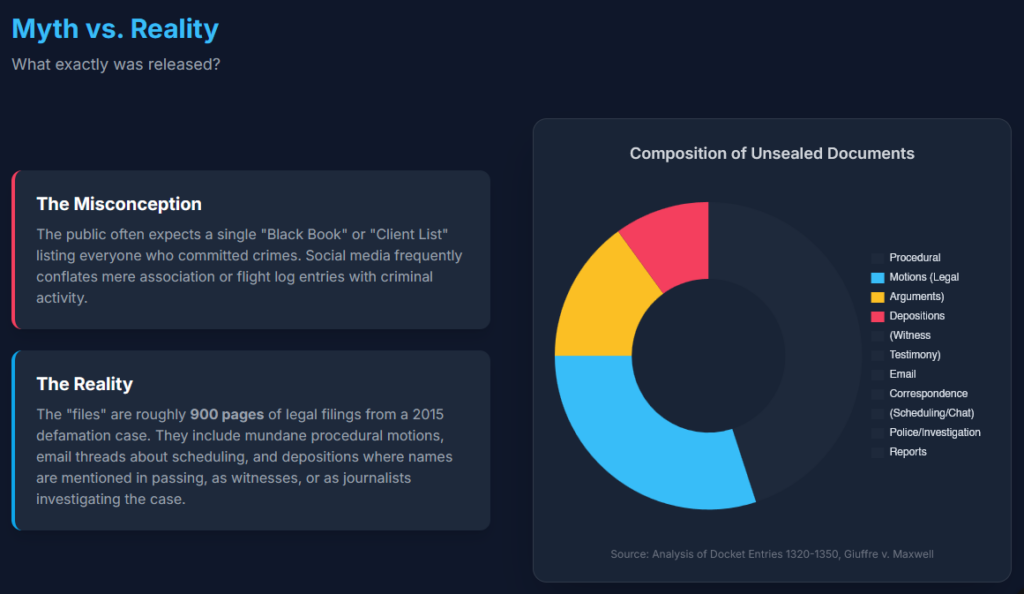
Perhaps the most significant reason for the perceived failure of the research is the disconnect between the public’s expectation of a “Client List” and the evidentiary reality of the documents. For years, the term “Client List” has been used as a shorthand for a definitive roster of individuals who paid Epstein for sex with minors. The research has been “unsuccessful” largely because such a list, in the simplified form imagined by the public, does not exist.
6.1 Understanding the Document Types
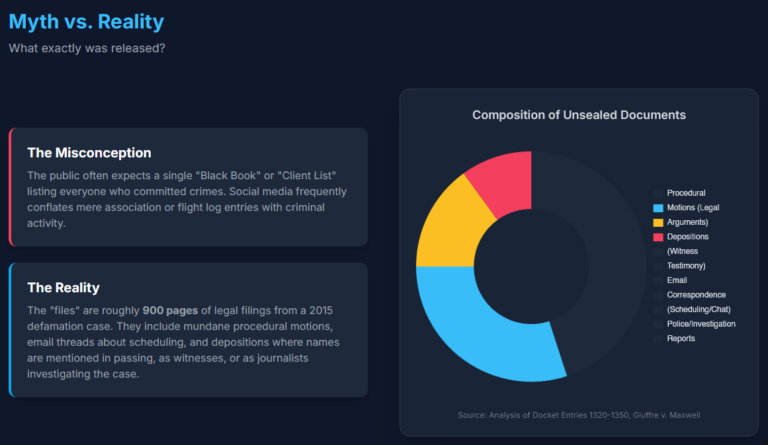
The “Epstein Files” are not a single ledger but a composite of different types of records, each with different evidentiary weight:
Flight Logs document who flew on Epstein’s aircraft. While they place high-profile individuals in Epstein’s company, mere presence on a flight does not constitute evidence of sexual crimes.
The “Black Book” (Contact Book) contained contact information for thousands of people, ranging from household staff to heads of state. Being listed indicates only that Epstein possessed a person’s contact information.
Court Documents and Emails contain the most substantive information, but much of this evidence is buried in legal arguments, hearsay, and procedural filings, requiring careful legal analysis to interpret.
6.2 The “No New Prosecutions” Stance
The ultimate metric of the research’s “failure” for many observers is the lack of legal consequences. Following the release of the 3.5 million pages, Deputy Attorney General Todd Blanche stated that the Department had reviewed the files and found “nothing in there that allowed us to prosecute anybody.”
This admission suggests that while the files are rich in moral indictment and embarrassing details for the global elite, they lack the specific, corroborative evidence required to sustain federal criminal charges beyond a reasonable doubt. The barriers to prosecution include the statute of limitations for many crimes dating to the early 2000s, credibility challenges given the death of the primary perpetrator and the incarceration of his key accomplice, and the absence of direct evidence linking transactions to crimes for the vast majority of named individuals.
For researchers and victims hoping that the files would serve as a roadmap for a new wave of indictments, this outcome represents a definitive failure. The research succeeded in documenting the proximity of power to abuse, but it failed to trigger the mechanisms of criminal justice.
7. High-Profile Implications: Domestic and International Fallout
While the research failed to trigger systemic legal accountability in the United States, it did produce significant fallout for specific individuals and corporations, particularly in the international arena.
7.1 Domestic Fallout: Resignations and Reputational Damage
In the United States, the consequences were largely reputational and professional rather than criminal.
Casey Wasserman: The LA28 Olympics chair and talent agency founder faced pressure after emails were revealed between him and Ghislaine Maxwell—in which he asked what he would need to do to see her in a “tight leather outfit”—as well as a previously-known humanitarian flight on Epstein’s plane. Facing a client exodus led by singers including Chappell Roan and Orville Peck, Wasserman announced the sale of his talent agency, saying he had “become a distraction.” However, as of this writing, the LA28 Olympic Committee’s board has determined he should continue to lead the 2028 Games.
Peter Attia: The longevity physician and podcaster faced intense scrutiny after emails revealed crude correspondence with Epstein, including a remark that “P—y is, indeed, low-carb.” Attia stepped down from his role as chief science officer of David Protein, a protein bar brand, and AG1 confirmed he was no longer an adviser. Attia stated he was never involved in criminal activity and never witnessed illegal behavior.
7.2 International Fallout: Resignations and New Probes
The impact of the files was perhaps more acute abroad, where legal and corporate standards differ from the U.S. context.
Sultan Ahmed bin Sulayem: The resignation of Sultan Ahmed bin Sulayem, the CEO of the logistics giant DP World, was a direct result of the unredacted files. Emails revealed disturbing correspondence between Sulayem and Epstein, making his continued leadership untenable.
French Investigations: In France, the release prompted the opening of new investigative probes. French authorities established a dedicated team to analyze the documents for links to French citizens, demonstrating a more proactive investigative stance than their American counterparts.
Peter Mandelson: In the United Kingdom, the fallout was severe. Mandelson—who had previously been dismissed as British ambassador to the United States by Prime Minister Keir Starmer due to earlier Epstein revelations—resigned from the Labour Party in early February 2026 and resigned from the House of Lords. The Metropolitan Police launched a formal criminal investigation into alleged misconduct in public office, following revelations that Mandelson had apparently passed sensitive UK government information to Epstein while serving in Cabinet, and that Epstein may have made payments totaling approximately $75,000 to accounts connected to Mandelson or his partner.
Table 2: Comparative Fallout – US vs. International Responses
| Region | Key Individuals Impacted | Nature of Consequence | Legal Status |
| United States | Casey Wasserman, Peter Attia, Leslie Wexner | Sale of agency; resignation from advisory roles; reputational harm | No criminal charges |
| UAE | Sultan Ahmed bin Sulayem | Immediate resignation from DP World | No public charges |
| France | Multiple named officials | New criminal and investigative probes opened | Active investigations |
| United Kingdom | Peter Mandelson, Prince Andrew | Resignation from Labour Party and House of Lords; Metropolitan Police criminal investigation into misconduct in public office | Active Metropolitan Police investigation |
8. The Justice Gap: International Law Perspectives
A significant dimension of the research’s failure is the gap between the U.S. legal assessment and broader calls for accountability. While the DOJ concluded that no further prosecutions were viable, independent legal observers and human rights advocates have pointed to the sheer scale and systemic nature of Epstein’s trafficking network as evidence that existing domestic legal frameworks may be inadequate to deliver the accountability that victims deserve.
The fact that millions of pages of material—documenting years of systematic sexual abuse, trafficking, and exploitation of minors—failed to produce a single new federal indictment highlights what many legal scholars describe as a systemic failure of the domestic legal framework. Statute of limitations barriers, evidentiary challenges, and the deaths of key witnesses have collectively insulated many of Epstein’s alleged enablers from criminal accountability, despite the vast documentary record now in the public domain.
9. Conclusion: The Architecture of Impunity
The research into the Epstein files, facilitated by the historic disclosures of early 2026, must be judged as unsuccessful in achieving its primary societal goals: closure, accountability, and justice. This failure is not a singular event but the result of a complex interplay of systemic forces.
The logistical failure of the “data dump” buried the truth under millions of pages of noise, requiring independent technologists to build the tools the government refused to provide. The ethical failure of the redaction process re-traumatized victims and forced the withdrawal of evidence, fragmenting the historical record. The political failure weaponized the investigation, turning oversight into theater and ensuring that findings were filtered through partisan lenses. And the legal failure—the DOJ’s determination that the evidence was insufficient for prosecution—left survivors without justice.
Ultimately, the 2026 release served less as a mechanism of justice and more as a monument to the architecture of impunity. It revealed a system that, even when compelled to transparency by law, retained the capacity to obfuscate, delay, and deny. The files are now open to the world, yet the full truth of the Epstein enterprise remains as elusive as ever, guarded by the very institutions designed to expose it. The research continues, largely driven by private citizens and independent archivists, but the window for systemic accountability has, largely, closed.
The data synthesis and literature review within this document were conducted using Gemini (Google). The author has exercised due diligence in cross-referencing AI-generated outputs with primary sources to mitigate the risk of “hallucinations” or factual errors.
About The Author