
PRELIMINARY — BASED ON EARLY OPEN-SOURCE REPORTING
The February 2026 United States and Israeli Military Offensive Against the Islamic Republic of Iran
February 28, 2026
⚠ ANALYTICAL DISCLAIMER
This assessment was produced within hours of the commencement of hostilities on February 28, 2026. It draws on early open-source reporting, verified wire dispatches, and expert commentary available as of the time of writing. Open-source research and web search tools — including Google Deep Research — were used to gather, cross-reference, and verify publicly available information. Where specific claims, figures, or attributions cannot be independently verified in real time, they are explicitly labelled as unconfirmed, reported, or projected. Scenario-based projections and strategic forecasts are analytical inferences and may not reflect final confirmed outcomes. Readers are advised to treat all casualty figures, damage assessments, and market data as provisional and subject to material revision.
Executive Summary
On the morning of February 28, 2026, the United States and the State of Israel launched a massive, coordinated, preemptive military offensive against the Islamic Republic of Iran. Designated “Operation Epic Fury” by the United States Department of Defense and “Operation Roaring Lion” (Hebrew: Mivtza She’agat Ha’ari) by the Israeli military, the campaign was confirmed simultaneously by Israeli Defence Minister Israel Katz and US President Donald Trump, who announced that the United States had begun “major combat operations” in Iran. This marks the most significant American military intervention in the Middle East since the 2003 invasion of Iraq.
The operation materialised amid the collapse of high-stakes nuclear negotiations in Geneva and follows a brief but intensely destructive 12-day war in June 2025 between Israel and Iran. Unlike previous limited engagements aimed at degrading nuclear enrichment capabilities, the February 2026 offensive carries an explicit maximalist objective: the total destruction of Iran’s military-industrial complex and the active instigation of regime change. By directly targeting the compound of Supreme Leader Ayatollah Ali Khamenei and the offices of President Masoud Pezeshkian, the allied forces have signalled an unequivocal intent to dismantle the theocratic state established during the 1979 Islamic Revolution.
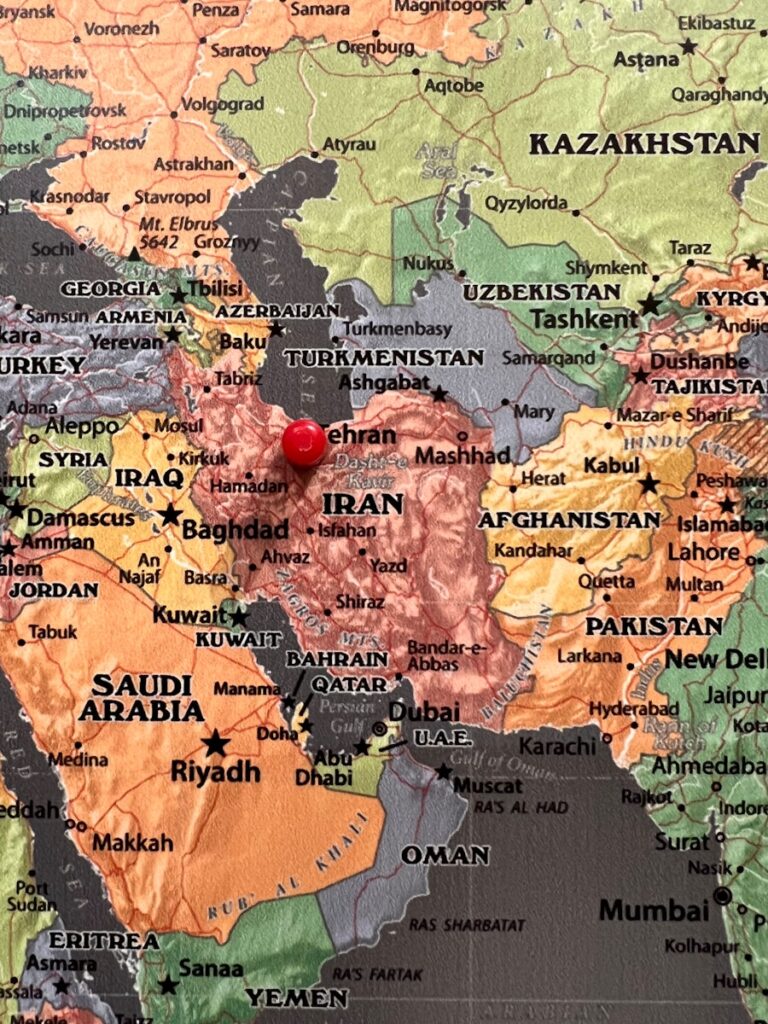
In rapid retaliation, the Iranian Islamic Revolutionary Guard Corps (IRGC) launched a coordinated barrage of ballistic missiles and loitering munitions across the Persian Gulf, targeting not only Israeli territory but also sovereign Arab states hosting US military infrastructure — including Bahrain, Qatar, Kuwait, Saudi Arabia, Jordan, and Iraq. The simultaneous targeting of Gulf Arab capitals represents an unprecedented escalation, erasing any illusion of geographical containment and imperilling the Strait of Hormuz.
Historical Context and the Breakdown of Diplomatic Frameworks
The June 2025 War and the Failure of Containment
The immediate precursor to the current crisis was the brief 12-day war of June 2025. On June 13, 2025, Israel launched major air strikes against Iranian nuclear and military facilities while negotiations between the US and Tehran were still ongoing. Iran responded within hours with large-scale missile and drone attacks on Israeli cities. On June 22, 2025, the United States directly intervened, striking Iranian nuclear facilities at Natanz, Fordow, and Isfahan. Iran subsequently retaliated by firing missiles toward the Al Udeid airbase in Qatar.
A US-brokered ceasefire took effect on June 24, 2025. Iran reported at least 610 of its citizens killed; Israel claimed 28 fatalities. However, the underlying strategic conflicts remained entirely unresolved. In the aftermath, Iranian President Masoud Pezeshkian signed legislation halting cooperation with the International Atomic Energy Agency (IAEA), barring inspectors from accessing nuclear facilities without explicit authorisation from the Supreme National Security Council — accelerating Western anxieties about Iran’s nuclear breakout timeline.
The Collapse of the Geneva Negotiations
Despite deep mutual hostility, the United States and Iran engaged in a final round of indirect nuclear negotiations in Geneva in late February 2026, mediated by the Sultanate of Oman. The diplomatic framework appeared briefly promising: on February 27, 2026, Oman’s foreign minister reported that Iran had agreed in principle to degrade its nuclear stockpiles to “the lowest level possible,” effectively reducing them to unrefined levels.
However, US envoys — operating under directives from President Trump — insisted on the total and permanent destruction of Iranian nuclear sites, a demand Tehran categorically rejected. Strikingly, the strikes were launched just hours after Oman’s mediators announced significant progress in the talks, and Israeli defence officials have since confirmed that the launch date was decided weeks in advance — even as negotiations continued.
The 2025–2026 Protest Wave: Pre-Existing Domestic Fragility
Beginning on December 28, 2025, Iran was convulsed by the largest domestic uprising since the 1979 Revolution, spreading to over 100 cities across all 31 provinces. The protests were sparked by catastrophic economic mismanagement, the collapse of the Iranian rial, severe water and energy shortages, and the violent enforcement of mandatory hijab laws.
The regime’s response was unprecedented in its brutality. The Iranian government has acknowledged 3,117 deaths from state-sponsored crackdowns; US-based human rights organisations have estimated the toll at approximately 7,000, while President Trump and others have publicly claimed figures as high as 32,000. These figures remain contested and unverified by independent international observers. The internet was shut down across Iran for more than two weeks following the outbreak of the protests.
Tactical Execution of Operation Epic Fury and Operation Roaring Lion
Strike Locations and Initial Phase
In a significant departure from standard Western military doctrine — which typically favours night-time operations — the offensive commenced during morning hours on Saturday, February 28. CNN reported that this daylight timing was calculated for tactical surprise, as Iranian air defence and civil defence networks were not anticipating a daytime assault.
Strikes have been confirmed in Tehran, Isfahan, Qom, Karaj, and Kermanshah. Additional explosions were reported in Ilam, Lorestan province, Tabriz, and Minab in Hormozgan province, though comprehensive geolocation confirmation of all sites is ongoing. Primary targets encompassed ballistic missile manufacturing facilities, naval installations, and IRGC command-and-control infrastructure.
Force Posture and Asset Deployment
The United States mobilised an extensive naval and aerial strike force to the region in the weeks preceding the offensive. Note: the specific basing and assignment of assets below is drawn from pre-conflict reporting and intelligence assessments available prior to February 28; real-time confirmation of all deployments is pending.
| Military Asset / Platform | Reported Deployment Location | Strategic Role |
| USS Abraham Lincoln (CVN 72) | Indian Ocean / Arabian Sea (reported) | Carrier strike group operations projecting power into the Persian Gulf |
| Guided-Missile Destroyers (Arleigh Burke-class) | Red Sea, E. Mediterranean, Arabian Sea (reported) | Tomahawk cruise missile strikes; Aegis ballistic missile defence |
| F-15E Strike Eagles | Azraq, Jordan (reported) | Deep-penetration bombing; advanced air-to-air capability |
| F-16, F-22, F-35 Squadrons | Al Kharj, Saudi Arabia and undisclosed bases (reported) | Stealth penetration; electronic warfare; SEAD missions |
| B-2 Spirit Stealth Bombers | Diego Garcia, Indian Ocean (reported) | Strategic strikes; capable of deploying GBU-57 Massive Ordnance Penetrators against hardened sites |
| E/A-18G Growler | Azraq, Jordan (reported) | Electronic warfare; jamming of Iranian radar systems |
| MQ-4C Triton & P-8A Poseidon | Al Dhafrah (UAE), Awali (Bahrain), Al Kharj (KSA) (reported) | High-altitude reconnaissance; maritime surveillance |
Table 1: Reported US military asset deployments — based on pre-strike reporting. Subject to revision.
Decapitation Strategies and High-Value Targeting
A defining characteristic of the offensive is the explicit targeting of Iran’s political leadership. At least seven missiles struck the district of Tehran housing the Supreme Leader’s residence and administrative offices. Iranian officials confirmed that Khamenei was evacuated to a secure location prior to the strikes. Claims that “several senior IRGC commanders were successfully eliminated” in the opening salvos remain unverified at time of writing and should be treated with caution.
Civilian Collateral Damage
Al Jazeera reported that an Israeli strike hit an elementary girls’ school in Minab, Hormozgan province, killing at least 40 people. Both the United States and Israel maintain that their targeting parameters are confined to military assets and regime leadership. The full extent of civilian casualties across the multiple strike zones remains unknown.
The Iranian Counter-Offensive
Expansion of the Target Matrix to Sovereign Gulf States
Within hours of the initial allied strikes, the IRGC launched successive waves of ballistic missiles, cruise missiles, and loitering munitions not only toward Israel but directly at sovereign Gulf Arab states. Iran’s Fars News Agency confirmed attacks targeting Al Udeid Air Base in Qatar and the headquarters of the US Navy’s 5th Fleet in Bahrain. This simultaneous targeting of multiple Gulf capitals marks a watershed escalation in Iranian military doctrine — abandoning the policy of proxy restraint and geographical containment.
Note: Iran’s retaliatory operation has been referred to in some Iranian sources as ‘True Promise 4’ (or ‘Truthful Promise 4’). This designation has not yet been independently confirmed by Western intelligence or media sources and should be treated as unverified at this stage.
| Country | Targeted Facility | Confirmed Impact and Defensive Response |
| Qatar | Al Udeid Air Base | Multiple missile waves intercepted by Patriot batteries. Qatar’s Ministry of Defence reported successful repulsion of projectiles. (Confirmed) |
| Bahrain | US Navy 5th Fleet HQ (Juffair) | Direct missile attacks confirmed. Air-raid sirens activated across Manama. Damage assessment ongoing. (Confirmed — extent classified) |
| UAE | Al Dhafra Air Base / Abu Dhabi | Missiles intercepted above Abu Dhabi. Falling debris killed at least one foreign national — the first confirmed Gulf fatality. (Confirmed) |
| Kuwait | Al-Salem Air Base / US Army Central | Air defences engaged and repelled projectiles. Severe commercial airspace restrictions imposed. (Confirmed) |
| Saudi Arabia | Riyadh and broader airspace | Multiple explosions reported by journalists in Riyadh. Saudi authorities have not issued official damage assessments. (Reported — unconfirmed) |
| Iraq & Jordan | US outposts; transit corridors | Iraqi airspace closed entirely. Jordan’s military shot down two ballistic missiles traversing its airspace toward Israel. (Confirmed) |
Table 2: Iranian retaliatory strikes on Gulf states — February 28, 2026. Sources: Al Jazeera, CNN, Washington Post.
The Explicit Objective of Regime Change
The Rhetoric of Liberation
In an extraordinary video address released concurrently with the initiation of hostilities, President Trump appealed directly to the Iranian populace and armed forces. He declared the objective was to “eliminate imminent threats” and completely destroy the Iranian missile industry and navy, offering IRGC members full immunity if they laid down their arms — or “certain death” if they refused. He urged Iranian civilians: “When we are finished, take over your government. It will be yours to take. This will be probably your only chance for generations.”
Israeli Prime Minister Netanyahu stated the joint operation would “create the conditions for the brave Iranian people to take their destiny into their own hands.” Exiled Crown Prince Reza Pahlavi issued a broadcast urging Iran’s military and security forces to abandon the Islamic Republic and join the people in facilitating a democratic transition.
Macroeconomic Shockwaves and Global Energy Security
The Strait of Hormuz Vulnerability
Approximately 13 to 16.5 million barrels of crude oil transit the Strait of Hormuz daily — roughly 25 to 31% of all seaborne crude oil globally. The strait is also the exclusive maritime exit for the entirety of Qatar’s LNG exports, and handles the vast majority of crude exported by Kuwait, Iraq, and the UAE.
Note: specific commodity price figures in Table 3 below were drawn from early market data and analyst projections available at the time of writing. These figures are provisional and subject to material revision when global markets open.
| Indicator / Commodity | Pre-Conflict Status (Approx.) | Post-Strike Market Reaction and Projections (Provisional) |
| Brent Crude Oil | ~$72.87 / barrel | Projected to gap up on market opening. Risk of $120–$150/bbl if Strait of Hormuz is blockaded or mined. (Analyst projection — unconfirmed) |
| WTI Crude Oil | ~$67.02 / barrel | Jumped ~2.8% prior to the weekend; projected to exceed $70/bbl on opening. (Preliminary data) |
| Gold (COMEX) | Near record levels | Reported spike of approximately 2%, to ~$5,296/oz — a single-session gain of ~$102. (Reported — not yet exchange-confirmed) |
| Silver (COMEX) | Elevated | Reported rally of approximately 8%, to ~$93.82/oz. (Reported — not yet exchange-confirmed) |
| Global Air Travel | Normal operations | Lufthansa, KLM, Air France, Wizz Air cancelled all flights to the Middle East. Iranian, Iraqi, UAE, and Jordanian airspace closed. (Confirmed) |
Table 3: Preliminary market impact data — provisional, subject to revision on exchange open.
Impact on Major Importing Nations
India finds itself in a highly precarious position: analytics data from Kpler indicates that nearly 50% of India’s monthly crude oil imports transit through the Strait of Hormuz. A prolonged conflict or blockade threatens to spike domestic inflation and force the Reserve Bank of India into a highly restrictive monetary posture. The Indian government has issued urgent advisories to citizens in the UAE, Qatar, and Iran.
China is the primary purchaser of Iranian crude, absorbing approximately 80% of exports from Iran’s Kharg Island terminal. If Iranian shipments are disrupted, analysts project China would need to source around 1.6 million additional barrels per day from alternative suppliers — a volume sufficient to materially alter global supply and demand dynamics.
International Diplomatic Fallout and Legal Dimensions
United Nations Charter: Article 2(4) vs. Article 51
The Iranian Foreign Ministry condemned the strikes as a “flagrant violation” of its territorial integrity under Article 2(4) of the UN Charter, while invoking Article 51 — the right to self-defence — to justify its retaliatory missile campaign. International legal experts note that the initial US-Israeli preemptive strikes occupy highly contested legal territory. To justify preemptive action under international law, the aggressor must demonstrate clear and imminent hostile intent, genuine capability to carry out an attack, and the absence of realistic diplomatic alternatives. Critics argue the Trump administration has not adequately demonstrated this threshold to the international community.
French President Macron called for an emergency session of the UN Security Council, demanding that the “ongoing escalation is dangerous for all. It must stop.” However, the UNSC remains institutionally paralysed: any resolution condemning the US or Israel faces an automatic US veto, while any measure against Iran will be blocked by Russia or China.
Sino-Russian Condemnation
The Russian Federation categorised the strikes as a “pre-planned and unprovoked act of armed aggression against a sovereign and independent UN member state,” warning that strikes on IAEA-safeguarded nuclear infrastructure risk triggering a severe “humanitarian, economic and possibly radiological catastrophe.” Russian Foreign Minister Lavrov communicated directly with Iranian Foreign Minister Araghchi, reiterating Moscow’s readiness to broker peace.
China, while more measured in its public rhetoric, views the American military mobilisation in the Persian Gulf as a direct strategic threat to its energy security and Eurasian ambitions. Both Moscow and Beijing are using the crisis to reinforce their narrative of American unilateralism and destabilising hegemony.
The European Dilemma
The E3 — the UK, France, and Germany — find themselves deeply conflicted. While they have explicitly condemned the Iranian retaliatory strikes against Gulf Arab states, European capitals have notably abstained from publicly endorsing or even directly commenting on the initial US-Israeli strikes. This silence reflects a profound transatlantic rift: Europe remains desperate to salvage a negotiated nuclear settlement and avoid a region-wide conflagration that could trigger mass refugee flows and energy crises on its doorstep.
Domestic US Political Polarisation and the War Powers Debate
The preemptive nature of the strikes — launched without a formal declaration of war or prior congressional consultation — has drawn intense scrutiny. Congressional Democrats and libertarian-leaning Republicans have moved to force a vote on a War Powers Resolution to limit further offensive military action against Iran without explicit legislative authorisation.
Senators Ruben Gallego (an Iraq War veteran) and Mark Warner publicly condemned the operation. Gallego called it an “illegal war,” arguing that “young working-class kids should not pay the ultimate price for regime change and a war that hasn’t been explained or justified.” Warner demanded a clear legal justification and a defined “end state.”
Conversely, defence hawks such as Senators Lindsey Graham and Tom Cotton have lauded the strikes. The administration’s legal justification — predicated on vague assertions of “eliminating imminent threats” — has been further complicated by reports from the Defense Intelligence Agency suggesting Iran remains approximately 10 years away from developing an ICBM capable of striking the US homeland.
Under the War Powers Resolution, the 60-day clock for continued military action without congressional authorisation began on February 28, 2026 — expiring around late April 2026. Whether Congress moves to enforce this deadline will be a defining test of executive war powers.
Strategic Forecast and Concluding Assessment
The joint US-Israeli offensive against Iran constitutes a historical geopolitical inflection point. By abandoning containment and deterrence in favour of preemptive destruction and active regime change, Washington and Tel Aviv have irrevocably altered the security architecture of the Middle East.
Iran’s rapid retaliatory strikes against sovereign Gulf Arab states have permanently shattered the illusion of geographical containment. The severe vulnerability of the Strait of Hormuz will continue to dictate extreme volatility in global macroeconomic indicators, forcing importing giants like China and India to rapidly reassess their energy security paradigms.
The strategic assumption that external military pressure will cleanly precipitate the collapse of the Islamic Republic and install a stable, pro-Western democracy is historically fraught. The entrenched power of the IRGC and its Basij paramilitary networks, combined with the potential for ethno-sectarian fracturing along Baloch, Kurdish, and Azeri lines, raises the distinct probability of state collapse and prolonged civil war rather than democratic transition.
In the medium to long term, the success or failure of Operation Epic Fury will be determined not by ordnance tonnage or facilities destroyed, but by whether the United States and Israel possess a coherent, executable, and politically sustainable strategy to manage the catastrophic fallout of a destabilised Iran within a region essential to the functioning of the global economy.
Key Sources and References
All sources are hyperlinked inline throughout this document. Principal sources consulted include:
• Wikipedia — 2026 Israeli–United States strikes on Iran
• Washington Post — Live Updates: US and Israel launch strikes on Iran
• CNN — What we know about the US-Israeli attack on Iran and Tehran’s retaliation
• Al Jazeera — US, Israel launch attack on Iran; explosions in Israel, Arab states
• Al Jazeera — Live Blog: Israel launches attacks on Iran
• Al Jazeera — Timeline of talks and threats leading up to attacks
• Al Jazeera — Why are the US and Israel attacking Iran?
• GovFacts — Does the joint US-Israel strike on Iran require separate congressional approval?
• Special Eurasia — Joint US-Israel Military Offensive and Iran Retaliation
Research Methodology and Limitations
This assessment was produced using Google Search and open-source web research tools to identify, retrieve, and cross-reference publicly available reporting as of February 28, 2026. It does not draw on classified or proprietary intelligence. All figures, attributions, and projections are sourced from news wire reports, official government statements, and analyst commentary available in the immediate aftermath of the commencement of hostilities. Given the fluid and rapidly evolving nature of the conflict, claims labelled ‘reported,’ ‘projected,’ or ‘unconfirmed’ should be independently verified before being relied upon for decision-making purposes. This document does not constitute legal, financial, or policy advice.
About The Author