
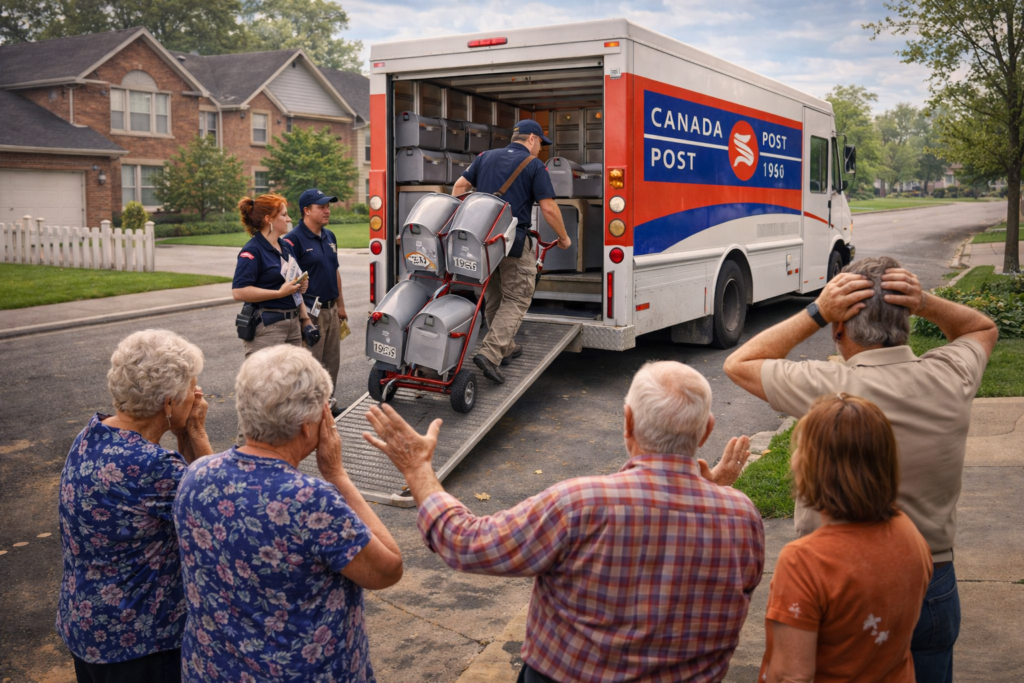
Let’s start with what this isn’t. It’s not a surprise. It’s not bold leadership. And it’s definitely not a sudden crisis that nobody saw coming.
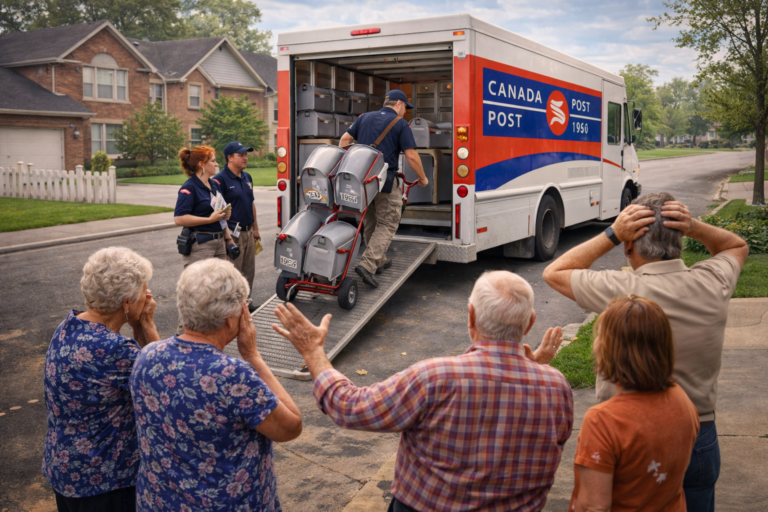
Canada Post has been bleeding money for years. More than $5 billion in cumulative losses since 2018. A $541 million shortfall in just the third quarter of 2025 alone. The federal government recently called the situation an “existential crisis” and described the corporation as “effectively insolvent.” And now, on March 31st 2026, Canada Post officially announced it’s moving forward with ending door-to-door home delivery for the remaining four million addresses in Canada that still have it.
So yeah. That knock at your door? That’s not the mail carrier anymore.
What’s Actually Changing
Right now, about three quarters of Canadians already pick up their mail from a community mailbox, one of those grey metal units you see on street corners and in parking lots. The people who still get mail at their door are the last 25 percent, roughly four million addresses across the country.
Those people are next.
Canada Post says the conversion will be phased in over nine years, but they’re expecting to get the bulk of it done in the first three to four. So if you’re in that last quarter, you’re probably looking at a new reality within the next few years, not the next decade.
On top of that, the government has lifted a 30-year moratorium on closing or converting rural post offices. That’s the part getting less attention, but it matters. Thousands of rural post office locations that have been protected since 1994 are now fair game for closure or conversion.
And one more quieter change: non-urgent letter mail will now travel by ground instead of air. Canada Post says that saves about $20 million a year. Not nothing, but also a rounding error compared to the losses they’re trying to plug.
Does This Affect Businesses?
This is where it gets specific, and it depends on where you are.
The short answer is that most businesses in established commercial areas are exempt. Canada Post has been clear that addresses in well-established business corridors, main streets, and locations that receive a large volume of mail will keep door delivery. If you’re running an office or a store on a commercial strip, you’re probably fine.
But here’s the part worth paying attention to. If your property sits in a primarily residential area, even if it operates as a business, Canada Post looks at the character of the street, not your zoning designation. A strip mall surrounded by houses? Likely getting converted. A home-based business on a residential street? Still a residential address in their eyes, regardless of what your municipal zoning map says.
The city’s zoning label doesn’t protect you. What matters is whether Canada Post classifies your location as part of a residential delivery route. If it does, you’re in scope.
The specific street-by-street conversion decisions haven’t been made public yet. That information is expected to come once Canada Post finishes consulting with the union and begins broader engagement with municipalities. So if you have a property that lives in that grey zone, now is the time to start paying attention.
Why Is This Happening Now
The honest answer is that it probably should have happened years ago, and didn’t, for political reasons.
The federal government paused community mailbox conversions back in 2015. The minister responsible for Canada Post was recently asked if that was a mistake. He said, and I’m paraphrasing slightly here, “probably yes.”
Meanwhile, the math got worse every single year. In 2006, Canada Post delivered 5.5 billion letters annually. By 2023, that had dropped to 2.2 billion, even as the number of addresses in Canada kept growing. The volume of mail collapsed. The number of doors to deliver to kept expanding. And the cost of running a service designed for the old volume stayed stubbornly high.
The parcel business, which should have been the lifeline, got eaten up by private couriers. FedEx, UPS, Purolator. Canada Post’s market share in parcels has been shrinking while the competition grew leaner and faster.
So here we are. Doing in a rush what could have been a gradual, managed transition over the past decade.
What About the People Who Actually Need Home Delivery
This is the question that tends to get buried under the financial arguments, and it shouldn’t.
Seniors. People with mobility issues. People in remote and Indigenous communities who depend on Canada Post in ways that urban and suburban Canadians simply don’t. These are the people for whom “just walk to the community mailbox” isn’t a minor inconvenience. It’s a real access problem.
Canada Post says its delivery accommodation program will stay in place. If you have a documented mobility issue, you can apply for weekly home delivery instead of being forced to the community mailbox. But note the word weekly. That’s already a reduction for many people who currently get mail five days a week.
The union, the Canadian Union of Postal Workers, has been raising this point loudly. They argue the changes disproportionately harm rural and remote communities. And frankly, they’re not wrong. The problem is that the union is also in the middle of ratifying a new collective agreement after a messy stretch of strikes in late 2025, and Canada Post dropped this announcement right in the middle of that process. The union says they’ve repeatedly asked to see the full transformation plan and haven’t been shown it. That’s not a minor procedural gripe. That’s a significant transparency problem.
The Bottom Line
Canada Post is broke. The way people use mail has changed permanently and there’s no going back to the letter volumes of twenty years ago. Something had to give.
But the way this is being handled, the rushed consultations, the union kept in the dark, the vague timelines, the unanswered questions about rural communities, all of that matters. Necessary doesn’t mean well-executed. And the people who are going to feel this change most sharply are almost certainly not the people who designed it.
If you’re in that last 25 percent who still get mail at your door, start thinking about what changes when that stops. And if your property sits anywhere near a residential delivery route, whether you’re a homeowner, a renter, or a small business owner, keep your eyes on the municipal consultations when they start. That’s when the specific decisions get made, and that’s when your input might actually mean something.
Information sourced from Canada Post, CBC News, Global News, CTV News, and BNN Bloomberg. Published April 2026.
About The Author