


No, Canada Post is not currently on strike. While there is no active job action at this time, negotiations between Canada Post and the Canadian Union of Postal Workers (CUPW) are ongoing, and the possibility of a future strike or lockout remains a significant concern for Canadians and businesses alike. This means regular mail and parcel delivery is operating as usual for now, but it's wise to stay informed.
Understanding the Potential Canada Post Labour Disruption

Any potential work stoppage would involve two major players: Canada Post Corporation, the Crown corporation that runs our national postal service, and the Canadian Union of Postal Workers (CUPW), which represents the employees on the front lines. So when you ask, "is Canada Post on strike," the answer depends on the status of negotiations between these two sides.
The collective agreements for roughly 55,000 postal workers, represented by CUPW, have expired, prompting a new round of contract negotiations. These discussions involve both the Urban Operations and Rural and Suburban Mail Carriers (RSMC) bargaining units. If these talks fail to produce an agreement, the union could hold a strike vote. A strong "yes" vote would give them a mandate to initiate job action if they deem it necessary.
Conversely, if talks break down, Canada Post could initiate a lockout—a tactic where the employer bars employees from coming to work. A combination of a strike and a lockout is what could bring most postal operations to a standstill.
To give you a scannable overview of the situation, here’s a breakdown of the key facts.
Potential Canada Post Labour Disruption at a Glance
| Metric | Details |
|---|---|
| Current Status | Negotiations are ongoing; no strike or lockout is currently in effect. |
| Parties Involved | Canada Post Corporation & Canadian Union of Postal Workers (CUPW) |
| Number of Workers | Approximately 55,000 |
| Key Issues | Wages, job security, health and safety benefits |
| Potential Impact | A halt in regular mail and parcel delivery if job action occurs. |
The core issues fuelling this potential dispute aren’t new. Workers are pushing for higher wages to keep up with the rising cost of living, better job security in an evolving industry, and improved health and safety benefits. While mediation talks are a possibility, significant disagreements must be bridged to avoid a strike. For a deeper dive into the historical context of these disputes, labornotes.org offers a good summary.
At its heart, a potential postal strike is more than just a halt in mail delivery; it's a fundamental conflict over the value of labour and the future direction of a national institution. Both sides are negotiating not just for a contract, but for their vision of Canada Post's role in the years to come.
If you’ve ever wondered why the phrase "Canada Post strike" seems to pop up every few years, it’s because this isn’t an isolated event. It's the latest chapter in a long, often tense history between the postal service and its employees. To understand what’s happening now, we need to look back at the conflicts that paved the way.

At the heart of this saga is the Canadian Union of Postal Workers (CUPW). The union has a well-earned reputation as a formidable force, built over decades of fighting for its members. This legacy of assertive action started even before it was legally allowed.
The union's identity was forged in defiance. Its first major move was an illegal wildcat strike back in 1965—a gutsy decision, considering public sector workers didn't even have the legal right to strike at the time. That single event set the tone for decades of battles over fair wages, job security, and safe working conditions. If you're curious about the union's origins and its influence on the broader Canadian labour movement, Wikipedia offers a comprehensive overview of the Canadian Union of Postal Workers.
Echoes of Past Conflicts
Jump ahead to more recent years, and you’ll see the same themes playing out on a loop. The rotating strikes in 2011 and 2018 are perfect examples of history repeating itself. In both cases, tens of thousands of workers walked off the job, causing major headaches for millions of Canadians trying to send and receive mail.
These past disputes keep circling back to the same core issues:
- Wage Disputes: The constant struggle to make sure paycheques keep up with the rising cost of living and actually reflect the demanding nature of the work.
- Job Security: A deep-seated fear that jobs are being threatened by automation, new technologies, and changing business models.
- Back-to-Work Legislation: The federal government’s tendency to step in and legislate an end to strikes, often leaving underlying problems unresolved.
The cyclical nature of these labour disputes reveals a deep-seated tension. Each conflict is not just about a single contract but about the ongoing push-and-pull over the future direction of Canada's postal service and the rights of its employees.
This historical backdrop is crucial. It shows that the current standoff isn't happening in a vacuum—it’s built on layers of old grievances and unresolved tensions, which makes finding a quick and easy solution a real challenge.
The Core Issues Fuelling the Current Dispute
Whenever a labour dispute like this looms, the question "Is Canada Post on strike?" is almost immediately followed by, "So, what's this all about?" The truth is, it's rarely just one thing. This conflict is a messy tangle of complex issues, with both sides seeing their positions as absolutely critical for the future. These are the sticking points that could bring negotiations to a grinding halt.
At its heart, the Canadian Union of Postal Workers (CUPW) is fighting for significant improvements on several fronts. They're demanding better wages to keep up with the soaring cost of living, stronger job security in an uncertain industry, and crucial health and safety measures. That last one is a big deal, especially as the sheer volume of parcels makes the work more physically demanding than ever before.
A Tale of Two Sides
One of the longest-running battles centres on the pay and working conditions for Rural and Suburban Mail Carriers (RSMCs). For years, the union has been pushing for pay equity, arguing that these workers deserve the same compensation as their urban colleagues for doing fundamentally similar work. It’s a recurring theme in nearly every negotiation and remains a top priority.
On the other side of the table, Canada Post's management is staring down a tough financial reality. Letter mail—once their bread and butter—is in a steep, years-long decline. At the same time, they're trying to compete in the booming but incredibly fierce parcel delivery market. Their offers are shaped by a pressing need to control costs and keep the entire postal service sustainable for the long haul.
The image below really drives home how much these disputes can disrupt service, showing the real-world consequences when the mail stops moving.
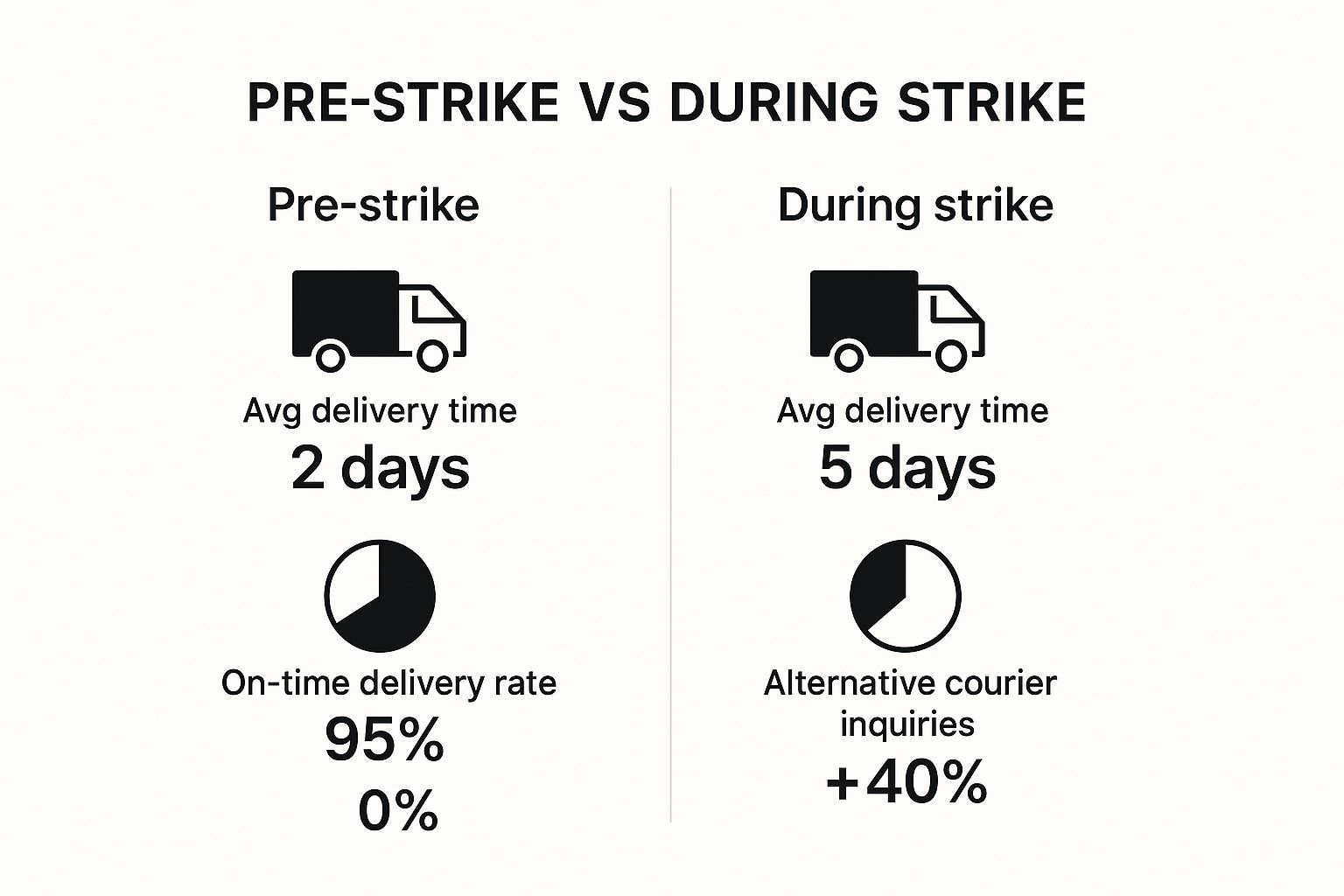
Past data shows a dramatic nosedive in efficiency and a spike in customers looking elsewhere during a strike. It’s a stark reminder of the high stakes involved for the corporation's reputation.
To get a clearer picture of where each side stands, here’s a breakdown of the main sticking points in the current negotiations.
Key Negotiation Sticking Points
| Issue | CUPW Demand | Canada Post Position |
|---|---|---|
| Wages | Significant increases to address inflation and cost of living. | More modest wage increases to manage operational costs. |
| Job Security | Stronger protections against layoffs and contracting out work. | Flexibility to adapt staffing to changing mail volumes. |
| RSMC Pay Equity | Equal pay and benefits for rural/suburban carriers compared to urban ones. | A different compensation model reflecting the unique nature of rural routes. |
| Health & Safety | Better protocols and staffing to reduce workplace injuries. | Investment in new equipment and processes to improve safety. |
As you can see, the gap between what workers are asking for and what management feels it can offer is substantial. It's a classic clash between labour's fight for fair compensation and security versus management's focus on keeping the lights on in a rapidly changing industry.
As talks continue, both sides trade offers and counter-offers. You can learn more about recent proposals Canada Post has tabled https://ncrnow.ca/2025/05/21/canada-post-tables-new-offers-in-hopes-of-averting-strike-but-will-it-be-enough/ in an attempt to prevent a full-blown strike. How this all shakes out will shape the future for thousands of workers—and the postal service we all rely on.
How Past Strikes Have Impacted Canadians

To really get a handle on what another postal strike could mean, we don't have to look far. The 2018 rotating strikes are a perfect, and painful, case study of just how quickly these disputes can throw a wrench into daily life and commerce across the country.
That year, the job action snowballed into a full-blown logistical nightmare. It hit right in the lead-up to the holiday shopping season, a critical time for retailers and families alike. Parcels didn’t just slow down; they piled up in sorting facilities, creating crippling backlogs that brought supply chains to a standstill. For small businesses relying on Canada Post for their e-commerce sales, the fallout was immediate and devastating.
The Government's Response and Financial Fallout
The chaos from the 2018 strike got so bad that the federal government had to step in, passing back-to-work legislation to force an end to the job action. It’s a move we've seen before in major postal disputes—the government intervenes to get the mail moving but often leaves the root causes of the conflict unresolved. If you want to dig deeper, you can find more on understanding the dynamics of a Canada Post strike https://ncrnow.ca/2025/05/20/understanding-canada-post-strike-2025/ and what it means for us here in the National Capital Region.
The financial toll is always staggering. In 2018, the rotating strikes caused such severe delays that Canada Post warned the backlogs could drag on well into the next year. Even with government intervention, the damage was done. The job action was a major factor in the Crown corporation reporting a significant pre-tax loss, highlighting the massive strain these conflicts put on its long-term health.
The 2018 strike is a stark reminder: postal disruptions quickly escalate from a labour issue into a nationwide economic crisis, hitting everyone from small online shops to families trying to send holiday gifts.
This history isn't just a trip down memory lane; it’s crucial context for what's happening now. It shows that when we ask, "is Canada Post on strike?", the answer ripples through the entire Canadian economy.
How to Navigate a Potential Mail Disruption
With the possibility of a mail service disruption, the big question is: what can you do? For most people and small businesses, preparing ahead of time is the best approach. Being proactive and getting familiar with your alternatives is key.
First things first, for any time-sensitive items like bill payments or legal notices, your best bet is to go digital. See if you can set up direct deposit, e-transfers, or receive documents by email wherever possible. This minimizes your reliance on physical mail.
If a strike does occur and you need to send something, it's time to look at other couriers. Companies like Purolator, FedEx, and UPS will still be running, but they would likely get swamped with a massive surge in volume. This would mean higher shipping costs and potential delays in their own networks, so booking early would be essential.
Finding the Right Shipping Alternative
When Canada Post goes on strike, the whole logistics landscape gets turned upside down. Small businesses, especially those in e-commerce that depend on the postal service for getting orders out the door, are hit the hardest. Here are a few practical steps you can take to prepare:
- Compare Courier Rates: Hop online and use comparison tools to check prices between different services. Be aware that rates could increase due to the extra strain on their capacity.
- Talk to Your Customers: Honesty is the best policy. Let your customers know there could be shipping delays if a strike happens and tell them what your contingency plans are.
- Look at Regional Carriers: Don't forget about the smaller, local couriers. They might have more room in their network than the big national players and can be a fantastic choice for deliveries within your city or province.
The single most important thing you can do is diversify your shipping strategy. Relying on just one carrier, especially during a potential disruption, is a huge risk. Being flexible is your best defence against a busted supply chain.
Ultimately, getting through a potential postal disruption just takes a little bit of planning. By checking out your alternatives and keeping everyone in the loop, you can cut down on the stress and keep things moving.
What to Expect Next in the Canada Post Dispute
So, where do we go from here? The path to resolving the Canada Post negotiations really only has a few potential routes, and each one carries its own set of major consequences for mail service, workers, and the Crown corporation itself.
The most hopeful option, of course, is a negotiated settlement. This is what everyone wants to see. If ongoing talks can successfully bring both CUPW and Canada Post's management to the table for a mutual agreement, the threat of a strike would be averted. A deal like this would almost certainly involve some give-and-take on the big-ticket items: wages, job security, and benefits.
But what if the talks stay stuck in neutral? If a deal remains out of reach and job action begins, the federal government will face mounting pressure to step in. This brings up the very real possibility of back-to-work legislation—a political tool Ottawa has used before in postal disputes, most notably during the 2018 strike. It’s a contentious move that legally forces an end to the job action, sending employees back to their routes while an arbitrator or an imposed settlement resolves the contract.
The Bigger Picture for Canada Post
Beyond the immediate negotiations, this whole situation is forcing a much-needed, and frankly difficult, conversation about the long-term future of Canada Post. The corporation is trying to find its footing in a world with less and less profitable letter mail and fierce competition in the parcel delivery game. Every day of a potential labour disruption not only risks losing money but also pushes more customers—especially small businesses—to try out competing couriers.
This reality has business groups on edge. Organizations like the Canadian Federation of Independent Business are vocal about the need for a quick resolution, stressing how much damage a prolonged strike can do to small businesses that rely on the mail. You can read more about the CFIB's plea to avoid a Canada Post strike https://ncrnow.ca/2025/05/15/cfib-pleads-to-avoid-canada-post-strike/ and what it could mean for our local economy.
No matter how these negotiations end, Canada Post is up against a fundamental challenge: it needs to figure out how to modernize and stay competitive, all while upholding its mandate as a national public service and meeting the fair demands of its workforce.
The final agreement—or a settlement imposed by the government—won’t just shape the future for 55,000 workers. It will set the course for Canada's entire postal service for years to come.
Your Strike Questions, Answered
With the possibility of a strike looming, you've probably got questions. Let's break down some of the most common ones people are asking.
Will My Government Cheques Still Arrive in a Strike?
Yes, they would. In past strikes, Canada Post has made it clear that essential mail, like government payments for social assistance, pensions, and Old Age Security, will continue to be delivered. That said, expect some potential delays due to the wider disruption. The safest bet? Sign up for direct deposit to make sure your payments land in your account on time, no matter what.
How Would a Strike Affect Other Shippers Like Purolator?
While Purolator is its own company and would keep running, a Canada Post strike creates a massive ripple effect across the entire shipping industry. Think about it: all those packages that would normally go through Canada Post have to go somewhere.
Couriers like Purolator, FedEx, and UPS would get slammed with a huge spike in volume. This sudden flood of packages can strain their networks, which might mean higher shipping costs and some delays for everyone.
Picture a major highway shutting down unexpectedly. All that traffic has to squeeze onto the side roads, causing instant gridlock. That's essentially what happens to other couriers during a postal strike—everything slows down.
What Would Happen to Parcels Shipped Before a Strike?
If your package was already in the mail system when a strike hit, it would likely get stuck in limbo. All parcels would be held at Canada Post's sorting and processing facilities. Deliveries would be paused and wouldn't start up again until the labour dispute is over. You could still use your tracking number to see where it was last scanned, but it would stay put until work resumes.
How Long Could a Canada Post Strike Actually Last?
This is the million-dollar question, and honestly, it’s impossible to predict. Looking back at past postal strikes, they've ranged from a few days to several weeks. It all hinges on how the negotiations between the union and management go.
If they hit a complete impasse, the federal government might decide to step in with back-to-work legislation, just like it did in 2018, to force an end to the strike and get the mail moving again.
For the latest news impacting Ottawa and the National Capital Region, trust ncrnow to keep you informed. Find all your local updates at https://ncrnow.ca.
About The Author