
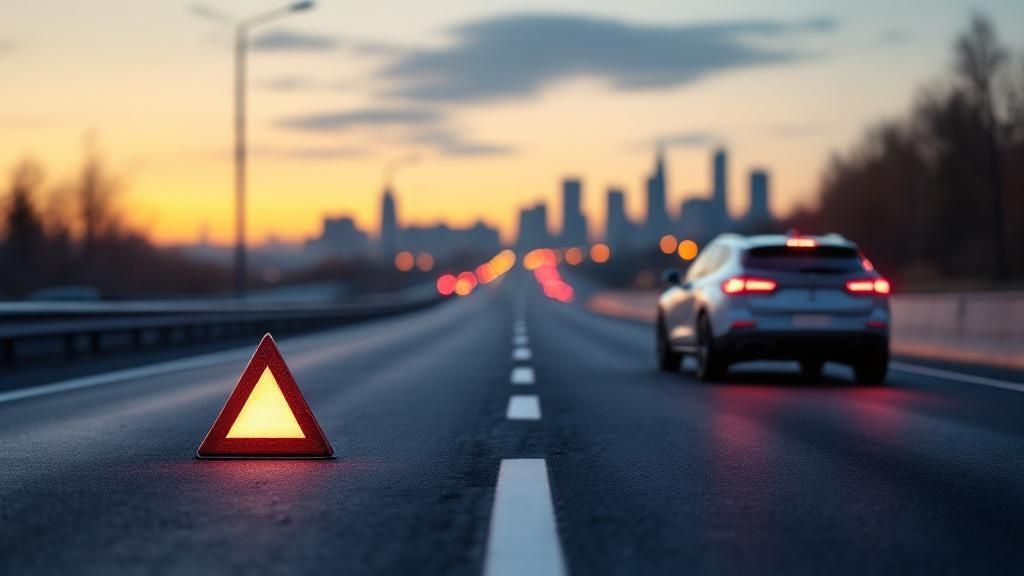
For many in the National Capital Region, driving on Highway 417 is a daily routine. But in the blink of an eye, a serious accident on the highway can turn a routine drive into a life-altering event. This guide is designed to be a practical roadmap for understanding why these incidents happen, how to reduce your risk, and what steps to take if you are involved in one.
The Reality of Highway Accidents in Ottawa
A collision on a high-speed road is a jarring experience that can leave even the most seasoned driver feeling disoriented. The velocity and volume of traffic on highways like the Queensway (Highway 417) or the 416 amplify the risks and stress of any incident. We’re not just talking about a simple fender-bender; we're talking about a crisis unfolding in a high-stakes environment where safety becomes the immediate priority.
Understanding this reality is the first step toward being prepared. No one plans to be in a crash, but having a clear mental framework can make a critical difference. This guide will walk you through the essential steps, from initial safety checks to documenting the scene, all within the context of Ottawa and the National Capital Region.
Your First Moves After a Collision
In the chaotic moments following a crash, your actions are critical. The primary goal is to prevent further harm and secure the area safely. Before doing anything else, focus on these priorities.
- Check for Injuries: Assess yourself, your passengers, and the occupants of other vehicles for injuries. If anyone is hurt, call 911 immediately. Do not move an injured person unless they are in immediate danger, such as from a fire.
- Move to a Safe Location (If Possible): If the crash was minor and your car is drivable, Ontario's Highway Traffic Act often requires you to move it to the shoulder or off the highway. This is crucial for preventing secondary collisions from oncoming traffic.
- Ensure You Are Visible: Activate your hazard lights immediately. If it is safe to exit your vehicle, place reflective triangles or flares behind it to give other drivers as much warning as possible.
Your safety and the safety of everyone else involved is the top priority. All other tasks—exchanging insurance information, assessing damage—are secondary. Adrenaline can mask injuries, so a careful self-check is essential.
Knowing Your Responsibilities
Understanding your legal duties after a highway accident is crucial. In Ontario, the law requires you to stop, offer assistance where possible, and exchange information. If the total damage appears to exceed $2,000 or if anyone is injured, you are legally required to report the collision to the police. For many non-injury accidents in Ottawa, this involves reporting to a designated Collision Reporting Centre.
The moments after a highway crash can feel overwhelming, but a clear head and a simple plan of action can make all the difference. The table below summarizes the most critical first steps to take.
Immediate Steps After a Highway Accident
| Priority | Action | Key Consideration |
|---|---|---|
| 1. Safety First | Check for injuries on yourself and others. Call 911 immediately if anyone is hurt. | Adrenaline can hide pain. Even if you feel fine, a thorough check is essential. |
| 2. Secure the Scene | If possible, move vehicles to the shoulder. Turn on hazard lights. | Your goal is to prevent another crash. Making your vehicle visible is critical. |
| 3. Report the Crash | Call the police if there are injuries or damages over $2,000. | In Ottawa, non-injury accidents often must be reported at a Collision Reporting Centre. |
| 4. Gather Information | Exchange names, contact info, driver's licences, and insurance details. | Take clear photos of the damage, the scene, and the other vehicle's licence plate. |
Following these steps methodically helps you maintain control during a stressful time, ensuring you handle the situation safely and meet all your legal obligations right from the start.
Why Highway Collisions Happen

To prevent an accident on the highway, it's important to understand that collisions are rarely random. They are often the predictable result of specific actions and conditions. Identifying the primary causes is the first step toward recognizing and avoiding danger on the road.
Analysis of highway crashes consistently points to three main contributing factors: distraction, speed, and impairment. Each of these factors significantly reduces a driver's reaction time, turning a minor error into a potential catastrophe.
The High-Speed Consequences of Distraction
At a speed of 100 km/h, a vehicle travels nearly the length of a football field in just over three seconds. At this velocity, there is zero margin for error. A quick glance at a text message, adjusting the infotainment system, or reaching for a fallen item is not a minor distraction—it's a moment of inattention that can have severe consequences.
In the five seconds it might take to read a text, a car can travel over 140 metres without the driver actively watching the road. That is more than enough distance to drift out of a lane, miss seeing brake lights ahead, or fail to notice a merging vehicle. The physics of highway speeds magnify small lapses in attention into major incidents.
Data from jurisdictions across North America supports this. For instance, according to Forbes Advisor, distracted driving was a factor in 3,522 traffic fatalities in the U.S. in a single recent year. You can explore more car crash statistics to understand the scope of this dangerous issue.
The Unforgiving Physics of Speed and Tailgating
Excessive speed is a major cause of highway collisions, not only because it increases the force of impact but also because it dramatically reduces a driver's ability to stop in time. A critical fact of physics is that doubling your speed doesn't just double your stopping distance—it quadruples it.
This highlights the danger of tailgating. Following another vehicle too closely eliminates your safety buffer. At highway speeds, a driver needs at least three seconds of following distance to react and stop safely. This isn't an arbitrary guideline; it accounts for perception time (seeing the hazard), reaction time (your brain signaling your foot to brake), and the time it takes for the brakes to bring the vehicle to a halt.
Think of it like this: You're walking closely behind someone in a crowded hallway. If they stop short, you might bump into them—no big deal. Now, imagine you’re both sprinting down that same hallway. A sudden stop would lead to a serious pile-up. That’s the difference between a city fender-bender and an accident on the highway.
When you tailgate, you erase that critical reaction window. A hard brake from the car ahead makes a rear-end collision almost inevitable.
The Devastating Impact of Impairment
Driving under the influence of alcohol or drugs remains a leading cause of the most catastrophic highway collisions. Impairment does far more than just slow reaction time; it fundamentally alters judgment, coordination, vision, and decision-making abilities.
An impaired driver may misjudge distances, struggle to stay in their lane, or react to other drivers with aggression and unpredictability. Their ability to process information and make safe choices is severely compromised.
The effects are widespread and debilitating:
- Judgment: An impaired driver is far more likely to take risks, such as speeding or making dangerous lane changes.
- Coordination: Fine motor skills needed for smooth steering and effective braking are diminished.
- Vision: Alcohol and drugs can cause blurred or double vision, making it difficult to see hazards.
- Concentration: The simple act of focusing on the road becomes an immense challenge.
By understanding how distraction, speed, and impairment dismantle a driver’s ability to operate a vehicle, you become far better equipped to spot these behaviours in others—and commit to avoiding them yourself. This awareness is the very foundation of defensive driving and your most powerful tool for preventing a serious accident on the highway.
Your Proactive Highway Safety Playbook
Knowing the causes of a highway accident is one thing; actively preventing one requires a different skill set. Driving on high-speed roads like Highway 417 is not a passive activity. It demands your full attention. This section is your guide to defensive driving—practical techniques to make you a more alert, prepared, and safer driver.
The goal is to shift from merely reacting to your surroundings to proactively managing your driving environment.
Mastering Your Following Distance
One of the simplest yet most effective safety tools you have is space. Creating a buffer zone between you and the car ahead buys you precious seconds to react when things go sideways. The best way to measure this is the three-second rule.
It's a simple but game-changing technique:
- Pick a fixed object up ahead—an overpass, a road sign, anything that stands still.
- When the car in front of you passes that object, start a slow count: "one-one-thousand, two-one-thousand, three-one-thousand."
- If you pass that same object before you finish counting, you’re tailgating. Back off.
At 100 km/h, that three-second gap gives you nearly 85 metres of breathing room. This isn't just a friendly suggestion; it's a non-negotiable buffer that accounts for the time it takes you to see a problem, react, and for your vehicle to actually stop. If you're dealing with rain, snow, or fog, stretch that count to four or even five seconds.
Conquering Your Blind Spots
Every vehicle has blind spots—the areas around your car that your mirrors cannot see. Forgetting about them, especially during lane changes, is a common cause of an accident on the highway. Relying solely on your mirrors is a gamble.
To be fully aware of your surroundings, make the shoulder check a reflex. Before every lane change, follow this sequence: check your rearview mirror, check your side mirror, and then—the most critical step—take a quick glance over your shoulder into the lane you want to move into. It’s the only way to be certain no one is hiding there.
Think of a shoulder check as your final safety confirmation. It’s the driving equivalent of "measure twice, cut once." That quick head turn can be the one thing that prevents you from merging into another car.
Navigating Merges and Lane Changes with Confidence
Merging onto a busy highway like the 417 can be stressful. The key is to be predictable and assertive—not timid or aggressive. Your primary goal on an on-ramp is to match the speed of the traffic you are joining.
Use the full length of the on-ramp to accelerate. This gives you time to check your mirrors and blind spot to find a gap. Signal your intention clearly, then merge smoothly. Hesitating or stopping on an on-ramp is extremely dangerous, as it can force following traffic to brake suddenly.
A little planning can also help you anticipate trouble spots. For instance, checking an Ottawa traffic map before you leave can give you a heads-up on busy merge points or congestion.
Here’s a practical look at how defensive techniques stack up against more passive, high-risk habits.
Defensive Driving Techniques Checklist
| Driving Scenario | Passive (High-Risk) Habit | Defensive (Low-Risk) Technique |
|---|---|---|
| Following Traffic | Driving close to the car ahead to "keep up." | Maintaining a minimum three-second following distance. |
| Changing Lanes | Relying only on side mirrors to check for space. | Performing a mirror check followed by a shoulder check every time. |
| Highway Merging | Slowing down or stopping at the end of the on-ramp. | Using the ramp to accelerate to highway speed before merging smoothly. |
| Vehicle Condition | Assuming tires, brakes, and lights are working fine. | Performing regular pre-drive checks on tire pressure, lights, and signals. |
Proactive safety is about building good habits. When these defensive techniques become second nature, you create a powerful shield against the most common causes of a highway accident. It’s not about being a perfect driver, but an aware and prepared one.
Your Step-by-Step Guide for the First 15 Minutes
The moments after a highway accident are a blur. Adrenaline kicks in, your heart is pounding, and it’s tough to think straight. But what you do in that critical 15-minute window can make all the difference. Think of this as your clear-headed plan to stay in control when you need it most.
Your first move is always about safety. Before anything else, take a breath. Check yourself for injuries. Are you okay? Now, check on your passengers. If anyone seems hurt, don't move them unless there’s an immediate threat, like a fire. Then, call 911 immediately.
Secure the Scene Immediately
Once you've checked for injuries, your next job is to prevent the situation from getting worse. A stopped car on a high-speed road is a magnet for another collision.
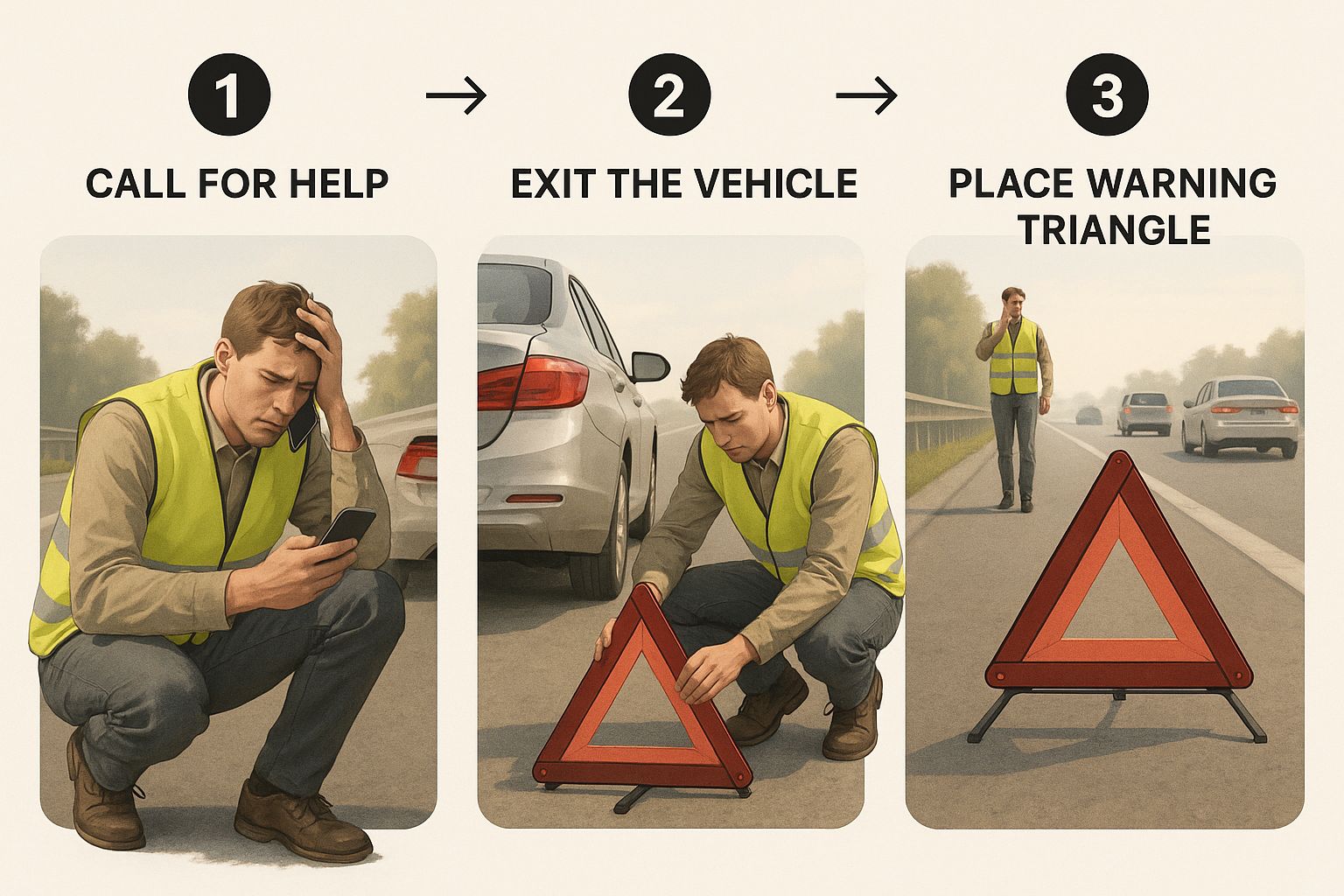
- Make Yourself Visible: Hit those hazard lights. It’s the universal signal for trouble and the quickest way to warn other drivers.
- Move if Possible: If the crash was minor and your vehicle can still drive, carefully guide it over to the right-hand shoulder. Getting completely out of the traffic lanes is one of the single most important steps you can take.
- Stay in Your Vehicle (Usually): On a busy highway like the 417, getting out of your car is incredibly risky. It’s often much safer to stay put with your seatbelt on until emergency responders arrive and secure the scene.
This image shows a driver taking these exact first steps—creating visibility and moving to safety.
These simple actions dramatically cut down the risk to you, your passengers, and every other driver on the road.
Calling for Help and Interacting with Others
When you call 911, the operator needs clear, quick information. Do your best to stay calm and give them the key details.
- Your Exact Location: Tell them the highway number, the nearest exit or overpass, and which way you were heading. If you see a kilometre marker, use it.
- The Nature of the Incident: Keep it simple. "It's a two-car collision," for example.
- Details on Injuries: Let them know if anyone is hurt and, if you can tell, how badly.
- Hazards Present: Mention any immediate dangers, like cars blocking traffic, smoke, or if you think dangerous goods are involved.
After the call, if it's safe to talk to the other driver, approach them calmly. This isn't the time to argue or determine fault. Your only goal is to exchange essential information: names, addresses, phone numbers, driver's licence numbers, and insurance details.
Here's a crucial piece of advice: never admit fault at the scene. Even a simple "I'm so sorry" can have serious legal and insurance consequences down the road. Just stick to the facts of what happened.
The danger on busy highways is very real. To put it in perspective, statistics show there are thousands of fatal and injury-related motor vehicle accidents on major highways annually. These numbers are a sobering reminder of the risks we face every time we merge onto the highway. You can get more context on this by reviewing California car accident statistics, which provide a detailed look at trends in a high-traffic state.
By following these steps, you can bring a sense of order to a chaotic situation. Securing the scene, calling for help with the right details, and calmly interacting with others shifts you from being a victim of the moment to an active manager of the crisis, keeping everyone safer in the critical minutes after an accident on the highway.
How to Document an Accident Scene
Once you've made sure everyone is safe, it’s time to shift gears and become a careful record-keeper. What you gather in the minutes and hours after an accident on the highway is absolutely vital for insurance claims and any legal issues that might pop up later. Think of yourself as an on-the-scene investigator—your job is to capture the facts, clearly and accurately.
In this situation, your smartphone is your best friend. A thorough set of photos can tell the story far better than words ever could. The goal is to document everything, from the smallest scratch to the big picture of the crash site.
Creating a Visual Record with Your Phone
Start by taking wide shots of the entire scene from a few different angles to show the final resting positions of all vehicles. Once you have the overview, move in closer to capture the details that really matter.
- Vehicle Damage: Take close-up photos of the damage on all cars involved, not just yours. Get pictures from every possible perspective—front, side, and back of the damaged areas.
- The Wider Scene: Photograph any skid marks on the road, debris from the impact, and the general condition of the pavement. Are there potholes? Is the road wet or icy? These details can be critical.
- Points of View: If it's safe, try to take photos from each driver's perspective. This can help illustrate what each person likely saw just before the collision.
- Landmarks and Signs: Snap pictures of nearby traffic signs (like speed limits or stop signs), kilometre markers, and any exit signs or landmarks that pin down the exact location.
A single photo of a stop sign hidden by an overgrown tree branch or a clear picture of hazardous road conditions can become a game-changing piece of evidence. Your job is to document the scene exactly as it was at the moment of the accident.
Exchanging Information and Knowing What to Say
When you speak with the other driver, the key is to stay calm and stick to the facts. This is simply an information swap, not a debate. In fact, you're legally required to exchange specific details.
Be sure to collect the following:
- Full Name and Address
- Phone Number
- Driver’s Licence Number
- Licence Plate Number
- Insurance Company and Policy Number
Politely but firmly avoid any discussion about who was at fault. Things said in the heat of the moment can easily be twisted or misinterpreted later on. You should never admit fault or apologize, as doing so can seriously jeopardize your insurance claim.
Interacting with Police and Obtaining the Report
If police arrive on the scene, cooperate fully. Give them clear, factual answers to their questions. The officer will create an official police report, which serves as an impartial account of what happened. Before you leave, make sure you get the officer's name, badge number, and the police report number.
Here in Ottawa, you can usually request a copy of the Motor Vehicle Accident Report directly from the Ottawa Police Service. This document is a cornerstone of your insurance claim, providing an authoritative summary of the incident. When you combine this official record with your own detailed documentation, you build a solid, complete account of the accident on the highway.
Navigating Insurance and Finding Local Ottawa Support
The immediate danger of an accident on the highway might be over, but the road ahead is just beginning. The aftermath kicks off a series of steps that can feel just as overwhelming as the crash itself. This is your guide to handling the post-accident process in Ottawa, from wrangling insurance claims to finding the support you need to get back on your feet.
Your first major hurdle is dealing with the insurance company. In Ontario, you must report any collision to your insurer promptly, regardless of who was at fault. This initial call initiates the claims process, leading to an adjuster being assigned to your case to investigate the incident and determine your coverage.
Starting Your Insurance Claim
When you make that call, have your policy number and all the notes and photos you gathered at the scene ready to go. You’ll need to give a clear, factual account of the accident. Your adjuster will then walk you through your policy’s coverage for things like medical care, vehicle repairs, and potential income replacement benefits.
Ontario’s no-fault insurance system means you deal directly with your own provider for benefits, which helps expedite the process. However, the system can be complex. It is beneficial to understand the truth behind some common myths about Ottawa driving and insurance to avoid any surprises.
When to Visit a Collision Reporting Centre
For many collisions in Ottawa where no one is seriously injured, police may not attend the scene. Instead, you are required to report the incident in person at an Ottawa Police Service Collision Reporting Centre.
You generally need to go to a CRC if:
- The combined damage to all vehicles appears to be more than $2,000.
- There are no serious injuries that required an ambulance.
- The crash did not involve a pedestrian, a cyclist, or any criminal activity like a hit-and-run.
Be sure to report to a CRC within 24 hours of the collision. Delays can result in fines and complicate your insurance claim. Remember to bring your vehicle (if drivable), driver's licence, ownership, and insurance slip.
Finding Legal and Emotional Support
While many insurance claims proceed smoothly, some situations warrant legal advice. If you've been seriously injured, if there is a dispute over fault, or if you feel your insurance company is not treating you fairly, consulting a personal injury lawyer who specializes in motor vehicle accidents is a prudent step.
Equally important is attending to your mental well-being. The emotional shock of a serious accident on the highway is significant and should not be overlooked. It is normal to experience post-traumatic stress, anxiety, or a new fear of driving. Recognizing the need for help is a sign of strength. Ottawa has numerous resources available, from counselors to trauma-focused support groups.
Think of it this way: road safety experts analyze crash data to pinpoint high-risk areas and make roads safer for everyone. You need to do the same for yourself—take stock of the impact the crash had on you and get the professional support you need to heal and move forward.
Common Questions About Highway Accidents
Even with comprehensive information, the aftermath of a highway accident can leave you with many questions. It's a stressful, confusing time, and uncertainty can be unsettling. Here, we address some of the most common concerns drivers have after a collision in the Ottawa area.
What If I Can’t Remember All the Details?
It is normal for your memory of a traumatic event to be incomplete or hazy. Adrenaline can affect how your brain processes and stores information during a stressful event.
The most important thing is to stick to the facts you are certain of when speaking with police and your insurance provider. Do not guess or invent details to fill gaps in your memory. Rely on the physical evidence you gathered—such as photos from the scene and the official police report—to provide an accurate account of what happened.
Should I Accept an On-the-Spot Cash Offer?
No. While it may seem like a quick and easy solution to avoid dealing with insurance, accepting a cash offer at the scene is a significant risk. Immediately after a crash, it is impossible to know the full extent of vehicle damage or to determine if you have sustained injuries that may not become apparent for hours or even days.
Accepting a cash settlement is almost always considered a final agreement. It means you forfeit your right to file an insurance claim later. Once you accept the money, you release the other driver from further liability, and you could be left responsible for thousands of dollars in unexpected repair or medical expenses.
Always proceed through official insurance channels to ensure you are fully protected.
How Does a Highway Accident Affect My Insurance Rates?
This is a primary concern for many drivers. In Ontario, an at-fault accident will almost certainly lead to an increase in your insurance premiums. The amount of the increase depends on several factors, including the severity of the claim, your past driving record, and whether your policy includes accident forgiveness coverage.
If you are found not-at-fault, your rates generally should not increase, as your insurer can recover the costs from the at-fault driver's insurance company. While navigating the claims process, it can be helpful to manage stress. Perhaps check out some local events happening in Ottawa this summer. Ultimately, a thorough understanding of your insurance policy is your best defense against financial surprises.
At ncrnow, we're dedicated to keeping you informed about the news and events that matter most in the National Capital Region. Stay connected with the latest Ottawa updates by visiting us at https://ncrnow.ca.
About The Author