

Why Roundabouts Are Reshaping Our Roads
Roundabouts are becoming more common across Ottawa, from suburban streets to major intersections like the one connecting the Sir John A. Macdonald Parkway with Island Park Drive. They are designed to keep traffic moving smoothly and, more importantly, safely. For many drivers, however, they can still be a source of confusion.
This guide is here to clear things up. We will give you practical advice to navigate any roundabout with confidence, covering everything from the moment you approach to choosing your lane, yielding, and signalling your way out.
There is a good reason for this shift in road design. Roundabouts change how vehicles interact at an intersection, and the benefits are backed by solid evidence:
- Improved Safety: They virtually eliminate the risk of dangerous, high-speed right-angle crashes, which are among the most severe types of collisions.
- Better Traffic Flow: By keeping vehicles moving slowly but steadily, roundabouts reduce the congestion and long waits common at red lights.
- Environmental Perks: Less time spent idling is good for your fuel economy and leads to lower vehicle emissions, making our community’s air a little cleaner.
The safety numbers speak for themselves. Studies have found that replacing a traditional four-way intersection with a roundabout can reduce severe crashes by 78%, with a 48% drop in overall collisions. These are not small changes. They are why transportation experts favour roundabouts as a proven way to make our roads safer. You can read more about roundabout accident statistics and their effectiveness.
By getting comfortable with these intersections, you are not just making your own drive smoother. You are contributing to a safer road for everyone in Ottawa.
How to Approach and Enter a Roundabout
Successfully navigating a roundabout starts before you reach the circle. The key is to prepare early.
As you get closer, slow down and look for the yellow warning sign. This is your first cue. It is usually followed by other signs showing the roundabout’s layout and which lanes go where. This is your moment to make a plan.
Knowing which lane you need before you enter is half the battle. To get a jump on things, especially during rush hour, it is always a good idea to check the latest Ottawa traffic map for any slowdowns near major roundabouts.
Choosing the Correct Lane
For the multi-lane roundabouts common across Ottawa, lane choice is quite intuitive. Think of it like a regular intersection.
- Going right or straight through (first or second exit)? Stick to the right-hand lane on your approach.
- Heading straight, left, or making a U-turn (second, third, or fourth exit)? You will need to be in the left-hand lane.
Getting this right from the start makes everything smoother. Committing to your lane early prevents last-second swerves that cause trouble for everyone inside the circle.
To make it even clearer, here is a quick guide on how to choose your lane for any multi-lane roundabout you will encounter.
Choosing Your Lane at a Multi-Lane Roundabout
| Your Intended Action | Which Lane to Use |
|---|---|
| Turning Right (First Exit) | Right Lane |
| Going Straight (Second Exit) | Right Lane OR Left Lane |
| Turning Left (Third Exit) | Left Lane |
| Making a U-Turn (Fourth Exit) | Left Lane |
Following this simple logic will put you in the right spot every time, reducing stress and making your path predictable for other drivers.
The Golden Rule: Yielding
Now for the most important part: yield to all traffic already inside the roundabout. This includes cars, trucks, and cyclists, who might be moving at a different pace.
As you approach the yield line, look to your left. You must wait for a safe gap in the circulating traffic before you can merge. This is not a four-way stop. If the way is clear, you do not need to come to a full stop. You can slow down, check that it is safe, and blend smoothly into the flow. This seamless movement is what makes roundabouts so effective at reducing congestion.
This design does not just improve traffic flow; it is a massive win for road safety.
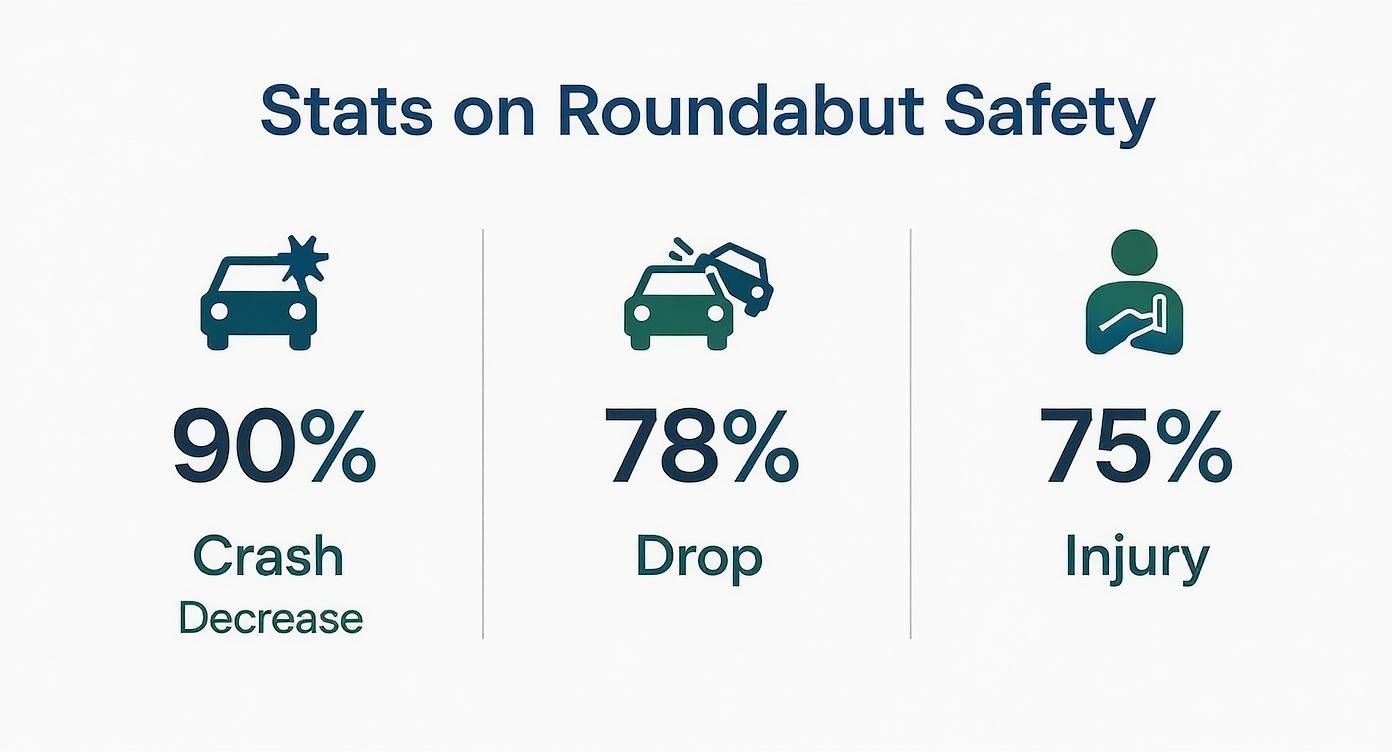
These statistics are quite compelling. They show a 90% drop in fatal crashes and a 75% reduction in injury crashes. It is no wonder cities like Ottawa are building more of them. They are proven to dramatically reduce the kind of serious accidents we see at traditional intersections.
Navigating And Exiting Like A Pro
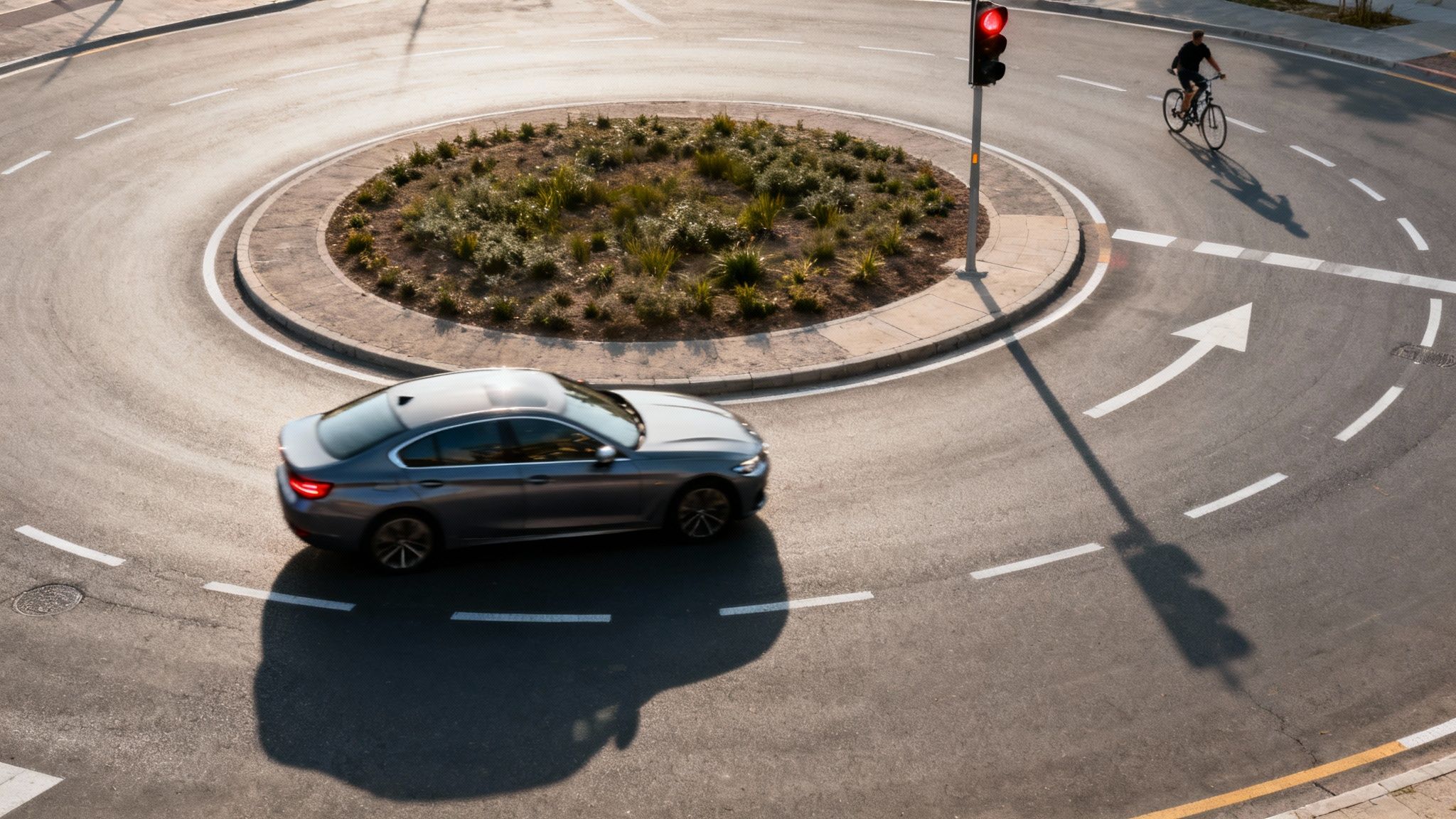
Entering a roundabout at a steady speed keeps everyone’s rhythm in sync. If you must stop, do so, but avoid stopping in the circle unless absolutely necessary.
- Stick with your chosen lane to avoid unexpected merges.
- Signal well before your exit so drivers behind you are not left guessing.
- Glance at your mirrors and blind spots before moving over.
As your exit approaches, activate your right-turn signal. A quick mirror check followed by a shoulder glance helps you spot any cyclists or pedestrians in your blind spot.
Always yield to pedestrians in marked crosswalks as you exit, even when you have priority over entering vehicles.
Mastering Mirror and Signal Checks
Mirrors and signals can feel automatic, but a reliable routine reduces surprises. Last winter on Hunt Club Road, a split-second mirror glance alerted me to a cyclist passing on my right, avoiding a potential collision.
I call my sequence the “mirror-signal-check.” It goes like this:
- Activate your signal.
- Give each mirror a quick look.
- Do a shoulder check for anything in the blind spot.
Once this rhythm becomes a habit, exiting any circle, even a busy multi-lane roundabout downtown, becomes almost second nature. Try it first on quieter streets to build confidence before tackling busier junctions.
Staying Alert For Live Traffic Updates
Conditions at busy spots like the Queensway roundabout can change in minutes. Checking ahead of time helps you pick the smoothest approach. For real-time visuals, check out our Live Traffic Camera feature.
- Monitor conditions before you leave home.
- Reroute to avoid known backups.
- Factor in rain, snow, or ice, as grip changes quickly.
When snow hides lane markers, knowing what you will encounter makes all the difference. Whatever the season, holding your line inside the circle prevents misunderstandings and collisions.
Winter Exit Tips
Cold weather turns exits into low-traction zones. Ice and packed snow demand a gentler touch.
- Slow down sooner than you think you need to.
- Brake lightly and signal with extra lead time.
- Maintain a wider gap around your vehicle to account for slide risk.
One frosty morning near Bank Street, I spotted black ice just before my exit. By easing off the throttle early, I cleared the circle without sliding.
Mastering these simple exit strategies will have you gliding through Ottawa’s roundabouts, snow or shine, like a seasoned local.
Sharing the Road with Others
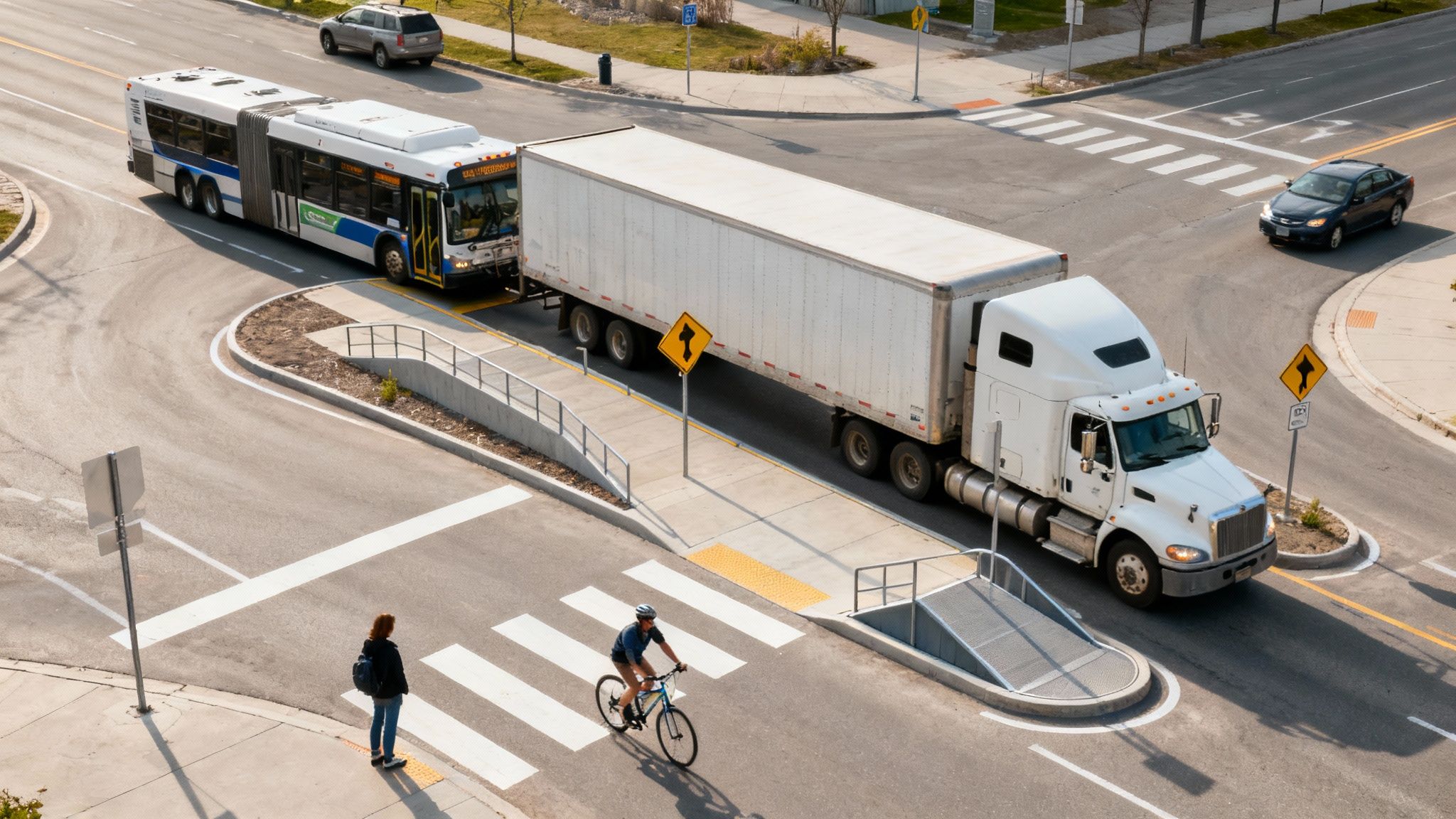
Roundabouts are not just for cars. They are shared spaces, and true mastery comes from knowing how to interact with everyone else, including pedestrians, cyclists, and large trucks.
Your awareness and a bit of courtesy are just as critical as knowing which lane to pick or when to use your signal.
Interacting with Pedestrians and Cyclists
Let us be clear: pedestrians always have the right-of-way at marked crosswalks. Whether you are entering or exiting the roundabout, you must be ready to stop for people crossing. Their safety is the top priority.
Cyclists are a bit different, and you need to anticipate their moves. They have a choice to make, and you will see them do one of two things:
- Ride like a vehicle: Many confident cyclists will enter the roundabout and take the full lane, just like a car. When they do, give them space. Do not try to squeeze past them; treat them as you would any other vehicle.
- Walk like a pedestrian: Some cyclists, especially at busier roundabouts, will dismount and walk their bike across the crosswalks. In this scenario, they are pedestrians, and you must yield to them.
Either way, the rule is simple: give cyclists plenty of room.
Navigating Around Large Vehicles
Sharing a roundabout with an OC Transpo bus or a transport truck can be intimidating, but it does not have to be complicated. These vehicles have a large turning radius and significant blind spots.
Never drive alongside a large truck inside a roundabout. It is incredibly dangerous. Their rear wheels follow a much tighter path than their front ones, a phenomenon called “off-tracking,” meaning the trailer can easily swing into your lane. The safest place is always well behind them.
To help these large vehicles get through, many modern Ottawa roundabouts have a feature called a truck apron. It is that slightly raised, often reddish-brown concrete ring around the central island. It is not a curb. It is designed specifically for the rear wheels of a large vehicle to roll over.
This gives the driver the extra space needed to make the turn without hitting a curb or swerving into your lane. If you see a truck’s tires riding up on that apron, that is your cue to stay back. Give them the room they need to manoeuvre, and you will stay safely out of their path.
Handling Tricky Situations and Winter Conditions
Knowing your way around a roundabout on a clear day is one thing. But what happens when you hear sirens, or when a classic Ottawa snowstorm hits? These scenarios demand a different level of awareness and a slight shift in your game plan.
If you see flashing lights or hear a siren approaching, your first instinct might be to stop.
Crucial Tip: Never stop inside a roundabout for an emergency vehicle.
Stopping in the circle not only blocks the ambulance or fire truck but can also cause dangerous gridlock. The proper move is to continue through, exit at your intended street, and then pull over to the right to let them pass safely.
Navigating Icy Winter Circles
Driving in an Ottawa winter is its own skill, and roundabouts are no exception. Snow, slush, and ice can completely hide the lane markings, turning a familiar intersection into a slippery puzzle.
Your single most important adjustment is to reduce your speed significantly long before you even reach the entry point.
On slick roads, sudden movements are your worst enemy. Every action, from braking to accelerating to turning the wheel, needs to be smooth and deliberate to avoid a skid. The curve of a roundabout makes it a constant challenge to maintain traction when conditions are poor.
Here are a few key adjustments for tackling a roundabout in the snow:
- Leave extra space. Double the following distance you think you need. That buffer is your best friend if the car ahead slides or has to brake suddenly.
- Look for lane markings early. Try to spot the painted lines on the approach before they disappear under the snow. If they are completely covered, rely on the overhead and roadside signs to get into the correct lane.
- Be extra cautious at exits. This is where slush and ice tend to build up as cars slow down, creating some of the most treacherous spots. Ease off the gas well before your turn.
When the weather gets particularly bad, parking bans often come into effect. For a full rundown, check out our guide on Ottawa winter parking bans.
Why We Should Embrace Complex Designs
Even the most intimidating, multi-lane roundabouts are designed with one goal in mind: making our roads safer and more efficient.
When California built its first “turbo roundabout” for a busy four-lane highway, many drivers were skeptical. But the data after the first year was undeniable. The new design led to a sharp drop in crashes and reduced traffic delays by 60%. The average wait time dropped from over 30 seconds to just 12.
It is a powerful reminder that with a bit of practice, even advanced designs can make our daily commutes faster and, more importantly, safer for everyone. By adapting our driving for tricky situations, we help these intersections do their job, no matter what the weather brings. Learn more about the successful roundabout project.
Common Roundabout Mistakes and How to Avoid Them
Even seasoned drivers can pick up bad habits at a roundabout. Knowing the most common slip-ups is the first step to being a safer, more predictable driver for everyone else on the road.
The biggest mistake is failing to yield properly. You must always yield to traffic already circulating inside the roundabout. Look left, wait for a safe gap, and then enter. Rushing this is how most collisions happen.
Signalling and Lane Discipline
Another frequent issue involves the turn signal. Using it incorrectly creates confusion for other drivers.
- Signalling too early: Activating your signal long before your exit can mislead drivers waiting to enter. They may think you are getting off sooner than you are and might pull out in front of you.
- Forgetting to signal at all: This leaves everyone guessing. The driver behind you has no idea you are about to slow down and exit, and the person waiting for a gap misses their chance to enter.
- Changing lanes mid-circle: This is unpredictable and dangerous. You need to choose your lane before you enter the roundabout and stick with it until you exit.
The right way is simple: turn on your right-turn signal just as you are approaching your intended exit. This sends a clear, timely message about what you are doing next.
One of the most frustrating things you can do is stop inside the circle when you do not have to. Unless the car ahead has stopped, keep moving at a slow, steady pace. Hitting the brakes suddenly can jam up the entire flow of the intersection.
Modern roundabouts are designed to force us to slow down, which is a big part of why they are so much safer. The data is compelling. Converting a standard two-way stop to a roundabout can reduce severe crashes by 82% and reduce overall collisions by 44%. If you are curious about the research, you can dig into the numbers in this California Department of Transportation report.
Avoiding these common mistakes is not just about following the rules. It is about making the road less stressful and much safer for you and your fellow Ottawa drivers.
Got Questions About Ottawa’s Roundabouts?
Even experienced drivers can be hesitant in certain roundabout situations. That is perfectly normal. Knowing the right move keeps everyone safe and traffic flowing as intended. Let us clear up a few of the most common questions we hear from drivers in the capital.
What if I Accidentally Miss My Exit?
First, do not panic. The most dangerous thing you can do is make a last-second swerve or an aggressive lane change to correct your mistake. It is a recipe for a collision.
The solution is simple. Just stay in your lane and go around the circle one more time. Taking an extra 15 seconds to loop around is always the right call over cutting someone off and causing an accident. It keeps the roundabout predictable for everyone.
Do I Need to Signal When I am Entering the Roundabout?
No, you do not need to signal as you are entering. Your lane choice and position as you approach the circle already tell other drivers your general intention.
The only signal you need to worry about is your right-turn signal. You should turn it on just as you pass the exit before the one you plan to take. This is a crucial cue for drivers waiting to enter, and for the cars behind you, that you are about to leave the circle. It is a small courtesy that makes a massive difference in traffic flow.
Who Has the Right of Way?
This is the golden rule: traffic already inside the roundabout always has the right of way. If you are approaching the yield line, you must wait for a safe gap in the traffic coming from your left before you can merge.
This rule holds true even if two cars approach different entrances at the same time. The driver who is already circulating gets to go first. You wait your turn at the yield line until it is clear.
For more practical guides and local news that matters to you, trust NCR Now. Stay informed and connected with your community by visiting us at https://ncrnow.ca.
About The Author