
Meta Description: Your complete guide on how to apply for an Ontario health card. Learn about OHIP eligibility, the documents you need, and the in-person application process.
So, you're ready to get your Ontario Health Card? It is one of the first and most important things to sort out when you move here. This card is your proof of coverage under the Ontario Health Insurance Plan (OHIP), giving you access to publicly funded healthcare in the province.
The good news is the old three-month waiting period is gone. Once your application is approved, your coverage begins. Let's walk through exactly how to get it done.
Your Guide to Getting an Ontario Health Card
Navigating the application process can feel a bit intimidating, especially when you see the list of required documents. But the system is designed to ensure only eligible residents get coverage, a key principle of our national healthcare framework. If you want to learn more about how it all works, check out our guide to the Canada Health Act and Medicare.
Why an In-Person Visit Is Essential
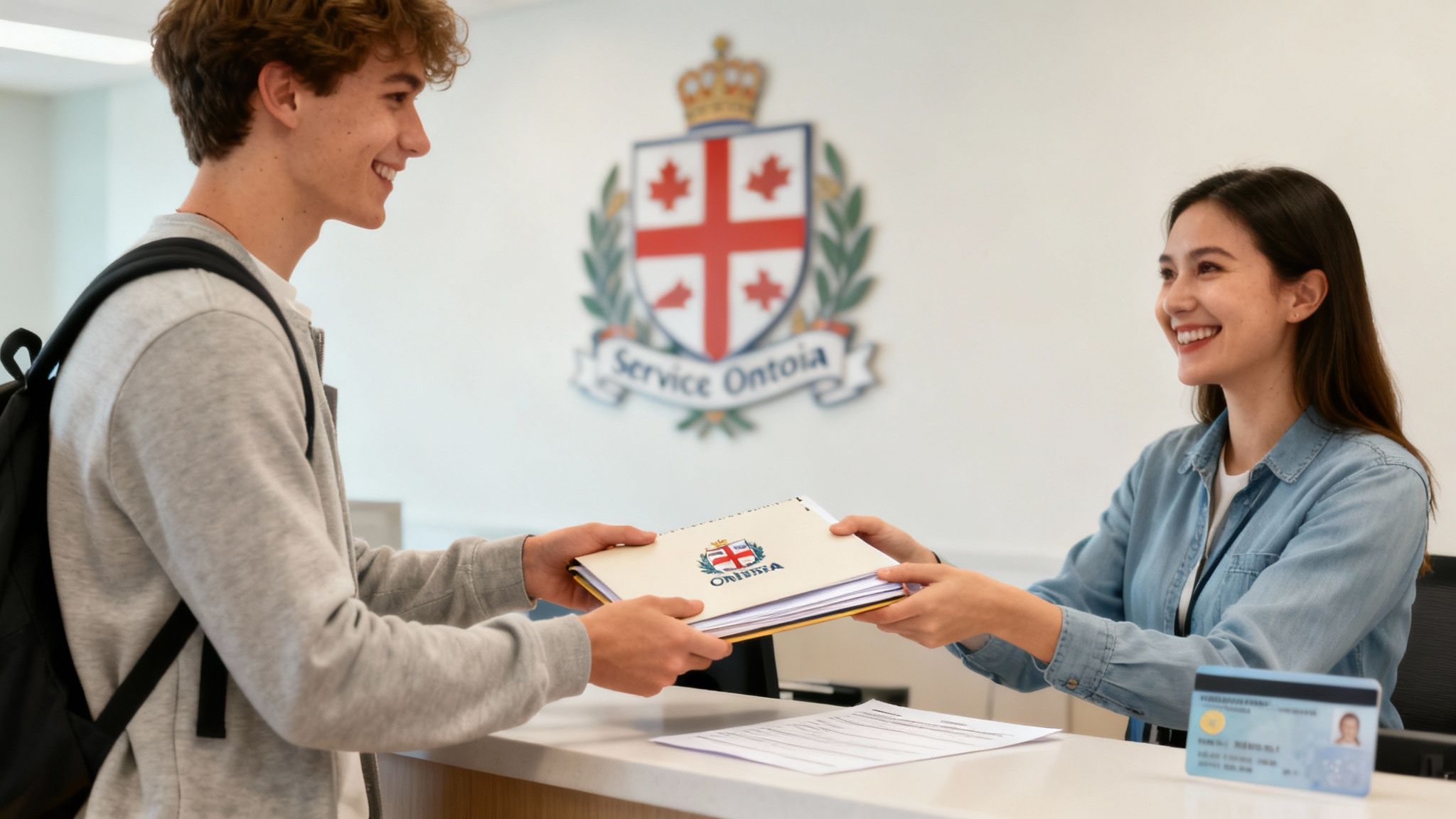
Unlike renewing your driver's licence, your first OHIP application must be done in person at a ServiceOntario centre. This is a crucial security measure.
A ServiceOntario agent needs to physically see your original documents to verify their authenticity and prevent fraudulent applications. This is also when they will take your photo and get your digital signature, making sure the card is securely tied to you.
What to Bring With You
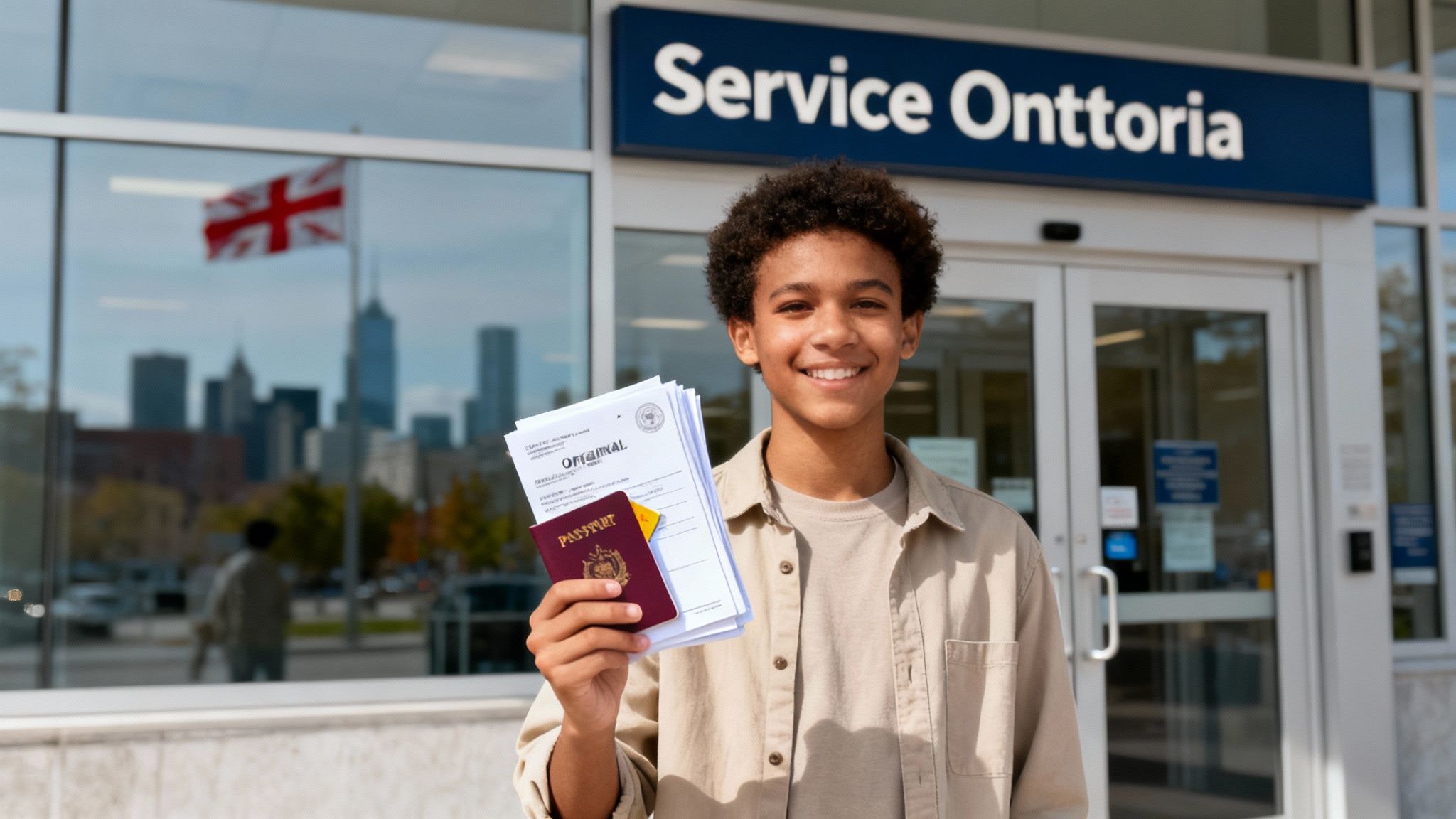
Success at ServiceOntario comes down to preparation. You need to bring three separate, original documents. Photocopies will not be accepted, and you will have to come back another day.
You will need one document from each of these three categories:
- Proof of citizenship or OHIP-eligible immigration status: This could be a Canadian passport, birth certificate, or a Permanent Resident Card.
- Proof of residency in Ontario: This needs to show your full name and current Ontario address. A recent utility bill, a lease agreement, or a bank statement works well.
- Proof of identity: You need a document that has both your name and your signature. A driver's licence or a credit card will do.
For a definitive rundown, you can find the complete list of accepted paperwork on the official provincial government page. Take a few minutes to gather these three items before you go. It is the best thing you can do to make your visit quick and successful.
To make things even clearer, here is a quick summary of what you will need.
OHIP Application Essentials
| Requirement | Details |
|---|---|
| Application Method | Must be in person at a ServiceOntario centre. |
| Required Documents | Three original documents are mandatory (no photocopies). |
| Document 1: Status | Proof of citizenship or OHIP-eligible immigration status (e.g., Canadian passport, PR card). |
| Document 2: Residency | Proof of living in Ontario with your name and address (e.g., utility bill, lease agreement). |
| Document 3: Identity | Proof of your identity with your name and signature (e.g., driver's licence, credit card). |
Getting these documents in order before you head out is the key to a smooth process and getting one step closer to securing your healthcare coverage in your new home.
Are You Eligible for an OHIP Card?
Before you start hunting for your passport and digging up utility bills, you need to make sure you qualify for OHIP. The eligibility rules are specific, and getting this part right can save you a lot of time and a wasted trip to a ServiceOntario centre.
OHIP is for people who truly call Ontario home. The rules, laid out in Ontario’s Health Insurance Act, are there to ensure the system serves its intended purpose. Right now, that system provides essential medical services for about 14.5 million Ontarians. You can dive deeper into the specifics by checking the official Ontario health card requirements.
Who Gets Coverage
The program is designed to cover a wide range of people, as long as they meet all the necessary criteria. Figuring out which category you fit into is the real first step.
Generally, you need to fall into one of these main groups:
- Canadian citizens
- Permanent residents (formerly known as landed immigrants)
- Indigenous peoples registered under the federal Indian Act
- Convention refugees or other protected persons
- People who have applied for permanent residence and have a letter from Immigration, Refugees and Citizenship Canada (IRCC) confirming their eligibility to apply
- Certain temporary foreign workers with a valid work permit for a full-time job in Ontario lasting at least six months
This list is not exhaustive. There are some specific exceptions for other groups, like members of the clergy. If your situation is unusual, it is always a good idea to double-check the official criteria.
The "Must Be Physically Present" Rule
This is the rule that often catches people off guard. Beyond your immigration status, OHIP has a strict residency requirement. It is not enough to have an Ontario address on paper; you must be physically present in Ontario for at least 153 days in any 12-month period.
This rule exists to make sure OHIP covers people who genuinely live here, not just those who maintain a mailing address while living elsewhere.
Let's say you're a Canadian citizen who just moved to Ottawa from Alberta. To get OHIP, you have to truly intend to make Ontario your main home. If your plan is to spend eight months of the year working remotely from a beach, you probably will not meet this fundamental requirement.
The physical presence test is especially critical when you first apply. You are required to be physically in Ontario for at least 153 of the first 183 days after you move here. This shows the government you are serious about setting down roots.
When you apply for OHIP, you are officially declaring Ontario as your primary home. The province, in turn, needs to verify that you are actually spending your time here. So, if you are a snowbird or a frequent business traveller, you will need to track your days outside the province carefully to keep your health coverage.
Gathering Your Three Essential Documents
Alright, you have confirmed you are eligible for OHIP. Now comes the paperwork. Getting this right is the most critical step in the process because ServiceOntario is very strict about having the correct, original documents.
Think of it like this: you need to present three distinct pieces of evidence. Each one answers a core question the province needs to know before covering your healthcare:
- Are you legally entitled to OHIP coverage?
- Do you actually live in Ontario?
- Are you who you say you are?
Let's break down exactly what you will need for each one.
1. Proof of Your Citizenship or OHIP-Eligible Status
First, you need to prove your legal status in Canada. This document shows you belong to one of the groups entitled to provincial health coverage. It is the foundation of your application.
This is a straightforward requirement, and several common documents work. Just remember, they need the original.
This graphic gives a simple visual breakdown of the main eligibility criteria you have to meet.
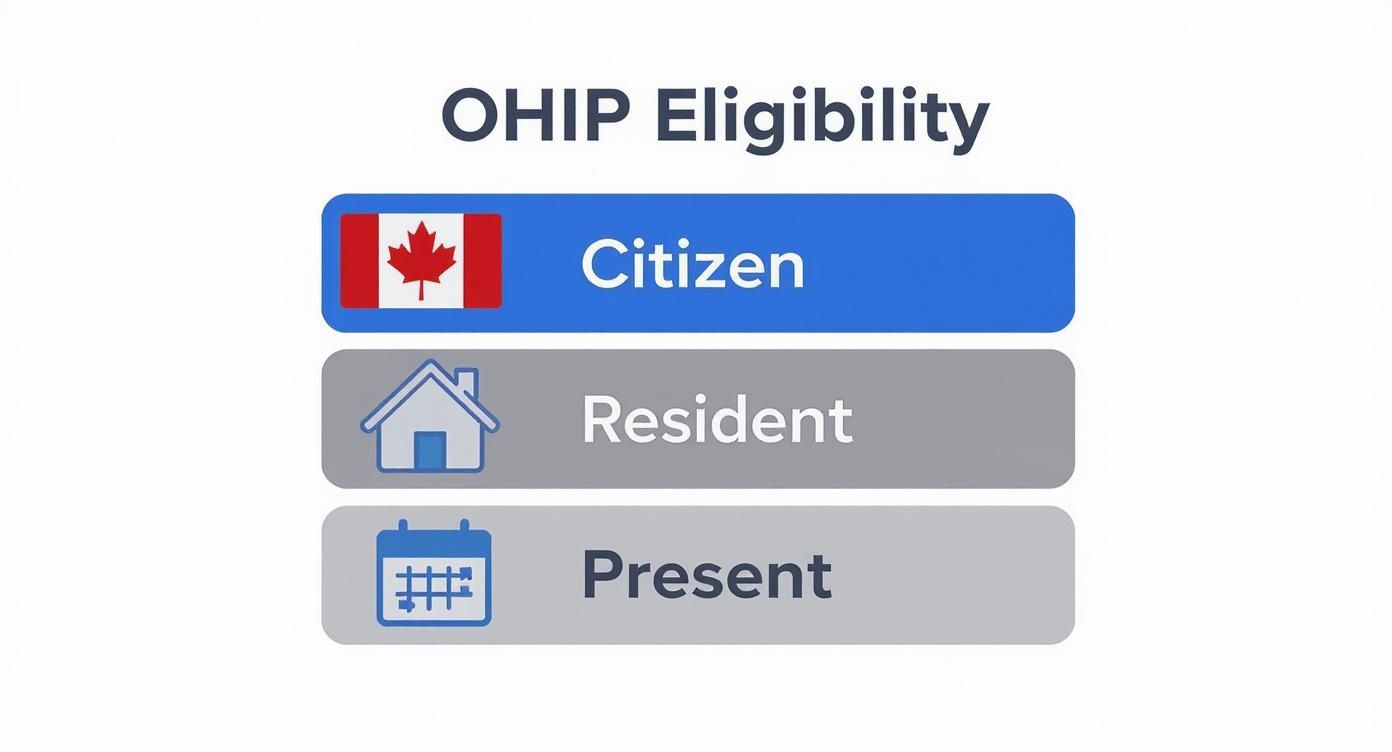
As you can see, your status in Canada combined with your physical presence in the province is what makes you eligible for OHIP.
2. Proof You Live in Ontario
Next, you have to prove that your main home is here in Ontario. This requires a document that clearly shows both your full name and your current residential address. The key here is that it has to be recent, usually dated within the last six months.
They need to see a clear, official link between you and an Ontario address. If you are new to the city and find address formats confusing, taking a moment to understand what a civic number is can be helpful.
3. Proof of Your Identity
Finally, you need a document to confirm you are who you say you are. This piece of ID must have both your full name and your signature. It is the last check to ensure the health card is issued to the right person.
This is often the easiest document to find. You might even use a document that also serves another purpose, like your driver's licence.
To make things crystal clear, here’s a table summarizing the types of documents you will need.
Accepted Documents for Your OHIP Application
This table lays out the most commonly accepted original documents for each of the three categories. Always bring more than you think you need, just in case.
| Document Category | Accepted Examples |
|---|---|
| Proof of Citizenship / Eligible Status | • Canadian Passport (valid or expired within 5 years) • Canadian Birth Certificate • Permanent Resident (PR) Card • Certificate of Canadian Citizenship • Work Permit (specific types) • Confirmation of Permanent Residence (IMM 5292) |
| Proof of Ontario Residency | • Ontario Driver’s Licence or Photo Card • Signed residential lease agreement • Recent utility bill (hydro, gas, water) • Monthly bank or credit card statement • Recent property tax bill |
| Proof of Identity | • Ontario Driver’s Licence or Photo Card • Credit card • Valid Passport (Canadian or foreign) • Union card or employee ID card |
This is not an exhaustive list, but it covers the most common documents people use successfully.
A Critical Reminder: Originals Only!
I cannot stress this enough: every single document you bring must be the original. ServiceOntario agents will not accept photocopies, scanned images on your phone, or printouts. This is a firm rule to prevent fraud, and showing up with copies is the number one reason people get turned away.
Take the time to gather these three specific, original documents before you think about booking an appointment. Having everything in order is the single best thing you can do to make your visit smooth and successful.
Navigating Your In-Person ServiceOntario Visit
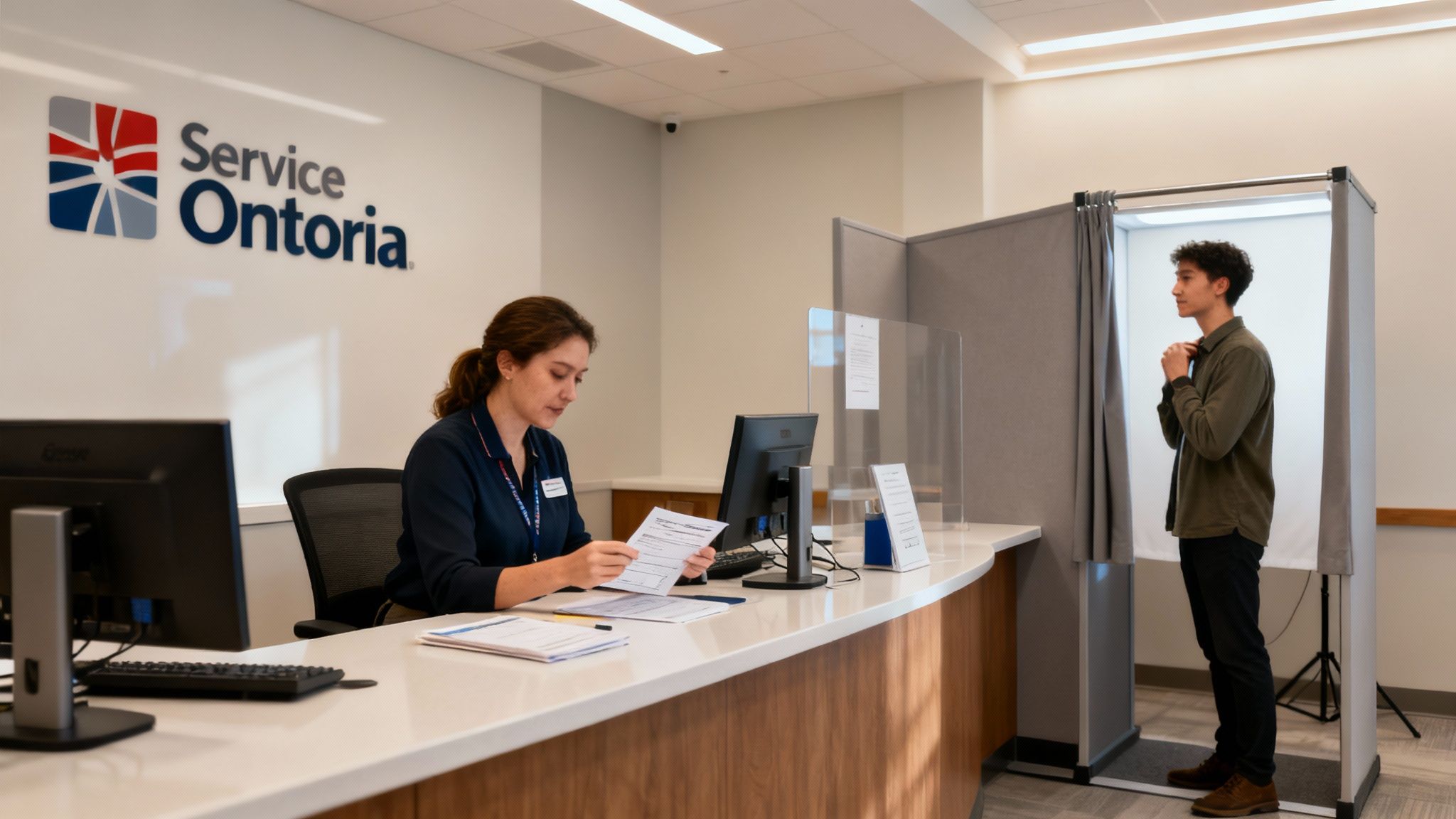
Alright, you have your three original documents ready. Now for the final step in your initial OHIP application: a mandatory trip to a ServiceOntario centre. This is not just a formality; it is a critical part of the process that protects the integrity of our healthcare system.
The main reason for the visit is security. An agent needs to physically inspect your original documents to confirm they are authentic. This is also when they will take your photo and capture your digital signature for your new health card.
Making Your Visit as Smooth as Possible
Walking into a government service centre can feel a little intimidating, but a bit of preparation can make all the difference. The goal is to get in, get it done, and get out with minimal fuss.
First, find the best ServiceOntario location for you. The provincial government's website has a handy service finder tool that shows locations, hours, and available services. Some smaller centres do not handle health card applications, so always double-check before you head out.
Next, see if you can book an appointment online. While not available everywhere, getting a time slot in advance is the best way to skip long queues. If you have to walk in, try going during off-peak hours, like mid-morning on a Tuesday or Wednesday, to avoid the rush.
The Photo and Signature Requirement
For most people, the in-person visit is non-negotiable, and it comes down to the photo ID. Every new health card issued in Ontario is a photo card, a measure that helps prevent fraud.
Anyone aged 16 and over has to register in person to provide their signature and have their photo taken. There are some exemptions for specific medical reasons, but they are rare. This system is a massive undertaking; in a recent year, over 1.1 million photo health cards were issued. You can find more details on the registration process on the official resources page for physicians.
What Happens at the Counter
Once your number is called, the agent will walk you through everything. They will carefully look over each of your three documents, making sure they are original and meet the requirements for status, residency, and identity.
The agent will ask a few simple questions to confirm the info on your application form. After that, they’ll snap your photo and have you sign a digital pad.
Once everything is approved, you will not leave empty-handed. The agent will give you a transaction record.
This piece of paper is your temporary proof of OHIP coverage. It has your new health number on it and acts as official evidence that you're insured. You can use it to access healthcare services right away, so keep it somewhere safe until your card shows up.
After Your Visit: The Waiting Game
Your official Ontario Health Card will be mailed to your home address. You can typically expect it to arrive within two to three weeks.
This timeline is usually solid, but external factors can cause delays. For instance, disruptions to postal services can impact delivery times. It is a good idea to be aware of any issues that might affect your mail.
See also: understanding the potential for a Canada Post strike.
When your new card arrives, sign the back immediately. It is your key to accessing Ontario’s healthcare system and a huge milestone in getting settled.
OHIP for Special Situations
While the main application process works for most, life is not always one-size-fits-all. People’s paths to getting or maintaining an OHIP card can look different.
From welcoming a newborn to dealing with a lost card, these unique circumstances have their own specific steps. Knowing the right moves can save you time and keep your health coverage active.
Registering a Newborn Baby
One of the happiest reasons to apply for an OHIP card is for a new baby. The province has made this simple, and you can usually get it sorted out before you leave the hospital.
If your baby is born in an Ontario hospital or with a registered midwife, you’ll be handed an Ontario Health Coverage Infant Registration form.
All you have to do is fill out the form with your baby’s details. The hospital staff or your midwife will handle submitting it. Your baby's new health card will show up in the mail, usually within a few weeks.
International Students and Temporary Workers
For anyone in Ontario temporarily, figuring out OHIP eligibility can feel confusing. It boils down to your official status and how long you plan to stay.
International Students
To qualify for OHIP as an international student, you generally need to be enrolled full-time in a degree or diploma program at an Ontario university or college that lasts for at least two years. You will have to show your study permit and proof of enrolment from your school.
Temporary Foreign Workers
If you're here to work, eligibility is tied to your work permit. The key requirement is having a valid work permit for a full-time job in Ontario scheduled to last for at least six consecutive months.
A crucial point for both groups: your OHIP card’s expiry date will almost always be linked to the expiry date on your immigration papers. That means every time you renew your study or work permit, you have to renew your OHIP coverage too.
Renewing or Replacing Your Health Card
Life happens. Cards get lost, stolen, damaged, or expire. Knowing what to do means you will not have a gap in your health coverage.
Replacing a Lost, Stolen, or Damaged Card
If your health card goes missing, your first move should be to report it. Call ServiceOntario immediately at 1-866-532-3161. This is a critical step to prevent identity theft.
To get a new one, you’ll need to head to a ServiceOntario centre in person. Bring your original documents proving your identity and that you live in Ontario. A small fee might apply for the replacement.
Your health card is a vital piece of ID. Reporting it missing is not just about getting a new card; it is about protecting your identity and the integrity of our public healthcare system.
Renewing an Expiring Card
You will get a renewal notice in the mail about 90 days before your card expires. This letter will tell you exactly what you need to do.
- Online Renewal: If your notice says you're eligible, this is the quickest way.
- By Mail: Some people will get a paper form they can fill out and mail back.
- In Person: If you need a new photo taken, you will need to visit a ServiceOntario centre.
Updating Your Personal Information
As your life changes, your OHIP details need to keep up. Whether you have moved or changed your name, updating your information with ServiceOntario is mandatory.
If you have a new address, you can update it online in minutes. For a name change, you have to go to a ServiceOntario centre in person. You’ll need to bring your current health card and the original legal document that proves the change, like a marriage certificate.
Your Ontario Health Card Questions Answered
Even with a step-by-step guide, it’s normal to have a few questions about applying for an Ontario health card. The process has its quirks, and clear answers can provide peace of mind.
Here, we tackle the most common questions from people applying for OHIP for the first time.
Is There Still a Waiting Period for OHIP Coverage?
This is a big one, and the answer is good news. No, the three-month waiting period for OHIP has been eliminated.
For a long time, most new residents had to wait three months before their provincial health coverage would begin. That policy was officially scrapped, which means your OHIP coverage starts the day your application is approved.
When you successfully register, the agent will give you a transaction record. This is your temporary proof of coverage, allowing you to access insured health services right away.
What if My Immigration Documents Are Expiring Soon?
You should still proceed with your application. ServiceOntario staff are familiar with handling applications from people with temporary status.
If your immigration documents are close to expiring, your OHIP card will simply be issued with a matching expiry date. This syncs your health coverage with your legal status.
Once you have renewed documents from Immigration, Refugees and Citizenship Canada (IRCC), you will just need to visit a ServiceOntario centre again to get your OHIP coverage extended.
Can I Apply for My First Ontario Health Card Online?
Unfortunately, no. All first-time applications for an Ontario health card must be done in person at a ServiceOntario centre.
It is a security measure. An agent needs to physically see and verify your original documents to prevent fraud. It is also the only way they can take your photo and get your signature for the card.
While the first application must be face-to-face, other services like changing your address or renewing your card can often be handled online.
What Should I Do if My Health Card Is Lost or Stolen?
Losing your health card is stressful, but there is a clear process to follow. The first step is to report it missing to protect your personal information.
You need to immediately contact ServiceOntario to report a lost or stolen card by calling their dedicated line at 1-866-532-3161. This action helps prevent fraudulent use of your health coverage.
Reporting a lost card is not just a bureaucratic step. It’s a crucial way to protect your identity and the integrity of our public healthcare system.
After you have reported it, you’ll have to go to a ServiceOntario centre to get a replacement. Be ready to bring your original documents again to prove your identity and residency. In some situations, a small replacement fee might be charged.
For more local news and practical guides to help you navigate life in Ottawa, visit NCR Now at https://ncrnow.ca.
About The Author