


If you're a government employee, you've probably heard about the public service pension plan. It's not just another line item on your pay stub; it’s a defined benefit plan designed to give you a predictable, lifelong income once you retire.
This security doesn't just appear out of thin air. It’s built through steady contributions from both you and your employer throughout your entire career.
Unpacking the Public Service Pension Plan
Think of your public service pension plan less like a typical savings account and more like a financial partnership you build over your working years. Your retirement income isn't left to the whims of the stock market. Instead, it’s a structured promise, carefully designed to provide a steady and stable income stream when you hang up your hat.
With every paycheque, both you and your employer chip in, building a secure foundation for your future, piece by piece. This dual-contribution model is what gives the plan its incredible strength and reliability.
The whole point is to give public servants long-term financial security, cutting through the usual complexities of retirement planning. For a deeper look at financial planning in Canada, you can explore the cost of living in Canada with our detailed guide.
The Foundation of Your Retirement Security
At its core, the plan works on a straightforward deal: your years of dedicated service are rewarded with a dependable income in retirement. This approach acts as a powerful buffer against the economic ups and downs that can make other retirement plans feel so uncertain.
So, what makes it tick? Here are the key ingredients:
- Defined Benefit: The pension you get isn't based on investment returns. It’s calculated using a set formula that factors in your salary and your years of service. Simple and predictable.
- Joint Contributions: You and your employer are in this together. Both parties pay into the fund, sharing the responsibility of funding your future pension.
- Professional Management: A team of investment professionals manages the pension fund. Their job is to grow the assets over the long haul to make sure the money is there to cover all future payments.
This shared approach means the financial weight of retirement doesn't fall entirely on your shoulders. It’s a joint commitment between you and your employer to secure your financial well-being after your career ends.
This model provides a solid layer of stability, letting you plan for your post-career life with a lot more confidence and a lot less guesswork.
How Your Pension Fund Is Managed and Grown
Your public service pension plan isn't just a savings account where your money sits quietly. Think of it more like a powerful financial engine, one built to run for decades and support thousands of retirees. This engine has three main fuel sources: your contributions, your employer's matching funds, and—this is the big one—the long-term growth from smart investments. All three work together to make sure the fund is big enough to pay out every promised dollar to you and all the other members for life.

This doesn't happen by accident. Massive pension funds like this are actively managed by teams of financial pros whose entire job is to grow the fund’s assets responsibly. Their strategy isn't about chasing risky, high-flying stocks; it's about building a steady, resilient, and diversified portfolio designed to stand the test of time.
The Strategy of Asset Allocation
To hit that sweet spot of stable growth, fund managers rely on a core strategy called asset allocation. It’s the financial version of the old saying, "don't put all your eggs in one basket." Instead of betting everything on one type of investment, they spread the capital across a wide range of different asset classes.
This diversification is the fund's secret weapon against market volatility. If one sector is having a bad year, strong performance somewhere else can help balance things out. It’s a tried-and-true method for minimizing risk while still capturing the steady, long-term returns needed to keep the pension promises.
A typical pension portfolio will include a mix of:
- Public Equities: These are shares in publicly traded companies, offering the best potential for significant growth.
- Fixed Income: Think government and corporate bonds. They’re the steady workhorses of the portfolio, providing predictable income.
- Real Assets: Tangible investments you can touch, like real estate and infrastructure projects (think toll roads or airports), which generate steady cash flow.
- Private Equity: These are investments in private companies, which often deliver higher returns over the long haul.
By blending these different investment types, the public service pension plan creates a robust portfolio built to weather economic storms and grow consistently over decades. It's all about ensuring your retirement security is on solid ground.
Seeing Investment Strategy in Action
This isn’t just theory—it’s a strategy that delivers real results. Just look at the California Public Employees' Retirement System (CalPERS), the largest public pension fund in the United States. In the fiscal year ending June 30, 2023, CalPERS reported a net investment return of 5.8%. While returns fluctuate annually, the fund maintains a long-term focus on stability and growth.
To enhance diversification and returns, CalPERS has a strategic asset allocation that includes significant holdings in private assets. You can dig into the details of the CalPERS investment performance to see exactly how these powerful strategies play out over time.
Getting Started: Your Eligibility and Contributions
So, how do you get into this plan? It's a key milestone in any public service career, but it’s not usually something that happens on your very first day. Typically, your eligibility is tied to your specific job—whether you’re full-time or part-time—and you’ll need to work for a certain period before you can officially join. This waiting period helps ensure the plan is built for dedicated, long-term employees.
Once you’re in, things get pretty simple. The whole system runs on an automatic, shared-responsibility model. With every paycheque, a set percentage of your pensionable earnings (that’s your regular salary) gets automatically funnelled into your pension. Think of it as a mandatory savings plan for your future self, and the best part is your employer contributes right alongside you.
This "set it and forget it" approach means you're consistently building your retirement nest egg without having to lift a finger. These contributions are the very foundation of the pension you'll receive down the road.
How Your Contributions Are Calculated
Your contribution rate isn't just one flat number. It’s actually tiered, which is a smarter way to do it. For most plans, you’ll contribute a lower percentage on your salary up to a specific limit, known as the Year's Maximum Pensionable Earnings (YMPE). Then, you'll contribute a higher percentage on any income you earn above that limit.
This two-tiered approach is designed to work hand-in-glove with the Canada Pension Plan (CPP), creating a more balanced approach to your overall retirement savings.
To make this clearer, here’s a simplified look at how contribution rates can vary by salary.
Example Contribution Rates by Salary Tier
This table shows how pension contribution rates can change based on your annual salary, with different percentages applied up to and beyond the Year's Maximum Pensionable Earnings (YMPE). The YMPE for 2024 is $68,500.
| Annual Salary Range | Contribution Rate |
|---|---|
| Earnings up to the YMPE (e.g., $68,500) | Lower Rate (e.g., 9.39%) |
| Earnings above the YMPE | Higher Rate (e.g., 12.25%) |
So, if you earned $80,000, you’d pay the lower rate on the first $68,500 and the higher rate only on the remaining $11,500. Your total deduction is just the sum of those two calculations, taken right off your paycheque.
Reaching the Vesting Milestone
Now, let's talk about one of the most important concepts you'll hear about: vesting. This is the point where your pension benefit becomes yours. It's legally locked in. Before you're vested, if you leave your job, you're generally just entitled to get your own contributions back (often with a bit of interest).
Vesting is like crossing a finish line. After a set period of service—often just two years—you secure a legal right to a future pension payment, even if you decide to leave the public service long before you actually retire.
Hitting this milestone is a huge deal. It gives you a massive layer of financial security, confirming that your years of hard work have officially earned you a tangible retirement asset. It’s a critical marker on your path to a comfortable future.
How Your Future Pension Benefits Are Calculated
So, how do all those years of hard work actually turn into a pension cheque? It’s the million-dollar question, and thankfully, the public service pension plan has a clear, predictable answer. There’s no guesswork here, no nail-biting over stock market swings. It all comes down to a straightforward formula based on two things you have a say in: your salary and how long you work.
The magic formula is surprisingly simple. It takes your years of pensionable service, multiplies it by a set percentage (usually 2%), and then multiplies that by the average of your highest-earning years. That’s it. This calculation gives you a solid number—the annual pension you'll receive for the rest of your life.
This infographic helps visualize the key milestones you’ll hit on your pension journey, showing how your benefits lock in over time.
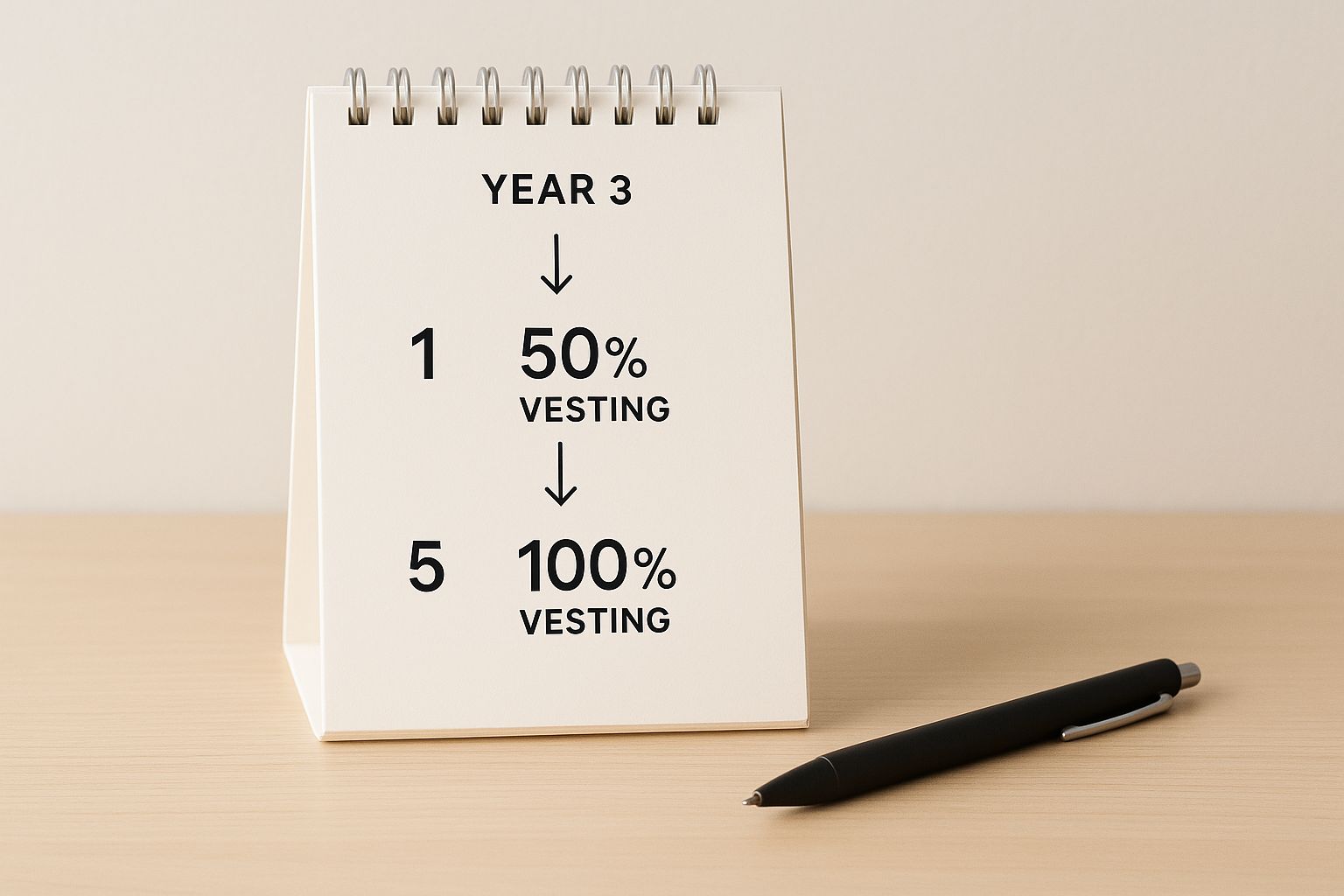
As you can see, vesting is a huge step. It’s the point where your pension rights become yours for good, and it usually only takes a few years of service to get there.
Breaking Down the Pension Formula
Let’s zoom in on the two key ingredients that cook up your final pension payment. Getting a handle on these will show you exactly how your career path shapes your financial future.
- Years of Pensionable Service: This is pretty much what it sounds like—the total time you’ve been paying into the plan. It covers your full-time work and also includes pro-rated part-time service. The more years you log, the bigger your pension grows. Simple as that.
- Average Salary: Here’s where things get interesting. The plan doesn't just look at your last paycheque. Instead, it typically calculates the average of your best five consecutive years of earnings. This is a great feature because it protects your pension from a potential dip in salary right before you retire.
By basing the calculation on your five best years, the plan ensures your pension reflects your peak earning potential. It’s a much fairer way to value your entire career contribution.
Seeing the Formula in Action
Let’s make this real with a quick example. Meet Alex, a public servant who’s ready to retire.
Alex has put in 30 years of pensionable service. Her average salary for her five best years works out to $80,000. Using the standard 2% accrual rate, the math looks like this:
2% (Accrual Rate) x 30 (Years of Service) x $80,000 (Average Salary) = $48,000 per year.
This means Alex will receive a lifetime pension of $48,000 annually, which breaks down to $4,000 every month. That’s the kind of predictable, stable income that lets you build a solid retirement plan.
Protecting Your Pension's Value Over Time
A good pension isn’t just about the number you start with; it’s about making sure that money still has the same buying power twenty or thirty years down the road. The public service pension plan has two powerful features to protect you.
First up are survivor benefits. If you pass away, a portion of your pension (often 50%) will continue to be paid to your eligible spouse or dependents. It's a crucial safety net that provides financial stability for your family when they need it most.
The second feature is indexing. To fight off inflation, your pension payments are regularly adjusted to reflect the cost of living, based on the Consumer Price Index (CPI). This ensures your income keeps pace with rising prices, so your standard of living doesn't take a hit. This automatic adjustment is a game-changer and a huge advantage of the plan.
The Real-World Pressures on Public Pension Systems
While the public service pension plan is built for the long haul, it isn't completely shielded from the real world. To really appreciate just how resilient it is, you have to understand the challenges it’s constantly navigating. These systems operate over decades, weathering economic storms and demographic shifts that demand sharp, strategic management.
One of the biggest topics you'll hear about is unfunded liabilities. Don't let the jargon intimidate you. Think of it as the gap between the total value of pension benefits promised to everyone (current and future retirees) and the actual money the pension fund has on hand right now. It’s not a sign that the sky is falling, but a long-term financial yardstick that plan managers watch like a hawk.
Closing this gap is a top priority for pension administrators, who use sophisticated financial strategies to make sure the fund stays healthy for generations to come.
Key Pressures on Pension Funds
Two major forces are at play here: people are changing, and the economy is unpredictable. Neither is something pension managers can control, but they have to be baked into every single decision to keep the plan on solid ground.
First off, people are living longer. That’s great news for all of us, but it means pension plans have to pay out benefits for more years than originally planned. This drives up the total lifetime cost for each person's pension, meaning the fund needs more cash in the bank to cover it.
Second, market volatility can throw a wrench in the works. Pension funds are all about the long game, relying on decades of compound growth to meet their promises. But when the market hits a rough patch or the economy slows down, that growth can stall. This can create a temporary shortfall that has to be managed with careful tweaks to the investment strategy.
At its core, the job of a pension manager is to balance these long-term risks. They have to make sure the fund's investment returns are strong enough to outrun the financial pressures of longer lifespans and unpredictable economic cycles.
Take California's major public pension systems, for example. They've been grappling with significant unfunded liabilities for years. A key driver is the state's aging population—the share of adults aged 65 and older jumped from 11% in 1990 to 15% in 2020 and is projected to reach 19% by 2030. You can dig deeper into public pension liabilities in California to see just how much demographics can sway a fund's health.
Why This Matters for You
Understanding these headwinds gives you important context when you hear news about pension reforms or changes to contribution rates. These adjustments aren't random; they're proactive moves made to keep the plan sustainable for the long term.
Think of it as responsible management, not a sign of trouble. Just as a city invests in a new rec centre to support a growing neighbourhood, pension managers make strategic adjustments to support their members. You can even read more about the importance of local community centre planning in a related article we wrote. By tackling these issues head-on, the system reinforces its promise to provide you with a secure and reliable income when you retire.
The Economic Ripple Effect of Pension Plans
It’s easy to think of a public service pension plan as just a retirement fund for government workers. But that’s only half the story. In reality, these plans are powerful economic engines that fuel entire communities.
When a retired public servant gets their pension payment, that money doesn’t just sit in a bank account. It gets spent. It flows right back into the local economy, paying for groceries, car repairs, and dinners out. This creates a steady, predictable stream of income that supports Main Street businesses and the people they employ.
Fueling Local Prosperity
Think of it this way: a pension plan isn't just an expense on a government balance sheet. It’s a strategic investment in regional prosperity. The financial health of the pension system is directly tied to the economic pulse of the communities it serves—and everyone benefits, not just the plan members.
This isn’t just a theory; the numbers back it up. A study found that in 2021, $75.6 billion in pension benefits paid to California retirees supported a total of $144.5 billion in economic output throughout the state. This activity sustained over 685,000 jobs and contributed significantly to state and local tax revenues. You can dig deeper into this data by checking out the Pensionomics 2025 findings.
What this shows is that pension benefits are recycled through the economy, generating a huge return on the initial investment. Every dollar paid out to a retiree helps create jobs, support local businesses, and generate tax revenue that funds public services for all.
At the end of the day, a healthy public pension plan is a key pillar of a thriving local economy. It creates a virtuous cycle where retirees support local businesses, those businesses employ community members, and the entire region prospers as a result.
Common Questions About Your Pension Plan
As you move through your career, it's natural for questions about your public service pension to pop up. Life happens, jobs change, and things aren't always straightforward. Here are some quick, clear answers to the questions we hear most often.
What happens if I take a leave of absence? Good news. A leave of absence without pay, like for maternity or parental leave, can often still count as pensionable service. The key is that you’ll typically need to make contributions for that period to make sure it gets fully credited toward your pension down the road.
Managing Career Transitions
Moving to a new job within the public service is usually pretty seamless. Your pension contributions and service years just keep rolling along under the same plan. No fuss, no interruption.
But what if you decide to leave the public service entirely before you're ready to hang up your hat?
- Vested Members: If you've put in enough time to be vested (usually two years), you’ve got options. You can leave your contributions in the plan and collect a deferred pension later on. Or, you might be able to transfer the value to another registered retirement plan.
- Non-Vested Members: If you leave before hitting that vesting milestone, you get a refund of every dollar you contributed, often with interest.
One of the plan's most powerful features is the option to buy back service. This lets you purchase credit for past periods of eligible work where you didn't contribute, like a previous contract gig. It's a fantastic way to boost your total pensionable service and significantly increase your retirement income.
These flexible features are designed to make sure your pension can adapt as your career path twists and turns. To keep on top of financial planning opportunities and other local happenings, you can find helpful information about events in Ottawa on our website. It’s a great resource for staying informed on topics that really matter to public servants in the region.
At ncrnow, we keep you connected to the news and events shaping the National Capital Region. Visit us at https://ncrnow.ca for the latest updates.
About The Author