
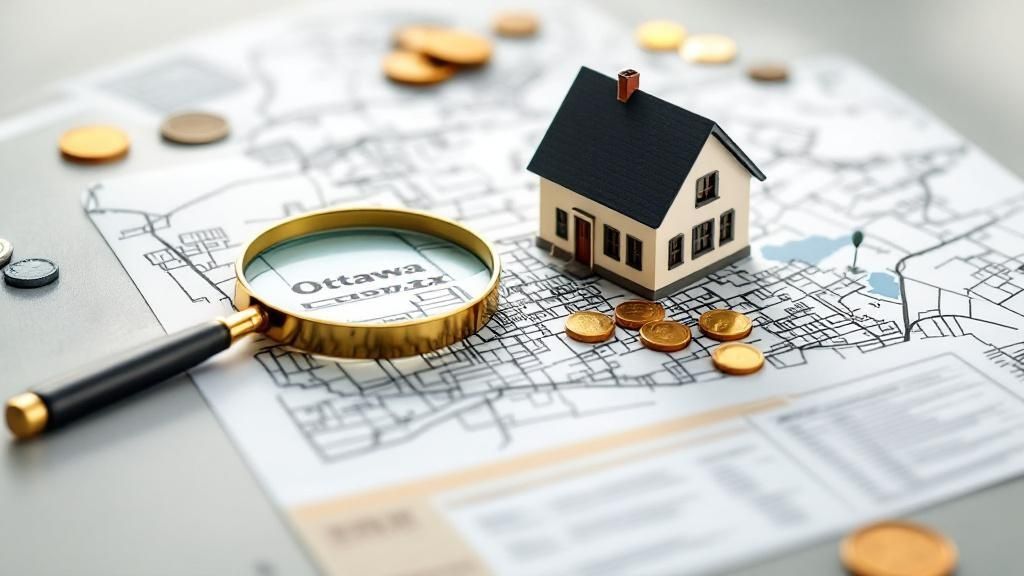
When you own a home in Ottawa, your property tax bill is one of those constants you can count on. But it's more than just another expense—it's your direct contribution to the services that keep our community running.
Your bill is calculated using two main ingredients: your property's assessed value, which is determined by the Municipal Property Assessment Corporation (MPAC), and the current tax rate, set each year by the City of Ottawa. Getting a handle on these two pieces is the first step to truly understanding where your money goes.
Your Ottawa Property Tax Explained in Minutes
Think of your property tax as a direct investment in the neighbourhood you call home. It’s not some arbitrary number pulled from thin air; it’s the primary way we fund the services that make Ottawa a great place to live. Every dollar is channelled back into the city to maintain and improve the programs and infrastructure we all rely on.
These funds are the lifeblood for a massive range of public services. We're talking about everything from ensuring police and fire departments are ready to respond at a moment's notice to keeping the roads clear in winter and the parks green in summer. The property tax system is designed to share the cost of these essential services among all property owners.
Key Components of Your Tax Bill
So, what actually determines the final number on your bill? It all boils down to two key factors working together.
- Assessed Property Value: This is the estimated market value of your home, and it’s calculated by MPAC. They look at things like your property’s location, size, and age, as well as what similar homes in your area have sold for recently.
- Tax Rate: The City of Ottawa sets this rate every year to meet its budget needs. It's a percentage that gets applied to your home's assessed value. A separate education tax rate, set by the province, is also factored in.
At its core, the formula is pretty simple: Assessed Value x (Municipal Tax Rate + Education Tax Rate) = Your Total Property Tax. While the math is straightforward, the impact is huge, playing a big part in your household budget and the overall cost of living in Ottawa. If you're curious about the bigger picture, you can learn more in our detailed guide on the cost of living in Ottawa.
To help you see it all in one place, here's a quick breakdown of what goes into your property tax bill.
Ottawa Property Tax At a Glance
| Component | What It Means for You |
|---|---|
| Assessed Value | The estimated market value of your property, set by MPAC. A higher value generally means a higher tax bill. |
| Municipal Tax Rate | Set by the City of Ottawa to fund local services like roads, parks, and emergency services. |
| Education Tax Rate | A provincial rate that supports the local school system. It’s collected by the city on behalf of the province. |
Ultimately, these components combine to determine how much you contribute to keeping Ottawa running smoothly.
Your property tax is more than just a payment; it’s a direct investment in Ottawa's public safety, infrastructure, and community well-being. By funding everything from road repairs to local libraries, your contribution helps sustain the city's quality of life.
Why You Pay Property Tax in Ottawa
Ever wondered where your property tax dollars actually go? It’s easy to look at that bill as just another household expense, but it’s really an investment in the community you call home. Every payment you make is a direct contribution to the essential city services that shape our daily lives here in Ottawa.
Think of it as a collective fund for the city. This pool of money, gathered from all property owners, is what allows the City of Ottawa to budget for and deliver the programs and infrastructure we often take for granted. From the moment you pull out of your driveway to the time you flip on your lights at night, you're benefiting from services funded by your Ottawa property tax.
This system creates a shared responsibility among all of us. It makes sure the costs of keeping Ottawa vibrant, safe, and running smoothly are distributed fairly, sustaining the quality of life we all get to enjoy.
Fuelling Ottawa's Essential Services
So, what exactly does your contribution support? The list is long and touches nearly every part of living in the city. Your property tax dollars are carefully spread across different departments to keep Ottawa running safely and efficiently.
A huge chunk of the budget goes toward public safety. This means funding for the Ottawa Police Service, Ottawa Fire Services, and our Paramedic Services, making sure emergency responders are well-equipped and ready to go when we need them most.
These funds are also crucial for maintaining the city's massive infrastructure network. We’re talking about everything from road repairs and snow removal during our infamous winters to the operation and expansion of the OC Transpo public transit system.
Building a Thriving Community
Beyond the basics of infrastructure and safety, your property taxes also help build a better, more connected community for everyone. These funds support the services that enrich our lives and bring people together.
Here are a few key community-focused initiatives funded by property taxes:
- Parks and Recreation: Keeping Ottawa's beautiful parks, community centres, swimming pools, and sports fields in top shape so residents have spaces to relax, play, and stay active.
- Libraries and Culture: Operating the Ottawa Public Library branches, which give us all access to books, digital resources, and community programs for every age.
- Waste Management: Funding vital services like garbage collection, recycling programs, and composting initiatives that keep our city clean and green.
Basically, every dollar helps make Ottawa a more liveable, enjoyable, and sustainable city. It’s the financial engine that powers the services you and your neighbours rely on every single day.
Your property tax is more than a bill—it's your stake in the city's future. It funds the police who keep your streets safe, the crews who clear the roads, and the parks where your family creates memories.
Of course, the city's budget needs change from year to year, which can affect the tax rate. Over the last decade, Ottawa's property tax rates have seen a steady increase. For instance, back in 2014, the combined residential property tax rate was about 1.1269%. By 2024, it had climbed to approximately 1.1956%—a rise of roughly 6.1% over ten years. You can dig into more details on these historical tax trends over at wowa.ca.
Deconstructing Your Property Tax Bill

When that Ottawa property tax notice lands in your mailbox, it's easy to just look at the bottom line and see it as one big charge. But that single number is actually a blend of two distinct levies, each with a very different job to do for our city and province. Peeling back the layers is the key to seeing exactly where your money goes.
Think of your bill as having two main ingredients. First, there's the municipal tax, set by the City of Ottawa to keep all those local services we talked about running smoothly. The second is the education tax, a rate set by the Province of Ontario to fund our local schools.
The City of Ottawa simply acts as the collection agency for both, rolling them into one straightforward bill to make life easier for homeowners.
The Municipal Levy: Your City's Share
The municipal portion is the real workhorse of your property tax bill. This is what gives the City of Ottawa the financial muscle it needs to operate. It directly funds the annual budget approved by City Council, covering everything from firefighters and snowplows to libraries and the parks in your neighbourhood.
This rate isn't set in stone; it can change from year to year based on the city's needs. If City Council decides to build a new LRT line or expand community programs, the municipal tax rate might be adjusted to cover those costs. It’s the most direct link between your tax dollars and the services you see every day.
The Education Levy: Supporting Our Schools
The other piece of the puzzle is the education tax. While the city collects it, this part is entirely controlled by the provincial government. It’s the Province of Ontario that sets the education tax rate for every type of property across Ontario.
That money is then funnelled directly to Ottawa's English and French-language school boards, including:
- Ottawa-Carleton District School Board
- Ottawa Catholic School Board
- Conseil des écoles publiques de l'Est de l'Ontario
- Conseil des écoles catholiques du Centre-Est
This system makes sure that every property owner, whether they have kids in school or not, contributes to the foundation of our local education system. While you can't influence this rate at the city level, it’s a crucial investment in the community's future. For a deeper dive, check out our guide on understanding your property tax bill.
Your total property tax isn't just one payment; it's a partnership. The municipal portion builds your city, while the education portion invests in its future generations, all managed through a single, streamlined bill.
Ottawa's Tax Rate in a National Context
So, where does Ottawa stand when you look at other major Canadian cities? Ottawa has consistently had one of the highest residential property tax rates among Canada's six largest cities.
When you measure the tax burden against property value and income, Ottawa’s average residential property tax rate hovers around 1.20%. While this rate is competitive, the combination of high property values and the tax rate itself results in a significant expense for homeowners.
How Your Ottawa Property Tax Is Calculated
Ever looked at your annual property tax bill and wondered how they landed on that specific number? While it might seem complicated, the math behind it is surprisingly straightforward. It really just comes down to combining your property's value with the current tax rates.
Once you get the hang of the calculation, you can look at your statement with confidence, knowing exactly where that final figure comes from. At its core, it’s all about one simple equation.
Your Annual Property Tax = (Your Property's Assessed Value x Municipal Tax Rate) + (Your Property's Assessed Value x Education Tax Rate)
Basically, your final Ottawa property tax bill is a mix of two separate calculations: one for city services and another for our local schools. They're just bundled together on one bill to make things easier.
The Two Key Ingredients
To figure out your tax, you really only need two numbers: your property's current value assessment and the combined tax rates for the year. Each one plays a different but equally important role.
1. Your Property's Assessed Value
This is the estimated market value of your property, determined by the Municipal Property Assessment Corporation (MPAC). It isn't necessarily what your home would sell for today, but rather its value on a specific, standardized date. MPAC looks at things like your location, lot size, how much living space you have, and what similar properties in your neighbourhood have sold for recently.
2. The Combined Tax Rate
This is the total percentage that gets applied to your assessed value. It’s made up of two parts: the municipal tax rate, which City Council sets every year to fund its budget, and the education tax rate, which the Province of Ontario sets to support local school boards.
Think of it this way: your assessed value determines the size of your slice of the pie, while the tax rate determines how big the entire pie needs to be for the city to collect.
This infographic gives a great high-level overview of the annual property tax cycle, from when you get your bill to when your payments are due.

It really highlights the key deadlines and payment options, which is a good reminder to stay on top of your tax obligations to avoid any late fees.
Putting It All Together: A Real-World Example
Let's walk through a quick calculation using a typical Ottawa home. This will show you exactly how these numbers work together to create your final tax bill.
Imagine you own a home in Ottawa, and MPAC has assessed its value at $500,000.
Next, we need the tax rates. For this example, we’ll use the combined 2024 residential tax rate of about 1.1985%, which you’d write as 0.011985 in a calculation. This rate is a combination of the municipal and education levies.
Here’s how the math breaks down:
- Property Tax = Assessed Value x Combined Tax Rate
- Property Tax = $500,000 x 0.011985
- Total Annual Property Tax = $5,992.50
So, for a home valued at half a million dollars, the annual property tax would come in just under $6,000. This amount would then be split into two installments for the interim and final tax bills.
The 2024 Ottawa budget included a 2.5% property tax increase. For an urban homeowner, this translated to an average increase of about $105 per year. For an average homeowner with a property assessed at $500,000, the yearly tax payment is about $5,993, showing the direct financial impact on households. You can dive deeper into these trends by checking out more insights about Canadian property tax changes on zoocasa.com.
Staying on Top of Your Payments and Deadlines
Figuring out how your Ottawa property tax is calculated is the first step, but keeping up with payments and deadlines is where the rubber really meets the road. If you miss a due date, penalty charges can start piling up faster than you’d think. This section will walk you through Ottawa’s payment system so you can handle your tax bills smoothly and sidestep any costly mistakes.
The best way to think about your property tax bill isn’t as one giant annual payment, but as a series of smaller, more manageable instalments. The City of Ottawa splits your total tax into two main bills each year—an interim bill and a final bill—each with its own deadlines. This approach is designed to spread out the financial hit.
This system makes budgeting for property taxes much more predictable. When you know the key dates ahead of time, you can plan your finances and have the funds ready to go, which saves a lot of last-minute scrambling.
Navigating Key Payment Deadlines
The City of Ottawa sends out tax bills in two waves, and it’s a good idea to get these dates into your calendar right away. While the exact days can shift a little from year to year, the general timing is pretty consistent.
- The Interim Tax Bill: This one usually shows up in your mailbox in February. It’s based on 50% of your property taxes from the previous year and gives the city the funds it needs to operate while this year's budget is being finalized.
- The Final Tax Bill: Sent out in late May, this bill is the real deal. It reflects the new, updated tax rates approved by City Council for the current year. It takes your total annual tax, subtracts what you already paid on the interim bill, and leaves you with the final balance.
Each of these bills is then split into two payments. That means you’ve got four key payment deadlines to keep an eye on, typically in March and June, with the others following later in the year.
Choosing How You Want to Pay
The City of Ottawa makes it easy to pay your bill by offering a few different options, so you can pick whatever works best for you. One of the most popular and stress-free methods is signing up for a Pre-Authorized Debit (PAD) plan.
With a PAD plan, your payments are automatically pulled from your bank account. You can even choose a schedule that fits your budget, like a 10-month plan that spreads payments from January to October, or one that just covers the standard due dates. It’s a classic "set it and forget it" approach that's perfect for making sure you never miss a payment.
The smartest way to handle property tax is to make it a predictable part of your budget. Using automated plans not only prevents late fees but also simplifies your financial planning, folding this major expense right into your household's cash flow.
If you prefer to handle things yourself, you’ve got other flexible options:
- Online or Telephone Banking: You can pay through your bank’s online portal or over the phone, just like you would with any other bill.
- At Your Bank: Feel free to pay in person at most Canadian banks or financial institutions. Just make sure you bring your tax bill with you.
- By Mail: You can also send a cheque made payable to the City of Ottawa. If you go this route, mail it well before the due date to account for delivery time.
Here’s a quick breakdown of the payment schedule and your options.
Key Payment Dates and Methods
| Installment Type | Typical Due Date | Available Payment Methods |
|---|---|---|
| Interim Bill (1st) | Mid-March | Pre-Authorized Debit, Online/Telephone Banking, In-Person at Bank, Mail |
| Interim Bill (2nd) | Mid-June | Pre-Authorized Debit, Online/Telephone Banking, In-Person at Bank, Mail |
| Final Bill (1st) | Mid-September | Pre-Authorized Debit, Online/Telephone Banking, In-Person at Bank, Mail |
| Final Bill (2nd) | Mid-October | Pre-Authorized Debit, Online/Telephone Banking, In-Person at Bank, Mail |
Choosing a payment method that aligns with your financial habits can make a big difference in staying organized.
Effectively managing these payments is a crucial piece of your overall household budget. To see how property taxes fit into the bigger financial picture, check out our guide to the cost of living in Ottawa.
How to Appeal Your Property Assessment

It happens every year. You open that Property Assessment Notice from the Municipal Property Assessment Corporation (MPAC) and the number just doesn't feel right. If your home's assessed value seems unfairly high, you're not just stuck with it—you have the right to challenge it.
An incorrect assessment can lead to a seriously inflated Ottawa property tax bill, so it’s worth taking action if you suspect an error. The appeal process is there to ensure fairness, giving you a clear path to make your case. Let’s walk through how to review your assessment, gather the right evidence, and navigate the system to make sure your tax bill is based on a fair valuation.
First, Dig Into Your MPAC Assessment Notice
Before you do anything else, you need to become an expert on your own assessment notice. Don’t just glance at the final number. Look at every little detail MPAC has on file for your property. The best place to start is MPAC's online portal, AboutMyProperty.ca.
Once you're logged in, you can see all the data MPAC used to calculate your home’s value. Even better, you can compare your property to as many as 100 similar properties right in your neighbourhood. This comparison is the bedrock of a strong appeal, as it’s the easiest way to spot where things might have gone wrong.
The most effective property tax appeals are built on solid evidence. Comparing your home's assessed value to similar properties in your area is the single most powerful tool you have to build a compelling case for reconsideration.
Filing a Request for Reconsideration
If you've done your homework and you're still convinced the assessment is too high, it's time to take the next step: filing a Request for Reconsideration (RfR) with MPAC. This is a totally free service where MPAC will take a second look at your assessment based on the new information you provide.
Pay close attention to the deadline, which is typically March 31st of the tax year. When you submit your request, you need to come prepared with proof. This isn’t about feelings; it’s about facts. Good evidence includes things like:
- Comparable Sales Data: Find recent sales of homes in your area that are similar to yours but sold for less than your assessed value.
- Photos and Documentation: Do you have a leaky roof or major structural issues? Take pictures. Documentation of problems that lower your property's value is compelling evidence.
- Factual Errors: Did MPAC get something basic wrong? Maybe they think you have four bathrooms when you only have two, or they have the wrong square footage listed. Point it out.
If MPAC agrees with your RfR, they'll adjust your assessment and let both you and the City of Ottawa know. If they don't, or you're not happy with their decision, you can take your case to the Assessment Review Board (ARB), an independent tribunal that handles these disputes.
Don't Forget About Tax Relief Programs
Beyond fighting your assessment, the City of Ottawa offers a few programs that can help ease the property tax burden for specific residents. These programs won't change your home's assessed value, but they can offer some much-needed financial breathing room.
- Tax Deferral for Seniors and Persons with Disabilities: If you're a low-income senior or an individual with a disability, you may be able to defer your property taxes. The city collects the deferred amount only when the property is sold or transferred.
- Charitable Organization Rebates: Registered charities that operate out of commercial or industrial properties might qualify for a rebate of up to 40% on their property taxes.
These programs provide another way to manage your Ottawa property tax obligations, which can be a lifeline, especially for those on a fixed income.
Common Questions Answered
When it comes to Ottawa property tax, it’s natural to have questions. It's one of the biggest bills homeowners face, after all. To save you from digging through dense city documents, here are some straightforward answers to the most common queries we hear.
Is There Any Way to Lower My Property Taxes?
Yes, a few avenues are worth exploring if you think your tax bill is too high. The most direct route is challenging your home's assessed value. If you believe the Municipal Property Assessment Corporation (MPAC) has overvalued your property, you can file what’s called a Request for Reconsideration (RfR).
On top of that, the City of Ottawa runs specific relief programs to help ease the financial strain for certain residents. These include:
- Tax Deferral Programs: These are available for eligible low-income seniors and people with disabilities, giving them the option to postpone their tax payments.
- Rebate Programs: Registered charitable organizations might also qualify for substantial rebates on their property taxes.
What Happens If I Miss a Payment Deadline?
Missing a property tax deadline has immediate financial consequences. The City of Ottawa doesn't waste any time and will start applying penalty and interest charges to whatever you owe. These charges can add up surprisingly fast.
If the bill remains unpaid, the city can escalate its collection efforts. This could eventually lead to a lien being placed on your property. In the most extreme cases, the city could even initiate a tax sale process to recover the unpaid balance. Your best bet to avoid this is to enrol in a pre-authorized debit plan so your payments are always made on time.
How Do Renovations Affect My Property Tax?
Any major renovation or addition—think finishing a basement, overhauling your kitchen, or building an extension—will likely increase your property's assessed value. MPAC typically learns about these improvements through building permits, which triggers them to reassess your home.
A higher assessed value almost always translates to a higher annual Ottawa property tax bill. It's worth noting, however, that smaller cosmetic updates like painting or putting in new flooring usually won't move the needle on your assessment.
For the latest news and insights on everything happening in Ottawa and the National Capital Region, trust ncrnow. Stay informed by visiting us at https://ncrnow.ca.
About The Author