

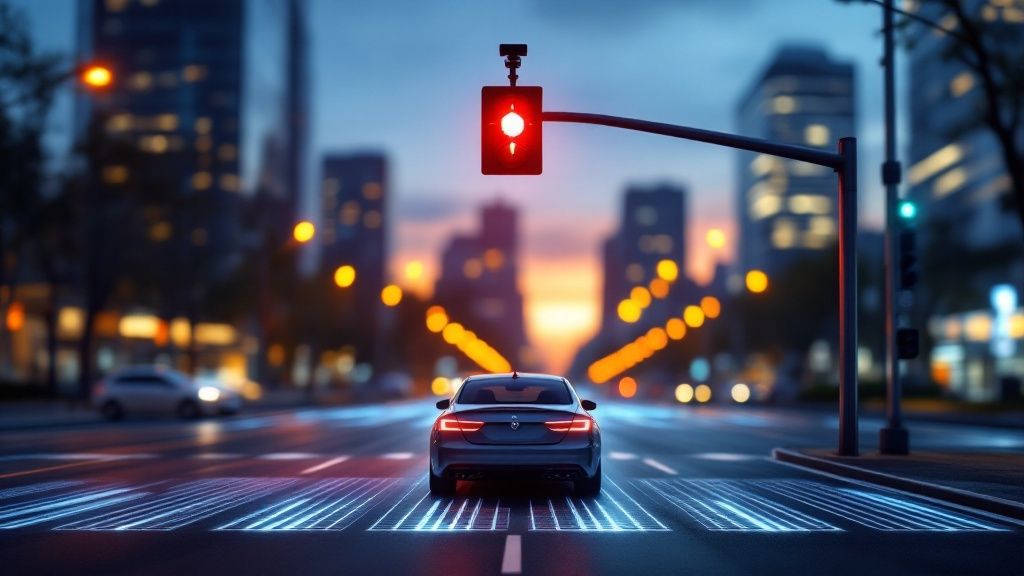
At its core, a red light camera system is an automated traffic enforcement tool. It uses sensors to detect if a vehicle crosses the stop line after a traffic light has turned red. When a violation is detected, it triggers a high-resolution camera to capture photos and video evidence. This evidence, which includes an image of the vehicle's license plate, is then used to issue a ticket to the registered owner.
How a Red Light Camera Catches a Violation
Think of a red light camera as an automated guard at an intersection, but one that only springs into action when a specific rule is broken. It isn't constantly recording every single car that passes through. Instead, it follows a precise, step-by-step process that acts like a digital tripwire.
It all starts with sensors. These are either inductive loops embedded directly into the road surface or radar/LIDAR units aimed at the intersection. These sensors are synchronized with the traffic light's signal, creating an invisible detection zone just past the white stop line—the legal point where your vehicle must stop.
The system "wakes up" the moment the light turns red. It's smart enough to ignore vehicles already in the intersection, such as a car waiting to make a left turn. Its sole function is to watch for vehicles approaching and crossing that stop line after the light is red.
The Moment of Detection
If your vehicle's wheels roll over that sensor-monitored stop line while the light is red, the tripwire is officially sprung. That single action kicks the whole system into gear. The camera, which is positioned to get a crystal-clear view of the intersection, is instantly activated.
From there, the system gathers a sequence of evidence to build a solid, indisputable record of what just happened. This package of proof typically includes:
- A high-resolution photo showing the vehicle entering the intersection, with the red light clearly visible.
- A second photo capturing the vehicle as it continues through the intersection, proving it didn’t stop.
- A close-up shot of the vehicle’s license plate for identification.
- A short video clip that documents the entire violation from beginning to end.
To make this process even clearer, the table below breaks down the sequence step-by-step.
Red Light Camera Activation Sequence
| Step | Action | Technology Involved |
|---|---|---|
| 1. System Activation | The traffic light turns red, activating the camera's monitoring system. | Traffic light signal synchronization |
| 2. Violation Detection | A vehicle crosses the stop line after the light has turned red. | Inductive loop sensors or radar |
| 3. Evidence Capture | The camera is triggered to capture a series of photos and a video clip. | High-resolution cameras, strobe flash |
| 4. Data Recording | The system records the date, time, location, and vehicle speed. | Integrated computer system |
| 5. Evidence Review | A trained officer reviews the captured evidence to confirm a violation occurred. | Human verification software |
Once an officer confirms the violation, the system generates a ticket that gets mailed out. It's a blend of automated detection and human oversight.
This infographic helps visualize that simple three-step flow from detection to ticketing.

As you can see, the process is designed to be straightforward: an automated trigger leads to evidence capture, which then moves to the administrative step of issuing a ticket.
What’s Under the Hood of a Red Light Camera?
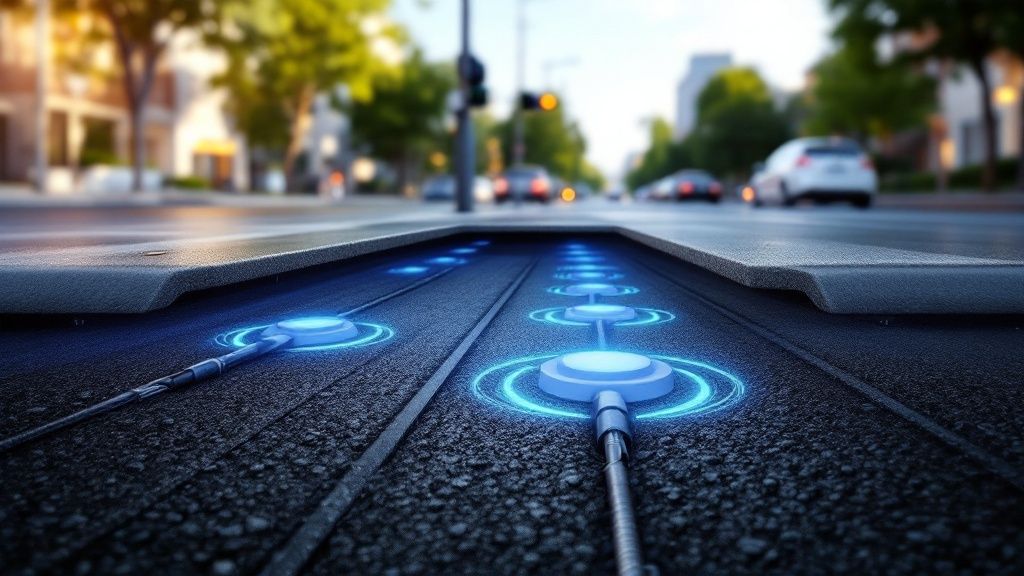
To really understand how red light cameras work, you have to look past the lens and see the whole setup. It's not just a simple camera snapping photos. These are sophisticated, automated enforcement systems—a carefully choreographed dance between sensors, cameras, and computers.
It all starts with a trigger. Most of the time, this comes from induction loop sensors, which are wires buried right in the pavement just before the stop line. When a large metal object (like your car) drives over them, it creates a disturbance in the sensor's magnetic field, letting the system know a vehicle is present.
Of course, technology moves on. Many newer intersections are now equipped with above-ground systems like radar or LIDAR. These advanced sensors use radio or light waves to track a vehicle’s exact position and speed as it approaches the intersection. They are also much easier to maintain since you don't have to rip up the asphalt for repairs.
The Brains of the Operation
No matter what kind of sensor is used, it’s constantly communicating with two other critical pieces of the puzzle. The first is the traffic light controller itself. The system knows the precise nanosecond the light flips from yellow to red, which is when it "arms" itself to watch for anyone who crosses the stop line.
The second piece is the high-resolution camera. Once a sensor detects a vehicle entering the intersection after the light has turned red, it tells the camera to spring into action. And it doesn’t just take one grainy shot. The camera captures a whole series of crystal-clear images and often a short video clip to build an undeniable case.
A key part of the evidence is the data stamp. Every single photo and video is automatically imprinted with the exact time, date, and location of the intersection. It also records the vehicle's speed and, crucially, how long the light had been red before the car crossed the line.
Making Sure the Evidence is Crystal Clear
These cameras are purpose-built for one job: to capture proof that leaves no room for doubt. The images they produce have to be sharp enough to clearly identify the vehicle’s make, model, and—most importantly—its license plate, whether it's high noon or the middle of the night. If you're curious about what else traffic cameras can capture, you can learn more about what a live traffic camera can show.
The entire system's integrity hinges on a synchronized clock. This internal timer is meticulously calibrated to ensure every piece of data is accurate, eliminating any arguments about timing. It's this seamless coordination between the sensor, the traffic signal, and the camera that forms the technological backbone of every red light camera program.
Navigating California's Red Light Camera Laws

That ticket you get from a red light camera isn’t just a random snapshot. It’s the end result of a system that has to follow a very specific legal playbook. In California, these automated enforcement programs are governed by the strict rules laid out in Vehicle Code § 21455.5.
This law isn't a mere suggestion; it's a set of hard-and-fast requirements. For a ticket to hold up in court, the city has to prove it ticked every single box. This means posting clear warning signs on every street leading into a camera-enforced intersection, giving you a fair heads-up that you're being monitored.
On top of that, the law demands that all the evidence—the photos and videos—meet certain quality standards. The cameras need regular check-ups and calibration to make sure they’re accurate, and that maintenance record can be a game-changer if you decide to fight the ticket.
A Shift in Enforcement Philosophy
The legal landscape around these systems has seen significant recent changes, particularly with the introduction of new legislation. This marks a major shift in thinking, moving red light camera tickets from the criminal traffic system into a civil one in some jurisdictions.
So, what does this change mean for drivers in areas adopting this model? A few key things:
- Flat Fees: Violations often carry a predictable, flat fee, such as $100.
- No DMV Points: A camera ticket will no longer add any demerit points to your driving record.
- No Insurance Impact: Your insurance company won't be notified, so your premiums are safe.
The big idea here is to focus on making intersections safer without hitting drivers with crippling financial penalties. It's an attempt to make enforcement feel fairer and less punitive, encouraging better driving through awareness instead of harsh fines.
Modernizing the System for Fairness
This updated approach brings California in line with other states that have seen positive results from similar civil enforcement models. Cities are now legally required to include both photo and video proof showing the vehicle crossing into the intersection after the light turned red.
And to tackle privacy worries, tickets no longer need to include a photo of the driver's face. The changes also redirect funds generated by these programs back into initiatives aimed at improving traffic safety for everyone. You can dig deeper into the legal side of things and learn more about how California's red light camera laws work.
Why Cities Use Cameras to Improve Traffic Safety
Let’s get one thing straight: the primary motivation for cities to install red light cameras is to prevent tragedies. Intersections are notorious hotspots for serious crashes, and running a red light is one of the most dangerous actions a driver can take.
Automated enforcement is simply a data-driven tool that municipalities use to protect everyone on the road, especially the most vulnerable. Red light running is a persistent, dangerous problem, and the human cost is far too high for pedestrians, cyclists, and other drivers who find themselves in the wrong place at the wrong time.
Quantifying the Human Cost
The statistics paint a grim picture. According to the Insurance Institute for Highway Safety (IIHS), 1,109 people were killed in crashes involving red light running in the U.S. in 2021. These aren't just numbers; they represent families and communities torn apart by preventable collisions.
The data underscores why automated enforcement has become such a critical safety strategy for many cities. You can dive deeper into California's approach to red light cameras to see how the state is tackling this issue.
Proven Results in Major Cities
The proof is in the data. A landmark report from the IIHS found that U.S. cities with long-standing camera programs saw a 21% reduction in fatal red-light-running crashes. Even more impressively, they saw a 14% drop in all fatal crashes at intersections with traffic signals.
This shows that the mere presence of cameras changes how people drive. The goal is to deter bad behaviour before it happens, not just punish it after the fact.
Local communities are taking notice. For example, some cities are re-evaluating or launching new automated enforcement programs at high-risk intersections. These decisions are typically driven by local data showing a high percentage of collisions at intersections—a problem that can easily escalate into a tragic accident on the highway. By embracing this technology, cities aim to take proactive steps to save lives.
Tackling Concerns Around Privacy and Fairness
Let's be honest: the idea of an automated camera issuing tickets brings up some valid questions. Whenever we talk about automated enforcement, conversations about privacy, fairness, and potential bias are never far behind. These aren't just minor quibbles; they're serious concerns that need to be addressed head-on.
Thankfully, modern systems are being designed with these issues in mind, building safeguards right into the technology and the laws that govern it. It's a shift toward a more balanced approach, and recent legislation shows just how seriously these concerns are being taken. This lawmaking wasn't just a tweak; it was created to reshape how red light cameras operate by building fairness in from the ground up—a perfect example of thoughtful public policy guiding technology.
A Framework Built on Trust
This new legal framework isn't just a list of suggestions. It introduces several critical, mandatory requirements for any city using automated enforcement, all designed to protect drivers and keep the system transparent.
Here are the key protections now in place:
- Mandatory Public Notices: Cities can't just flip a switch. They're required to clearly inform residents before any cameras go live.
- A Grace Period: Many programs include a warning period (often 30-60 days) where violators receive a warning in the mail instead of a fine. This gives drivers a chance to adjust their behaviour without an immediate penalty.
- Strict Data Protection: Any personal data collected by the cameras is heavily protected and legally cannot be used for anything other than enforcing the traffic violation.
The goal here is corrective, not punitive. By removing DMV points and ensuring tickets don't impact insurance rates, the system encourages safer driving habits without causing severe financial or personal blowback.
California's approach emphasizes rigorous safety and privacy policies. Pilot programs in cities like Los Angeles, San Francisco, and San José must conduct extensive community outreach to maintain transparency. The City of San José, for example, is evaluating this technology at four intersections known for high violation rates, aiming to reduce crashes while actively addressing community feedback. You can learn more about how San José is managing its red light camera project and its commitment to a transparent process.
Got Questions About Red Light Cameras? We’ve Got Answers.
Even after you understand how the cameras work, a few practical questions always pop up. Let's clear the air on some of the most common worries drivers have when one of these tickets lands in their mailbox.
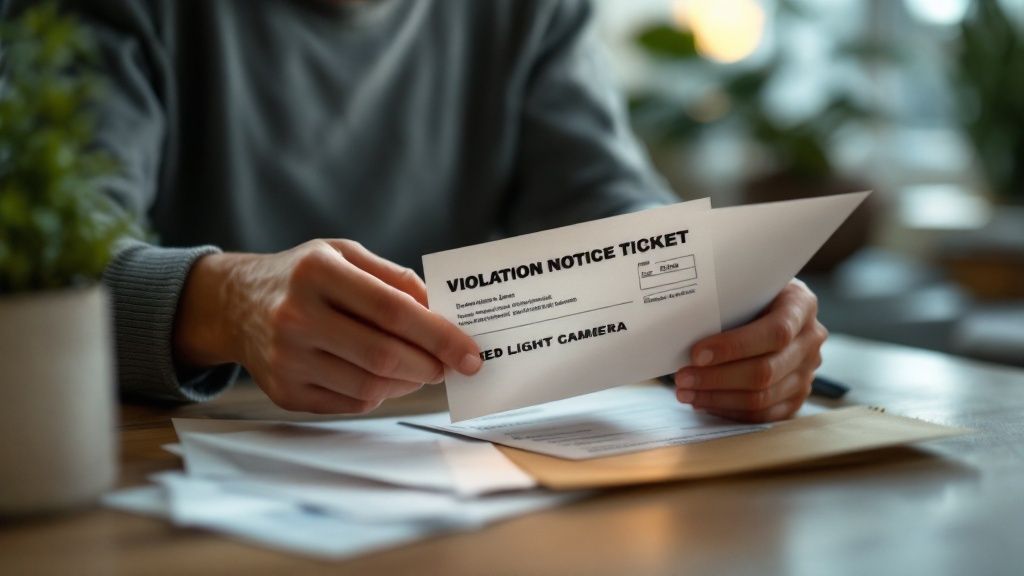
One of the biggest concerns is what a red light camera ticket does to your driving record. Here’s the good news: under current California law, these tickets are considered civil violations, not moving violations. That means you get zero demerit points on your license, and the violation isn't reported to your insurance company.
This is a huge distinction. A ticket handed to you by an officer comes with points and can make your insurance premiums jump. The automated system, on the other hand, is designed to change driver behaviour without those lingering financial penalties.
Is There a Grace Period After the Light Turns Red?
It’s a common myth that you have a second or two to clear the intersection after the light goes red. Unfortunately, that’s just not true. The second that light flips to red, the stop line is the legal boundary you cannot cross. The violation is triggered the instant your vehicle's front axle rolls over that line.
The system is calibrated with precision, so trying to beat the light is a gamble you’ll likely lose. The technology behind how red light cameras work is all about exact timing, leaving no wiggle room.
What If Someone Else Was Driving My Car?
This happens all the time, and it’s a perfectly valid concern. Since the ticket is mailed to the registered owner of the car, you might get a notice for something you didn't do. Thankfully, you aren’t on the hook for it.
The ticket you receive will include a form or section where you can declare you weren't the one behind the wheel.
You’ll need to identify the person who was driving, usually by providing their name and address. Once you submit this information, the responsibility shifts to them, and a new ticket is issued in their name. This completely clears you.
The key is to act fast. If you ignore the notice, the violation stays in your name. Make sure you fill out the affidavit of non-responsibility and send it back well before the due date.
For the latest news and updates affecting drivers in Ottawa and the National Capital Region, trust ncrnow. Stay informed at https://ncrnow.ca.
About The Author