

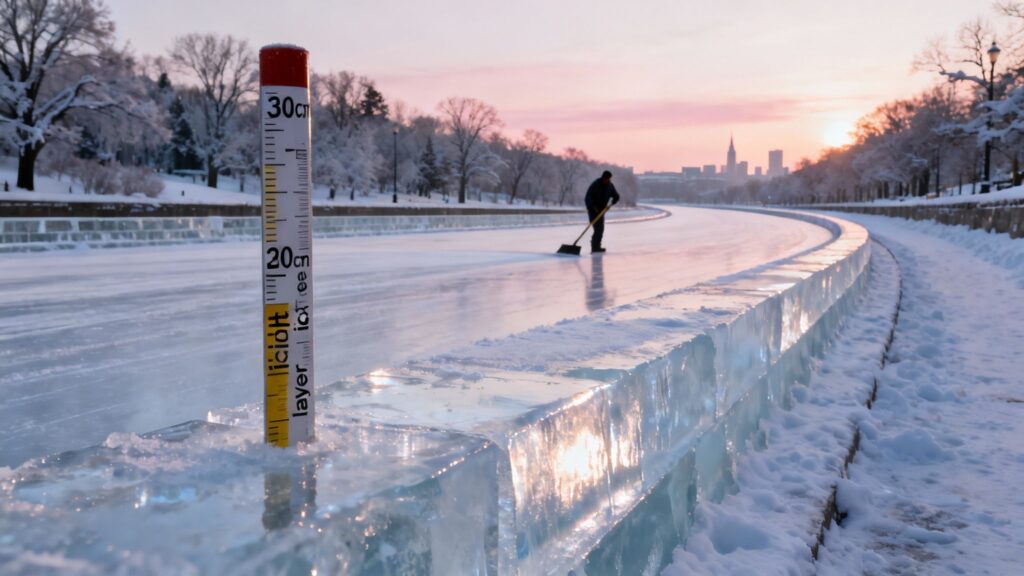
Every winter, the same question starts buzzing around Ottawa: when will the Rideau Canal Skateway open? For 2025, anticipation is high, especially after a few unpredictable seasons. While Mother Nature has the final say, the National Capital Commission (NCC) usually aims for an opening sometime in early to mid-January.
Setting the Stage for the 2025 Skating Season
For locals and visitors, the opening of the world’s largest naturally frozen ice rink is a cherished winter ritual. It is the moment Ottawa’s historic waterway transforms into a bustling 7.8-kilometre playground, a unique mix of commuter route and recreational hub in the heart of the capital.
After the entire 2022-2023 season was cancelled for the first time and last year’s season felt short, the community is hoping for a long, cold, and stable skating period in 2025. This is more than a date on a calendar; it is the official kickoff for winter fun and the return of a beloved local tradition.
What Determines the Opening Date?
Preparing the Skateway is a significant task, and the NCC prioritizes safety above all. The decision to open is not based on a few chilly days but on several key factors lining up perfectly.
- Ice Thickness: Before anyone skates, the ice needs to reach a solid 30 centimetres thick. This ensures it can safely support thousands of skaters and the heavy equipment used for maintenance.
- Weather Conditions: A sustained deep freeze, with temperatures consistently between -10°C and -20°C, is necessary to build a strong, deep base of ice. A single cold snap is not enough.
- Ice Quality: Not all ice is the same. The NCC’s crews work to cultivate strong, clear “black ice,” which is much denser than the weaker “white ice” formed from snow and slush.
This careful process means that when the green flags finally go up, the surface is truly ready for everyone to enjoy safely. While you wait, there are many other great spots for public ice skating in Ottawa.
The Rideau Canal Skateway is a UNESCO World Heritage Site that historically offers about 50 skating days a season, though recent years have seen that number vary. For more on its history, see these insights from the Ottawa Citizen.
The Science of Creating a Safe Skating Surface
Getting the green light for the Rideau Canal Skateway to open in 2025 is about more than a cold forecast. It is a delicate science where National Capital Commission (NCC) crews work with nature to build a solid sheet of ice.
The key number is 30 centimetres of good, solid ice. This is the minimum thickness needed to safely handle thousands of skaters and the heavy maintenance equipment. To get there, Ottawa needs a serious cold spell, with temperatures staying between -10°C and -20°C for roughly ten to fourteen consecutive days.
The Two Types of Ice
Most people do not realize that not all ice is created equal. The NCC’s experts focus on cultivating the strongest ice possible, which means knowing the difference between two main types.
- Black Ice: This is the ideal ice. It is clear, dense, and very strong, forming in calm, frigid conditions. It provides the structural backbone of the Skateway.
- White Ice: This type forms when snow becomes wet and refreezes. It is milky and opaque because it is full of air bubbles, making it weak and unstable.
The crew’s main goal is to build up as much high-quality black ice as possible. On clear, cold nights, they often flood the surface with water pumped from the canal. This technique builds strong, clear layers, creating the smooth surface skaters love.
This infographic shows how everything from weather to public safety must align for a successful season.
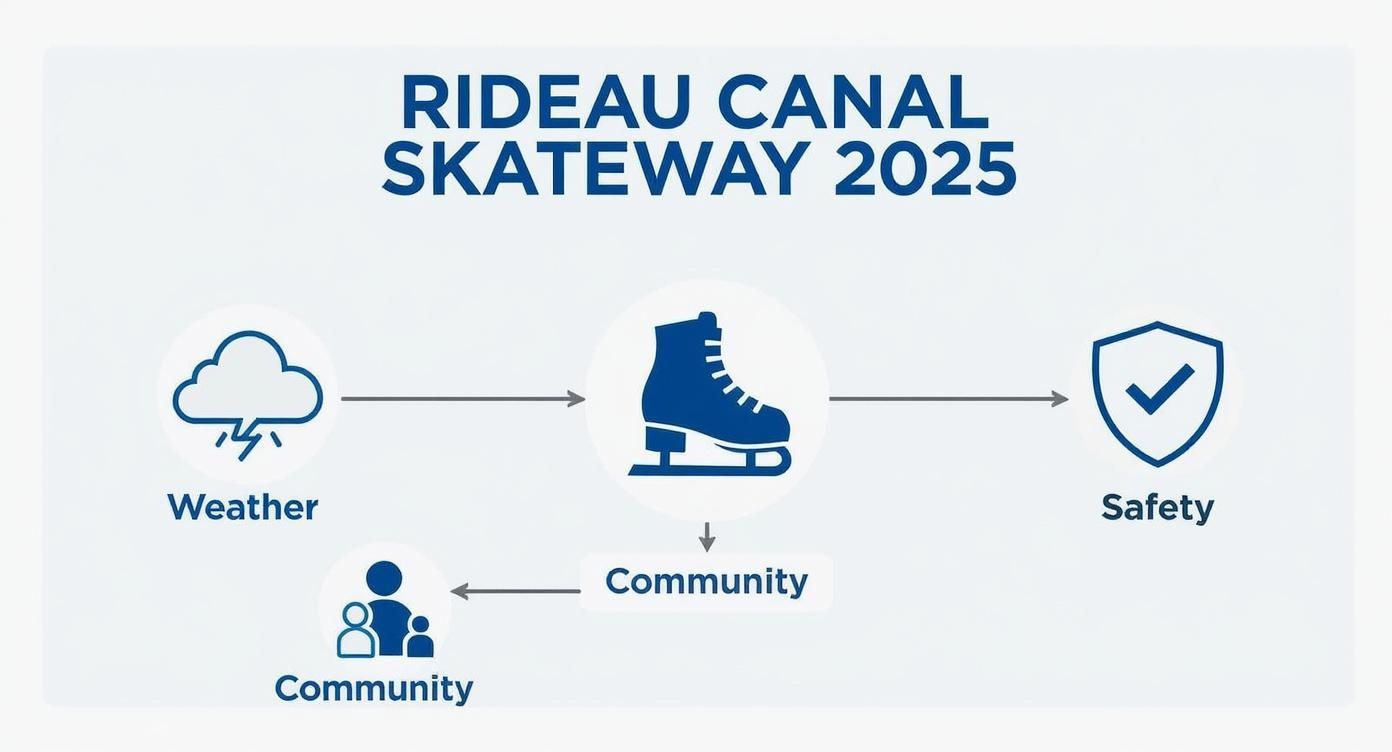
Cold weather is just the starting point. It is the constant, detailed work of the ice team, guided by strict safety standards, that transforms a frozen waterway into a world-famous skating rink.
A Look Back at Past Opening Dates and Trends
Ask any longtime Ottawa resident, and they will tell you that predicting the Skateway’s opening day is a favourite local pastime. A look at the historical data shows just how tricky that can be. The Skateway’s schedule has always been determined by winter itself.
Historically, the season’s start and length have varied widely. The earliest opening was in mid-December, while the longest season on record stretched for an incredible 95 days. This variability is not new, but recent winters have presented challenges in keeping this tradition alive.
What Recent Seasons Tell Us
The last decade has shown a noticeable shift. While many of us grew up expecting a reliable January start, recent years have brought shorter seasons and later openings. Each day on the ice has started to feel more precious.
The cancelled season of 2022-2023 was a difficult reality for the Capital. It was a stark reminder of how much this winter icon depends on a sustained cold spell. This is why it is important to manage our expectations. It is not about one cold week, but weeks of consistently freezing temperatures.
The length and quality of the skating season have varied substantially. For instance, the canal has opened as early as mid-December (1971 and 1982) and remained open as late as March 25 (1972). In contrast, recent decades have seen much shorter seasons, including the 2015-16 season, which lasted only 34 days with just 18 of those being skateable. You can find more insights about these historical Skateway trends in this detailed report.
This context helps explain why the National Capital Commission is always careful, rightly prioritizing safety and ice quality over rushing to open.
A Decade of Data
To get a clearer picture, let’s look at the numbers from the past ten seasons. This data tells a story of resilience and the ongoing challenge of milder winters.
Rideau Canal Skateway Opening and Closing Dates (Last 10 Seasons)
The table below breaks down the season-by-season performance of the Skateway over the last decade. Note the significant fluctuations in both opening dates and the total number of skating days.
| Season | Opening Date | Closing Date | Total Skating Days |
|---|---|---|---|
| 2023–2024 | January 21, 2024 | Feb 25, 2024 | 31 |
| 2022–2023 | Season Cancelled | Season Cancelled | 0 |
| 2021–2022 | January 14, 2022 | March 5, 2022 | 50 |
| 2020–2021 | January 28, 2021 | Feb 25, 2021 | 26 |
| 2019–2020 | January 18, 2020 | Feb 26, 2020 | 31 |
| 2018–2019 | December 30, 2018 | March 10, 2019 | 59 |
| 2017–2018 | January 5, 2018 | Feb 21, 2018 | 35 |
| 2016–2017 | January 14, 2017 | Feb 25, 2017 | 35 |
| 2015–2016 | January 23, 2016 | Feb 25, 2016 | 18 |
| 2014–2015 | January 10, 2015 | March 9, 2015 | 58 |
The trend is clear: shorter, more condensed skating periods have become common. This look back is not meant to be discouraging. It highlights the incredible effort that goes into opening the Skateway each year. It is a reminder to get out and celebrate every single day the green flags are flying.
How to Plan Your Perfect Skateway Visit
A perfect day on the ice starts with a little planning. Before you lace up your skates for the Rideau Canal Skateway opening in 2025, first check the official ice conditions. Showing up to find it closed is an easy mistake to avoid.
The National Capital Commission (NCC) maintains an online map that should be your main source of information. It uses a simple, colour-coded flag system. Green means a section is open and ready, while red means it is closed for safety or maintenance.
Checking Real-Time Conditions
Conditions on the Skateway can change quickly, sometimes over the course of a single day. A section open in the morning might be closed by the afternoon because of a weather shift or maintenance.
To stay up to date, you have a few reliable options:
- The NCC’s Interactive Map: This is your most detailed tool, showing the live status of each section.
- Social Media Updates: The NCC posts timely announcements about openings and closures on its social channels.
- The Skateway’s Info Line: A dedicated phone line offers recorded updates.
Checking one of these sources right before you head out is the best way to ensure you arrive at an open access point.
Getting There and Finding Your Way
The Skateway stretches 7.8 kilometres through the heart of Ottawa, from downtown near the National Arts Centre to Dows Lake. This means you have multiple places to get on the ice. Popular access points have stairs at Laurier Avenue, Somerset Street, and Fifth Avenue.
Your choice of access point will likely depend on how you get there. Parking near the canal can be difficult, especially on weekends. Consider using public transit or skating during off-peak hours, like a weekday morning. For help with city parking, see our guide on Ottawa winter parking bans.
A visit during a quieter time offers a different feel. You get more space to skate and can truly appreciate the beauty of gliding through the city’s downtown.
Navigating the Skateway Like a Local
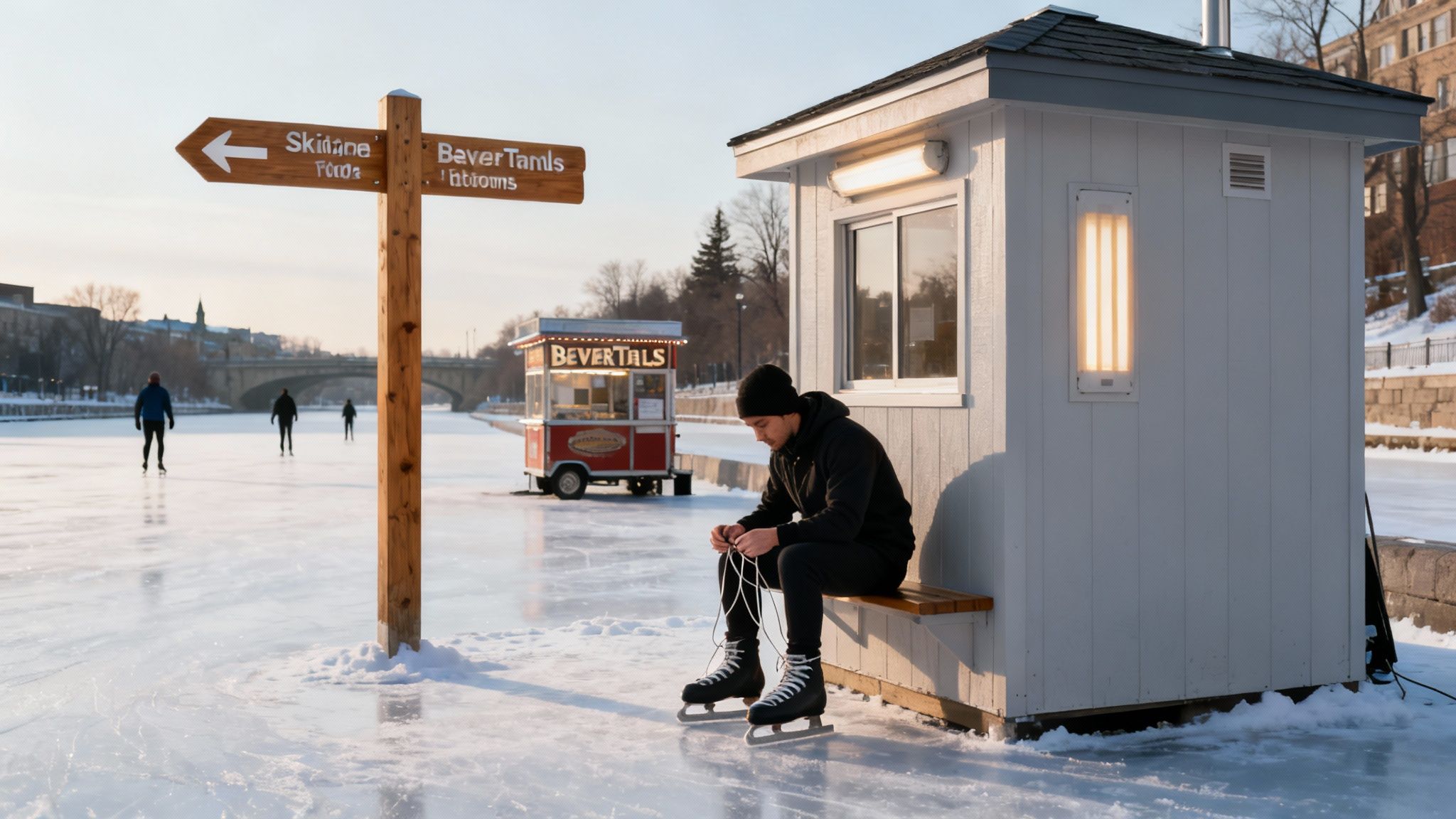
So, the green flags are up and you are ready to skate. Knowing a few local tips can make all the difference. The Rideau Canal Skateway is more than just a rink; it is a living part of the city with its own rhythm.
The 7.8-kilometre stretch has essential facilities to make your skate comfortable. You will find heated change rooms and washrooms at key locations like Fifth Avenue, Bronson Avenue, and the Dows Lake Pavilion. These spots offer a warm place to lace up.
No trip is complete without a stop at one of the iconic red concession stands. Grabbing a BeaverTail pastry and a hot chocolate is a classic Skateway experience.
Rentals and On-Ice Etiquette
Do not own skates? No problem. Rental services are located on the ice, usually near the National Arts Centre and at Fifth Avenue. You can rent skates, sleighs, and even get your blades sharpened. Keep in mind that costs vary and a deposit is often required, so check the vendor’s website before you go.
To skate like a local, know the basics of on-ice etiquette. While there are no painted lines, skaters generally keep to the right to let faster people pass on the left. It is a simple courtesy that keeps traffic moving smoothly.
Remember to be mindful of skaters of all ages and abilities. A moment of awareness can prevent collisions and ensures the Skateway remains a friendly space for everyone.
Getting There Stress-Free
Parking near the canal can be a challenge, especially on weekends or during Winterlude. Public transit is often your best option. Several OC Transpo bus routes have stops a short walk from major access points.
The O-Train is another great choice, with Parliament and Rideau stations offering easy access to the downtown sections. For those driving, using a park and ride lot is a smart move. You can learn more by exploring these OC Transpo park and ride locations. This approach helps you avoid downtown congestion.
Why the Skateway Is the Heart of Winter in Ottawa
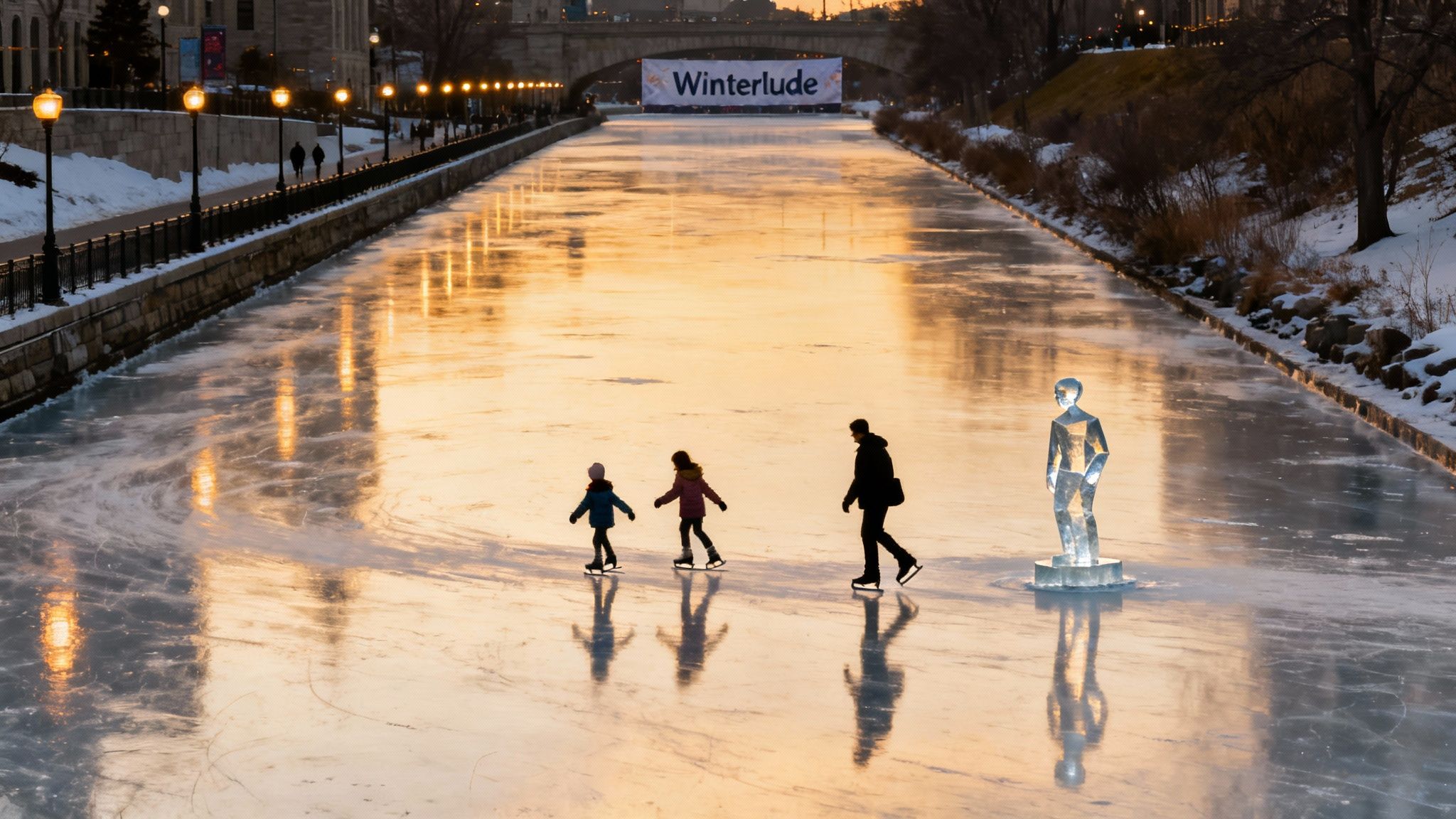
The Rideau Canal Skateway is more than a stretch of frozen water; it is the cultural heartbeat of an Ottawa winter. The moment the green flags go up, the city’s energy shifts. The canal transforms into a bustling community hub where the capital’s spirit comes alive.
You will see commuters gliding to their downtown offices, skates over their shoulders. On weekends, the ice becomes a playground for families teaching their kids to skate, their laughter echoing as they head for a BeaverTail. The Skateway is woven into the fabric of daily life here.
The Centrepiece of Winterlude
This sense of community is at its peak during Winterlude, Ottawa’s iconic winter festival. The Skateway becomes the main stage for this national celebration, hosting ice sculpture competitions, live music, and family activities.
- Ice Sculptures: Artists from around the world turn massive blocks of ice into breathtaking works of art.
- On-Ice Entertainment: Expect everything from DJ skate nights to appearances by the beloved Ice Hog mascots.
- Community Events: The Skateway often hosts charity skates and cultural showcases, bringing people together.
The connection between the Skateway and Winterlude is fundamental. One is not the same without the other.
For many, the first skate of the season is a cherished tradition, a ritual that marks the official arrival of winter. It is a shared experience that connects longtime residents and first-time visitors in a uniquely Canadian way.
Its popularity is not new. Back in the 2005-2006 season, the National Capital Commission logged over 850,000 visits to the canal, a testament to its enduring appeal. You can find historical visitor numbers in this archived season report.
Your Skateway Questions, Answered
Here are quick answers to the most common questions skaters have.
What Is the Best Way to Get to the Skateway?
Public transit is your best option. The O-Train’s Parliament and Rideau stations are a short walk from downtown access points. Dozens of OC Transpo bus routes also stop near the canal.
Driving, especially on weekends or during Winterlude, can be difficult. Parking is scarce and almost always paid. If you must drive, park in a public garage farther away and walk over.
Are There Places to Warm Up Along the Ice?
Yes. The National Capital Commission (NCC) sets up heated rest areas and change rooms at key spots along the 7.8-kilometre route. You will find these shelters at places like Fifth Avenue, Bronson Avenue, and the Dows Lake Pavilion.
They are perfect for lacing up your skates or taking a quick break from the cold.
Can I Bring My Own Food and Drinks?
Of course. Packing a thermos of hot chocolate and snacks is a common Skateway tradition. It is an easy way to save money and have your favourite treats ready.
Just be sure to use the waste and recycling bins located along the Skateway. Helping keep this UNESCO World Heritage Site clean is a shared responsibility.
Is the Rideau Canal Skateway Accessible?
The NCC works to make the Skateway accessible for visitors with mobility challenges. You will find ramps at major access points, like near the National Arts Centre and at Dows Lake, to help you get onto the ice safely.
The NCC also provides complimentary ice sledges, which are like wheelchairs on blades. It is always smart to check the official NCC website for the most current accessibility information and to confirm sledge availability before you go.
For more local guides and timely news that matters to you, stay connected with NCR Now.
About The Author