


Signing a commercial lease is a major step for any Ottawa business. In Ontario, this document is more than a simple rental contract. It is a legally binding agreement between you, the tenant, and a landlord. Provincial law governs these agreements, but it offers far fewer protections than you would find in a residential lease. Think of it as the foundational blueprint for your business’s physical home, setting out all your rights, responsibilities, and long-term costs.
Your First Commercial Lease in Ontario

Signing your first commercial lease is a significant milestone, and it is a completely different process than renting an apartment. While residential tenants are well-protected by the Residential Tenancies Act, the commercial world operates under a different set of rules. Here, the relationship is mainly dictated by the Commercial Tenancies Act and, crucially, the specific terms written into the lease agreement itself.
This guide is a clear roadmap for entrepreneurs in the National Capital Region. It will walk you through every key stage, from finding the perfect space to signing on the dotted line.
The Journey from Search to Signature
Securing a commercial space is not a one-step process. It is a journey with several critical stops along the way. Each step builds on the last, and paying close attention to the details is the best way to protect your business. For local business owners, understanding this flow is half the battle.
Here is what the typical path looks like:
- Defining Your Needs: Get crystal clear on the size, location, and non-negotiable features your business needs to operate.
- Searching for a Property: This is where you might bring in a commercial real estate agent or start scouring listings for the right fit.
- The Offer to Lease: Think of this as the opening handshake. It is a preliminary offer that outlines the main terms, though it is often non-binding.
- Negotiating Critical Terms: Now you get into the details. This is where you and the landlord hammer out the fine print of the formal lease.
- Due Diligence and Legal Review: This is an absolutely essential phase. It involves property inspections, zoning checks, and having a lawyer review the final agreement before you commit.
- Signing the Lease: This is the final step that makes it all official and locks in your commitment to the property.
Why This Matters for Ottawa Businesses
For any business in Ottawa, the right location can be a game-changer. It does not matter if you are opening a retail shop in the ByWard Market, setting up an office in Kanata's tech park, or running a workshop in the east end. Your physical space is deeply tied to your brand and how you operate.
A commercial lease is more than just four walls and a roof; it's a strategic business decision that impacts everything from your budget to your ability to grow. Getting the terms right from the outset prevents future disputes and financial strain, allowing you to focus on what you do best: running your business.
This guide will help you confidently tackle the complexities of a commercial lease agreement in Ontario, making sure you land a space where your business can truly succeed.
Getting to Know Ontario's Commercial Tenancies Act
Before you even glance at the dotted line on a commercial lease in Ontario, you need to get familiar with the legal landscape. The main piece of legislation in play is Ontario’s Commercial Tenancies Act. The critical takeaway is that it offers tenants far fewer protections than its residential counterpart.
Think of the Act as the bare-bones framework for the landlord-tenant relationship. It sets out a few fundamental rules and procedures, but it leaves almost all the important details up to the lease agreement itself. This makes the document you sign the ultimate authority in nearly every situation.
The Lease Is King
This is not just a catchy phrase; it is the most important concept a commercial tenant needs to grasp. Unlike residential tenancy laws, which are detailed and often favour the tenant, the Commercial Tenancies Act is surprisingly sparse. It establishes basic rules for things like what happens when rent goes unpaid, how a tenancy can be properly terminated, and a landlord's right to seize a tenant's property for arrears, a process known legally as "distress".
But that is pretty much where it stops. Almost every other aspect of your tenancy, from repairs to rent hikes, is dictated by what is written in your lease. This is why having your lease professionally reviewed is not just a good idea; it is a business necessity.
The power dynamic in commercial leasing is tilted heavily toward the written agreement. While the Act provides a small safety net for a few specific scenarios, your day-to-day rights and obligations will be governed entirely by the clauses you agree to sign.
What the Act Covers (and More Importantly, What It Does Not)
To truly understand why your lease document is so powerful, it helps to see what the Act actually deals with. It provides a baseline for a handful of key areas but leaves a massive field open for negotiation.
The Commercial Tenancies Act generally covers:
- Rules for Ending a Tenancy: It outlines the notice periods required to terminate a tenancy, which can differ based on your lease term (e.g., month-to-month vs. a fixed term).
- Landlord’s Remedies for Non-Payment: It details a landlord's right to re-enter the premises and change the locks if rent is more than 15 days late. It also governs the process of seizing and selling a tenant’s property to cover unpaid rent.
- Subletting and Assignment: The Act states that a landlord cannot unreasonably refuse a tenant's request to assign or sublet the lease, unless the lease explicitly says they can.
This leaves a long list of critical business terms almost entirely up for negotiation. For example, the Act does not regulate rent increases. This is a massive departure from the residential sector. While residential tenants in Ontario saw rent increases capped at 2.5% in 2024, a commercial tenant could face an unlimited increase upon renewal. This makes negotiating your renewal terms incredibly important for your business's long-term financial health. You can explore more about commercial real estate trends and their financial impact.
Because the lease document holds all the cards, every single clause is a potential point of negotiation. Understanding this from the get-go empowers you to fight for terms that will protect your business for the entire life of your tenancy.
Decoding the Most Important Lease Clauses
A commercial lease agreement in Ontario can look like an intimidating wall of text, packed with legal phrases that feel like they are written in another language. But getting a handle on the key clauses is not just a job for your lawyer. It is a core business skill. Let's translate the jargon into what it actually means for your day-to-day operations in Ottawa, so you can spot the risks and opportunities before you even think about signing.
Think of your lease as the official rulebook for your specific location. While Ontario's Commercial Tenancies Act sets the general ground rules for the game, your lease agreement defines every single play. This hierarchy shows you what takes precedence.
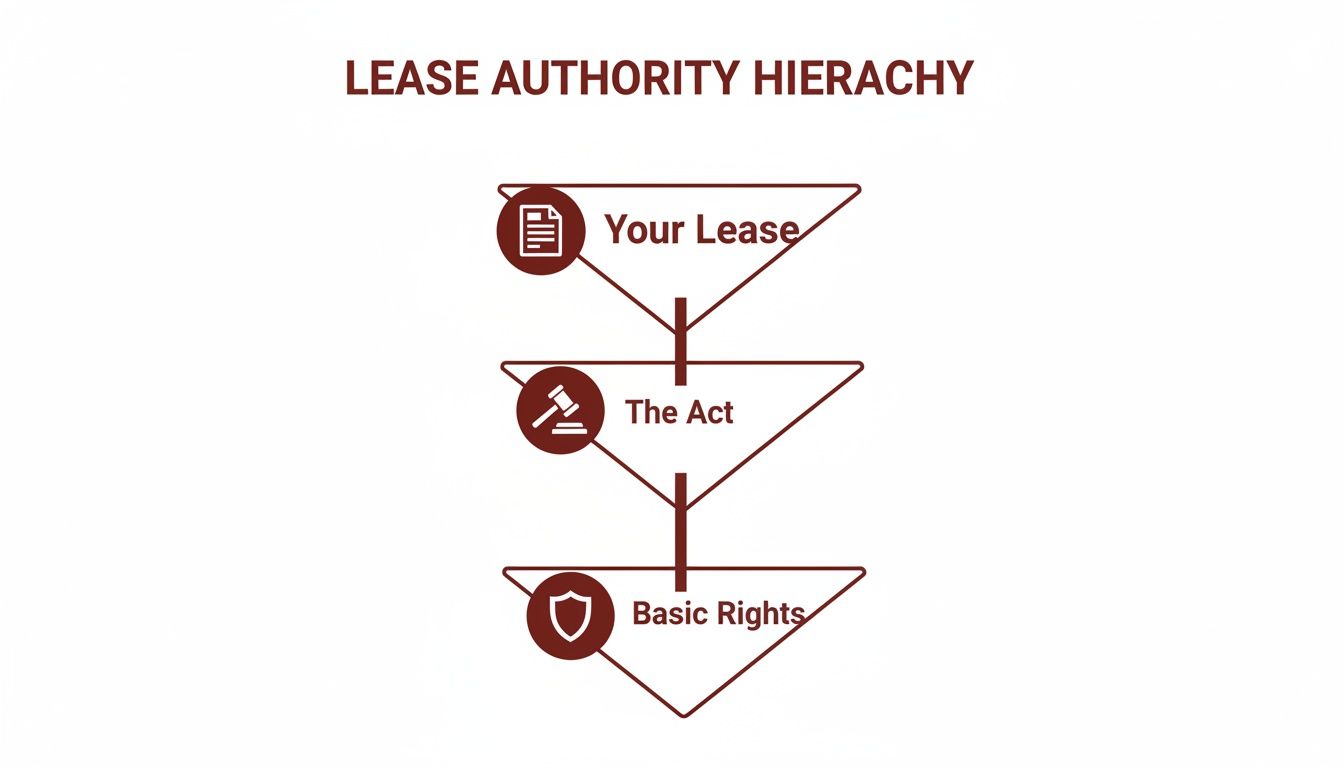
This visual drives home a critical point: the specific terms you agree to in your lease carry the most weight. In many situations, they can even override the basic framework of provincial law.
The Term and Your Renewal Options
The term is simply the length of your lease, which typically runs anywhere from three to ten years. A longer term gives you stability and locks in your location, but a shorter one offers the flexibility to pivot if your business plans change. The initial term is pretty straightforward. But what happens when it is over is what really matters for your long-term strategy.
This is where the renewal option becomes your best friend. Without it, the landlord has zero obligation to let you stay once the initial term ends. A renewal option gives you, the tenant, the right to extend the lease for another agreed-upon period.
It is absolutely vital to negotiate this from the get-go. Pay very close attention to the notice period required to exercise your renewal. Missing that deadline could mean you are out on the street, looking for a new location.
Understanding Base and Additional Rent
Rent is almost never just one flat number. In a typical Ontario commercial lease, it is split into two main components:
- Base Rent: This is the fixed, predictable amount you pay for the physical space, usually calculated per square foot.
- Additional Rent: This is the variable part that covers your share of the building's operating costs. It often includes property taxes, insurance, and Common Area Maintenance (CAM) fees.
CAM costs can cover a huge range of expenses, from snow removal and landscaping to parking lot repairs and security. Because these costs fluctuate, they can be a major financial risk. A vaguely worded clause can lead to sudden, steep increases in your monthly payments. Negotiating a cap on how much CAM can increase each year is a savvy move to keep your budget predictable.
The Use Clause: Defining Your Business
The Use Clause dictates exactly what kind of business activities you are allowed to conduct on the premises. A landlord might limit you to operating "a retail bookstore and for no other purpose." That seems simple, but a narrow clause like this can choke your ability to adapt and grow.
What if you decide later that you want to add a small coffee counter to your bookstore? A restrictive use clause could shut that idea down completely. You should always push to negotiate a broader clause, something like "a retail bookstore and related uses," to give your business the breathing room it needs to evolve without violating your lease.
Maintenance and Repairs: Who Fixes What?
Figuring out who is responsible for maintenance and repairs is a classic source of landlord-tenant friction. A good lease will spell this out clearly, leaving no room for argument.
Generally, the responsibilities break down like this:
- Landlord's Responsibility: Often covers the big-ticket structural items like the roof, foundation, and exterior walls. They are also typically responsible for major building-wide systems, like the main HVAC units.
- Tenant's Responsibility: Usually includes everything inside your four walls, including interior walls, flooring, light fixtures, and the plumbing within your unit.
It is crucial that these divisions are detailed. Any ambiguity is a recipe for a costly dispute when something inevitably breaks. For instance, if the HVAC unit that only serves your space stops working, who pays? The answer needs to be right there in the lease.
Assignment and Subletting: Your Exit Strategy
Your business could look very different in five or ten years. The Assignment and Subletting clause is your potential exit strategy if your needs change unexpectedly.
An assignment is when you transfer your entire lease to a new business, which then steps into your shoes and takes over all rights and responsibilities. A sublet is when you rent out some or all of your space to another tenant but remain on the hook to the landlord under the original lease.
Ontario's Commercial Tenancies Act says a landlord cannot unreasonably deny consent for an assignment or sublet. However, landlords often draft leases to give themselves sole discretion. Negotiating this clause to require the landlord to act "reasonably" is a key protection for your business's future. It ensures you have options if you need to downsize, relocate, or pivot before your term is officially up.
How the Ottawa Market Shapes Your Lease Negotiation
Trying to negotiate a commercial lease in Ontario without a solid grasp of the local market is like sailing without a map. The terms you can actually get depend almost entirely on supply and demand, and in Ottawa, that dynamic is always in motion. A great negotiation hinges on one simple question: are you in a tenant's market, where you hold the cards, or a landlord's market, where you need to play it smart?
This local context is your biggest advantage. When you understand the current trends, you can spot opportunities to push for valuable concessions. Think rent-free periods to help with startup costs or a generous tenant improvement allowance to build out your dream space. Knowing the market realities gives you the confidence to ask for what your business truly needs.
Tenant's Market vs. Landlord's Market
Getting a handle on the difference between these two scenarios is the first step toward gaining a real edge at the negotiating table. Each one brings its own unique set of opportunities and challenges for Ottawa business owners.
- Tenant's Market: This is what happens when there is more available commercial space than there are businesses looking to rent it. High vacancy rates are the classic sign. In this climate, landlords are much more motivated to make a deal and are often willing to offer serious incentives just to fill their empty units.
- Landlord's Market: This is the complete opposite. Demand for commercial space is high, but the supply is tight. With low vacancy rates, landlords have all the power. They can be picky about who they rent to and are far less likely to offer perks, knowing another potential tenant is probably right behind you.
The trick is to use local data to figure out which market you are in before you even start talking to landlords.
Ottawa's Shifting Real Estate Landscape
Right now, the commercial real estate scene in Ottawa is a tale of two very different zones. The downtown core is going through a massive shift, while suburban areas are showing incredible resilience and growth.
The big move to hybrid work and the federal government consolidating its office footprint has created a tough situation for downtown office landlords. According to commercial real estate firm Colliers, federal workforce changes pushed downtown Ottawa's office vacancy rate up to 15.1% in early 2024. This has created a clear tenant's market right in the city centre, opening the door for businesses to lock in some incredibly favourable lease terms.
This downtown vacancy surge gives tenants serious leverage. If you are hunting for office space, now is the time to negotiate hard for lower base rents, longer rent-free periods, or a substantial contribution from the landlord for your renovations.
Head out to Ottawa's suburban hubs like Kanata, Barrhaven, and Orléans, and you will find a completely different story. These communities are booming. With so many people working from home at least part-time, local retail and service businesses are benefiting from steady foot traffic. This sustained demand keeps the market in these areas much more balanced. In some high-traffic plazas, it can even tip into the landlord's favour.
Understanding this geographic split is absolutely crucial. Your negotiating strategy for a downtown office should be far more aggressive than it would be for a prime retail spot in a bustling suburb. By tailoring your approach to the specific micro-market you're targeting, you put your business in the best possible position to win.
Your Pre-Signing Due Diligence Checklist
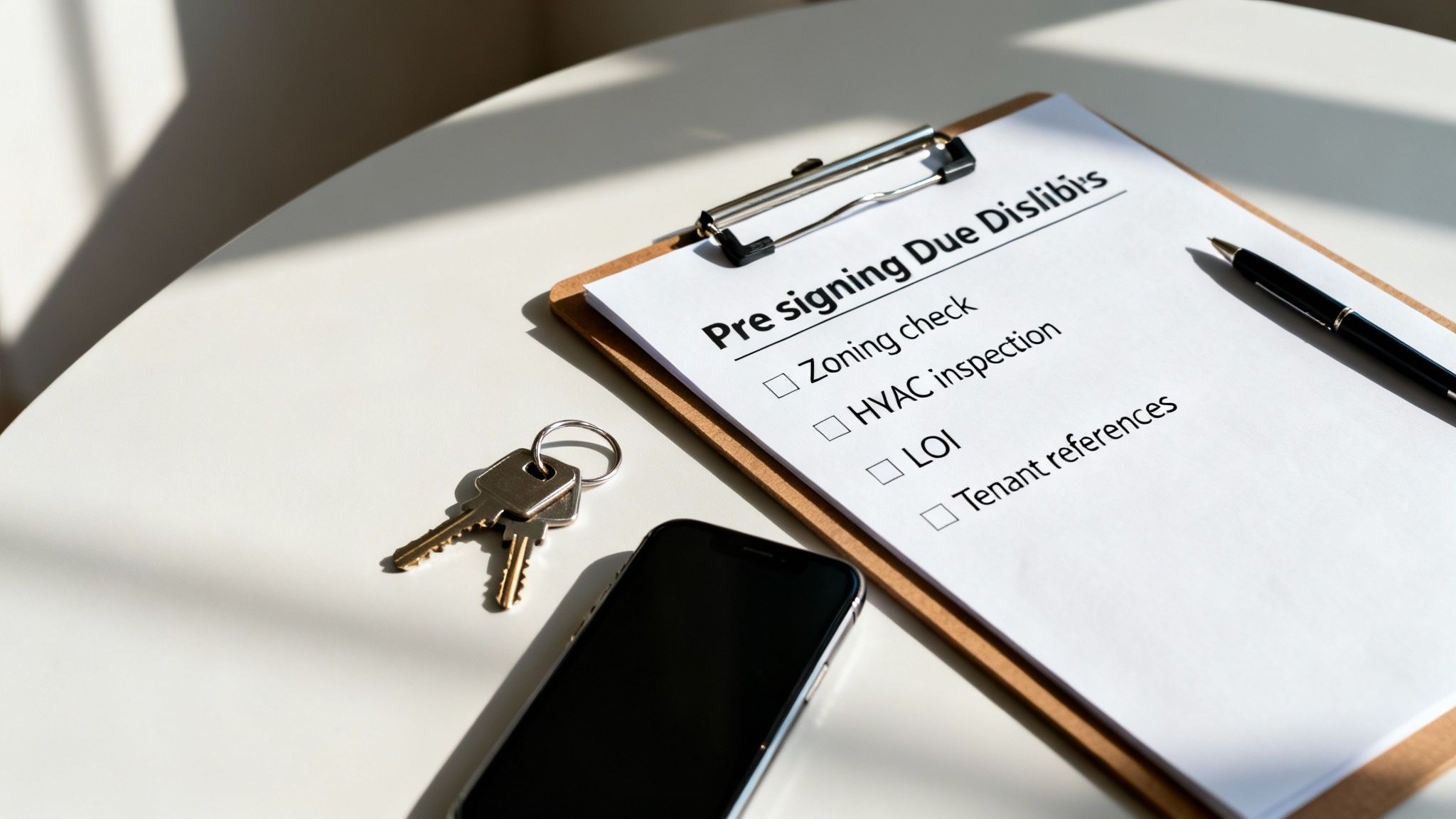
Signing a commercial lease is one of the biggest commitments your business will make. Before you even think about putting pen to paper, you need to do your homework. A thorough due diligence process is your single best defence against nasty surprises down the road.
Think of it as the final inspection before buying a house, but for your business's future home. This is not just about reading the contract. It is about digging deep into the property itself, understanding every legal string attached, and building a rock-solid negotiation plan. Rushing this stage is a rookie mistake that can have serious, long-term financial consequences for your Ottawa-based business.
The Due Diligence Phase
This first step is all about verification and investigation. You are looking for any hidden issues that a quick walkthrough or a skim of the lease document would never reveal. It is time to put on your detective hat.
- Confirm Zoning and Permitted Use: Do not ever assume the space is zoned for your type of business. A quick call to the City of Ottawa can confirm if the property’s zoning allows for your specific operations. Getting this wrong could literally stop your business before it even opens its doors.
- Arrange Professional Inspections: This is not the place to cut corners. Hire qualified professionals to inspect the building's core systems, including HVAC (heating, ventilation, and air conditioning), electrical, and plumbing. Imagine finding out you are on the hook for a $15,000 HVAC replacement six months in.
- Research the Landlord and Property: Do a little research. Look up your potential landlord or the property management company. What are their online reviews like? Better yet, talk to some of the other tenants in the building. A difficult, unresponsive landlord can make your life miserable.
- Complete a Full Legal Review: This is absolutely non-negotiable. Get a lawyer who specializes in Ontario commercial real estate to go through the lease with a fine-toothed comb. They will spot risky clauses, clarify your obligations, and propose crucial changes to protect you.
This groundwork is fundamental. For Ottawa entrepreneurs, local market conditions can present unique opportunities in stable areas like Kanata or Barrhaven, where foot traffic has not been hit as hard by hybrid work models compared to some GTA cores.
Your Negotiation Strategy
Once your homework is done, you can walk into negotiations with confidence and leverage. This is where you turn your findings into favourable lease terms that actually work for your business.
A well-planned negotiation strategy begins long before you sit down with the landlord. It requires defining your absolute must-haves, knowing your walk-away points, and understanding the market leverage you possess.
A Letter of Intent (LOI) is a great way to start. It is a non-binding document that lays out the main deal points like rent, term length, and any special conditions before you get bogged down in the formal lease. This ensures everyone is on the same page and saves a ton of time and legal fees.
Be crystal clear about your non-negotiables. These are the deal-breakers essential to your success. Maybe it is a critical renewal option, a cap on additional rent increases, or the right to sublet if you need to pivot. If you're still working through the basics of setting up your company, our guide on how to register a business in Ontario can help.
Finally, always be prepared to walk away. If the landlord will not budge on critical terms or your due diligence uncovered major red flags, do not be afraid to kill the deal. The perfect space with the wrong terms is a recipe for disaster, and a better opportunity is almost always out there.
Common Lease Pitfalls and How to Avoid Them
Learning from the mistakes of others is one of the smartest things you can do in business. When it comes to a commercial lease in Ontario, a few common but costly traps snag even the most careful entrepreneurs. Spotting these issues before you sign the document can save you years of headaches and financial stress.
Think of this section as your final pre-flight check. We will walk through the most frequent missteps Ottawa business owners make and give you clear, actionable advice on how to sidestep them.
Underestimating Total Occupancy Costs
One of the most dangerous traps is getting laser-focused on the base rent while glossing over the true cost of additional rent. Vague clauses for Common Area Maintenance (CAM) fees can lead to unpredictable, soaring monthly bills. A sudden invoice for a new roof or a major parking lot repaving could be a massive blow to your cash flow.
How to Avoid It: Get specific. Demand a detailed list of exactly what CAM fees cover. Even more importantly, negotiate a cap on how much those costs can increase each year. This one move turns a scary unknown into a predictable business expense you can actually budget for.
Accepting a Restrictive Use Clause
It is easy to agree to a narrow ‘Use’ clause that perfectly describes your business right now. For example, "a retail shop for handmade candles." But what happens in two years when you decide to offer candle-making workshops or sell complementary home decor? A restrictive clause could shut that idea down completely, strangling your ability to grow.
How to Avoid It: Always push for broader language. Try to negotiate something like, "retail sale of candles and related home fragrance and decor products, and for ancillary uses." This small wording change gives your business the breathing room it needs to evolve.
Overlooking the Demolition Clause
Tucked away in the fine print of many leases, you might find the dreaded demolition clause. This term gives the landlord the right to terminate your lease with surprisingly short notice, often just a few months, if they decide to redevelop or tear down the building. Imagine pouring thousands into your custom fit-up, only to be told you have to pack up and leave.
A demolition clause can completely wipe out your long-term security. If you see one, you must negotiate for a longer notice period, fair compensation for your unamortized leasehold improvements, and maybe even relocation assistance.
Failing to tackle these pitfalls head-on can easily lead to serious disputes. In a worst-case scenario, you might find yourself in a legal fight that was entirely avoidable.
Failing to Secure a Clear Renewal Option
This might be the most heartbreaking mistake of all. You build a thriving business with a loyal local following, only to find out your landlord has zero obligation to let you stay when your term is up. Without a clearly defined Option to Renew in your lease, they can simply rent the space to someone else, forcing you to start all over again in a new location.
How to Avoid It: Treat the renewal option as a non-negotiable from day one. Make sure the lease gives you, the tenant, the exclusive right to extend the term. It should also spell out exactly how the rent for that new period will be determined, so there are no nasty surprises down the road.
Frequently Asked Questions
Even the most thorough guide can leave you with lingering questions. When you're dealing with something as complex as an Ontario commercial lease, a few specifics always come up. Here are some quick, direct answers to the most common queries we hear from Ottawa business owners.
What Happens If I Need to Break My Lease Early?
Breaking a commercial lease is not like leaving a residential apartment. The stakes are much higher, and there is no easy exit ramp. If you simply walk away, your landlord has the right to sue you for all the rent you would have paid for the rest of the term. It is a serious financial blow.
Your first move should be to pull out your lease and find the assignment and subletting clauses. Finding another suitable business to take over your space is often the cleanest way out. If that is not an option, you will have to negotiate a formal termination agreement with your landlord, which will almost certainly involve a hefty penalty.
Who Is Responsible for Repairs?
This is one of those details that absolutely must be crystal clear in your lease. Generally, the landlord is on the hook for major structural elements, like the roof, foundation, and building-wide systems. The tenant is typically responsible for everything inside their own four walls, from drywall and paint to light fixtures.
Pay close attention to who is responsible for the HVAC unit that serves your space. A vague clause here can easily lead to a five-figure dispute when the air conditioning dies in the middle of a July heatwave.
Do I Really Need a Lawyer to Review My Lease?
Yes. Without a doubt, yes. Ontario's Commercial Tenancies Act provides very few safety nets for tenants, which means the lease document itself is the final word on your rights and obligations. A lawyer who specializes in commercial real estate is trained to spot the risks you cannot see.
They will identify dangerous clauses, push back on unfair terms, and negotiate protections you would not even know to ask for.
Think of a legal review as a critical business investment, not just another expense. The fee for a lawyer's time is a drop in the bucket compared to the potential financial ruin of a bad clause that comes back to bite you three years into your term.
What Is the Difference Between Lease Types?
Knowing the type of lease you're signing is key to understanding your true monthly costs. It is not just about the base rent.
- Gross Lease: This is the simplest model. You pay one flat, all-inclusive amount, and the landlord handles all the building's operating costs like property taxes and maintenance. What you see is what you pay.
- Net Lease: You pay a lower base rent, but you are also on the hook for some of the operating expenses. This could be just property taxes (Single Net) or taxes and insurance (Double Net).
- Triple Net (NNN) Lease: This is very common in commercial real estate. You pay your base rent plus your proportionate share of nearly all operating costs, including property taxes, building insurance, and common area maintenance (CAM). While popular, it shifts the most financial risk onto you, the tenant.
At NCR Now, we believe informed business owners build stronger communities. For more practical guides and local business insights tailored to the Ottawa region, explore our resources.
Visit us at https://ncrnow.ca to stay connected.
About The Author