
Meta Description: Learn how to register a business in Ontario with this guide. We cover choosing a business structure, using the Ontario Business Registry, and understanding costs.
Registering your business in Ontario is a key step in turning your idea into an official enterprise. The process usually begins at the online Ontario Business Registry, where you will either secure a Master Business Licence or file Articles of Incorporation. This guide explains the essential steps to make your venture official in the eyes of the province.
Your Starting Point for Ontario Business Registration

Starting a business is a major milestone. The next step is handling the administrative side to make it official. This guide is a practical roadmap for getting registered in Ontario, whether you are a freelancer in Ottawa or opening a new storefront in the GTA.
Making your business official is about more than paperwork. It provides legal standing, allows you to open a business bank account, and builds credibility with customers and suppliers. Before you begin, you need to decide on a business structure. This choice affects everything from your personal liability to how you will handle taxes.
We will walk through the main options:
- Sole Proprietorship: You are the business. It is the simplest structure, ideal for individuals running the business alone.
- Partnership: This is for two or more people who own and operate the business together.
- Corporation: A distinct legal entity separate from its owners, offering the highest level of liability protection.
Once you have chosen a structure, the next step is registering through the correct government channels. Your primary tool for this is the Ontario Business Registry (OBR), an online portal that has simplified the process for entrepreneurs across the province.
This guide focuses on the specific steps to register your business correctly from day one. If you are looking for a broader overview of the entire entrepreneurial journey, our guide on how to start a small business in Canada is a great place to start. Our goal here is to clarify the registration process and give you the confidence to build a solid foundation for your new venture.
Choosing Your Business Structure
Before you can register your business name, you have a critical first decision to make: what kind of business are you building? Choosing the right structure is more than a formality. It sets the legal and financial foundation for your venture.
This choice directly impacts your personal risk, how you will handle taxes, and the amount of administrative work you will face. It is the difference between your personal bank account being at risk for a business debt and having a legal firewall protecting your assets. Let's walk through the three main paths in Ontario.
The Sole Proprietorship
The sole proprietorship is the most common choice for new entrepreneurs because it is the simplest and least expensive way to start. In this structure, you are the business. There is no legal separation between you and the enterprise.
This structure is well suited for freelancers, consultants, or small operators. A graphic designer in Ottawa working from home with a few clients is a classic example of a sole proprietorship. The setup is fast, affordable, and requires minimal paperwork.
The main trade-off is unlimited liability. If your business accumulates debt or is sued, your personal assets, like your car, house, and savings, could be at risk. For taxes, the process is straightforward: all business income is reported on your personal tax return.
The Partnership
A partnership is like a sole proprietorship but for two or more people. It is a common structure for professionals who team up, such as two developers launching a small agency or two chefs opening a restaurant in the Glebe.
In Ontario, you will find two main types:
- General Partnership: This is the most common form. All partners are usually involved in running the business and share equally in the profits, debts, and management. Like a sole proprietorship, all general partners have unlimited personal liability.
- Limited Partnership: This structure is more complex and involves at least one general partner with unlimited liability who manages the business, and one or more limited partners. Limited partners are typically investors whose liability is capped at the amount they invest.
While you are not legally required to register a partnership, it is highly recommended to have a formal partnership agreement drafted by a lawyer. This document outlines how decisions are made, how profits and losses are divided, and what happens if a partner leaves. It can prevent significant problems later on.
The Corporation
Creating a corporation means establishing a new legal entity that is completely separate from its owners, who are known as shareholders. This separation is the biggest advantage over other structures and offers the strongest protection.
For example, a small construction company in Kanata that hires employees and takes on larger projects would benefit from incorporating. The owner's personal assets are shielded if the company faces serious financial or legal trouble. The corporation itself is responsible for its debts and obligations. This is called limited liability.
This protection comes with higher costs and more complexity. Corporations are more expensive to set up and maintain. You must keep detailed records, hold annual meetings, and maintain a corporate minute book. For taxes, the corporation files its own separate return, often at a lower corporate tax rate, which can create significant tax planning opportunities.
The choice between these structures involves a trade-off between simplicity and protection. A new freelancer will likely prefer the low cost and ease of a sole proprietorship. However, if your business involves employees, significant assets, or higher risk, you should seriously consider incorporation from the start.
Comparing Ontario Business Structures
Choosing a business structure is a significant decision, but breaking it down by key features makes it easier. The table below compares the core differences in liability, taxation, and complexity to help you decide which option best aligns with your goals.
| Feature | Sole Proprietorship | Partnership | Corporation |
|---|---|---|---|
| Owner(s) | One individual | Two or more individuals or entities | One or more shareholders |
| Liability | Unlimited personal liability | Unlimited personal liability (for general partners) | Limited liability for shareholders |
| Taxation | Business income is reported on your personal tax return | Profits and losses pass through to partners' personal returns | Files its own corporate tax return at a separate rate |
| Setup Cost | Low (typically under $100) | Low (similar to sole proprietorship) | Higher (often $300+ plus professional fees) |
| Complexity | Very simple setup and maintenance | Simple setup; partnership agreement is key | More complex, requires formal record-keeping |
| Best For | Freelancers, consultants, and single-owner small businesses | Collaborations, professional services, family businesses | Businesses seeking growth, investment, or liability protection |
This table is a starting point. While a sole proprietorship might be perfect today, remember that your business structure can change. As your venture grows, you can transition to a different structure, like incorporating, to meet your changing needs.
The Registration Process: Step-by-Step
Once you have picked your business structure, it is time to make it official by registering with the government.
This step lays the foundation for your business. Taking the time now to secure your name and navigate the government portals will save you from future complications. Let's walk through the process.
The first major task is choosing and registering your business name. This is not just about branding; it is about establishing your legal identity in Ontario. The process differs depending on whether you are a sole proprietor, in a partnership, or incorporating.
The infographic below provides a visual breakdown of how these three structures differ.
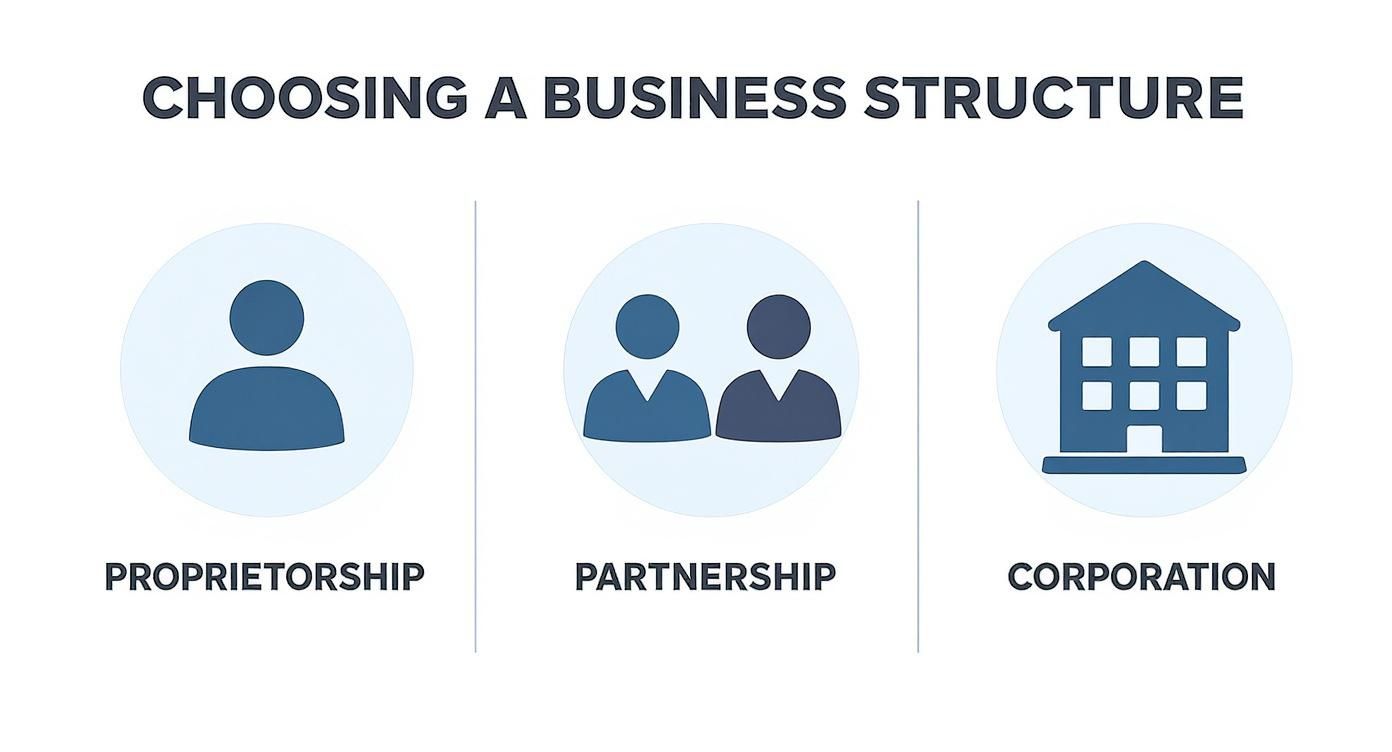
As you can see, the differences in ownership and legal status directly affect the registration steps you need to follow.
Securing Your Business Name
If you are launching a sole proprietorship or partnership, the name you operate under is officially called a trade name. The rule is that if you use any name other than your personal legal name, you must register it. For example, if your name is Sarah Chen and you call your business "Sarah Chen," no registration is needed. But if you call it "Sarah Chen Web Design," that name must be registered.
Corporations have a legal corporate name, which offers stronger, province-wide protection. Once your corporate name is registered, it is unique to you in Ontario and no one else can use it. This provides a higher level of exclusivity than a trade name.
A mandatory step for any corporation is obtaining a NUANS report. This is a comprehensive name search that scans multiple databases to ensure your proposed name is not too similar to existing corporate names or trademarks.
Even if you are a sole proprietor or in a partnership where a formal search is not required, conducting one is a wise move. It helps you avoid infringing on another company's name, which could lead to legal issues. We cover this in more detail in our guide to business name registration.
Using the Ontario Business Registry
Your main tool for registration is the Ontario Business Registry (OBR), which you can access through ServiceOntario. This is the online portal where the registration takes place. The platform has become much more user-friendly over the years, making it possible for most entrepreneurs to handle the process on their own.
The government has been working to make these services more efficient. According to the Ministry of Public and Business Service Delivery's 2024-2025 plan, many services are meeting or exceeding their standards, which means less waiting for you.
Registering a Master Business Licence
For sole proprietors and general partnerships, you will apply for a Master Business Licence (MBL). This document is your official proof of business name registration in Ontario and is valid for five years.
Here is what you will need to have ready:
- Your Chosen Business Name: The exact name you will be operating under.
- Business Activity Description: A short, one-sentence summary of what you do, for example, "providing residential landscaping services."
- Your Business Address: This must be a physical address in Ontario, not a P.O. box.
- Your Name and Home Address: As the owner or partner.
Once you submit everything, you should receive your MBL electronically within a few business days. You will need this document for tasks like opening a business bank account and signing contracts.
Filing Articles of Incorporation
If you are setting up a corporation, the process is more formal. Instead of an MBL, you will file Articles of Incorporation. This legal document officially creates your corporation as a separate entity.
The Articles of Incorporation require more detailed information, including:
- The legal name and address of the corporation.
- The number of directors, along with their names and addresses.
- The share structure, such as the number and types of shares the corporation can issue.
- Any restrictions on the business's activities or how shares can be transferred.
After your articles are successfully filed, you will be issued a Certificate of Incorporation. This is your corporation's official birth certificate.
Getting Your Business Number from the CRA
The final step is getting your Business Number (BN) from the Canada Revenue Agency (CRA). This nine-digit number is your unique identifier for all federal tax matters.
If you incorporate, a BN is automatically generated for you. For sole proprietors and partnerships, you will need to register for one yourself if you expect to:
- Hire employees and need a payroll account.
- Make more than $30,000 in a year, which requires you to register for a GST/HST account.
You can sign up for a BN online using the CRA's Business Registration Online service. This number is critical for managing your federal taxes, so do not skip this step. Once you have your provincial registration and your federal BN, you are officially in business.
Understanding the Costs and Timelines
When launching a business, it is important to understand the actual costs and timelines involved. This knowledge is crucial for setting a realistic budget and avoiding surprises.
The good news is that registering a business, especially a sole proprietorship, is affordable and quick when using online systems.
A Breakdown of Government Fees
The first costs you will face are the direct government fees, which vary based on your business structure. A sole proprietorship is the least expensive option, while a corporation has a higher price tag.
Here is a quick look at the direct government fees:
- Master Business Licence (Sole Proprietorship/Partnership): Registering your business name online through the Ontario Business Registry costs $60. This registration is valid for five years and must be renewed for the same fee.
- Provincial Incorporation: To create a corporation in Ontario, you must file Articles of Incorporation, which has a government fee of $300. This is a one-time cost.
- NUANS Name Search Report: This is a mandatory step for incorporating. A provincial NUANS report, which ensures your chosen name is unique in Ontario, typically costs about $25.
These are the required costs for making your business official with the government.
Potential Extra Costs to Consider
Beyond the filing fees, other expenses may arise. While not mandatory, investing in these early on can prevent future problems.
It is wise to budget for:
- Legal Advice: A lawyer can review a partnership agreement or guide you through incorporation. This ensures your legal foundation is solid and protects everyone involved.
- Accounting Services: An accountant can provide advice on tax planning, help you set up bookkeeping correctly, and ensure you understand your GST/HST obligations.
- Third-Party Filing Services: Many companies can handle the registration or incorporation process for you. While this adds to the upfront cost, it offers convenience and peace of mind.
Investing in solid legal or accounting advice at the beginning is one of the smartest things a new entrepreneur can do. It builds a strong foundation and helps you avoid costly mistakes.
Realistic Timelines for Registration
How long does this all take? Thanks to the province's online portals, the process is faster than ever. The exact timeline depends on your business structure and how you file.
- Online Registration: If you are registering a Master Business Licence online for a sole proprietorship or partnership, you can often receive your official documents within one to two business days.
- Incorporation: Incorporating takes a little longer. Once you have submitted your NUANS report and Articles of Incorporation online, you can usually expect to receive your Certificate of Incorporation within a few business days.
- Mail-in Applications: Filing by mail is still an option, but it can take several weeks for paper applications to be processed. For anyone who values their time, online filing is the best choice.
Looking Beyond Provincial Registration
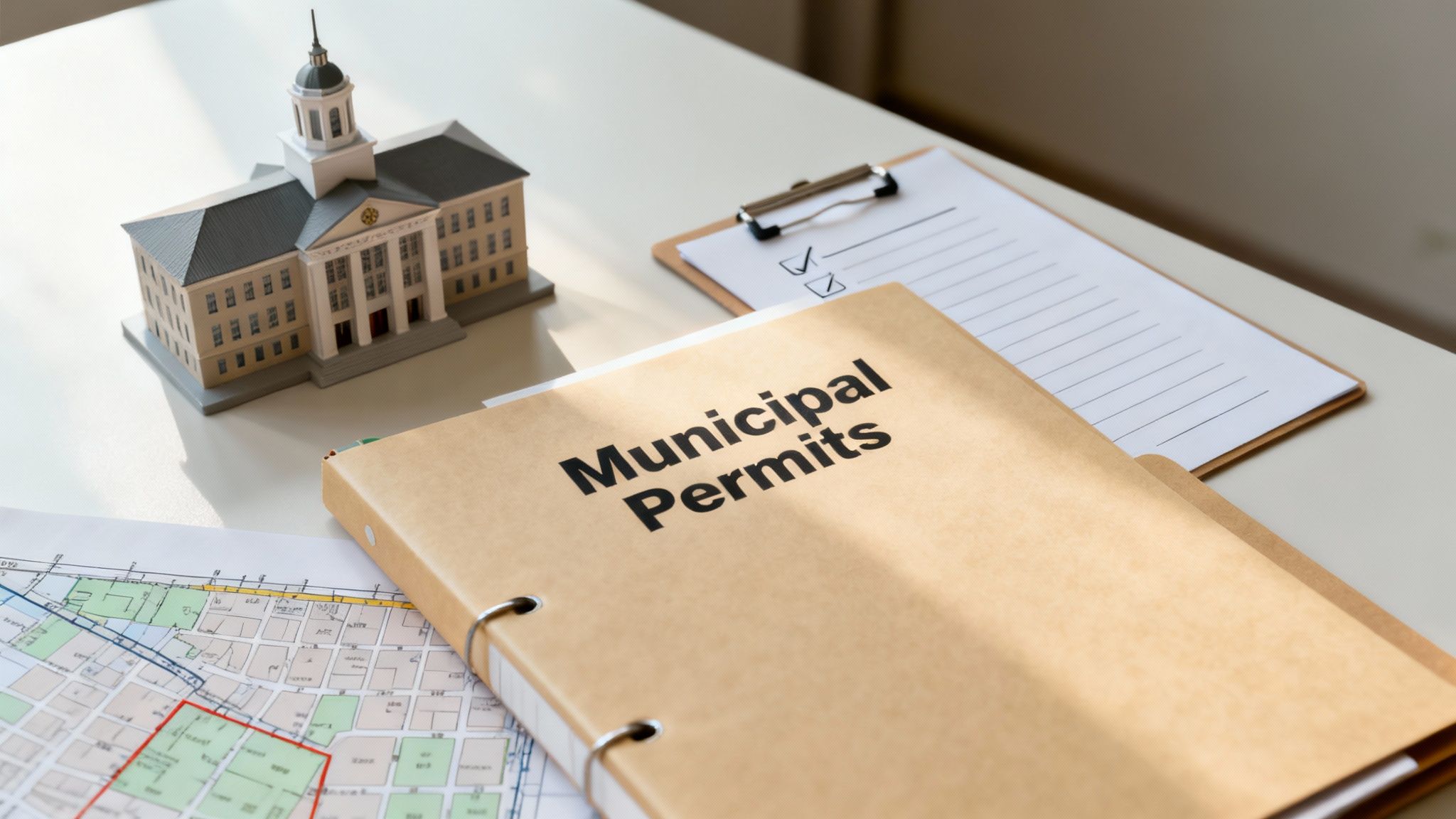
Provincial registration is a major step, but the paperwork does not end there. That registration is the foundation. Now, you need to add the next layers, which often involve municipal and sometimes federal rules. This is where your business connects with the local community you plan to serve.
For anyone launching in a city like Ottawa, that next layer is the municipality. Your business is a physical presence in a neighbourhood, and local by-laws ensure everything runs smoothly.
Before you print business cards or put up a sign, you need to make sure your business is allowed to operate from your chosen location.
Checking Municipal Zoning and Licences
First, you must look into local zoning by-laws. These rules dictate what kind of commercial activities can happen where. A quiet residential street has different rules than a commercial zone like the ByWard Market. This is especially important for home-based businesses, which often face restrictions on customer traffic, signage, and the type of work you can do.
Next are municipal business licences. The City of Ottawa, like other municipalities, requires certain types of businesses to get a licence before they can operate. These rules are usually in place to protect public health and safety.
Some common businesses that need a municipal licence include:
- Restaurants, cafes, and food trucks
- Contractors and skilled tradespeople
- Personal service businesses like hair salons or tattoo shops
- Daycares and child care centres
- Taxis and ride-sharing services
You can usually find the complete list and apply on your city's website. Skipping this step is not worth the risk of fines and other issues.
Municipal compliance shows you are a responsible local business owner who respects community standards. This builds trust with your neighbours and future customers.
When to Consider Federal Incorporation
While most new businesses in Ontario incorporate provincially, there are times when federal incorporation is the better choice. A provincial incorporation protects your business name within Ontario. In contrast, federal incorporation gives you name protection across Canada.
This is the path to take if you plan to operate nationwide from the start. If you want to open offices in multiple provinces or secure your brand name from coast to coast, going federal is the way to go. Remember that even with federal status, you must still register as an extra-provincial corporation in every province where you have a physical presence.
Ontario's economy is highly connected, with 14 border crossings to the United States. This location provides excellent access to global markets, but it also means a solid, compliant business structure is essential if you plan to grow. You can learn more about Ontario's economic outlook on occ.ca.
Industry-Specific Permits and Regulations
Finally, some industries have their own unique rules. These regulations are often handled by provincial ministries or specific industry bodies. For example, a daycare must meet provincial child care standards, while a home renovator needs to follow the Ontario Building Code.
Once you have all your registrations, licences, and permits, the next major task is managing your financial responsibilities. To get a head start, check out our guide on how to file taxes in Canada for a clear overview. Understanding these additional layers of compliance will ensure your business is not only legal but also built for long-term success.
Common Questions About Registering a Business in Ontario
Starting the business registration process for the first time will likely bring up some questions. This section addresses the most common questions from new entrepreneurs in Ottawa to provide direct answers and clear the path forward.
Do I Need to Register My Business If I Use My Own Name?
This is one of the most common questions. If you are a sole proprietor and your business name is your exact legal name, for example, "Jane Doe," you typically do not need to register it. The government views you and the business as the same entity.
However, if you add anything to your name, registration becomes mandatory. Calling yourself "Jane Doe Consulting" or "Jane Doe & Co." requires you to register that name and get a Master Business Licence. This is for transparency, so your customers know who they are dealing with.
What’s the Difference Between Provincial and Federal Incorporation?
The choice of where to incorporate depends on your business ambitions. Provincial incorporation, which we have focused on here, establishes your corporation under Ontario's laws. This is suitable for most new businesses, as it gives you the right to operate within the province and protects your corporate name here.
Federal incorporation creates your corporation under Canadian law. This provides name protection across the country, which is a major advantage if you are planning a national operation from the start. It is a more involved process. Even with a federal charter, you must still register your corporation in every province where you have a physical presence, like an office or warehouse.
For most startups with a local or regional focus, provincial incorporation is the simplest and most cost-effective option. You can always expand and register in other provinces as your business grows.
How Do I Get a Business Number and What Is It For?
Your Business Number (BN) is a unique, nine-digit identifier assigned by the Canada Revenue Agency (CRA). It is essential for all your federal tax matters. You can think of it as a social insurance number for your business.
How you get a BN depends on your business structure:
- Corporations: A BN is automatically assigned when you incorporate. You do not need to take any extra steps.
- Sole Proprietorships & Partnerships: You must register for a BN yourself directly with the CRA. This is mandatory if you plan to hire employees, which requires a payroll account, or if your annual revenues are expected to exceed $30,000, which requires a GST/HST account.
You can register for a BN online using the CRA's Business Registration Online (BRO) service. It is a straightforward process that officially places your business on the federal tax radar.
Can I Change My Business Structure Later On?
Yes, businesses evolve, and it is very common for entrepreneurs to change their structure as they grow. The most frequent change is a sole proprietor deciding to incorporate to gain limited liability protection and access new tax possibilities.
This is not as simple as flipping a switch. You cannot just "convert" a sole proprietorship into a corporation. The process involves legally dissolving your old business registration and then starting from scratch to create a new corporation. This means you will need to formally transfer assets, client contracts, and bank accounts from the old business to the new one.
Because this change has major legal and financial implications, it is crucial to get advice from both a lawyer and an accountant. They will ensure the transition is handled correctly, protecting your assets and setting up your new corporation for success.
At NCR Now, we provide practical information for those living and working in Ottawa and the National Capital Region. From navigating business registration to discovering local events, we are your source for relevant, community-focused content. Explore more at https://ncrnow.ca.
Article created using Outrank
About The Author