

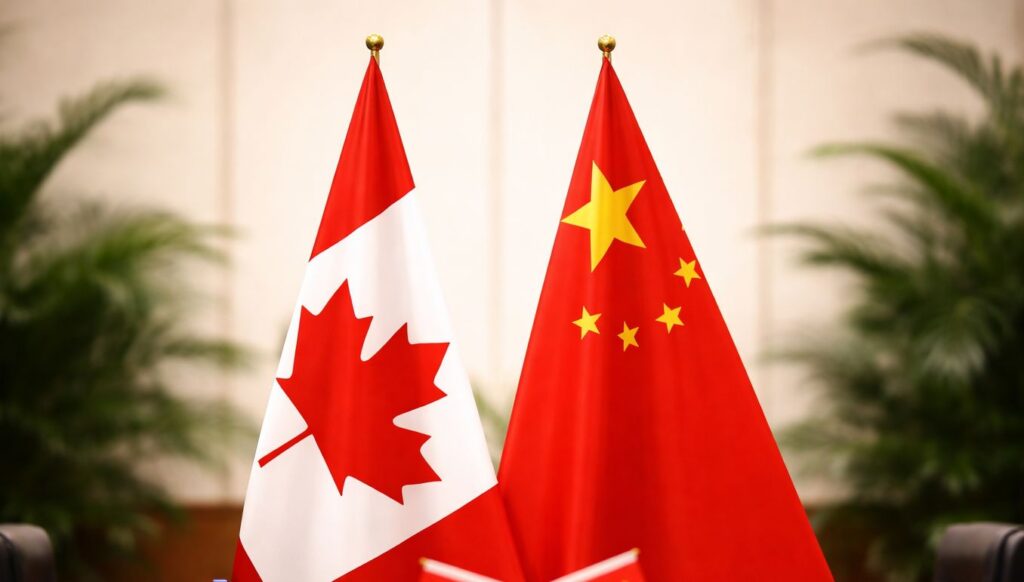
In January 2026, Canada made a deliberate shift in its international trade strategy by striking a preliminary trade agreement with China, signalling a broader reorientation of Canada China trade relations amid mounting global economic pressures. The move, led by Prime Minister Mark Carney during a state visit to Beijing, reflects a pragmatic response to a rapidly shifting trade environment rather than a sharp ideological realignment.
The heart of this development is a deal to reset tariffs on key goods that have long been points of contention between the two countries. Canada agreed to reduce tariffs on Chinese-made electric vehicles (EVs) from 100 per cent to 6.1 per cent for up to 49,000 cars annually, with the quota set to rise over time. In exchange, China pledged to lower its punitive tariffs on Canadian canola seed from about 84 per cent to roughly 15 per cent, and to lift anti-discrimination tariffs on other agricultural and food products like lobsters, crabs, and peas. These changes are expected to unlock nearly $3 billion in trade opportunities for Canadian exporters.
Carney framed the agreement as part of a “new strategic partnership” that reflects the realities of a more fragmented global economy and Canada’s desire to diversify its export markets. It was the first visit by a Canadian prime minister to China since 2017.
Canada China Trade Driven by Mounting Economic Pressures
Relations between Ottawa and Beijing have been strained for years, punctuated by tariff escalations, diplomatic disputes, and tit-for-tat economic measures that culminated in what analysts call a Canada China trade war in 2024–25. Canada’s initial 100 per cent tariff on Chinese EV imports in 2024 was part of broader protectionist measures targeting what Ottawa described as unfair competition. China responded with heavy tariffs on Canadian agricultural exports, choking off sales that historically helped sustain Canadian producers, especially in prairie provinces.
Canada’s adjustment in 2026 reflects not only Ottawa’s desire to restore market access but also to hedge against the fallout of strained relations with the United States. Under President Donald Trump, the U.S. imposed tough tariffs on Canadian goods, prompting Ottawa to seek alternative markets for exporters and to rely less on its largest trading partner. Rebasing Canada China trade through this agreement is part of that broader economic strategy.
Economic Impacts and Industry Reactions
Supporters of the deal argue that it restores predictability and opens new avenues for Canadian industries that have suffered under recent trade retaliation. For farmers and fish harvesters, the prospect of restored access to China’s large consumer market offers a tangible economic lifeline after months of disrupted exports. Early signs of a thaw emerged when a Chinese importer purchased about 60,000 metric tonnes of Canadian canola — the first such deal since imports stalled in late 2025 — in anticipation of the tariff reduction.
In the automotive sector, the reduction of EV tariffs is expected to bring Chinese-made vehicles back into the Canadian market at more competitive prices. Industry analysts have even pointed to potential benefits for third parties; for example, Tesla could leverage its Shanghai production to ship vehicles to Canada more efficiently, though domestic automakers in Ontario have expressed concern about increased competition.
Despite these potential upsides, some critics remain wary. Ontario Premier Doug Ford was one of several politicians to publicly criticize the tariff rollback, warning it could undermine domestic auto manufacturing if not paired with guarantees of investment and jobs within Canada. In broader political commentary, some analysts argue that pivoting heavily toward China risks overdependence on a single market and raises questions about long-term strategic autonomy. Opponents point out that deeper economic ties could complicate Canada’s relationships with traditional allies and entangle trade policy with geopolitical stakes.
Balancing Pragmatism and Risk
Carney’s approach has been consistent with his broader rhetoric about navigating a changing global landscape. When pressed about human rights and political differences during the visit, he indicated that Canada must engage with the world as it is, not as policymakers wish it to be — a statement that underscores the pragmatic logic behind these trade decisions.
This pragmatism resonates with a central feature of modern Canada China trade: both countries are major participants in global supply chains whose economic interests are deeply interwoven despite ongoing political tensions. China remains a large market for Canadian commodities, particularly agricultural products and natural resources, while Canada represents a significant source of foreign demand for Chinese manufactured goods. Strengthening this relationship may help Canadian exporters reduce their vulnerability to bilateral tensions and benefit from China’s role in global commerce.
At the same time, the deal highlights the challenges of balancing economic diversification with political risk. Critics — including a former Canadian ambassador who has warned that embracing China too quickly may sideline more comprehensive market diversification — point to the long cycle of disputes and retrenchment that have characterized the bilateral relationship over the past decade. Such concerns suggest that Ottawa’s pivot, while practical, is not without its own strategic trade-offs.
Looking Ahead
What happens next with Canada China trade will depend on how both governments implement the preliminary agreements and whether they can translate tariff reductions into sustained export and investment growth. The tariff deal is provisional and subject to ongoing negotiations; final decisions on some aspects, such as anti-dumping investigations, are expected in the coming weeks.
For Canada, the pivot toward China highlights a broader effort to adapt to a world where economic dependence on a single trade partner is increasingly seen as a vulnerability. Whether this strategic balancing act will deliver long-term stability and growth remains an open question, but Canada’s recent gambit shows a willingness to take calculated risks in pursuit of economic resilience.
About The Author