
Photo by Khaled Ashgr
At 1:15 a.m. Eastern on February 28, 2026, American B-2 Spirit bombers initiated the opening strikes of the Iran war, marking the most consequential U.S. military operation since the 2003 invasion of Iraq. Dubbed Operation Epic Fury by the United States and Operation Roaring Lion by Israel, this massive joint campaign decimated over 1,000 targets within its first 24 hours. The primary military objectives included disabling missile production sites, neutralizing air defence infrastructure, and systematically dismantling the high command of the Islamic Revolutionary Guard Corps (IRGC). war
By dawn, the Supreme Leader of the Islamic Republic, Ayatollah Ali Khamenei, was dead—a fact confirmed by Iranian state media shortly thereafter. While Israeli Prime Minister Benjamin Netanyahu publicly claimed responsibility for these precise leadership decapitation strikes, the United States focused its messaging on the broader degradation of Iran’s military capabilities. However, the celebratory tone struck by the White House, which implied a swift and decisive victory, quickly gave way to a much starker reality. What began as a targeted aerial bombardment has rapidly evolved into a volatile, multi-front conflict whose staggering financial and human costs are only just beginning to register on the global stage.
The Geopolitical Fault Lines
The international coalition supporting the bombing campaign is notably narrower than initial diplomatic rhetoric suggested. As nations reposition themselves, it is clear that the geopolitical fallout of the Iran war will reshape international alliances.
The Opportunists and the Vulnerable: Global superpowers Russia and China have predictably condemned the operation, labelling it Western aggression. For Beijing, the stakes are immediate and physical: China receives a significant share of its oil through the Strait of Hormuz and faces immediate supply disruption. Russia, conversely, finds itself in a paradoxical position. While it loses a vital regional partner and customer for advanced air defence systems, the stranding of Middle Eastern crude forces heavy consumers like India and China to deepen their reliance on Russian oil exports, potentially granting Moscow immense commercial leverage.
The Core Architects: Israel’s alignment is unambiguous. Operating alongside the U.S. under the joint codename Operation Roaring Lion, Israeli forces reportedly took direct responsibility for the leadership decapitation strikes.
The Unlikely Allies: Ukraine’s position is less intuitive at first glance but reflects a concrete strategic interest. Throughout its own conflict with Russia, Kyiv has been battered by Iranian-manufactured Shahed drones. For Ukraine, the disruption of Iranian drone and missile proliferation is an existential survival issue. Further broadening the coalition, Canada has also expressed qualified support.
The Gulf State Dilemma: The situation is profoundly complicated for neighbouring Gulf nations. Historically, Saudi Arabia and the United Arab Emirates have advocated for a weakened Iran to curb its regional influence and proxy forces in Yemen and elsewhere. Yet, as analysts note, adjacency to a war zone does not grant control over it. Iranian retaliatory strikes have already hit U.S. military bases scattered across Qatar, Kuwait, Bahrain, and the UAE.
The Strait of Hormuz and the Oil Surge
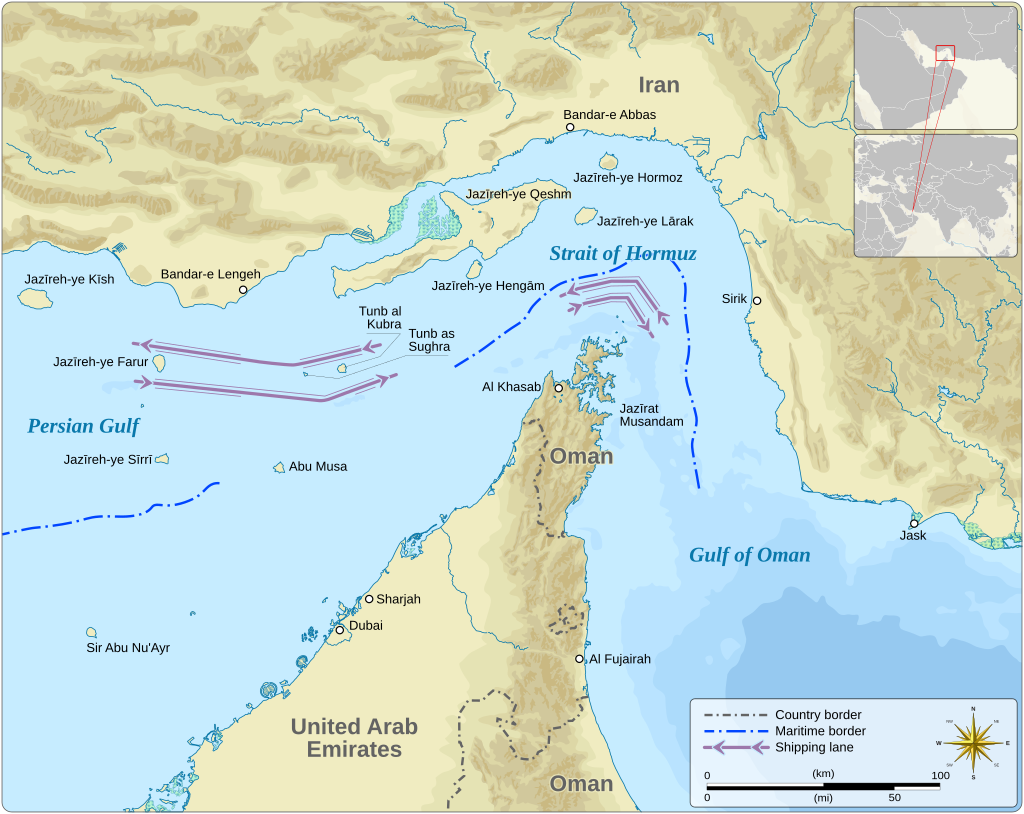
The economic fallout of Operation Epic Fury materialized faster than the military results. The primary theatre for this economic shock is the Strait of Hormuz, a narrow maritime chokepoint through which approximately 20% of the world’s daily oil consumption flows.
Iran did not need to officially declare a naval blockade to effectively close the strait. A handful of IRGC drone and rocket attacks on commercial vessels during the opening days of the conflict triggered widespread panic in the shipping industry. Major maritime insurers—including Gard, Skuld, NorthStandard, and the London P&I Club—swiftly withdrew war-risk coverage, making transit financially impossible for most carriers. Global shipping giants like Maersk and Hapag-Lloyd immediately suspended their routes. Consequently, the benchmark freight rate for Very Large Crude Carriers (VLCCs) exploded to an all-time high of $423,736 per day, from approximately $218,420 per day, representing a massive 94% increase in a single weekend.
This disruption to global crude flows triggered an immediate surge in oil prices across energy markets. Brent crude, which traded just above $73 before the strikes, skyrocketed roughly 11% in three trading sessions, settling at $81.40 per barrel. Financial institutions are sounding the alarm. JPMorgan’s head of global commodities research, Natasha Kaneva, informed clients that this represents the “first near total halt to shipping through the Strait in modern history.” Wood Mackenzie warns prices could easily breach $100 per barrel if maritime traffic is not quickly restored. If the disruption lasts beyond three weeks, JPMorgan models suggest Brent could hit $120, and a worst-case scenario involving a full naval blockade yields speculative projections of $200 per barrel.
This specific Iran war oil surge functions essentially as a highly regressive global tax. Working-class households in the U.S. and Europe—who devote a larger percentage of their income to fuel and heating—will absorb the brunt of these costs, with American pump prices expected to rise by 10 to 30 cents per gallon almost immediately, according to GasBuddy’s Patrick De Haan. In the Global South, the combination of dollar-denominated fuel costs and weakened local currencies threatens to plunge recovering economies back into severe stagflation.
The Iran War Economy Paradox: Public Cost vs. Private Gain
Perhaps the most glaring aspect of the conflict is the stark asymmetry of the war economy, in which immense public financial losses directly fuel concentrated private gain. The economic architecture of this conflict deserves far more scrutiny than it is currently receiving.
The United States is locked into an incredibly expensive strategy of attritional warfare against Iranian technology. The Pentagon relies on highly advanced systems like the THAAD interceptor to shoot down incoming threats. A single THAAD interceptor costs American taxpayers roughly $12.77 million. By contrast, the Iranian Shahed drones that are deployed to destroy cost merely $20,000 to $50,000 each. Because Iran utilizes saturation tactics—launching waves of cheap drones simultaneously—the financial exchange ratio overwhelmingly favours the attacker, forcing the U.S. to absorb a staggering 100:1 cost differential.
Yet, for defence contractors, this dynamic is immensely profitable. The military must constantly replenish its depleted stockpiles, guaranteeing massive, sustained contracts regardless of the strategic outcome on the ground. Wall Street has eagerly priced in these windfalls. While the broader Dow Jones and S&P 500 remained flat at the outbreak, defence stocks surged. RTX, manufacturer of Patriot systems and Tomahawk cruise missiles, closed up 4.7%, and Northrop Grumman rose 6%. Lockheed Martin—which recently signed a contract to quadruple its THAAD production from 96 to 400 annually—saw its stock climb nearly 40% since the beginning of the year as tensions grew, hitting record highs near $698 on March 2.
A similar paradox exists in the energy sector, adding a second layer to the war economy. Unlike the 2003 invasion of Iraq, when the U.S. was a net importer of crude, the U.S. is now the world’s largest oil producer, extracting approximately 13.6 million barrels daily. When global supply panics drive Brent crude up by $10 a barrel, domestic energy giants like ExxonMobil capture astronomically higher revenues on every barrel they extract. Ultimately, the average consumer pays the inflated price at the gas pump while shareholders reap the dividends.
Human Costs and the Illusion of Regime Change
Behind the soaring stock tickers and commodity index charts is a rapidly escalating humanitarian crisis. Inside Iran, the situation is both militarily and politically volatile. Early Red Crescent figures cited 201 civilian casualties and 747 injuries within the first day of strikes. By March 2, the human rights organization Hengaw estimated 1,300 Iranian military personnel had been killed.
The defining strategic wager of the Iran war’s Operation Epic Fury is regime change—the belief that severe military punishment will shatter the Islamic Republic’s grip on power and spark a democratic transition that the local population can exploit. History severely undermines this optimism. A century of evidence from strategic bombing campaigns suggests that coercion traditionally fails when a sovereign government perceives itself to be fighting an existential battle for survival.
Populations subjected to intense foreign bombardment typically default to solidarity rather than revolt. As experts at the Stimson Center observe, strategic airpower has almost never toppled a government by itself. The often-cited comparison to Libya actually serves as a cautionary tale: NATO’s air superiority only achieved regime change because it was paired with organized, indigenous ground forces to convert military pressure into political collapse. In Iran in 2026, no such unified opposition force currently exists to capitalize on the chaos. The decapitation of the IRGC high command may degrade Iranian command and control without producing the internal revolution the White House desires. Time magazine noted that even Iranians who have been beaten and imprisoned by the regime fiercely condemn foreign interference.
Conclusion: A Genuine Strategic Quagmire
While Iran’s leadership is battered and its economy is under intense stress, it does not currently appear to be on the precipice of total collapse. As the conflict moves on, the durability of the Western political coalition will be severely tested. Public support may crumble as voters simultaneously face skyrocketing gas and grocery costs. Ultimately, whether this heavy bombardment ends in a successful regime change or devolves into a gruelling, decade-long insurgency remains a genuinely open question. But one fact is already settled in the wake of the Iran war: the architects and beneficiaries of the war economy have already won, and their shares are trading at record highs.
Note: The data synthesis and literature review within this document were conducted using Gemini (Google) and Claude (Anthropic). The author has exercised due diligence in cross-referencing AI-generated outputs with primary sources to mitigate the risk of “hallucinations” or factual errors.
Further Reading
- Geopolitics: The Stimson Center – Analysis of Global Security and Foreign Policy
- Energy Markets: U.S. Energy Information Administration (EIA) – U.S. Crude Oil Production Data
- Defence Tech: Terminal High Altitude Area Defense (THAAD) Overview
- Global Trade Routes: The Strategic Importance of the Strait of Hormuz
About The Author