
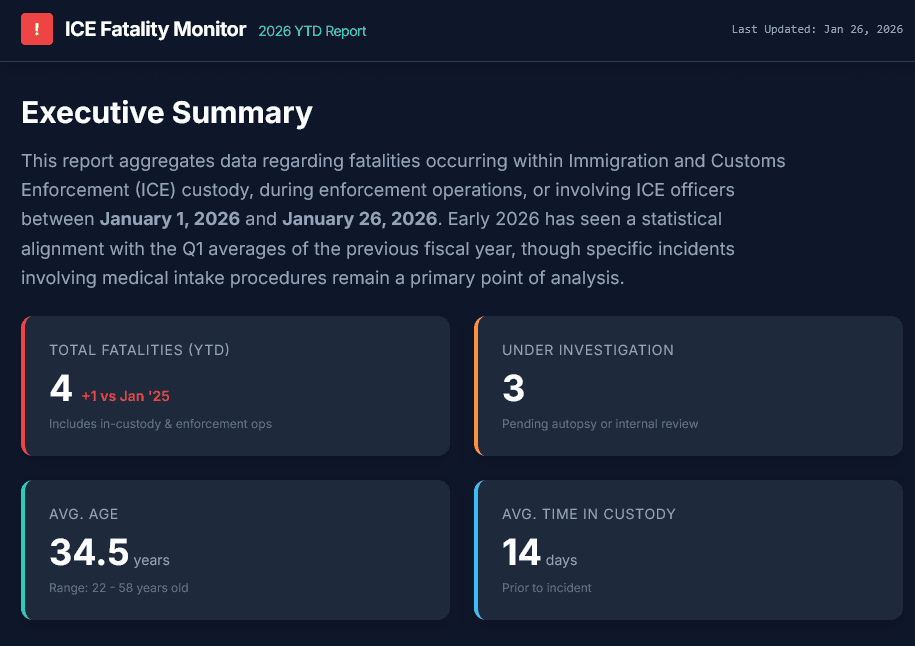
The opening weeks of 2026 have witnessed a precipitous and unprecedented escalation in fatalities associated with the operations, handling, and custodial detention of U.S. Immigration and Customs Enforcement (ICE) and the broader Department of Homeland Security (DHS) apparatus. This surge in mortality follows a calendar year in 2025 that was already identified as the deadliest for the agency in over two decades, with at least 32 reported deaths.1 As of January 25, 2026, the current year has already recorded six disclosed deaths within the civil detention system and two high-profile fatal shootings of American citizens in Minneapolis, Minnesota.4 This trajectory suggests not only a quantitative increase in lethal outcomes but a qualitative shift in enforcement tactics, characterized by a militarized interior presence, the systematic dismantling of internal oversight mechanisms, and a critical divestment from the medical infrastructure required to sustain a record-high detained population.6
The current operational landscape is defined by “Operation Metro Surge,” an intensive federal enforcement initiative that has deployed thousands of agents into metropolitan centers, often resulting in violent confrontations that blur the lines between civil immigration enforcement and paramilitary action.5 This analysis examines the specific fatalities occurring since January 1, 2026, within the context of systemic stressors, including a total detained population exceeding 73,000, the suspension of payments to medical contractors, and a deepening jurisdictional crisis between federal agencies and state authorities.6
Forensic Analysis of Custodial Fatalities
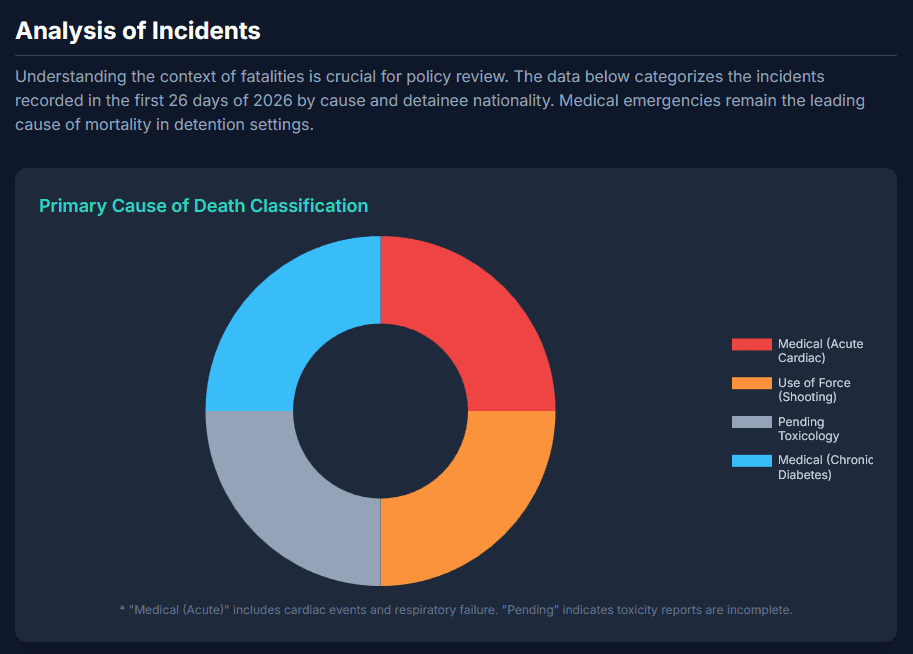
The mortality rate within ICE detention facilities during the first twenty-six days of 2026 reflects a state of systemic collapse. The six documented deaths encompass a range of circumstances, from medical neglect and untreated substance withdrawal to contested suicides and a confirmed homicide by asphyxia.4 These incidents are geographically dispersed across facilities in Texas, Georgia, Pennsylvania, and California, yet they share common denominators of inadequate medical intervention and the escalatory use of physical restraint.4
The 2026 Custodial Mortality Record
The following table synthesizes the known data for individuals who have died in ICE custody or during the immediate handling process since January 1, 2026.
| Date of Death | Name | Age | Nationality | Location of Incident | Primary Reported Cause |
| 2026-01-03 | Geraldo Lunas Campos | 55 | Cuba | Camp East Montana (El Paso, TX) | Homicide (Asphyxia via restraint) |
| 2026-01-05 | Luis Gustavo Nunez Caceres | 42 | Honduras | HCA Healthcare (Conroe, TX) | Congestive Heart Failure |
| 2026-01-06 | Luis Beltran Yanez–Cruz | 68 | Honduras | JFK Memorial Hospital (Indio, CA) | Cardiac Arrest / Chest Pains |
| 2026-01-10 | Parady La | 46 | Cambodia | T. Jefferson Univ. Hospital (Phila., PA) | Organ Failure (Drug Withdrawal) |
| 2026-01-14 | Heber Sanchez Dominguez | 34 | Mexico | Robert A. Deyton Facility (Lovejoy, GA) | Apparent Suicide (Hanging) |
| 2026-01-14 | Victor Manuel Diaz | 36 | Nicaragua | Camp East Montana (El Paso, TX) | Presumed Suicide |
Case Study: The Homicide of Geraldo Lunas Campos
The death of Geraldo Lunas Campos on January 3, 2026, serves as a critical indictment of the current use-of-force protocols within segregation units.4 Lunas Campos, a 55-year-old Cuban national who had resided in the United States since 1996, died following an altercation with guards at the Camp East Montana facility in El Paso.11 Initial reports from the Department of Homeland Security characterized the event as a suicide attempt, claiming that guards intervened to save him.6 However, subsequent forensic evidence and eyewitness testimony have fundamentally undermined this narrative.
An autopsy conducted by the El Paso County Medical Examiner’s Office and released on January 21, 2026, officially ruled the death a homicide.4 The deputy medical examiner, Dr. Adam Gonzalez, identified the cause of death as asphyxia due to neck and torso compression.12 The report noted the presence of petechial hemorrhages—tiny blood spots from burst capillaries—in the eyelids and the skin of the neck, which are classic indicators of intense external pressure on the respiratory and circulatory systems.4 Eyewitness accounts from fellow detainees provide a harrowing description of the events: at least five guards reportedly tackled and choked Lunas Campos after he refused to enter a segregation unit, claiming he needed his medication for bipolar disorder and anxiety.6 Witnesses heard him repeatedly state, “No puedo respirar” (“I can’t breathe”), a plea that was reportedly ignored until he became unresponsive.4
This homicide ruling is particularly significant because it occurred within a facility located on the Fort Bliss army base, a jurisdiction that often complicates state and local oversight.12 The case has triggered demands from Representative Veronica Escobar and other congressional leaders for a full briefing on the “segregation” policies that frequently lead to such escalations.11 Furthermore, the administration’s decision to label Lunas Campos a “criminal illegal alien and convicted child sex predator” immediately following the homicide ruling has been criticized as a diversionary tactic aimed at delegitimizing the victim rather than addressing the misconduct of the personnel involved.11
Medical System Failure and the Crisis of Neglect
The deaths of Luis Gustavo Nunez Caceres, Luis Beltran Yanez-Cruz, and Parady La highlight a broader collapse in the medical care infrastructure within the detention system. This collapse is directly linked to the October 3, 2025, decision to halt payments to various medical care contractors, leading to a “rationing” of care and basic supplies.1
Parady La, a 46-year-old Cambodian national, died on January 10, 2026, after suffering from anoxic brain injury and multiple organ failures.4 Family members and advocates reported that while being held at the Federal Detention Center in Philadelphia, La was undergoing severe drug withdrawal.4 Despite begging for water and medical assistance while vomiting in his cell, he was reportedly denied timely intervention.4 This incident reflects a systemic failure to manage detoxification protocols, a basic requirement for custodial safety.
Similarly, the deaths of Nunez Caceres (42) and Yanez-Cruz (68) from cardiac-related issues suggest that the agency is struggling to manage a population that includes older individuals and those with chronic health conditions.4 The rapid expansion of the detention system, which now utilizes over 100 more facilities than it did a year ago, has outpaced the agency’s ability to provide even minimal health screenings or emergency responses.15 At facilities like the Adelanto ICE Processing Center, which has seen a surge in population following increased enforcement in California, advocates report that medical oversight has been further eroded under the current administration, making private lawsuits often the only viable path for grieving families.16
Mental Health and the Question of Custodial Suicide
The deaths of Heber Sanchez Dominguez and Victor Manuel Diaz on January 14, 2026, underscore the severe psychological impact of the current detention environment. Sanchez Dominguez was found hanging in his cell at the Robert A. Deyton Detention Facility in Georgia, an event that advocates from El Refugio claim is symptomatic of long-standing mental health neglect at the facility.4 In the case of Jesus Molina-Veya, who died in a similar manner in late 2025, a cloth ligature was found around his neck tied to a bunk rail, raising questions about the frequency of suicide watch checks.4
Victor Manuel Diaz, a 36-year-old Nicaraguan national, died at the Camp East Montana tent facility in El Paso just eight days after being arrested in Minneapolis.6 While ICE has characterized his death as a “presumed suicide,” his family has disputed this finding.4 The fact that Diaz was transferred thousands of miles and then found unresponsive within a week highlights the disorientation and despair often produced by the “mass deportation” logistics, where individuals are moved rapidly through a series of transient facilities.6
Lethal Force and Shootings in the Interior
Beyond the walls of detention centers, the “handling” of suspects during arrests and “Operation Metro Surge” raids has resulted in a series of lethal shootings. The most visible of these incidents have occurred in Minneapolis, a city that has been under a state of virtual federal occupation since early January.5
The Fatal Shooting of Renee Nicole Good
On January 7, 2026, Renee Nicole Good, a 37-year-old American citizen and mother of three, was fatally shot by ICE agent Jonathan Ross in South Minneapolis.8 Good was reportedly in her vehicle near her home when she was surrounded by three agents conducting a raid.21 According to a statement by her wife and subsequent video analysis by Human Rights Watch, Good was alerting her neighbors to the presence of the agents when she was confronted.21
The DHS narrative claimed that Good “weaponized her vehicle” and attempted to run over the officers, justifying the lethal response.8 However, bystander video shows Agent Ross firing three shots through the windshield and driver’s side window at eye level while the vehicle appeared to be moving away from the officers.21 The aftermath of the shooting was marked by further reports of misconduct: ICE vehicles reportedly blocked the arrival of emergency services, forcing paramedics to reach the victim on foot.21 This delay in medical aid is a violation of international human rights standards, which mandate that law enforcement ensure injured persons receive medical assistance as soon as possible.21
The Killing of Alex Jeffrey Pretti
Weeks later, on January 24, 2026, the city experienced a second fatal shooting of an American citizen. Alex Jeffrey Pretti, a 37-year-old intensive care nurse at a Veterans Affairs hospital, was shot and killed by a Border Patrol agent during an immigration protest.19 Pretti was a legal gun owner with a permit to carry and was reportedly filming the federal agents’ interactions with protesters.5
The administration immediately labeled Pretti a “domestic terrorist” who intended to “massacre” law enforcement.5 However, multiple videos and witness accounts suggest a far different reality: Pretti was attempting to assist a woman who had been shoved to the ground by an agent.5 An agent reportedly tackled Pretti and took his handgun from him; while Pretti was pinned to the ground and unarmed, another agent fired at him at least ten times.25 This incident has sparked a massive political backlash, with Minnesota Governor Tim Walz declaring the federal operation a “campaign of organized brutality” and accusing the DHS of providing “sickening lies” about the victim.19
Non-Lethal but Critical Shooting Incidents
The frequency of firearm discharges by federal agents has increased dramatically, with at least 17 shootings reported since the beginning of the second Trump administration, resulting in four deaths and numerous injuries.3
| Date | Location | Incident Type | Victim Status | Agency Involved |
| 2026-01-08 | Portland, OR | Vehicle Stop | 2 Wounded (Nico-Moncada & Zambrano-Contreras) | CBP |
| 2026-01-11 | Minneapolis, MN | Arrest Attempt | 1 Wounded (Latino male, shot in leg) | ICE |
| 2026-01-15 | Kyle, TX | Enforcement Action | 1 Injured | ICE |
In the Portland shooting on January 8, agents fired into a vehicle in a hospital parking lot, wounding Luis David Nico-Moncada in the arm and his wife, Yorlenys Betzabeth Zambrano-Contreras, in the chest.23 Again, the DHS claimed the driver attempted to ram the agents, a claim disputed by witnesses who saw the agents box in the vehicle and fire five shots after banging on the windows.23 These incidents suggest a pattern where agents interpret any attempt to flee or avoid contact as an “imminent threat” justifying lethal force, a standard that deviates significantly from established Fourth Amendment jurisprudence.9
Systemic Drivers of Lethality and Oversight Failure
The fatalities recorded in early 2026 are the direct consequence of several structural shifts in the Department of Homeland Security’s operational and oversight philosophy. These shifts have created a “perfect storm” of high-risk enforcement and low accountability.
The Erosion of Internal and External Oversight
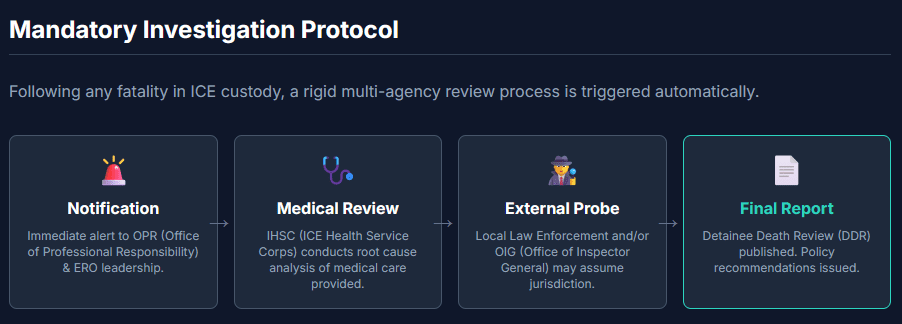
Under the leadership of Secretary Kristi Noem, the mechanisms intended to investigate and prevent misconduct have been systematically weakened. The ICE Office of Detention Oversight (ODO) reportedly reduced its inspection frequency by over 36 percent in 2025.6 Perhaps more significantly, a new requirement was reinstated requiring members of Congress to provide seven days’ notice before conducting oversight visits to detention centers.6 This policy effectively eliminates the possibility of unannounced inspections, which are crucial for identifying the true conditions of confinement.6
Additionally, the Department of Justice has been accused of actively blocking state-level investigations into fatal shootings.5 In the Renee Good case, the FBI took over the investigation and cut off Minnesota officials’ access to evidence, forcing the Hennepin County Attorney to appeal to the public for video footage and information.3 This “jurisdictional shield” makes it nearly impossible for state or local prosecutors to hold federal agents accountable for potential criminal acts.10
The Impact of “Operation Metro Surge” Tactics
The tactics authorized under “Operation Metro Surge” have prioritized speed and volume over safety and community stability. These tactics include:
- Vehicle Interdictions: ICE agents have been documented ramming cars in residential neighborhoods and smashing windows to extract drivers.20
- “Baiting” and Surveillance: In one documented case in Columbia Heights, MN, ICE agents allegedly used a 5-year-old child as “bait” to lure his father into opening the door for an arrest.20
- Militarized Presence: The deployment of approximately 3,000 federal forces to Minneapolis has transformed a civil enforcement matter into a “siege” that frequently results in clashes with bystanders and protesters.10
These aggressive methods increase the likelihood of “escalation” during encounters. When agents operate in plainclothes or in unmarked vehicles, as was the case in several Chicago-area shootings in late 2025, civilians may not realize they are being approached by law enforcement, leading to flight or resistance that the agents then meet with lethal force.10
The Budgetary and Population Crisis
The detention population reached 73,000 by late January 2026, a figure that is nearly double the capacity of a year prior.6 This rapid expansion has been funded through a proposed $170 billion allocation for border and interior enforcement over four years.7 However, the 2026 DHS appropriation bill, which includes $10 billion for ICE, has become a flashpoint in Congress.6
Senate Democrats, led by Chuck Schumer, have threatened to block the spending bill unless strict conditions are attached to the use of force and detention conditions.6 This standoff occurs as the agency is already struggling with a “medical care cutoff” that began in October 2025.6 The combination of a massive, medically vulnerable population and a lack of funding for healthcare and oversight is a primary driver of the custodial deaths seen in January.1
Comparative Data: Trends in ICE Lethality
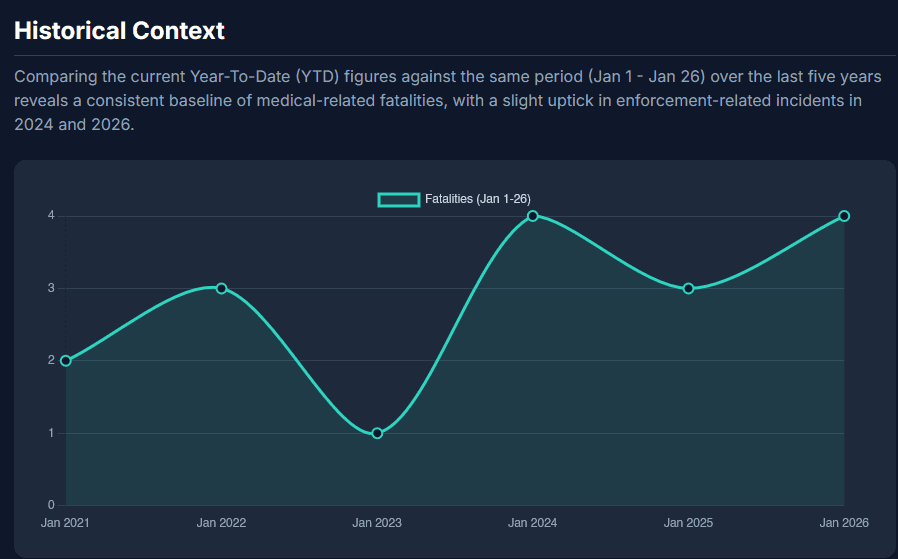
To understand the severity of the 2026 data, it must be placed in a historical and comparative context. The year 2025 set a record for deaths in custody, and 2026 is currently on pace to exceed those numbers.
| Year | Reported Deaths in ICE Custody | Detained Population (Approx. Peak) | Lethal Shootings (DHS Operations) |
| 2020 | 21 | 15,000 – 40,000 | Variable |
| 2025 | 30 – 32 | 68,000 | 8 |
| 2026 (Jan 1-25) | 6 | 73,000 | 2 |
This data illustrates that while the detained population has increased significantly, the rate of lethal outcomes—both in custody and during operations—has grown disproportionately. This suggests that the increase in deaths is not merely a function of a larger population but a result of more dangerous handling and detention conditions.6
Legal and Sociopolitical Repercussions
The fatalities of January 2026 have produced a series of profound legal and political crises that threaten the stability of federal-state relations.
State-Level Resistance and Judicial Injunctions
In response to the “Metro Surge” violence, a federal judge in Minneapolis issued an injunction on January 16, 2026, prohibiting ICE agents from retaliating against peaceful protesters or using excessive force during enforcement actions.9 Similarly, Governor Gavin Newsom of California has called for the resignation of Secretary Noem and the firing of Border Patrol Chief Gregory Bovino, following reports of militarized agents “terrorizing” local communities.25
The legal battle for evidence preservation is also intensifying. In Texas, the children of Geraldo Lunas Campos have filed a federal lawsuit to stop the government from deporting the witnesses who saw their father being choked by guards.6 This indicates that families and local advocates are increasingly turning to the courts to bypass the administration’s internal “quagmire” of investigation and oversight.10
The Threat of a Government Shutdown
The January 30, 2026, deadline for passing federal appropriations has become a referendum on the administration’s immigration policies. Lawmakers like Representative Frank Pallone and Senator Brian Schatz have vowed to oppose the DHS funding package, arguing that the agency cannot be trusted with additional money after the “lawless” killing of Renee Good and Alex Pretti.30 This budgetary stalemate creates a scenario where the very agencies responsible for the deaths may face a partial shutdown, potentially further destabilizing the already fragile medical and security infrastructure of the detention system.6
Synthesis and Outlook
The research data indicates that since January 1, 2026, the intersection of immigration enforcement and custodial management has become increasingly lethal. The six deaths in detention and two fatal shootings of U.S. citizens are not disconnected incidents but are the predictable outcomes of a system that has expanded too rapidly while simultaneously removing the safeguards of transparency, medical funding, and judicial oversight.
The homicide of Geraldo Lunas Campos highlights the extreme risks of using “segregation” as a primary tool for managing mental health crises, while the killings of Renee Good and Alex Pretti illustrate the dangers of deploying militarized border agents into domestic urban environments. The administration’s continued reliance on a narrative of “self-defense” and “domestic terrorism,” even in the face of contradictory video evidence, has further eroded the credibility of the DHS among state leaders, local law enforcement, and the public.
Moving forward, the primary points of conflict will likely involve the preservation of evidence in these fatal encounters and the legislative fight over the DHS budget. Without a restoration of the Office of Professional Responsibility’s independence and a return to “spot check” oversight by Congress, the mortality rate within ICE operations is likely to remain at historic levels. The current trajectory suggests that the “human cost” of current immigration enforcement is increasingly being borne not just by the undocumented, but by bystanders, protesters, and the very legal and constitutional framework that defines federal authority in the United States.
Works cited
- Who’s watching DHS and ICE?, accessed January 26, 2026, https://www.washingtonpost.com/opinions/2026/01/19/ice-immigration-enforcement-oversight-dhs/
- 2025 was ICE’s deadliest year in two decades. Here are the 32 people who died in custody, accessed January 26, 2026, https://www.theguardian.com/us-news/ng-interactive/2026/jan/04/ice-2025-deaths-timeline
- US immigration agents shot at people 16 times under Trump’s crackdown – The Guardian, accessed January 26, 2026, https://www.theguardian.com/us-news/2026/jan/07/trump-immigration-ice-shootings
- List of deaths in ICE detention – Wikipedia, accessed January 26, 2026, https://en.wikipedia.org/wiki/List_of_deaths_in_ICE_detention
- Minneapolis: 37-year-old US citizen shot and killed by federal agents, accessed January 26, 2026, https://www.theguardian.com/us-news/2026/jan/24/minneapolis-shooting-federal-agents
- U.S.-Mexico Border Update: Detention deaths, DHS appropriations, ICE warrants, December data – Washington Office on Latin America | WOLA, accessed January 26, 2026, https://www.wola.org/2026/01/u-s-mexico-border-update-detention-deaths-dhs-appropriations-ice-warrants-december-data/
- LATINO ICE DETENTIONS DRAMATICALLY RESHAPED UNDER TRUMP – UCLA Center for Neighborhood Knowledge, accessed January 26, 2026, https://knowledge.luskin.ucla.edu/wp-content/uploads/2026/01/UCLA_CNK_Unseen_Latino_ICE_Detentions_Dramatically_Reshaped_Under_Trump_Jan2026.pdf
- The ICE Killing of Renee Nicole Good is a Watershed Moment for …, accessed January 26, 2026, https://www.vera.org/explainers/the-ice-killing-of-renee-nicole-good-is-a-watershed-moment-for-trump
- Understanding the Legal Limits on ICE: Detentions, Arrests, Force, and Your Rights – Nolo, accessed January 26, 2026, https://www.nolo.com/legal-encyclopedia/understanding-the-legal-limits-on-ice-detentions-arrests-force-and-your-rights.html
- What ICE agents are taught: How to use ‘deadly force’, evade …, accessed January 26, 2026, https://www.aljazeera.com/features/2026/1/23/are-ice-agents-trained-to-shoot-and-evade-lawsuits
- Cuban immigrant in ICE custody died of homicide due to asphyxia, autopsy finds – PBS, accessed January 26, 2026, https://www.pbs.org/newshour/nation/cuban-immigrant-in-ice-custody-died-of-homicide-due-to-asphyxia-autopsy-finds
- Cuban-born immigrant died by homicide at ICE facility in Texas, autopsy finds – CBC, accessed January 26, 2026, https://www.cbc.ca/lite/story/9.7055697?feature=random
- ICE detention staff reported death of restrained man as a suicide, accessed January 26, 2026, https://www.washingtonpost.com/business/2026/01/23/ice-detainee-death-911-calls/
- This ICE Crackdown Is Making the Case for Real Immigration Reform – Veronica Escobar, accessed January 26, 2026, https://escobar.house.gov/news/documentsingle.aspx?DocumentID=3031
- Report: Immigration Detention Is Bigger, Harsher, and Less Accountable Than Ever, accessed January 26, 2026, https://www.americanimmigrationcouncil.org/press-release/report-trump-immigration-detention-2026/
- Death in ICE custody – Los Angeles – LAist, accessed January 26, 2026, https://laist.com/brief/news/politics/ice-detention-death-investigation-advocates-say-government-oversight-insufficient
- Advocate calls for transparency, congressional investigations on deaths of ICE detainees after man dies in Clayton County facility | 11alive.com, accessed January 26, 2026, https://www.11alive.com/article/news/politics/immigration-news/amilcar-valencia-el-refugio-interview-ice-detention-death-clayton-county-georgia/85-d8fe399a-0be8-400c-b26d-d803680a85de
- ICE reports death of illegal alien in custody in El Paso | ICE, accessed January 26, 2026, https://www.ice.gov/news/releases/ice-reports-death-illegal-alien-custody-el-paso
- Man shot and killed by federal officers in Minnesota was an ICU nurse, his parents say, accessed January 26, 2026, https://www.pbs.org/newshour/nation/man-shot-and-killed-by-federal-officers-in-minnesota-was-an-icu-nurse-his-parents-say
- ICE expansion has outpaced accountability. What are the remedies? – Brookings Institution, accessed January 26, 2026, https://www.brookings.edu/articles/ice-expansion-has-outpaced-accountability-what-are-the-remedies/
- US: Minneapolis Killing by ICE Unjustified | Human Rights Watch, accessed January 26, 2026, https://www.hrw.org/news/2026/01/09/us-minneapolis-killing-by-ice-unjustified
- Trump threatens to use the Insurrection Act to ‘put an end’ to protests in Minneapolis – OPB, accessed January 26, 2026, https://www.opb.org/article/2026/01/15/trump-threatens-to-use-the-insurrection-act-to-put-an-end-to-protests-in-minneapolis/
- 2026 U.S. Border Patrol shooting in Portland, Oregon – Wikipedia, accessed January 26, 2026, https://en.wikipedia.org/wiki/2026_U.S._Border_Patrol_shooting_in_Portland,_Oregon
- Pain, anger, action in Twin Cities after a second fatal shooting by a federal agent, accessed January 26, 2026, https://www.mprnews.org/story/2026/01/24/minneapolis-looking-into-possible-shooting-by-ice-agent
- Here’s what California leaders said about latest Minneapolis killing, accessed January 26, 2026, https://calmatters.org/newsletter/alex-pretti-minneapolis-killing/
- Gatherings across Wisconsin protest ICE shooting of Alex Pretti, accessed January 26, 2026, https://www.wpr.org/news/gatherings-across-wisconsin-protest-ice-shooting-alex-pretti
- Federal immigration agents shoot 2 people in Portland, Oregon, police say | PBS News, accessed January 26, 2026, https://www.pbs.org/newshour/nation/federal-immigration-agents-shoot-2-people-in-portland-oregon-police-say
- Immigration Enforcement Dashboard | Resources | The U.S. House …, accessed January 26, 2026, https://oversightdemocrats.house.gov/immigration-dashboard
- List of shootings by U.S. immigration agents in the second Trump …, accessed January 26, 2026, https://en.wikipedia.org/wiki/List_of_shootings_by_U.S._immigration_agents_in_the_second_Trump_administration
- Pallone Condemns Deadly Actions by Federal Immigration Agents, Opposes DHS Funding Increase, accessed January 26, 2026, https://pallone.house.gov/media/press-releases/pallone-condemns-deadly-actions-federal-immigration-agents-opposes-dhs-funding
Federal Update: US House Approves Final Spending Bills as Senate Weighs Next Steps, accessed January 26, 2026, https://www.lmc.org/news-publications/news/all/federal-update-us-house-approves-final-spending-bills-as-senate-weighs-next-steps/
The data synthesis and literature review within this document were conducted using Gemini (Google). The author has exercised due diligence in cross-referencing AI-generated outputs with primary sources to mitigate the risk of “hallucinations” or factual errors.
About The Author