
Scientists warn humanity faces unprecedented existential threats from nuclear weapons, climate change, and artificial intelligence
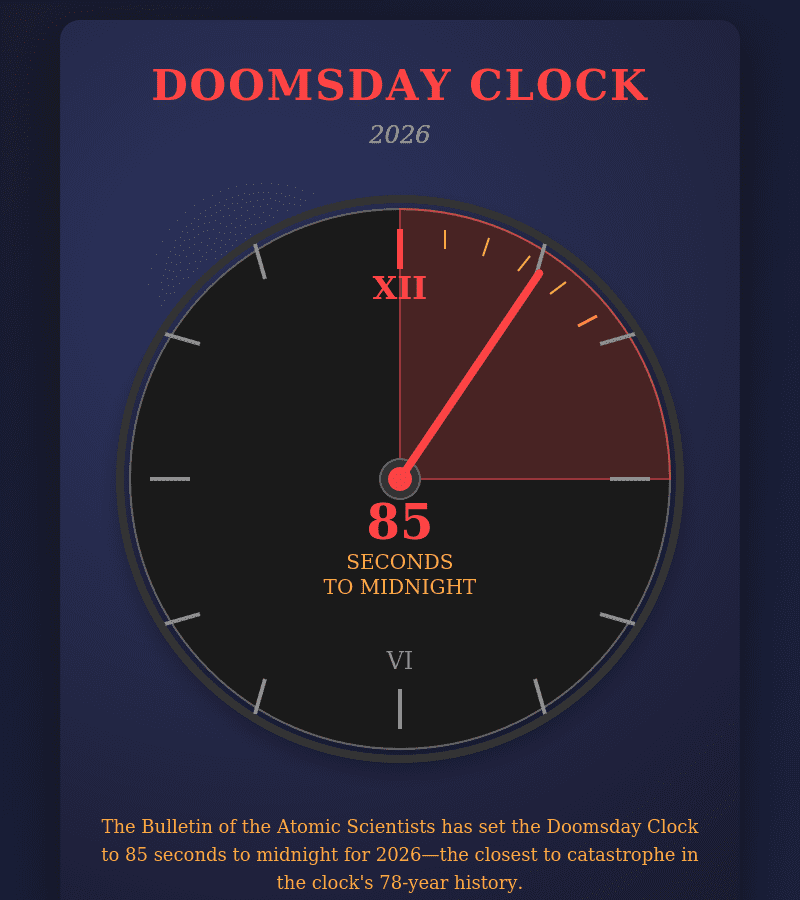
The symbolic Doomsday Clock has been set to 85 seconds to midnight for 2026, marking the closest humanity has ever been to potential self-annihilation since the clock’s creation in 1947.
The Bulletin of the Atomic Scientists announced the updated time on Monday during a news conference in Washington, advancing the clock four seconds from last year’s record-setting 89 seconds to midnight.
Scientists cited unregulated disruptive technologies like artificial intelligence that could be used to spread disinformation Time, alongside longstanding concerns about nuclear weapons and climate change. The clock represents how close humanity is to global catastrophe, with midnight symbolizing the apocalypse.
“Every second counts, and we are running out of time. It is a hard truth, but this is our reality,” said Alexandra Bell, President and CEO of the Bulletin of the Atomic Scientists.
The organization pointed to several factors driving the decision, including deteriorating international cooperation on nuclear arms control, setbacks in climate action, and emerging risks from biotechnology and artificial intelligence.
The Bulletin warned that international cooperation is going backwards on nuclear weapons, climate change and biotechnology, while artificial intelligence poses new threats.
On the nuclear front, scientists expressed particular concern about the expiration of the New START Treaty on February 4. The treaty represents the last remaining agreement limiting deployed intercontinental-range nuclear weapons between the United States and Russia. Despite Russian President Vladimir Putin expressing interest in restarting nuclear arms talks, the Trump Administration has not yet responded to the overture.
Climate change remains a critical factor in the clock’s setting. The Bulletin noted that US President Donald Trump has “essentially declared war on renewable energy and sensible climate policies, relentlessly gutting national efforts to combat climate change“. The organization also criticized recent UN climate summits for failing to emphasize phasing out fossil fuels or monitoring carbon dioxide emissions.
However, the assessment wasn’t entirely bleak. Renewable energy, especially wind and solar, saw record growth in both capacity and generation in 2024, and renewable and nuclear energy together surpassed 40 percent of global electricity generation for the first time.
The Doomsday Clock has been adjusted 27 times since its debut, with its position fluctuating based on global events and threats. The furthest it has ever been from midnight was 17 minutes in 1991, following the end of the Cold War and significant nuclear arms reductions between the United States and Russia.
In recent years, the clock has steadily moved closer to midnight. It stood at 90 seconds to midnight in 2023 and 2024, before moving to 89 seconds in 2025.
The Bulletin emphasized that reversing this trajectory is still possible. Scientists called for specific actions, including the resumption of nuclear arms talks between the US and Russia, international cooperation to reduce the risk of AI-created biological threats, and clear guidelines for military use of artificial intelligence.
The clock’s time is determined annually by the Bulletin’s Science and Security Board in consultation with its board of sponsors, which includes eight Nobel laureates. The board considers recent global events, technological developments, and political trends when making their assessment.
While the Doomsday Clock is symbolic rather than predictive, it has served as a widely recognized tool for sparking global conversation about existential threats facing humanity since the dawn of the nuclear age.
About The Author