
Thinking about a home project in Ottawa? The first critical question is always the same: do I need a building permit?
Getting this answer right from the start is essential. Proceeding without a required permit can lead to serious consequences, including fines, stop-work orders, and significant complications when you decide to sell your home. Understanding the City of Ottawa's rules upfront is your best protection.
When You Need a Building Permit in Ottawa
Navigating the world of a building permit in Ottawa can feel overwhelming, but the core principle is simple. Permits are required for projects that could affect health and safety, your home's structural integrity, or the City's zoning by-laws. They ensure all construction adheres to the Ontario Building Code.
This isn't just bureaucratic red tape; it's a safety and compliance system. The City has tracked construction for decades. By 1977, data collection on building permits was well-established in Canadian cities, including Ottawa. In Ontario, this oversight covered about 94% of the population, creating a strong framework for managing urban development safely. This history highlights how vital permits are for safe urban growth. You can delve into the history of this data collection and see its long-term impact.
Projects That Definitely Require a Permit
If your project falls into any of these categories, you can be certain you’ll need to apply for a permit.
- Structural Changes: This is a major category. It includes adding or removing walls, beams, or columns. Even if you believe a wall isn't load-bearing, moving it often still requires a permit as it alters the floor plan and can impact fire safety and ventilation.
- New Living Spaces: Finishing a basement to create a family room, a new bedroom, or especially a secondary dwelling unit (like an in-law suite) will always need a permit. The same applies to converting a garage or attic into a livable area.
- Additions and Extensions: Any time you're increasing your home's footprint—whether it's a sunroom, a new room, or an entire second storey—a permit is mandatory.
- Decks and Porches: The rule of thumb here is height. A permit is needed for any deck that is more than 600 mm (about 24 inches) above the ground. You'll also need one if the deck is attached to the house or serves an entrance.
- Enlarging Openings: Thinking of installing a new window or door, or making an existing one larger? You'll need a permit for that, as it impacts your home's structure.
A great starting point for any homeowner is the City of Ottawa's official building permits page. It's where you'll find all the forms, fee schedules, and submission guides.

This portal is your home base for the entire application process.
When You Likely Do Not Need a Permit
On the other hand, many smaller cosmetic or minor repair jobs don't require you to go through the permit process. Knowing the difference can save you significant time and paperwork.
Key Takeaway: A building permit is about safety and compliance, not aesthetics. If your project alters the structure, plumbing, electrical systems, or how a space is used, you need a permit. If it's just a surface-level upgrade, you likely do not.
Common projects that are typically exempt from needing a building permit in Ottawa include:
- Replacing roofing shingles (as long as you aren't doing any structural repairs to the roof itself).
- Painting, putting up wallpaper, or replacing flooring.
- Swapping out kitchen or bathroom cabinets, provided you don't change the plumbing or electrical layout.
- Installing new siding on small residential buildings.
- Building a small, detached shed that is under 10 square metres (about 108 square feet).
Permit Required vs Permit Not Required Scenarios
To make it even clearer, here’s a quick-reference table that breaks down some common project scenarios.
| Project Type | Permit Required? | Key Consideration |
|---|---|---|
| Finishing a basement | Yes | Involves structural changes, plumbing, electrical, and creates new living space. |
| Building a small garden shed | No | As long as it's under 10 m² and a single storey. |
| Replacing kitchen cabinets | No | Considered a cosmetic update, if plumbing and electrical locations stay the same. |
| Installing a new bathroom in the basement | Yes | Requires new plumbing and electrical work, which must be inspected. |
| Re-shingling a roof | No | This is considered maintenance, unless you're altering the roof structure. |
| Building a deck over 24 inches high | Yes | Height and attachment to the house are key factors for safety and structural load. |
| Replacing a window with the same size | No | No structural opening is being changed. |
| Making a window opening larger | Yes | This is a structural alteration to an exterior wall. |
This table should give you a better feel for the City's logic. When in doubt, it never hurts to make a quick call to the City's Building Code Services to confirm. A five-minute phone call can save you weeks of trouble down the road.
Assembling Your Permit Application Package
Getting a building permit in Ottawa comes down to detail. Think of your application package as the complete story of your project—one that shows the city reviewer not just what you're building, but that you're doing it safely and by the book. A meticulously prepared package is your best defense against the dreaded "incomplete application" notice, which can stop your project in its tracks.
The goal is to paint a crystal-clear picture of your plans. This clarity prevents endless back-and-forth communication with the city, potentially saving weeks or even months on your project timeline. A strong application doesn't just get you approved faster; it demonstrates professionalism.
The Core of Your Application: Your Drawings
Your construction drawings are, without question, the most important part of your permit application. These are not just sketches; they must be precise, professional, and drawn to scale. The city needs to see exactly how your project will come together, from the foundation to the roof.
Here’s a look at the essential drawings you'll almost always need:
- Site Plan: This is the bird's-eye view of your property. It must show your property lines, the existing house, and exactly where the new structure (like a deck, addition, or garage) will sit. Most importantly, it has to include setbacks—the specific distances from the new construction to every property line—to prove you’re following local zoning by-laws.
- Floor Plans: You'll need a detailed floor plan for every level affected by the work. These plans should map out room dimensions, identify all walls (new, existing, or being removed), show every window and door, and label the use of each space (e.g., "Primary Bedroom," "Kitchen," "Home Office").
- Elevations: These drawings show what the building will look like from all four sides (north, south, east, and west). They need to specify exterior finishes like brick or siding, window styles, roof pitch, and the final height of the building.
- Cross-Sections: Imagine slicing your house in half to see the components inside—that's a cross-section. This drawing reveals the construction details of your floors, walls, and roof. It shows materials, like the type of insulation, the size of framing lumber, and how the foundation is built. This is how you prove your project meets the structural standards of the Ontario Building Code.
Remember, if a reviewer cannot read or understand your drawings, they cannot approve them. Clarity is essential.
Essential Forms and Supporting Documents
Beyond the drawings, a few other key documents are non-negotiable. Missing even one of these is a guaranteed way to have your application returned.
First is Proof of Ownership. The city needs to know you have the legal right to build on the property. A recent property tax bill or the deed/transfer document usually suffices. If you're a tenant or your contractor is applying on your behalf, a signed letter of authorization from the property owner is required.
Next, you'll need the official Building Permit Application Form from the City of Ottawa, filled out completely. It sounds obvious, but fields are often missed. Double-check that every box is filled, especially your contact information and the project description.
Insider Tip: When describing your project, be specific. Don't just write "basement renovation." Instead, try: "To finish a 500 sq. ft. area of the basement, creating one (1) new bedroom, one (1) 3-piece bathroom, and a new family room." This detail helps the city assign the right staff to your file from the start.
Finally, there's the Schedule 1: Designer Information form. This is absolutely critical. It must be completed and signed by the qualified designer or firm that created your drawings. They must have a valid Building Code Identification Number (BCIN), which proves they are registered with the province and qualified to perform the work. An application without a signed Schedule 1 will be rejected.
This system of using qualified designers and detailed paperwork ensures all construction in the city is planned to be safe and sound. We dive even deeper into the paperwork and process in our complete guide to securing building permits in Ottawa.
Final Checks Before You Submit
Before you upload your files to the city’s portal or visit a service centre, take a moment for one last, thorough review.
- Are all drawings properly scaled and clearly labelled?
- Is every single form filled out, signed, and dated?
- Did you include your proof of ownership or letter of authorization?
- Are your phone number and email address correct on all documents?
Spending an extra 30 minutes double-checking your package can easily save you weeks of frustrating delays. A complete, professional application signals that you’re serious and ready to build correctly.
How to Navigate the Permit Application Process
Alright, you’ve got your application package ready to go. What's next? The next step is submitting it to the City of Ottawa and guiding it through their internal review system. Think of it less as a simple drop-off and more as a journey where your plans will be examined by different experts to ensure everything is safe and up to code.
The most efficient way to get your project in the queue is by using the City of Ottawa’s online portal through your MyServiceOttawa account. This is the recommended method, as it allows you to upload all your documents, pay fees electronically, and communicate directly with city staff. This digital-first approach is much faster than mail or in-person drop-offs.
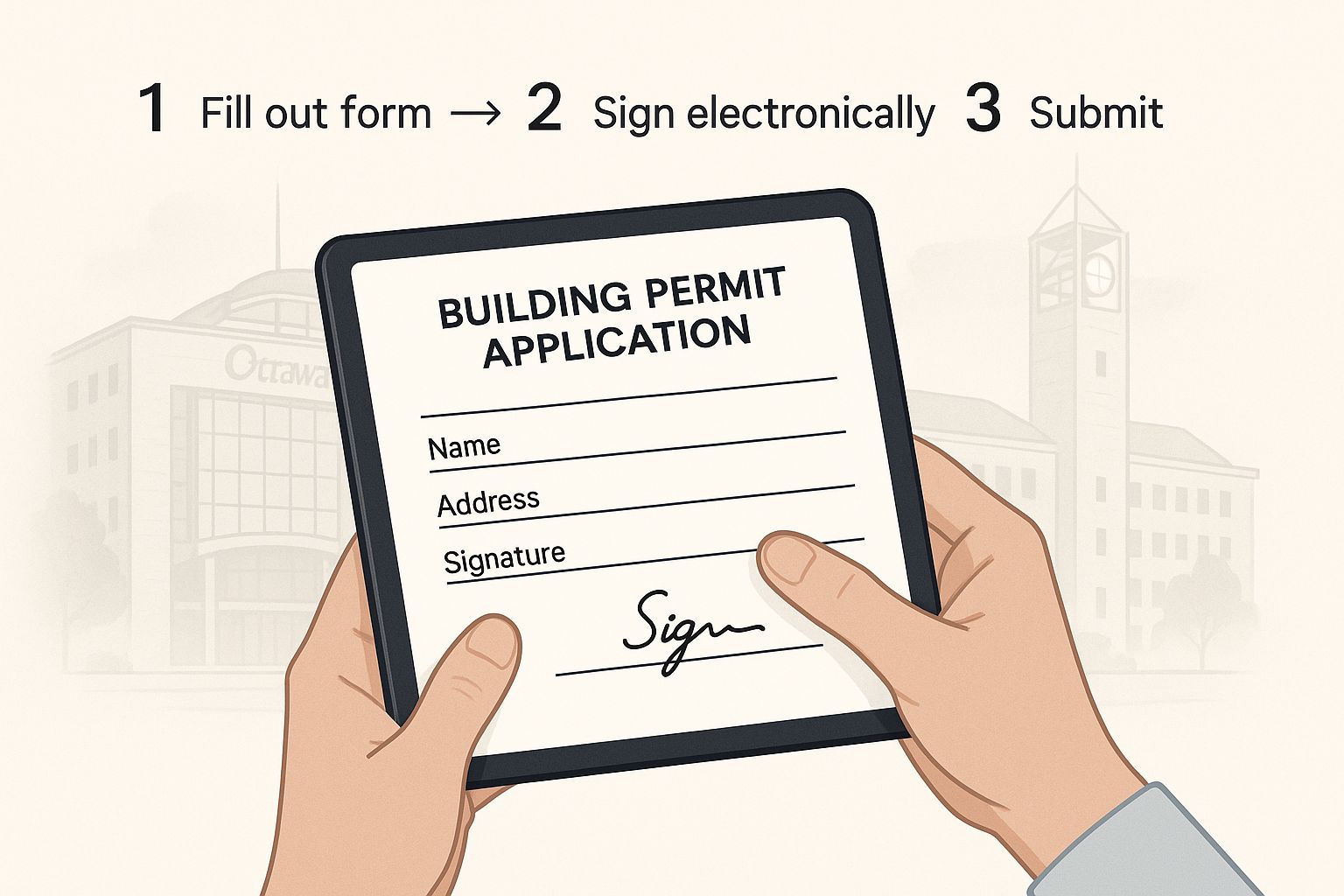
A clean digital submission is your first big step toward getting reviewed and, eventually, approved.
The Internal Review Journey
Once you hit 'submit,' your application doesn't just sit on one person's desk. It kicks off a coordinated review process involving a few specialized departments. Each team looks at your plans from a different angle, checking for compliance with specific by-laws and codes.
- Zoning Services: This is usually the first checkpoint. The zoning reviewer will examine your site plan and compare it against Ottawa’s Zoning By-law. They're ensuring your project respects all the rules for setbacks, height limits, and lot coverage for your property.
- Building Code Technicians: Next, this team does a deep dive into your construction drawings. They check every detail—from your foundation design and framing specs to your HVAC plans and fire safety measures—to confirm everything aligns with the Ontario Building Code.
- Other Departments (if needed): Depending on your project, your plans might take a detour to other groups. If you’re near trees, Urban Forestry might get involved. If your home is in a designated heritage district, the Heritage Planning branch will need to review it.
If any of these reviewers spot an issue, you’ll get a deficiency notice explaining exactly what needs to be fixed. Responding to these requests quickly and accurately is the single best way to keep your application moving.
Demystifying Permit Fees and Payments
The cost of a building permit in Ottawa is not a flat rate; it's tied directly to the size and scope of your project. The city uses a fee schedule, usually based on the total floor area of the new construction or renovation, to determine the cost. The logic is simple: bigger, more complex projects require more time for reviews and inspections, so the fees are higher.
There's a minimum fee for every application to cover basic administrative work. For most projects, the final cost comes down to a rate per square metre. It's crucial to budget for this, as you'll need to pay before the permit is officially issued. You’ll receive a fee notice after your application passes the initial intake stage.
Key Insight: Don't think of permit fees as just another tax. They're an investment in your project's safety and legality. That cost covers the expert review of your plans and the crucial inspections that ensure the work is done right, protecting your home's value for years to come.
Realistic Timelines for Your Project
Patience is a must. While the City of Ottawa works to process applications as quickly as possible, timelines can vary widely depending on your project's complexity and the volume of applications in the system.
A straightforward project, like a standard deck or a small interior renovation with no major structural changes, might be reviewed within 5 to 10 business days. On the other hand, something more involved, like a second-storey addition or a new secondary dwelling unit, could easily take 30 business days or more.
The quality of your submission also makes a huge difference. A complete, accurate application with clear, professional drawings will always move through the system faster than one that needs multiple corrections. High construction demand also impacts wait times. For example, in 2023, the total value of building permits issued in Ottawa exceeded $4.5 billion, reflecting a very active construction sector. This is why a polished, perfect application is your best bet for a speedy approval.
Understanding what's happening behind the scenes helps set realistic expectations. For a complete walkthrough of the entire process, from paperwork to final sign-off, check out our full guide on how to get your building permits in Ottawa.
Getting your building permit in Ottawa is a huge milestone, but it’s really just the starting point. Now, your project moves from paper to the real world, and each stage of construction needs to be signed off on through a series of mandatory city inspections.
This isn’t about creating busywork. It’s the City’s way of verifying that what was approved on the plans is what’s actually being built—safely, and up to code. Skipping these check-ins or failing an inspection can lead to costly stop-work orders and major delays. Think of each inspection as a quality-control checkpoint that protects your investment and confirms your project is structurally sound.
Getting Ready for Your Mandatory Inspections
Throughout your project, a City of Ottawa Building Inspector will need to visit your site at specific milestones. It is your responsibility to book these inspections at the correct time, which almost always means before you cover up the work. For example, your foundation must be inspected before you backfill it, and your framing needs to be reviewed before any drywall is installed.
Here’s a breakdown of what inspectors are looking for at each key stage.
Mandatory Inspection Stages for a Typical Ottawa Renovation
Every renovation has its own set of required inspections, but for most projects, you can expect to book a visit at these key milestones. Getting the timing right is crucial—book too early and you're not ready; book too late and you might have to tear out completed work.
| Inspection Stage | When to Schedule | What the Inspector Checks |
|---|---|---|
| Foundation/Footings | Before pouring concrete | Correct excavation depth, footing forms, soil conditions, and rebar placement all match the approved plans. |
| Framing | Before installing insulation or drywall | All structural parts (beams, joists, studs) match the plans in size, spacing, and material. This confirms structural integrity. |
| Plumbing & HVAC | Before closing up walls and ceilings | All new drains, vents, water lines, and HVAC ductwork are installed correctly and have proper clearance. |
| Insulation & Vapour Barrier | Before installing drywall | The right type and amount of insulation are used, and the vapour barrier is installed correctly to prevent future moisture issues. |
You can schedule your inspections online through your MyServiceOttawa account or by calling the city. Always have your permit number ready and provide at least 48 hours' notice.
What Happens After the Inspector Visits?
If everything aligns with the Ontario Building Code and your approved plans, the inspector gives you the green light. You’re clear to move on to the next phase of construction.
However, if they spot a problem, they will issue a field report or an Inspection Order. This document will spell out exactly what needs to be fixed. Once you’ve made all the corrections, you’ll have to book a re-inspection. You can only proceed once you pass.
Crucial Insight: An open building permit can become a serious legal and financial issue. Recent Ontario court cases have shown that buyers can sometimes back out of a property sale if an open permit is discovered, as it signals unfinished work and potential legal risk. Properly closing your permit isn't just a final step—it's essential for protecting your home's future resale value.
Closing Your Permit and Final Occupancy
Once all work is done and every required inspection has been passed, it’s time for the final step: the final inspection.
The inspector will do one last walkthrough to confirm the project is 100% complete, safe, and ready for use. After it passes, your permit file is officially closed. This final sign-off is your proof that the work was done correctly and in compliance with all city regulations—a critical document you’ll need for insurance and especially if you ever decide to sell your home.
Common Permit Mistakes and How to Avoid Them

If you want to get your project off the ground smoothly, learning from the missteps of others is the fastest path to success. When trying to secure a building permit in Ottawa, a handful of common errors cause most delays and rejections. Knowing these pitfalls ahead of time means you can sidestep them completely.
The permit system exists to manage the city's constant growth. This isn't just a modern issue; construction has been a huge economic driver for decades. For instance, in the first 11 months of 2003, building permits across Canada reached a value of nearly $46.7 billion. The residential sector, driven by cities like Ottawa, accounted for $29.2 billion of that—an 8.1% increase from the previous year. This history shows how crucial the permit process is for orderly development. You can read more about these national construction trends and their drivers if you're curious.
The Inaccurate Site Plan
One of the most frequent—and frustrating—mistakes is a flawed site plan. This drawing is the plan reviewer's first impression of how your project fits on your property. If it shows incorrect property lines or, more often, fails to account for proper setbacks, your application will be stopped.
Setbacks are the non-negotiable minimum distances your new structure must be from your property lines, as dictated by Ottawa's zoning by-laws.
- Common Error: Guessing property lines or "eyeballing" the distance from a fence. That fence might not be on the actual property line.
- How to Avoid It: Always use your official property survey to draft your site plan. If you don't have one, it's a worthwhile investment. You can also use the City’s online tools, like geoOttawa, to get a preliminary idea of your property's dimensions and zoning rules.
Missing or Incorrect Designer Information
The City of Ottawa is very strict about this: most plans must be prepared by a qualified and registered designer. This is verified with the Schedule 1: Designer Information form. This form must be filled out and signed by your designer, complete with their valid Building Code Identification Number (BCIN).
Submitting your application without this form, or with one from an unqualified individual, is an instant rejection. It's a critical check to ensure the person designing your project is knowledgeable and properly insured.
Insider Tip: Don't think of a qualified designer as just an expense; they are an investment. A good designer or architect with experience in Ottawa won't just provide compliant drawings. They will anticipate potential zoning or building code issues, saving you significant time and money down the road.
Ignoring Local Zoning By-laws
The Ontario Building Code tells you how to build something safely. But it's Ottawa's local Zoning By-law that dictates what you can build and where on your property. Many homeowners spend money on beautiful, code-compliant plans only to discover they violate local zoning rules like:
- Maximum lot coverage: The total percentage of your property that can be covered by buildings.
- Height restrictions: Exactly how tall your new structure or addition can be.
- Permitted uses: Whether you’re even allowed to add something like a secondary dwelling unit (a garden suite, for example).
A pre-application consultation with the City’s Building Code Services can be a game-changer. It's a meeting where you can discuss your ideas with a city official before investing in detailed drawings. They can flag potential zoning issues early, allowing you to adjust your plans and avoid a guaranteed rejection. For a deeper look at the paperwork involved, our comprehensive guide on building permits in Ottawa has the full checklist.
By tackling these common mistakes head-on—verifying your site plan, hiring a qualified professional, and confirming your zoning compliance upfront—you turn your application from a guess into a professional package that's ready for approval.
Answering Your Ottawa Building Permit Questions
Even with a good grasp of the application process, it's normal to have a few questions. Getting straight answers can provide the confidence needed to see your project through. Let's tackle some of the most common questions we hear about getting a building permit in Ottawa.
Think of a permit as more than just a piece of paper—it's a live file that must be managed correctly. This means knowing its lifespan, who’s responsible for it, and the real-world financial and legal consequences tied to your project.
How Long Is My Building Permit Valid?
Once the City issues your permit, a timeline begins. You must start the construction work within six months of the issue date. If no work has begun after that six-month period, the permit is no longer valid.
It doesn't stop there. Once you begin, you cannot abandon the project. The Ontario Building Code states that work cannot stop for more than a year. If your site sits dormant for over 12 months, your permit can be revoked, forcing you to re-apply to resume work.
Unexpected delays are part of construction. If you encounter a major issue, you can request a permit extension from the City of Ottawa. You’ll need to provide a solid reason for the delay and a realistic new timeline for completion.
What Happens If I Build Without a Permit?
Building without a required permit in Ottawa is a significant risk with potentially severe financial and legal consequences. It's a gamble that is never worth taking.
If the City discovers unpermitted work, they will issue a stop-work order, bringing all activity to an immediate halt. After that, you could face:
- Hefty Fines: The financial penalties for non-compliance can be substantial.
- Orders to Comply: You may be forced to apply for a permit after the fact. This often means removing finished work—like drywall—so an inspector can see the construction underneath.
- Removal Orders: In a worst-case scenario, the city could order you to demolish and remove the entire unpermitted structure at your own expense.
Key Insight: Building without a permit creates massive legal headaches, especially at the time of sale. Recent Ontario court cases have highlighted that an open or unclosed permit is a major red flag that can cause a property sale to fall through. For buyers and their legal counsel, it signals unresolved issues and risks they are often unwilling to accept.
Who Is Responsible: The Homeowner or The Contractor?
This is crucial. As the property owner, you are ultimately and legally responsible for ensuring your project complies with all city by-laws and has the necessary permits.
While your contractor can (and often should) apply for the permit on your behalf, the legal responsibility remains with you. If your contractor says they’ll "handle it," always obtain a copy of the issued permit and post it visibly on the job site. Do not just take their word for it. If they proceed without one, any fines or city orders will be directed to you, the owner.
How Are Permit Fees Calculated?
Permit fees in Ottawa are not arbitrary. They are calculated based on the size and value of your project, using a fee schedule tied directly to the floor area of the construction.
For instance, a renovation fee might be calculated at a specific rate per square metre of the work area. To cover administrative and review costs, there’s always a minimum fee, which as of early 2024 is approximately $110 for smaller projects.
For something larger, like a new single-family home, the fees will be much higher, reflecting the project's complexity and the greater number of inspections required to ensure everything is built safely and to code.
At ncrnow, we provide the latest news and insights that matter to residents of Ottawa and the National Capital Region. Stay informed about local development, business, and trends by visiting us at https://ncrnow.ca.
About The Author