


Homelessness in Ottawa is no longer a hidden issue; it’s a full-blown crisis unfolding across our city. The support systems designed to help are stretched to their limits, struggling to keep up with the relentless demand from individuals and families who have nowhere else to go. This isn't a problem confined to the margins—it’s a reality that touches every corner of our community.
The Overwhelming Reality of Homelessness in Ottawa
Imagine if our city’s hospitals were so overwhelmed they had to turn away people who were desperately sick. That’s essentially what’s happening right now with homelessness in Ottawa. The shelter system, which is our emergency response, is operating so far beyond its capacity that it’s leaving a growing number of vulnerable people out in the cold.
This isn't just a bad week or a temporary spike in numbers. It’s a systemic failure that has been building for years, and the gap between the need for shelter and the available beds is getting wider every day. For every person who manages to find a spot for the night, another is left to fend for themselves on the streets, in parks, or in makeshift encampments. The system is at its breaking point.
A Crisis Measured in Numbers
The data paints a stark and undeniable picture of a crisis that is deepening by the day. Homelessness in Ottawa has hit record levels, and without serious new investments in affordable housing, that trend is only expected to continue.
This infographic lays out some of the key numbers that tell the story.
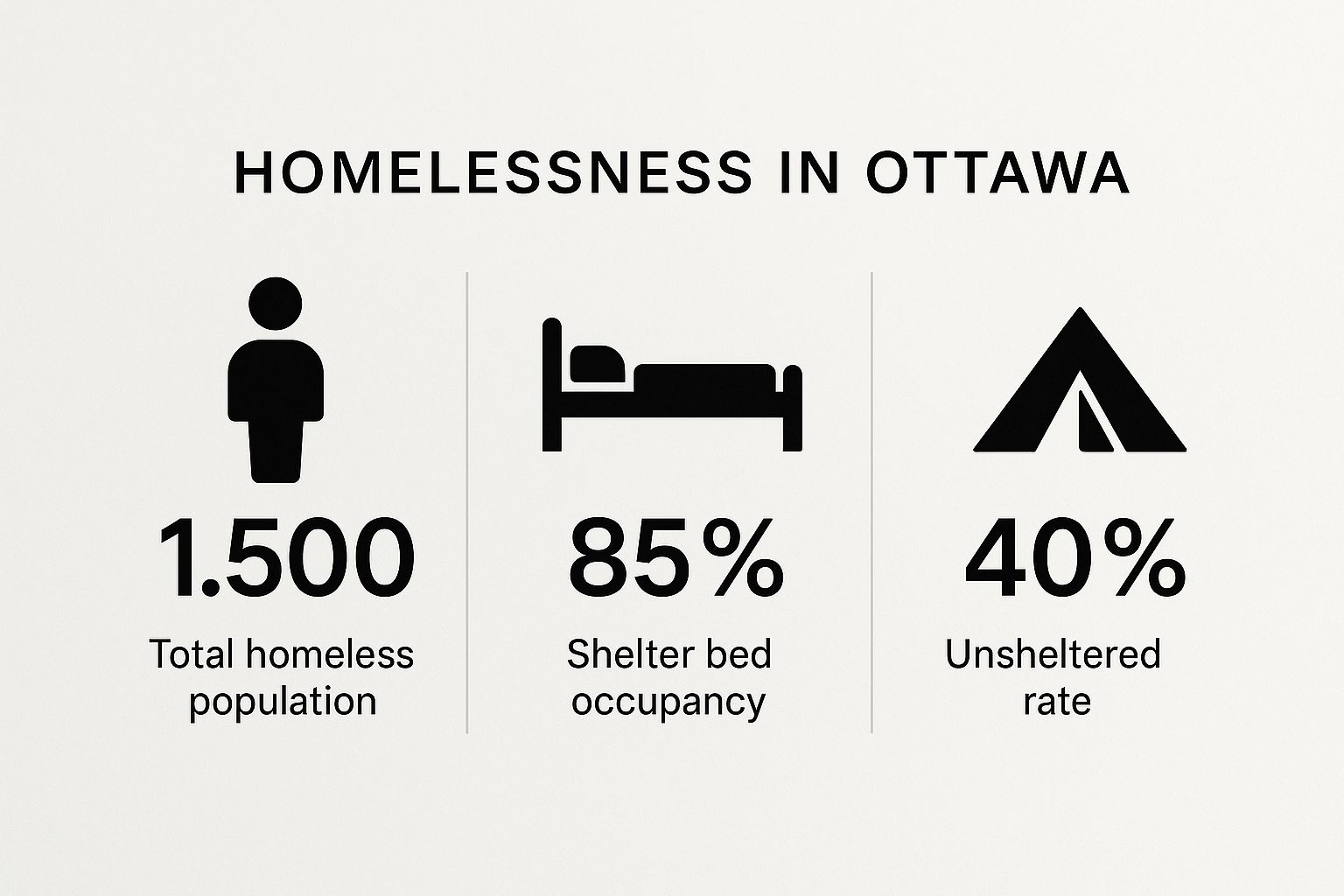
These figures show a system where shelters are constantly overflowing, while a huge portion of the homeless population has no shelter at all.
To put some real numbers on this, the 2021 Point-in-Time Count found 2,952 homeless individuals on a single night. That's a staggering 78.5% increase since 2018. This isn’t a slow creep; it’s a tidal wave of need that is completely overwhelming the city’s ability to respond. You can explore the full analysis of Ottawa's affordable housing and homelessness challenges to truly grasp the scale of the issue.
The table below offers a quick, high-level look at just how serious the situation has become.
Homelessness in Ottawa: A Statistical Snapshot
| Metric | Figure | Time Period/Source |
|---|---|---|
| Increase in Homelessness | 78.5% | 2018 to 2021 (Point-in-Time Count) |
| Shelter Occupancy Rate | Over 98% | City of Ottawa |
| Unsheltered Individuals | 28% | 2021 Point-in-Time Count |
| Increase in Family Homelessness | 48% | 2020 to 2022 |
These aren't just statistics; they represent thousands of our neighbours facing unimaginable hardship every single day.
The most alarming trend is the sharp increase in family homelessness. Families now constitute the largest group within the shelter system, a clear indicator that the crisis is affecting a broader and more vulnerable segment of the population.
The Alarming Rise in Family Homelessness
One of the most heartbreaking parts of this story is the devastating impact on families. The number of families turning to emergency shelters has skyrocketed, jumping from 3,597 people in early 2020 to 5,350 by mid-2022—a shocking 48% rise.
This has profound consequences. When children experience homelessness, it disrupts every part of their lives—their schooling, their health, their sense of safety. The trauma can create a cycle of poverty that is incredibly difficult to escape. This trend points to several critical breakdowns:
- Economic Pressures: Wages aren't keeping up, jobs are precarious, and the cost of everything from groceries to rent is pushing more low-income families over the edge.
- Housing Affordability: There simply aren't enough affordable, family-sized rental units available. Once a family loses their home, finding a new one is next to impossible.
- Systemic Gaps: Our support systems often aren't set up to meet the unique needs of families, like providing childcare or ensuring kids can stay in their home school.
For these families, every day is a battle for survival in environments never meant for children. This sharp rise in family homelessness is a five-alarm fire, signalling that the economic foundation for many Ottawa residents is crumbling and needs an urgent, targeted response.
Unpacking the Root Causes of the Crisis

The alarming homelessness statistics you see in Ottawa don’t just pop up overnight. They’re the result of a perfect storm where systemic cracks and personal hardships collide, leaving more and more of our neighbours without a safe place to call home.
This isn't about one single misstep. It's about a chain reaction of interconnected issues that slowly erodes a person's entire support system until there’s simply nothing left to catch them.
Think of it like a foundation built on a few key pillars: affordable housing, a stable income, good health, and a sense of community. When one pillar starts to wobble, the others can usually take the strain. But what we’re seeing in Ottawa is multiple pillars cracking at once, causing the whole structure to give way for thousands of people.
Homelessness is the visible symptom of these much deeper problems brewing just beneath the surface of our city. To build real, lasting solutions, we have to start by understanding what's causing the collapse in the first place.
The Foundation of the Problem: The Housing Affordability Gap
The biggest driver of homelessness in Ottawa, hands down, is the crushing lack of affordable housing. For a growing number of residents, the math just doesn't work anymore. When rents shoot through the roof but wages barely budge, a gap forms—a gap that eventually becomes impossible to cross.
Many people are forced to spend well over the recommended 30% of their income on rent alone. That leaves next to nothing for groceries, bus fare, or medicine. It also means there is absolutely zero financial cushion.
One unexpected car repair, a sudden illness, or even just having your hours cut at work can be all it takes to trigger an eviction and send a family spiralling into crisis. This isn't an accident; it's the direct result of a housing market that often values profit over people, creating a severe shortage of homes for those with low or moderate incomes.
When your entire financial life is a tightrope walk, the slightest gust of wind can lead to a fall. The lack of affordable housing has removed the safety net, turning minor setbacks into life-altering catastrophes for many in Ottawa.
Economic Instability and Precarious Work
At the same time, the world of work has fundamentally changed. The old promise of a steady, full-time job with benefits is a distant dream for too many people. Instead, precarious work—think short-term contracts, gig economy jobs, and part-time roles with unpredictable hours—is the new normal.
This kind of instability makes it nearly impossible to plan for the future. How can you budget for next month's rent when you have no idea how many hours you’ll get next week?
This reality hits marginalized communities the hardest, including racialized individuals, newcomers, and people with disabilities, who already face extra hurdles in finding stable employment. And as the general cost of living in Ottawa keeps climbing, the pressure just gets worse, pushing more people right to the edge.
The outcome is a city where far too many people are just one paycheque away from losing their home, trapped in a cycle of financial uncertainty with no clear way out.
Compounding Factors: Mental Health and Systemic Barriers
While money and housing set the stage for homelessness, other challenges can speed up the slide. Untreated mental health issues and addiction are often deeply tangled up with housing instability. It’s a vicious cycle. The trauma of being unhoused can destroy a person's mental health, while mental health struggles make it incredibly difficult to navigate the complicated systems needed to find and keep a home.
Consider this: a homeless individual with a health condition costs the public healthcare system six times more than a housed person with the same health history. It shows how homelessness doesn't just happen to people with health problems—it actively makes them worse.
Systemic barriers are a huge piece of the puzzle, too. For many, like Indigenous peoples dealing with intergenerational trauma or youth aging out of the child welfare system, the social safety net is full of holes. These are systems designed to help, but when a person is discharged into the community without adequate housing, income, or support, they can unintentionally create a direct path into homelessness.
The Human Stories Behind the Statistics

It's easy to get lost in the numbers when we talk about homelessness in Ottawa. But behind every single statistic is a person, a unique story, and a path that led them into crisis. While the data shows us the sheer scale of the problem, it can never quite capture the daily grind, the quiet resilience, or the very real human cost of losing a home.
To get a real sense of what's happening, we have to look past the spreadsheets and listen to the lived experiences of those caught in the city's housing emergency. These anonymized stories put a face to the crisis, turning an abstract policy issue into something deeply personal.
The Single Mother Navigating the Shelter System
Picture Sarah, a single mom with two young kids, holding down a part-time retail job. Her life was turned upside down when the landlord decided to sell the apartment her family had called home for years. Suddenly, she was facing an eviction notice. Despite working hard, finding another affordable two-bedroom in a city with skyrocketing rents was impossible.
Now, she and her children are in the crowded family shelter system. Every single day is a battle to create some sense of normalcy for her kids—helping with homework in a noisy common room, all while worrying about the stability they’ve lost. For Sarah, homelessness wasn't a choice. It was the direct result of an unforgiving housing market that left her family with nowhere else to turn.
The Senior on a Fixed Income
Then there’s Robert, a 72-year-old widower living on a fixed pension. After his wife passed away, his only income came from Old Age Security and a small company pension. He managed for years, but a sudden—and perfectly legal—rent hike pushed his housing costs to over 70% of his monthly income.
He started skipping meals just to make ends meet, but it wasn't enough. Facing eviction, he feels invisible and ashamed, trapped between the rising cost of living and an income that won't budge. Robert's story is a tough reminder of how economic pressures hit seniors the hardest, pushing them from stable housing into a state of constant uncertainty.
These aren't isolated incidents. They represent common pathways into homelessness in Ottawa, where a single event—a job loss, an eviction, or a health crisis—can completely shatter a person's stability.
The Youth Aging Out of Care
For a young person like Maya, turning 18 and aging out of the child welfare system isn't a celebration—it's a cliff edge. Lacking the family support most of her peers take for granted, she was left to figure out housing and employment entirely on her own.
She struggled to land a stable job without a permanent address and couldn't find a landlord willing to take a chance on a teenager with no credit history or co-signer. Many youth in her situation become homeless within the first year of leaving care, shining a spotlight on a critical gap in our social safety net.
These diverse experiences all point to one crucial truth about homelessness in Ottawa: it can happen to anyone. It impacts families, seniors, youth, and newcomers in different ways, with each group facing its own unique set of barriers. By looking at the human stories, we see it's not a single problem but a complex web of individual struggles demanding compassionate and tailored solutions.
Ottawa's Support Systems on the Front Lines

Tackling the crisis of homelessness in Ottawa isn't a one-person job—it takes a coordinated, city-wide response. The best way to think about it is like a dedicated emergency response team. Each organization has a specific role, from providing immediate first aid to offering long-term recovery support, all working in concert to help people in their toughest moments.
This network is a complex web of city-funded programs, non-profit agencies, and dedicated community volunteers. Together, they form the front lines in the daily battle against housing insecurity, offering a crucial lifeline to thousands across the capital.
At the heart of this system are the emergency shelters, which are often the first stop for someone with nowhere else to go. But the support network runs much deeper than just a bed for the night.
The First Responders: Emergency Shelters
Emergency shelters are the paramedics of the system, stepping in to provide critical, immediate care. Organizations like The Ottawa Mission and Shepherds of Good Hope are pillars of our community, offering not just a safe place to sleep but also meals, clothing, and other essential services.
These shelters aren't just buildings; they're hubs of support where people can connect with case managers, get health services, and start the long journey toward finding stability. They offer a moment to breathe and figure out what comes next.
But the pressure on these front-line services is crushing. According to data from the Alliance to End Homelessness Ottawa, the city's shelter system has been running at over 100% capacity for years. In its 2022-2023 fiscal year, The Ottawa Mission served over one million meals—a number that speaks volumes about the staggering level of need. Despite federal investments, experts warn the gap between available resources and the scale of the crisis remains dangerously wide.
This constant state of overflow highlights a critical system-wide strain. When emergency services are perpetually maxed out, it signals that the crisis is outpacing the response, leaving too many without the immediate help they desperately need.
Moving Beyond Crisis: Transitional Housing and Outreach
While shelters address the immediate emergency, the next stage is about moving people toward permanent housing. This is where transitional housing programs come in, acting like a rehabilitation centre after a major incident. These programs offer temporary, supportive places to live where individuals can build life skills, get employment training, and work through underlying issues like trauma or addiction.
At the same time, outreach teams act as mobile units, actively seeking out and engaging with people living unsheltered. They build trust, connect people with services, and provide essential supplies, reaching those who might never step foot inside a traditional shelter. These teams are vital for making sure no one falls through the cracks.
The support ecosystem also includes crucial financial aid designed to prevent homelessness before it even starts. Something as simple as accessible transportation can be the key to helping someone keep their job and their home. You can learn more by checking out our guide on applying for the low-income bus pass in Ottawa.
The Strategic Blueprint: The 10-Year Plan
Guiding this entire effort is the City of Ottawa’s 10-Year Housing and Homelessness Plan. Think of this document as the strategic blueprint for the city's entire emergency response, outlining long-term goals and clear priorities.
The plan zeroes in on several key areas:
- Preventing Homelessness: Rolling out strategies to stop people from losing their homes in the first place.
- Strengthening Support Systems: Making sure frontline agencies have the resources they need to be effective.
- Increasing Housing Affordability: Working to create more affordable housing options across the city.
This long-term vision aims to shift the focus from just managing the crisis to actively ending homelessness in Ottawa. It's a clear acknowledgment that the only way forward is with a coordinated, forward-thinking strategy that builds a future where everyone has a safe place to call home.
What the Future Holds for Ottawa's Housing Crisis
When you look at the sheer scale of homelessness in Ottawa today, it's impossible not to ask: where are we headed? The honest answer is that the future isn’t written in stone. It all comes down to the choices and investments our city makes right now. But if we look at the projections, we get a pretty sobering glimpse of what’s coming if we don’t act decisively.
Think of Ottawa’s housing supply like a reservoir for a growing city. For years, the inflow of new, affordable homes has slowed to a trickle, while the demand has become a torrent. If we stay on this path, that reservoir won’t just run low—it will run dry for thousands more of our neighbours, pushing them into a state of precarity or onto the streets.
The decisions made today will either start refilling that reservoir or condemn us to an even deeper deficit for years to come.
The 2031 Housing Projections
Official city data paints a stark picture of what’s ahead if we stick to business as usual. These numbers aren’t just statistics; they’re a direct warning about the future of homelessness in Ottawa.
A key report, the Housing Needs Assessment, projects that by 2031, Ottawa will need nearly 100,000 new housing units to keep up. But here's the critical part: over 3,150 of those must be deeply affordable community housing units built specifically for our most vulnerable residents. The assessment even shows that with improved investment, the population at risk of homelessness could still jump by 20% because of ongoing affordability issues. You can read the full Housing Needs Assessment to see the detailed findings.
This tells us something crucial: just building more houses isn't the answer. Without a laser focus on creating and protecting affordable housing, this crisis will only get worse.
The future of Ottawa's housing crisis is a mathematical certainty if we fail to act. The projected deficit isn't a possibility; it's a direct consequence of inaction, threatening to lock thousands more into cycles of poverty and instability.
Worsening Socioeconomic Trends
Beyond the housing numbers, a few broader trends are threatening to pour fuel on the fire. These factors are creating a high-pressure environment where even a minor setback—a lost job, a health issue—can mean losing your home.
Here are a few key trends that could make things much worse:
- Stagnant Wage Growth: When wages for low-income workers don't keep up with the sky-high cost of living, more people get pushed right to the financial edge.
- Precarious Employment: The rise of the gig economy and short-term contracts means less job security and unpredictable income for a huge chunk of the workforce.
- Aging Population: As more seniors retire on fixed incomes, they become incredibly vulnerable to rent hikes and other economic shocks.
Together, these factors are shredding the financial safety net for thousands of Ottawans. Any long-term strategy for tackling homelessness in Ottawa has to be woven into our city's larger economic and social plans. To see how these pieces fit together, you can explore the City of Ottawa Official Plan, which lays out the city’s vision for growth.
Stopping this crisis from deepening requires more than just managing the symptoms. It demands a fundamental shift in policy and investment to build a city that’s more resilient and equitable for everyone who calls it home.
Pathways to Progress: How We Can All Make a Difference
Looking at the numbers and root causes of homelessness in Ottawa can feel heavy, but this is not an impossible problem to solve. The way forward is built on proven strategies and all of us working together. It’s about shifting our focus from just managing the crisis to actively preventing it in the first place.
This isn't just about charity; it’s about making smart, evidence-based investments in our community. Think of it like public health. We don't just treat illnesses as they pop up; we invest in things like clean water and wellness programs to stop people from getting sick. The same logic applies here—preventing homelessness is far more humane and, frankly, more cost-effective than reacting to it.
Championing Proven Solutions Like Housing First
One of the most powerful strategies we have is the Housing First model. This approach completely flips the traditional script. Instead of asking people to meet certain conditions like sobriety before they get a roof over their head, it provides immediate access to permanent housing.
Once someone is safely housed, they’re given wraparound support to tackle other challenges, whether it's mental health, addiction, or finding a job. This model gets one thing right: it’s nearly impossible to work on complex personal issues while living with the daily trauma of being unhoused. By providing that stable foundation first, the chances of long-term success shoot way up. Supporting organizations that use this model is one of the most direct ways to help end chronic homelessness in Ottawa.
"Ending homelessness is absolutely possible. Prevention, rapid housing, and stronger coordination across the city can stop the cycle of homelessness. Ottawa has the ability to lead this cause."
– Kaite Burkholder Harris, Executive Director, Alliance to End Homelessness Ottawa
Actionable Steps for Getting Involved
Every single one of us has a role to play in building a city where everyone has a home. The solution isn't one single thing—it's a mix of individual generosity, community organizing, and the political will to make change happen. Even small actions, when multiplied across thousands of people, can create a powerful current for good.
Here are a few concrete ways you can make a real difference:
- Donate and Volunteer: Frontline organizations like The Ottawa Mission, Shepherds of Good Hope, and the Alliance to End Homelessness Ottawa are on the ground every day and rely on community support. Financial gifts fund essential services, while volunteering your time makes a direct, personal impact.
- Advocate for Policy Change: Get in touch with your city councillor and MPP. Let them know you want to see more investment in affordable housing, stronger protections for tenants to prevent evictions, and support for new housing projects in your neighbourhood. Your voice adds pressure where it counts.
- Get Educated and Talk About It: Share what you've learned about why people become homeless with your friends, family, and coworkers. Busting myths and fighting stigma are crucial first steps toward building a more compassionate and effective community response.
When we commit to these pathways, we stop just reacting to a crisis. We start building a future where homelessness is rare, brief, and never happens again—a future where every person in Ottawa has a safe and dignified place to call their own.
Answering Your Questions About Homelessness in Ottawa
When it comes to the homelessness crisis in our city, there are a lot of myths and questions floating around. Getting clear, fact-based answers is the first step toward building real, community-driven solutions. Let's tackle some of the most common questions head-on to help separate fact from fiction.
By getting on the same page, we can build a better understanding of the crisis and figure out how we can all contribute in a meaningful way.
What Is the Housing First Approach?
The Housing First model is a game-changing strategy that flips the traditional approach to ending homelessness upside down. Instead of asking people to solve complex issues like addiction or unemployment before they can qualify for housing, this model gives them a permanent home right away.
Once someone has the stability of a roof over their head, they’re connected with wraparound support services. This could be mental health care, addiction treatment, or job counselling—whatever they need. The model recognizes a simple truth: it’s nearly impossible for someone to work on life’s biggest challenges while dealing with the daily trauma of being unhoused.
Why Can’t People Just Get a Job?
The idea that a job is a simple fix for homelessness really misses the huge barriers people are up against. If you don't have a stable address, just applying for a job is a massive hurdle. Many don't have a phone, a computer, or even a safe place to keep their ID and other important documents.
Even if they do land a job, it's often precarious work with unstable hours and low wages—not nearly enough to cover Ottawa's high rent. On top of that, physical and mental health issues can make it incredibly difficult to hold down a job. Getting a job isn't the first step; it's often the final piece of the puzzle that falls into place after housing, healthcare, and support are established.
The reality is that preventing homelessness is not only more humane but also significantly more cost-effective than managing it. For example, a homeless individual costs the public healthcare system six times more than a housed person with a similar health history.
How Does My Donation Actually Help?
Every contribution, no matter the size, is a direct investment in the frontline services that are a lifeline for people in crisis. Donations allow organizations like The Ottawa Mission and Shepherds of Good Hope to provide immediate, essential relief right where it’s needed.
Here’s how community support translates into direct action:
- Meals and Shelter: Your funds provide hot meals and a safe, warm bed for the night. It’s the most basic, yet most critical, form of support.
- Outreach Services: Donations help fuel the teams that go out into the community to connect with unsheltered individuals, offering supplies, building trust, and linking them to services.
- Support Programs: Contributions also fund the long-term work—case management, addiction counselling, and skills training that empower people to rebuild their lives for good.
Every dollar helps maintain this vital infrastructure, ensuring there's a safety net for anyone facing homelessness in Ottawa.
At ncrnow, we believe in the power of an informed community. For more local news and in-depth stories that matter to our city, visit us at https://ncrnow.ca.
About The Author