
It might feel like bad luck when a red light camera catches you, but the technology is surprisingly straightforward. These cameras are not watching 24/7. Instead, they activate only when a vehicle crosses a sensor at the stop line after the traffic light has turned red.
This automated process is designed to capture clear evidence, which is then reviewed by an officer before a ticket is ever mailed. Let’s break down how it all works.
The Automated Process of Catching a Violation
You are approaching an intersection, the light turns red, and a moment later, a bright flash goes off. It is a sinking feeling every driver knows. So, what exactly happened? It is a precise, automated sequence that is not about constant surveillance; it is a reactive system that kicks into gear only when specific conditions are met.
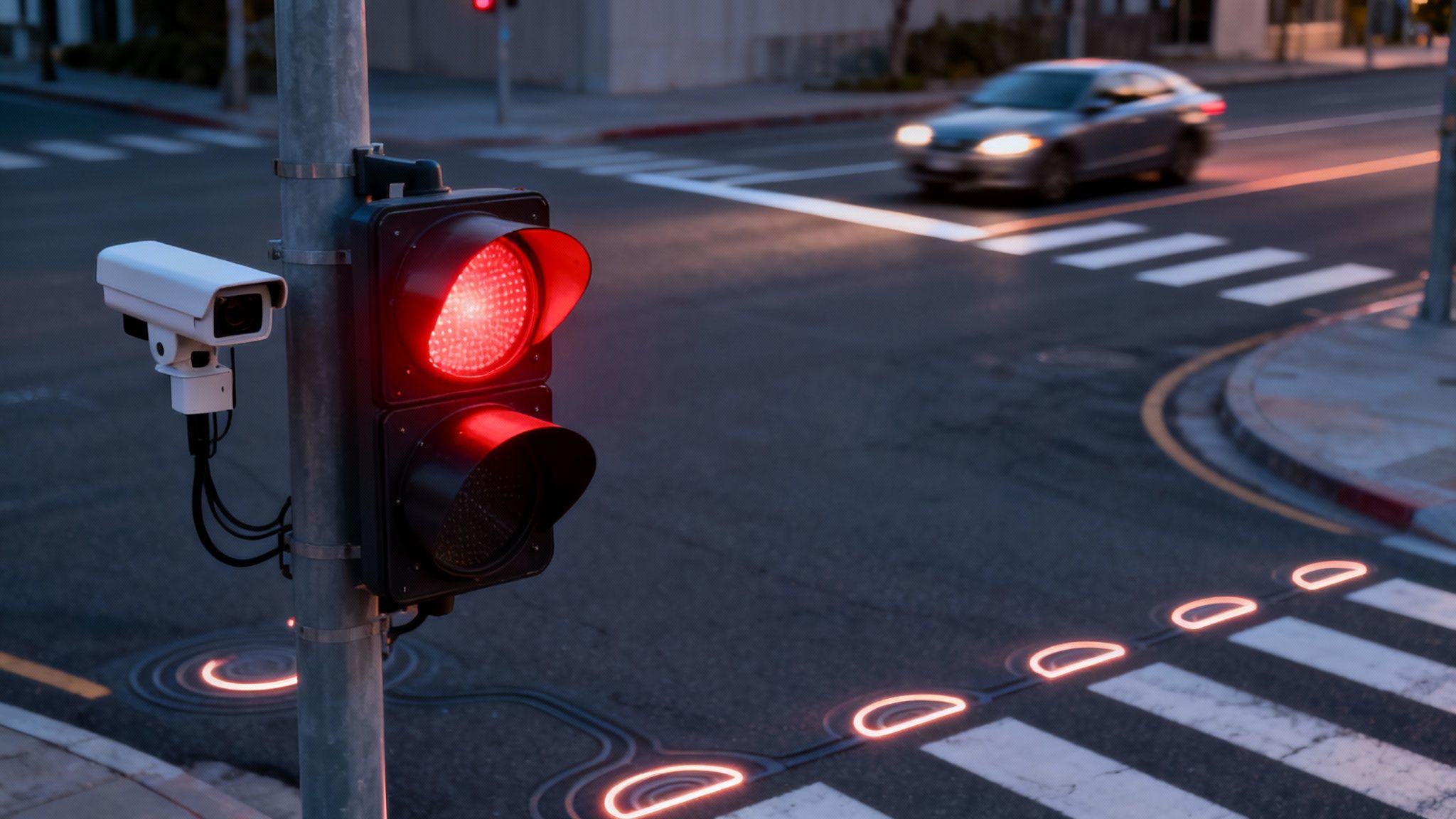
The entire operation depends on sensors. These are usually embedded in the pavement as inductive loops or mounted on a pole as radar units. They are wired directly into the traffic light’s signal, creating an invisible tripwire at the white stop line.
How a Violation Is Detected
As long as the traffic light is green or yellow, the camera system is dormant. The instant the light switches to red, the sensors activate. If a vehicle crosses over these sensors while the light is red, the system triggers.
This trigger sets off a rapid, multi-step process. The table below breaks down what happens in that split second.
| Step | Action | Technology Involved |
|---|---|---|
| 1. Initial Trigger | Vehicle crosses the stop line sensor after the light turns red. | Inductive loop or radar sensor |
| 2. First Photograph | A high-resolution photo is taken, capturing the vehicle at the stop line with the red light visible. | High-resolution digital camera |
| 3. Second Photograph | A second photo is taken moments later, showing the vehicle in the middle of the intersection. | High-resolution digital camera |
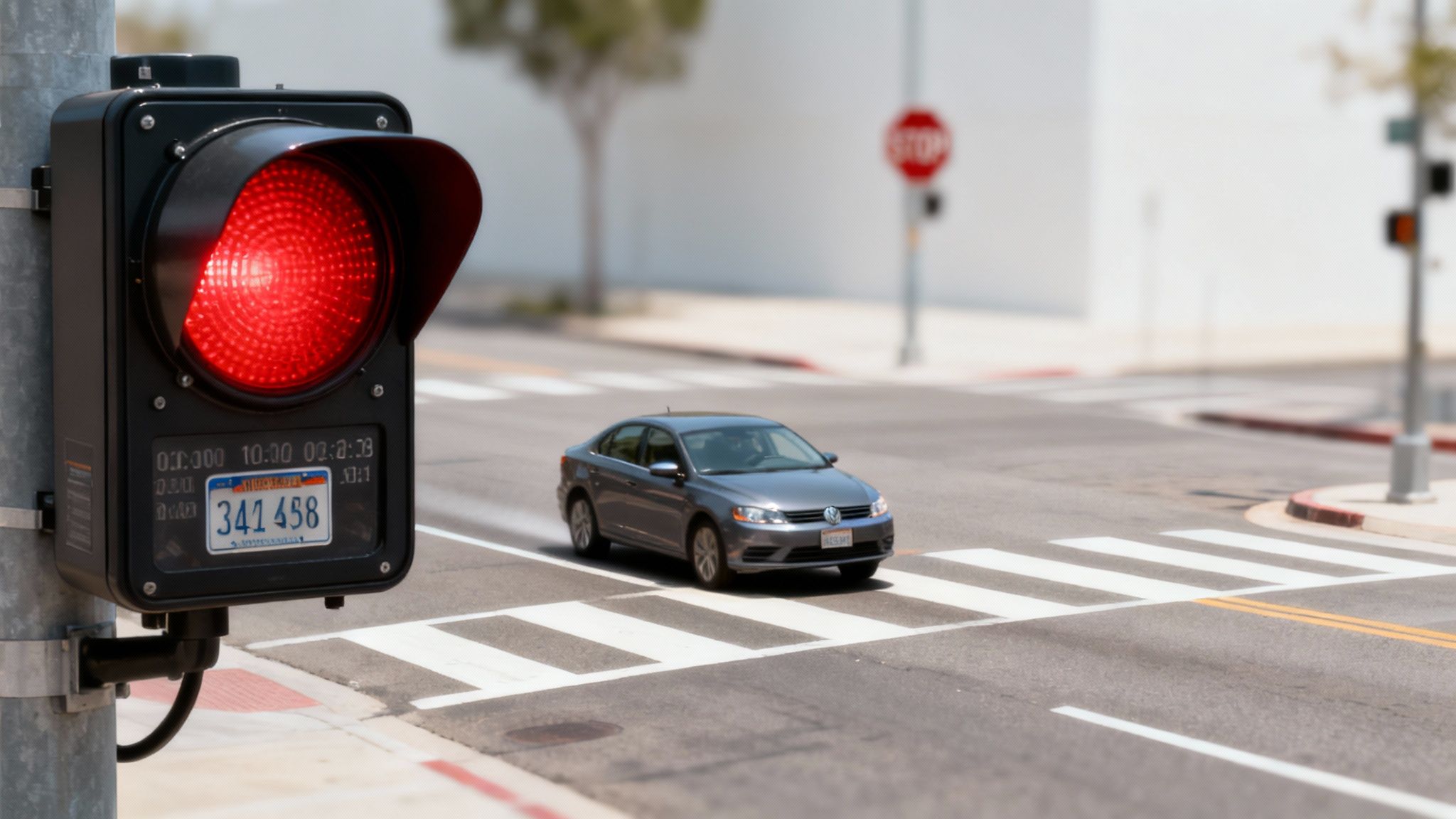
| 4. Data Capture | The system records the date, time, location, and time elapsed since the light turned red. A close-up of the licence plate is also captured. | Integrated computer system |
This sequence is designed to create a clear, indisputable record of the event, leaving little room for ambiguity.
The Human Review Element
This is an important point: the flash of the camera does not automatically mean a ticket is in the mail. Every captured event is sent to a processing centre for a crucial step: human review. A trained Provincial Offences Officer examines all the evidence.
They check to make sure the images are clear, the licence plate is readable, and that it was a legitimate violation. This review process filters out instances where a ticket is not appropriate, like when a driver enters an intersection to make way for an emergency vehicle.
Only after an officer confirms the violation does the process of issuing a ticket to the vehicle’s registered owner begin. This is not just an Ontario practice; many jurisdictions use a similar blend of sensors and cameras. You can learn more about how the City of San Jose documents these violations on its official website.
The Technology Powering Traffic Cameras
Ever wondered what is inside that grey box on the traffic pole? It is not just a simple camera. Red light camera systems are a sophisticated blend of sensors and high-speed photography, all calibrated to work in sync with traffic lights.
Across Ontario, from Toronto to Ottawa, these systems share the same mission: to know the exact moment a vehicle crosses the stop line after the light has turned red. To do that, they rely on a couple of key technologies.
Inductive Loops: The Original Tripwire
The traditional, tried-and-true method uses something called inductive loops. These are loops of wire buried in the asphalt, usually just before and after the thick white stop line. If you look closely at older intersections, you can often see the faint rectangular outlines where the pavement was cut to install them.
Think of these loops as a simple metal detector. They generate a weak magnetic field. When a large metal object like a car drives over them, it disturbs that field, and the system knows a vehicle is there.
The loops are wired directly into the traffic light’s controller. As soon as the light turns red, the system “arms” the loops. If a car disrupts the field while the light is red, it signals the camera to start shooting.
Radar and Video Analytics: The Modern Approach
Burying wires in the road is effective, but it is also a hassle to install and maintain. That is why newer systems are moving toward technologies mounted on the poles with the cameras.
- Radar Sensors: These units work like a police speed gun. They send out radio waves that bounce off moving vehicles. By measuring the signals that come back, the system can calculate a car’s exact position and speed as it approaches the intersection.
- Video Analytics: The latest evolution uses a separate video camera paired with smart software. The system is programmed to understand the intersection’s geography. It “watches” the video feed, and if it sees a vehicle cross the stop line after the light turns red, it triggers the main enforcement camera.
No matter which trigger is used, the next step is the same: the high-resolution camera captures the evidence.
These are not average cameras. They are built to capture crystal-clear, legally admissible images of licence plates in any condition, rain, snow, day, or night.
Every photo is automatically stamped with the precise time, date, and location. The system also records how long the light had been red before the vehicle crossed the line. This complete data package is what gets sent for review.
Related reading: Learn more about our live traffic camera systems, which monitor traffic flow for efficiency and safety.
From a Camera Flash to a Fine in Your Mailbox
That bright flash in your rearview mirror is a familiar, gut-sinking feeling. But that split-second event is just the first step in a meticulous process. Understanding what happens after the flash reveals a system built on both sophisticated technology and essential human oversight, especially here in Ontario.
The journey from a digital snapshot to a ticket in your mailbox is not instant. Once the camera captures its photos and data, the information is encrypted and sent securely to a central processing centre. This is where a critical human check comes into play.
The Role of the Provincial Offences Officer
Before any ticket is mailed, a trained Provincial Offences Officer personally reviews every captured event. This is a legal requirement in Ontario and acts as a safeguard to filter out mistakes. The officer is the system’s common-sense check.
Their job is to scrutinize the evidence. They examine the photos showing the vehicle before it crossed the white stop line and then again as it travelled through the intersection, all while the traffic light was red. They also confirm the licence plate is legible and that all the time-stamped data adds up.
This manual review weeds out situations that are not true violations. For instance:
- Emergency Vehicles: An ambulance needing to proceed through a red light with its sirens on? The officer will see this and cancel the event.
- Funeral Processions: Vehicles in a formal funeral procession are often exempt, and these cases are typically dismissed.
- Avoiding a Hazard: If a driver had to enter the intersection to swerve away from a potential collision, that context can be considered.
This human oversight helps keep the system fair.
A key piece of information for Ontario drivers: red light camera tickets are issued to the registered owner of the vehicle, not the person driving. This means no demerit points are added to your licence, and the ticket does not affect your insurance rates.
This is a major difference from a ticket handed to you by a police officer, which carries demerit points and can impact your driving record.

Whether an in-ground loop or a pole-mounted radar, these are the triggers that start the chain of events that ultimately lands on an officer’s desk.
What Arrives in the Mail
Only after a Provincial Offences Officer confirms a violation has occurred does the process continue. The system then uses the licence plate to retrieve the vehicle owner’s details from the Ministry of Transportation’s records. A formal ticket, called an Offence Notice, is then mailed to the address on file.
The notice you receive is designed to be transparent. It includes the photographic proof of the violation, showing your vehicle in the intersection while the light was red. It also spells out the location, date, time, fine amount, and all your options for how to respond.
Are Red Light Cameras Making Our Roads Safer?
The debate over red light cameras is familiar in Canadian cities. It usually boils down to a single question: are they a public safety tool or just a cash grab? The data paints a nuanced picture, with city officials pointing to safety improvements while critics raise valid points.
The primary target of these cameras is the right-angle collision, what most of us call a “T-bone” crash. These are among the most dangerous incidents at intersections, happening when a driver runs a red light and hits a vehicle with the right of way.
The Impact on Collision Types
Across Canada, official numbers tell a consistent story: when a red light camera is installed, the number of severe right-angle collisions at that intersection drops. The City of Ottawa, for instance, has reported that these dangerous, injury-causing crashes decrease at camera locations. From that perspective, the program is doing what it was designed to do.
But the conversation is more complicated. A common criticism is that the cameras might cause more rear-end collisions. The logic is that drivers, trying to avoid a ticket, brake more abruptly than they normally would.
While traffic studies often show an increase in rear-end collisions, these accidents are typically far less severe than the T-bone crashes the cameras prevent. Municipalities and safety advocates argue that trading a potential increase in minor fender-benders for a drop in catastrophic side-impact collisions is a worthwhile public safety trade-off.
A Look at the Broader Data
Data from other regions often backs up the case for automated enforcement. According to the Insurance Institute for Highway Safety, a U.S. organization, communities with red light camera programs experienced a 21% reduction in fatal red light running crashes.
The core of the debate often hinges on this trade-off: a documented decrease in severe, life-altering collisions versus a potential rise in less severe rear-end incidents.
This balanced view is key to understanding how red light cameras work, not just as machines, but as a public policy tool.
Addressing Privacy and Revenue Concerns
Another sticking point is privacy. It is fair to ask what these cameras are recording. In Ontario, the law is clear. The cameras are set up to photograph only the rear of the vehicle, capturing the licence plate. They do not take pictures of the driver or passengers, and the data is encrypted for law enforcement use only.
Then there is the “cash grab” argument. While the fines generate revenue, municipalities are generally required to reinvest that money into road safety programs. This could mean funding traffic calming measures, adding pedestrian crossings, or other initiatives.
Ultimately, whether red light cameras make our roads safer depends on how you weigh the evidence. They demonstrably reduce the most dangerous types of intersection crashes, but they also bring other factors like driver behaviour and public trust into the conversation.
How to Handle a Red Light Camera Ticket
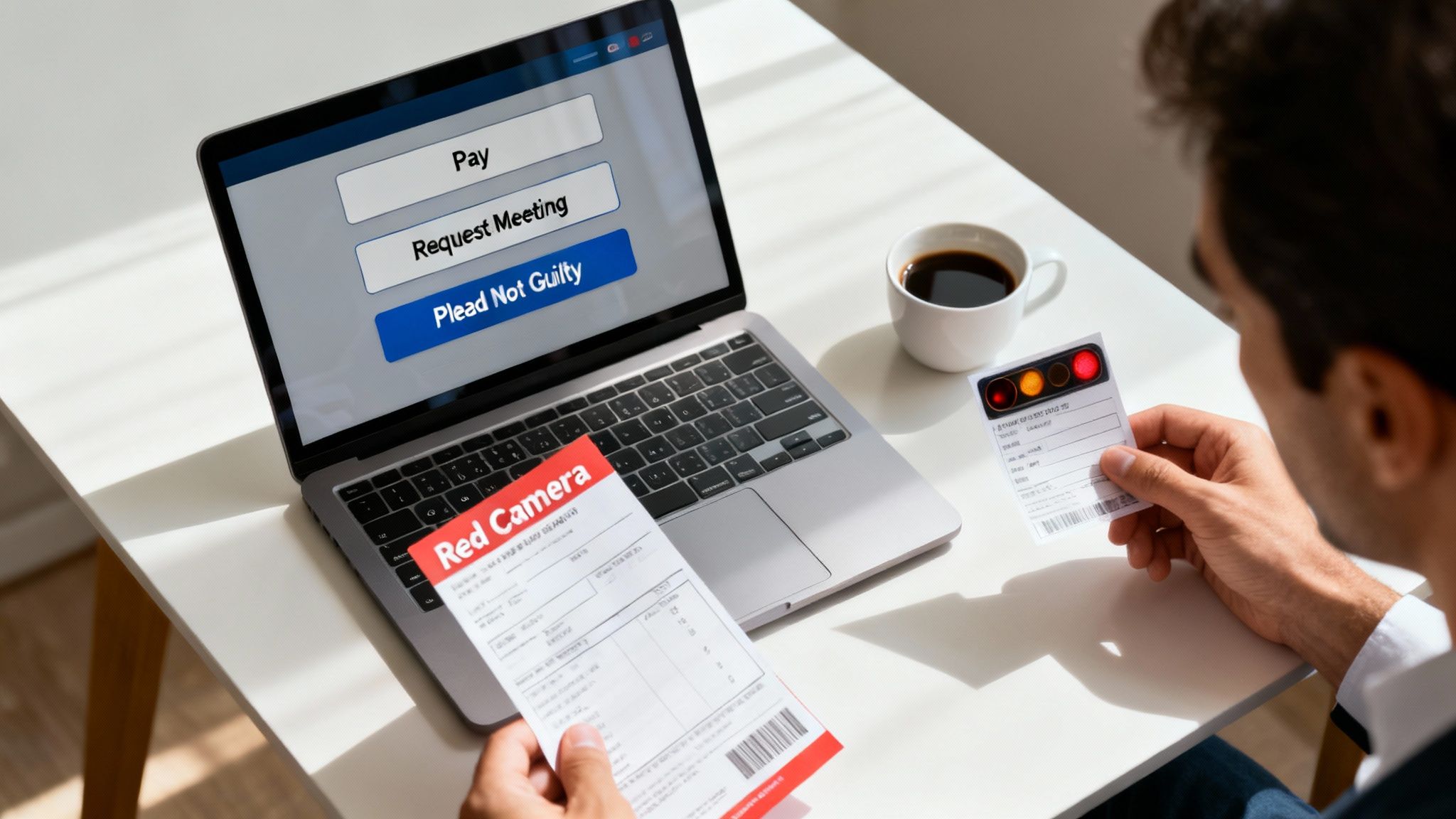
Seeing that official Offence Notice in your mailbox is never a great feeling. But do not panic. Knowing your options is the key to handling a red light camera ticket. In Ontario, these tickets are sent to the registered owner of the vehicle, not the person driving at the time.
This guide will walk you through the steps you can take to deal with the notice.
Cities like Ottawa and Toronto publish maps of all their red light camera locations online. This transparency is intentional; the goal is to improve road safety, not to catch drivers by surprise.
Understanding Your Three Options
Once you have the ticket, the notice will outline three paths you can take. Each one starts a different process within the provincial court system, so it is important to respond before the due date.
Here is a breakdown of the three official choices available:
- Plead Guilty and Pay the Fine: This is the simplest route. Paying the fine is an admission of guilt. This type of ticket does not add demerit points to your licence or affect your insurance rates.
- Request a Meeting with a Prosecutor: This is a pre-trial discussion. It is your chance to talk with a prosecutor to see if you can reach a resolution, which might mean a reduced fine.
- Plead Not Guilty and Request a Trial: If you choose this option, you are officially challenging the ticket. The court will set a trial date where you can argue your case before a Justice of the Peace.
Knowing what each option entails is the first step. The table below breaks down your choices and what to consider for each path.
Your Options for a Red Light Camera Ticket
| Option | What It Means | Key Considerations |
|---|---|---|
| Pay the Fine | You admit the vehicle committed the offence and agree to pay the penalty. | Quickest resolution. No demerit points or insurance impact in Ontario. |
| Meet the Prosecutor | You discuss the ticket with a prosecutor to seek a possible resolution, like a lower fine. | Not a trial. A reduced fine is possible but not guaranteed. |
| Go to Trial | You formally contest the ticket in court, presenting evidence. | You will need a valid legal defence. It requires time and preparation. |
Each option has its place, depending on your circumstances.
Grounds for Challenging a Ticket
Many people think it is impossible to fight a ticket from a machine, but that is not true. A successful challenge usually depends on proving specific circumstances.
Here are a few recognized grounds for a challenge:
- The vehicle was stolen: If you can show a police report proving your car was stolen before the violation occurred, the ticket can be dismissed.
- You were no longer the owner: If you have proof of the ownership transfer dated before the offence, you will not be held liable.
- The licence plates were stolen: If your plates were reported stolen and used on another car, this is a solid defence.
It is important to understand that claiming someone else was driving is not a valid defence in Ontario. Because the ticket is issued to the registered vehicle owner, they are ultimately responsible.
See also: The options for dealing with an automated ticket share similarities with navigating a parking infraction notice.
The decision is yours. Whether you choose to pay the fine or contest the charge, understanding the process empowers you to make the right call for your situation.
Got Questions? We’ve Got Answers.
We have explored the tech and the process, but most people want to know how it all affects them. It is time to tackle the practical questions that drivers across the National Capital Region often ask.
Can You Get a Ticket for Turning Right on a Red?
This is a common question, and the answer is almost always no. Red light camera systems in Ontario are set up to catch vehicles going straight through an intersection or making an illegal left turn on a red. They are not calibrated to ticket drivers making a legal right turn.
However, you must do it legally. A proper right turn on red means coming to a complete stop behind the white line before proceeding. While the camera likely will not ticket you, a police officer who sees you roll through the stop can still issue a ticket.
Will a Red Light Camera Ticket Affect My Insurance?
Here is some good news: a red light camera ticket in Ontario will not affect your insurance rates. It all comes down to how the ticket is issued. Since the camera only photographs your vehicle’s rear licence plate, it cannot prove who was driving.
Because of this, the ticket goes to the registered owner. This means:
- You get zero demerit points on your licence.
- The ticket does not show up on your personal driving record.
- Since insurance companies rely on your driving record, they will not know about it and cannot use it to raise your premiums.
This makes it very different from a ticket handed to you by an officer, which does go on your record and can affect your insurance.
What Happens if an Ambulance Triggers the Camera?
It happens all the time. An emergency vehicle with lights and sirens on will set off the camera if it runs a red light. The sensors do not know the difference between a fire truck and a passenger car.
This is exactly why a human is a critical part of the process. Every photo is sent to a Provincial Offences Officer for review. The moment that officer sees an emergency vehicle in the photo, they immediately cancel the violation.
This human review is the system’s most important safeguard. It ensures first responders are not penalized for doing their jobs.
This step prevents thousands of incorrect tickets from ever being mailed.
How Long Is That Yellow Light?
It can feel like yellow lights are getting shorter, but their timing is a carefully calculated science. Traffic engineers determine the duration of a yellow light based on the road’s posted speed limit.
The camera system only activates after the light turns fully red. It does not monitor the yellow phase.
As a general rule for timing in Ontario:
- On roads with a speed limit of 50 km/h or less, the yellow light lasts for about 3 to 4 seconds.
- For faster roads where speeds are between 60 km/h and 80 km/h, the duration is increased to between 4 and 5 seconds.
These timings are engineered to give a driver travelling at the speed limit enough time to either clear the intersection or come to a safe stop. Understanding that can help take the panic out of a changing light.
At NCR Now, we believe informed residents are the foundation of a strong community. From understanding how municipal services work to discovering local events, our goal is to provide clear, relevant journalism that helps you navigate life in the National Capital Region. https://ncrnow.ca
About The Author