
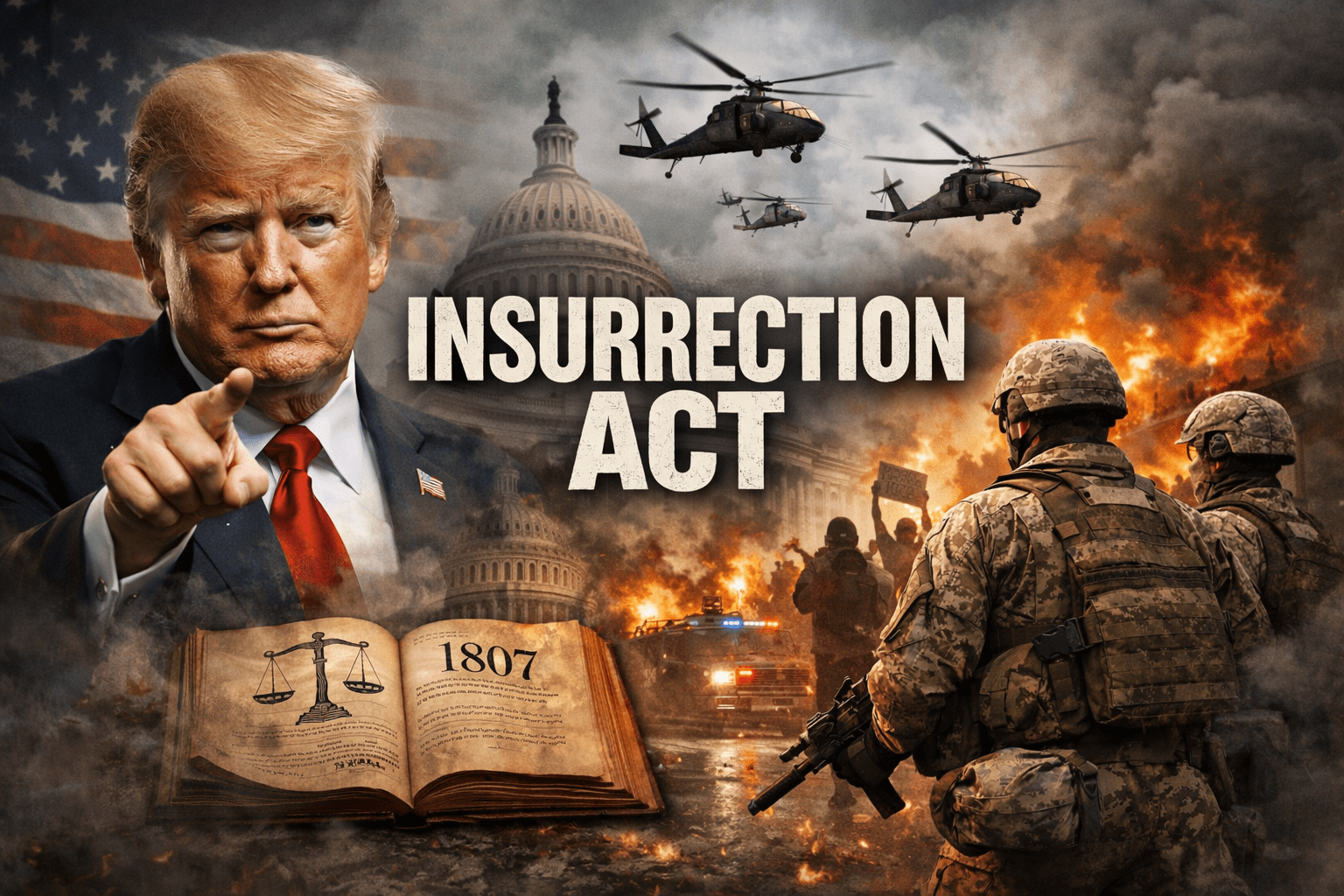
The Insurrection Act has re-entered public debate after U.S. president Donald Trump threatened to invoke it following unrest in Minnesota on January 14, 2026. The comments came after a second violent confrontation involving federal immigration officers in Minneapolis, escalating protests that were already underway and raising serious questions about federal power, civil liberties, and the limits of presidential authority.
While the Insurrection Act is rarely used, it is one of the most sweeping emergency powers available to a U.S. president. Understanding what the Insurrection Act allows, why Trump is invoking it rhetorically now, and what its use would actually mean is critical to understanding the stakes of the moment.
What Happened in Minnesota on January 14?
On January 14, Minneapolis saw large demonstrations after a federal immigration officer shot a man in the leg during an enforcement operation. The incident followed an earlier shooting involving federal agents that had already inflamed community tensions. Protests quickly spread, with demonstrators accusing federal authorities of excessive force and a lack of accountability.
According to reporting by the Associated Press, crowds gathered near federal buildings and law enforcement staging areas, with clashes involving crowd-control measures such as tear gas and pepper projectiles. Local officials called for calm and emphasized that city and state law enforcement were actively responding to the situation.
Within hours, Trump issued public statements warning that if Minnesota officials failed to “restore order,” he would consider invoking the Insurrection Act to deploy federal forces. CBS News reported that Trump framed the protests as an attack on federal authority rather than a public demonstration.
What Is the Insurrection Act?
The Insurrection Act is a collection of federal laws first passed in 1807 that allows the president to deploy U.S. military forces inside the country under limited circumstances. It exists as a narrow but powerful exception to the Posse Comitatus Act, which normally prohibits the military from performing domestic law-enforcement duties.
The Act gives the president authority to use the armed forces or federalize the National Guard when state authorities are unable or unwilling to protect constitutional rights or enforce federal law.
Unlike many emergency powers, the Insurrection Act does not require prior approval from Congress. In some cases, it can be invoked without the consent of a governor, a feature that makes it especially controversial.
When Can the Insurrection Act Be Used?
Legal scholars generally describe three scenarios in which the Insurrection Act can be invoked.
First, a state government can request federal assistance to suppress an insurrection or serious domestic disturbance.
Second, the president can act unilaterally if federal law cannot be enforced due to rebellion, obstruction, or widespread violence.
Third, the Act can be used when citizens are being deprived of constitutional rights and state authorities fail or refuse to intervene.
The Brennan Center notes that the language of the Act is broad, granting the president significant discretion in deciding when conditions have been met
This breadth is precisely why civil-liberties groups have long warned that the Insurrection Act is vulnerable to abuse.
How Often Has the Insurrection Act Been Used?
Despite its sweeping powers, the Insurrection Act has been used sparingly. It has been invoked roughly 30 times in U.S. history, often in moments of deep national conflict.
Notable uses include President Eisenhower sending federal troops to enforce school desegregation in Arkansas in 1957, and President George H. W. Bush deploying troops during the 1992 Los Angeles riots.
In more recent decades, presidents have largely avoided using the Act without state consent. Even during widespread protests following the killing of George Floyd in 2020, the Act was threatened but not ultimately invoked.
Why Is Trump Threatening to Use the Insurrection Act Now?
Trump’s threat is rooted in how he is framing the unrest in Minnesota. Rather than treating the protests as a civil response to federal enforcement actions, he has characterized them as violent resistance to federal authority.
Reuters reported that Trump described demonstrators as “insurrectionists” and accused local leaders of allowing chaos to spread.
This framing is politically significant. If protests are defined as an “insurrection,” it lowers the rhetorical threshold for federal intervention. Critics argue this language conflates dissent with rebellion and risks criminalizing protest itself.
What Would Invoking the Insurrection Act Actually Do?
If formally invoked, the Insurrection Act would allow the president to deploy active-duty military personnel or federalize the National Guard in Minnesota. These forces could be used to assist law enforcement, secure infrastructure, and suppress unrest.
This would represent a dramatic escalation. Military troops are trained for combat, not civilian policing, and their presence can fundamentally alter the dynamics of protest and public order.
Legal experts quoted by PBS emphasize that invoking the Act in a state where courts, police, and elected officials are functioning would likely face immediate legal challenges.
How Are Minnesota Leaders Responding?
Minnesota officials have rejected Trump’s characterization of the situation. Governor Tim Walz and Minneapolis Mayor Jacob Frey have stated that state and local authorities are capable of managing public safety and that federal escalation would worsen tensions rather than calm them.
The Associated Press reports that state leaders are also reviewing the legality of federal enforcement tactics that sparked the protests in the first place.
Several governors from other states have also criticized Trump’s threat, warning that misuse of the Insurrection Act could undermine democratic norms and state sovereignty.
Why the Insurrection Act Is So Controversial
At its core, the controversy surrounding the Insurrection Act is about power. The law concentrates extraordinary authority in the presidency, with limited oversight and vague standards.
Civil-rights organizations argue that the Act’s language is outdated and fails to reflect modern understandings of protest, policing, and constitutional rights. Some members of Congress have repeatedly introduced legislation to reform or repeal portions of the Act, though none have succeeded.
The Brennan Center has warned that leaving the Act unchanged creates a “loaded weapon” that depends entirely on presidential restraint
Why This Moment Matters
The renewed focus on the Insurrection Act is not just about Minnesota. It reflects a broader struggle over how governments respond to protest, dissent, and public anger.
If protests triggered by controversial federal actions can be labeled as insurrection, the line between democracy and authoritarian response becomes dangerously thin. Conversely, genuine breakdowns of law and order do require tools for emergency response.
The question is not whether the Insurrection Act exists, but how narrowly it should be interpreted and how cautiously it should be used.
As tensions continue in Minnesota, Trump’s threat alone has already reshaped the conversation. Whether or not the Insurrection Act is formally invoked, its use as a political weapon has real consequences for public trust, civil liberties, and the future balance of power in the United States.
About The Author