
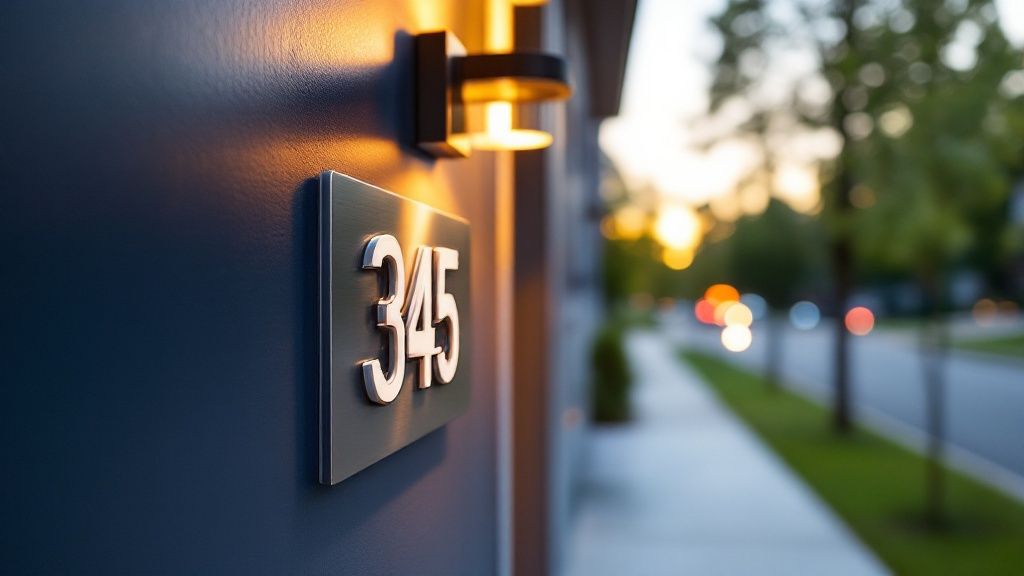
Ever notice that number on the front of your house? That's your civic number, and it’s way more than just a decorative touch. It's the first and most crucial part of your address, acting like a unique pinpoint on a map that tells everyone from your pizza delivery driver to first responders exactly where you are.
So, What's in a Number?
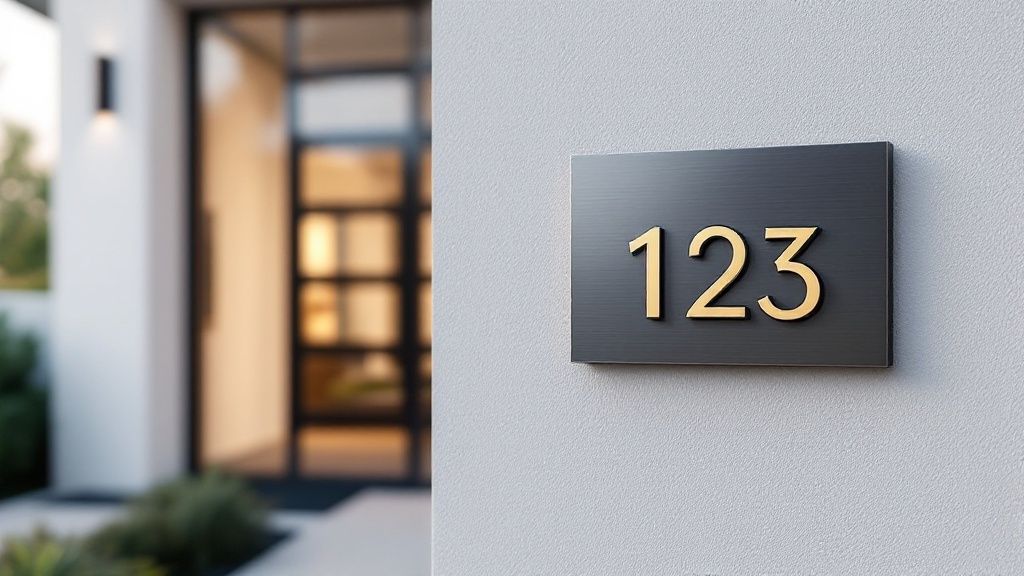
Think of it this way: while dozens of homes might share a street name like "Elm Street," your civic number is unique to your property on that street. It’s what separates your front door from your neighbour’s, ensuring there’s no mix-up.
This simple number is the critical link connecting your property to the entire community's infrastructure. Police, firefighters, and paramedics rely on it to find you without a second’s delay. In an emergency, a clearly visible civic number can literally be a lifesaver.
In Canada, every property within a municipality is assigned a unique civic number to make it easily identifiable. So, if your address is "345 Elm Street," your civic number is 345. Its primary job is to help emergency crews get to the right place, fast. Companies like Kalitec, who are experts in municipal signage, stress just how vital clear numbering is for public safety.
"Your civic number is more than just an address component; it is a vital link to safety and community services. When seconds count, a clear civic number is the fastest way for help to find you."
To really see how it all fits together, it helps to break down a typical Canadian address into its core parts.
Components of a Standard Civic Address
This table shows how each piece of your address works together, with the civic number leading the way.
| Component | Description | Example |
|---|---|---|
| Civic Number | The unique number identifying the building or lot. | 345 |
| Street Name | The official name of the road the property is on. | Elm Street |
| Municipality | The city, town, or district where the property is located. | Ottawa |
| Province | The provincial jurisdiction. | Ontario |
| Postal Code | A code used by Canada Post to sort and deliver mail. | K1A 0B1 |
As you can see, from the specific house number to the broad postal code, each component narrows down the location until it points directly to your doorstep.
How Do You Get a Civic Number? The Assignment Process
Ever wonder how your house got its number? It’s not just plucked out of thin air. Municipal governments use a surprisingly logical system to make sure every single property has a unique, easy-to-find address. This process is all about creating order and preventing the chaos of duplicate or confusing addresses.
It usually all starts when a new property is developed. Whether you're a developer building a new subdivision or a homeowner adding a secondary unit, applying for a building permit in Ottawa is what kicks off the civic addressing process. From there, the municipality uses a standardized grid or measurement system to assign a new number.
Think of it like a giant ruler laid out along your street. Numbers are typically assigned based on a property's distance from a set starting point, like a major intersection or where the street begins. This is why numbers almost always increase in a predictable sequence, making it far simpler for anyone—from friends to paramedics—to find their way.
The Official Source of Truth
To keep everything straight, most regions rely on an official, authoritative database. In Nova Scotia, for example, this master list is called the Nova Scotia Civic Address File (NSCAF). It’s the single source of truth for every civic number used by 911 dispatchers, utility companies, and other essential services. If you want to see how these requests work in another major city, the Halifax municipal website offers a good look.
This map here shows how a civic number is more than just a number on a mailbox—it's a precise point on a map.
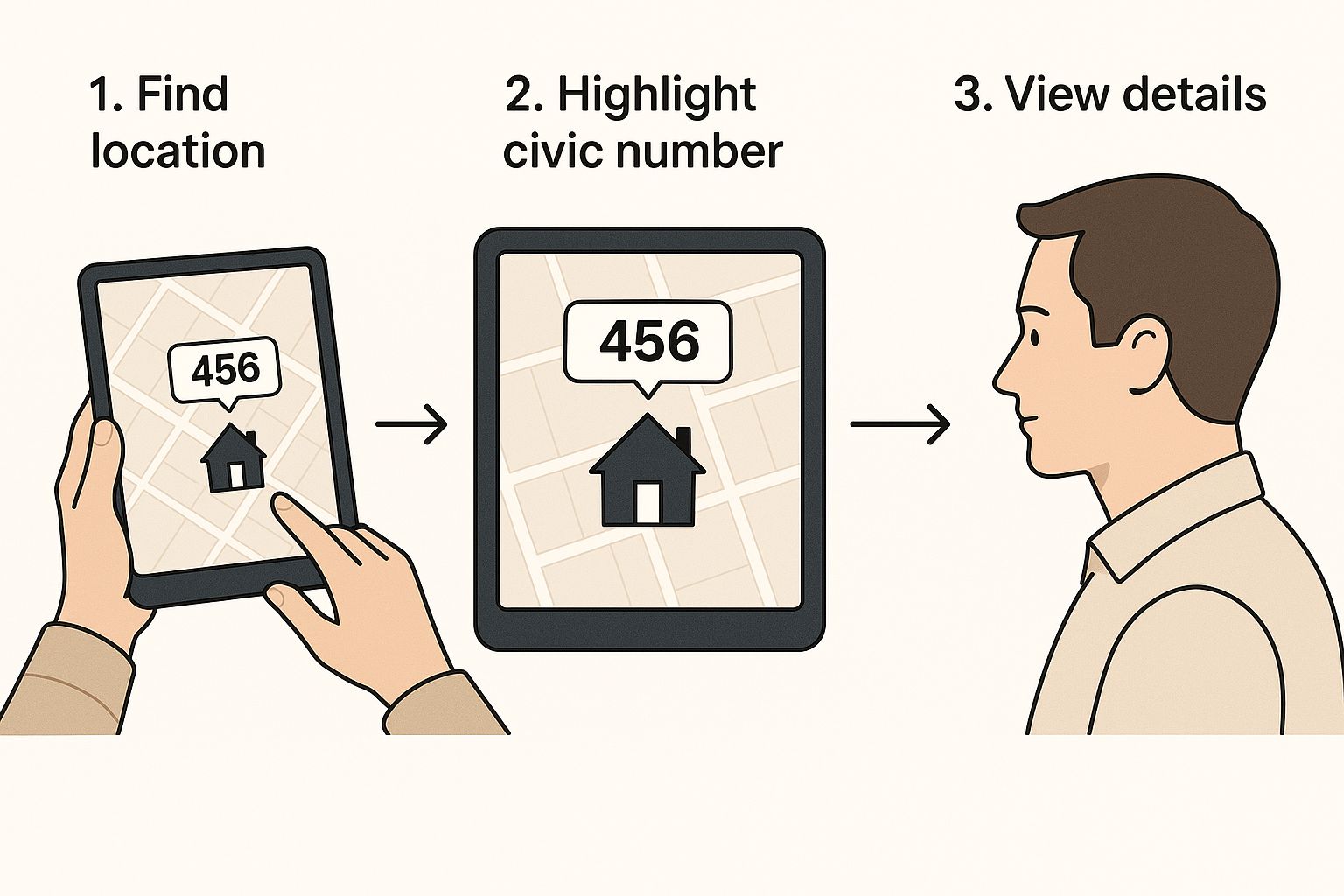
As you can see, a civic number is a specific data point that allows for pinpoint accuracy, which is absolutely critical for emergency services.
Relying on the official municipal address is critical. Commercial mapping apps are helpful for general navigation, but for emergency response, the data maintained by your local government is the only one that counts.
That official database is the direct link between your physical location and the entire emergency response network. When you call 911, the dispatcher isn't plugging your name into a consumer GPS app. They’re pulling your location from the official, verified civic address file to send help straight to you, no guesswork involved. The accuracy of this system is the bedrock of public safety.
Why Your Civic Number Can Be a Lifesaver
In an emergency, every tick of the clock feels like an hour. When you're waiting for paramedics, firefighters, or police to arrive, the only thing that matters is how fast they can find you. This is the moment your simple civic number becomes a critical piece of life-saving equipment for your home.
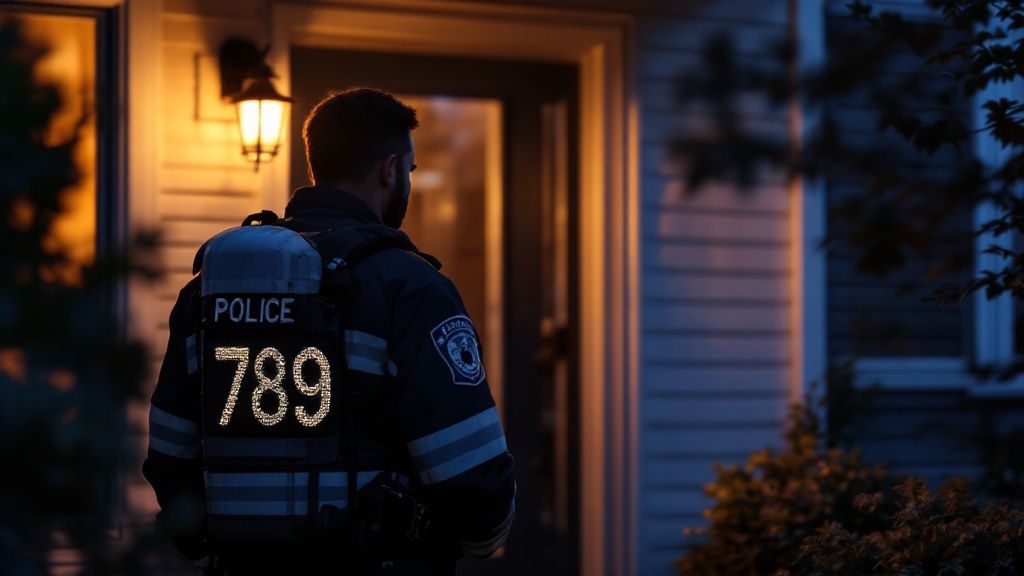
Think about it. A loved one is having a medical emergency, and you've called 911. Help is on the way. But what if your civic number is hidden by overgrown bushes, faded from the sun, or just isn't there? First responders are forced to slow down, search, and guess which house is yours. Those lost moments can have devastating consequences.
A clearly posted number is the single most effective way to help emergency crews locate you without a single second wasted. It acts as a beacon, guiding them straight to your front door when time is everything.
Making Your Home Easy to Find
To make sure that beacon is working, most municipalities have specific bylaws about how civic numbers need to be displayed. The exact rules can vary, but they all share one common goal: making you easy to find. Fast.
These requirements often boil down to a few key things:
- Contrasting Colours: Your numbers should stand out against their background. Think black on white or white on black—no subtlety needed here.
- Reflective Materials: A sign that reflects light is a game-changer. It allows headlights to illuminate your number at night or during a storm.
- Proper Placement: The number needs to be visible from the centre of the road, without trees, decorations, or parked cars blocking the view.
In communities across Canada, like the Barrington Municipality in Nova Scotia, having a clear and reflective civic number isn't just a suggestion—it's a key part of their emergency response strategy. Studies have shown that properties without proper signage can add several precious minutes to response times. You can learn more about these vital municipal requirements and why they matter so much.
A visible civic number isn’t just about following rules; it's one of the most fundamental steps you can take to protect your family. It empowers first responders to do their job effectively and acts as a silent guardian for your home.
This simple, proactive measure directly supports the incredible work of teams like the Ottawa Fire Department, letting them focus on the emergency, not on a frustrating search for the right address.
Civic Numbers in Your Everyday Life
We usually think of our civic number as something for emergencies, but its real job is much bigger—it's the quiet organizer working behind the scenes of your daily life. It’s the simple code that lets countless services pinpoint your exact location, turning your property from a dot on a map into a specific destination.
Think about the last time you ordered something online. Courier companies and Canada Post rely on that civic number as the single most important detail to get that package from a warehouse to your front door. Without it, your address is just a name on a long street, making a timely delivery almost impossible. That one number is the backbone of modern logistics.
More Than Just Mail
But the importance of a civic number goes way beyond getting your packages. It’s the key that unlocks all the essential household services that make modern life run smoothly.
Utility providers are a perfect example. They need your civic number for a few critical reasons:
- Getting You Connected: Companies providing hydro, water, natural gas, and internet need your exact address to hook everything up.
- Fixing Problems Fast: When there’s an outage, your civic number helps crews figure out exactly where to go to get the power or water back on.
- Fair and Accurate Billing: It ensures the bill you get is for your home’s usage, not your neighbour’s.
On top of that, municipal governments use this number for all sorts of administrative tasks. It helps them map out waste collection routes, figure out which school district your kids belong to, and process permits for things like renovations. It's also fundamental to how they calculate your annual fees. You can learn more about how this works by reading our guide to understanding your property tax bill.
Every essential service—from mail delivery to utility setup and municipal administration—hinges on the accuracy and clarity of your civic number. It’s the unique identifier that connects your home to the entire community framework.
How to Find and Verify Your Official Civic Number
So, where do you actually find your official civic number? It’s probably easier than you think. The most reliable places are the official documents tied directly to your property.
A great place to start is your latest property tax assessment or the land title documents for your home. These are issued by the government, so they’ll always list the legally registered civic number. Utility bills for services like hydro and water are also solid bets, since those companies use the official address for everything they do.
Go Straight to the Source for Confirmation
While your paperwork is a good starting point, the absolute most authoritative source is your local municipal government. Getting in touch with them directly is the only way to be 100% sure your number is correct.
Just head to your city’s website and look for the civic addressing or public works department. This step is a must if you’re a new homeowner or if there's any confusion floating around about your address. Remember, they’re the ones who hold the master file that emergency services depend on.
It’s tempting to rely on GPS or online maps, but for official purposes, that can be a risky move. While they’re great for getting around town, these apps sometimes have outdated info and are definitely not the legal source of your civic address. When in doubt, always trust your municipality's records.
If you live in a rural area, you can often just take a look at the entrance to your property. Many municipalities require a standardized, reflective signpost—usually green or blue—at the end of the driveway. This sign is designed to display the official civic number clearly, especially for first responders racing to a call. If that sign is missing or beat up, your next step is to call the municipality.
Common Questions About Civic Numbers
Even after getting the basics down, a few common questions always seem to pop up about civic numbers. Let's clear up any lingering confusion and nail down the differences between the various parts of your address.
Getting these details right is more than just trivia—it’s crucial for everything from getting your Amazon packages to ensuring an ambulance can find you in an emergency.
Is a Civic Number the Same Thing as a Postal Code?
Not at all, but they're a team. A civic number is your property's unique ID on a specific street. Think of it as the "345" in "345 Elm Street"—it points to one single, specific home.
On the other hand, a postal code like K1A 0B1 covers a much wider area. It's a sorting code for Canada Post that groups together dozens or even hundreds of addresses into a single delivery zone. You share your postal code with all your neighbours, but your civic number is yours alone.
What if My New House Doesn't Have a Civic Number?
If you've just built a new home, you'll need to formally apply to get a civic number assigned. This isn't automatic. The process is handled by your local municipal government, usually through the planning, public works, or addressing department.
This step is absolutely essential. Without an official civic number, you can't set up utilities like hydro and internet, receive mail, or be located by 911 emergency services. The city will assign a number that fits logically into the sequence of your street, keeping everything consistent for navigation and safety.
A civic number isn't just created when a house is built. It’s an official identifier assigned by a government authority to plug your property into the community’s logistical and emergency response networks.
Why Are So Many Civic Number Signs Blue or Green?
There's a very practical reason for that specific look: maximum visibility. The sharp contrast of reflective white numbers on a blue or green background is incredibly easy for emergency responders to spot, especially at night or in bad weather like a blizzard or thick fog.
When a fire truck or ambulance is racing to your home, their headlights will make that reflective sign light up like a beacon. This allows them to confirm they have the right address instantly, without losing precious seconds. These standards are often set by local by-laws and are a simple but life-saving public safety feature.
Can I Change My Civic Number if I Don't Like It?
Almost certainly, no. Civic numbers aren't a matter of personal taste; they are a critical part of a logical, city-wide system built for navigation. This system is what allows mail carriers, delivery drivers, and first responders to find places efficiently.
Changing even one number would throw the whole sequence on your street into disarray, creating confusion that could dangerously delay an emergency response. A municipality would only ever consider changing a number in an extremely rare case where a documented public safety risk was proven. For everyone's sake, the integrity of the system comes first.
At ncrnow, we provide the latest news and essential information for residents of Ottawa and the National Capital Region. Stay informed about your community by visiting us at https://ncrnow.ca.
About The Author