

Photo by Scott Graham
The arrival of tax season in 2026 brings renewed urgency for Canadians to protect their personal data from sophisticated fraudsters posing as the CRA. While the anxiety of filing taxes is a perennial Canadian experience, the tools being used to exploit that stress have undergone a radical transformation. We are no longer just dealing with poorly worded emails and suspicious links; we are entering an era of “hyper-realistic” fraud driven by artificial intelligence. According to the RBC 2026 Fraud Prevention Month Poll, 81% of Canadians now feel that scams are becoming significantly harder to distinguish from legitimate government communications. This “fraud fatigue” is exactly what cybercriminals are counting on as they refine their tactics to bypass our traditional defences.
The Evolution of the AI-Enhanced CRA Tax Scam
As we navigate this digital minefield, the most significant shift is the disappearance of the “obvious” red flags. In years past, a savvy taxpayer could spot a scam by looking for spelling errors or awkward grammar. Today, generative AI tools allow scammers to craft pixel-perfect replicas of official CRA correspondence in seconds. As noted by Global News, cybersecurity experts warn that AI has removed the barriers to entry for even inexperienced fraudsters.
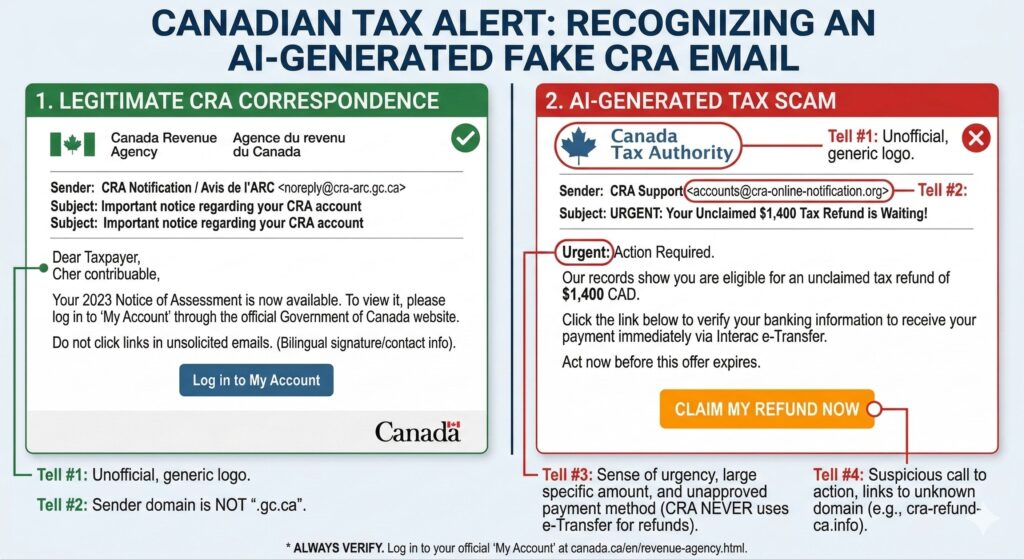
Furthermore, the rise of “vishing”—or voice phishing—has become a primary concern. Scammers now use AI voice cloning technology to impersonate agents. By harvesting just a few seconds of audio from a person’s public social media profile, a fraudster can clone a voice with startling accuracy. According to the Canadian Centre for Cyber Security, these deepfakes exploit trust and emotional triggers, making it nearly impossible for a human listener to distinguish a cloned voice from an authentic one.
The Strategy of Disinformation: Fake Benefits and Lures
In 2026, the tactics have expanded beyond threats of arrest to include “tax disinformation.” The official CRA Scam Alert page has issued specific warnings regarding viral social media advertisements and text messages promising non-existent government rebates. These lures often cite specific, realistic-sounding figures—such as a $2,000 “financial relief” payment or a $680 “housing supplement” direct deposit—none of which are real.
These “carrots” are designed to entice you to click a link that leads to a spoofed login page. The Canadian Anti-Fraud Centre (CAFC) reports that identity fraud remains the most frequent type of report, contributing to a staggering $704 million in total reported fraud losses across the country in 2025 alone.
The Psychology of the Scam: Emotional Hijacking
While a scammer’s ultimate objective is to steal your money, their fundamental method is the exploitation of your emotions. Fraudsters create a state of “emotional ether” designed to bypass your rational judgment and trigger an impulsive, costly reaction.
The 4 Primary Emotional Triggers
- Fear: Threatening immediate arrest or deportation to shut down logic.
- Urgency: Using artificial deadlines (e.g., “action required in 10 minutes”) to prevent independent verification.
- Hope/Greed: Luring victims with fake rebates or unclaimed refunds to trigger a reward response.
- Authority: Mimicking official government branding to exploit our natural bias to trust figures in power.
Hard Numbers: The Financial Reality of Fraud
The scale of the problem is often underestimated because of the “Iceberg Effect.” Analysts at CAFC estimate that only 5% to 10% of victims actually report their losses to the authorities. For many, the embarrassment of being “tricked” leads to silence, allowing these criminal networks to flourish. The latest statistics show that while everyone is at risk, certain demographics are hit harder; seniors accounted for nearly 28% of the overall dollar loss in the previous year.
The Golden Rules of Verification
To stay safe, it is vital to remember the protocol established by the government. Regardless of how convincing an email or voice sounds, the CRA will never:
- Demand immediate payment via Bitcoin, prepaid credit cards, or gift cards.
- Send a refund or any form of payment via Interac e-transfer or text message.
- Use aggressive, threatening language or threaten you with immediate arrest.
The only secure way to verify your status is to manually type https://www.canada.ca/en/revenue-agency/services/e-services/cra-login-services.html into your browser and navigate to the official CRA “My Account.”
Building a Culture of Digital Resilience
Beyond technical tools, the best defence is a proactive one. Security experts now recommend that families establish a “secret code word.” According to the RBC poll, only 27% of Canadians currently use a family code word, yet it is one of the most effective ways to verify identity during an “emergency” call. Additionally, enabling Multi-Factor Authentication (MFA) on your government accounts provides a critical secondary barrier that is much harder for AI-driven bots to breach.
Conclusion: Staying One Step Ahead
The landscape of fraud is constantly shifting. While a scammer’s ultimate objective is to steal your money, their fundamental method is the exploitation of your emotions. Whether they use the “carrot” of a fake refund or the “stick” of a legal threat, they rely on you acting quickly without thinking. By slowing down and using official portals, you can reclaim your peace of mind. In 2026, skepticism is not just a trait—it is your most valuable asset during tax season.
Additional Reading & Resources
- CRA: Recognize a Scam – Full List of Official Protocols
- Canadian Anti-Fraud Centre: Latest Fraud Alerts and Reporting Portal
- RBC: 2026 Fraud Prevention Month Tips and Research
- https://antifraudcentre-centreantifraude.ca/protect-protegez-eng.htm
About The Author