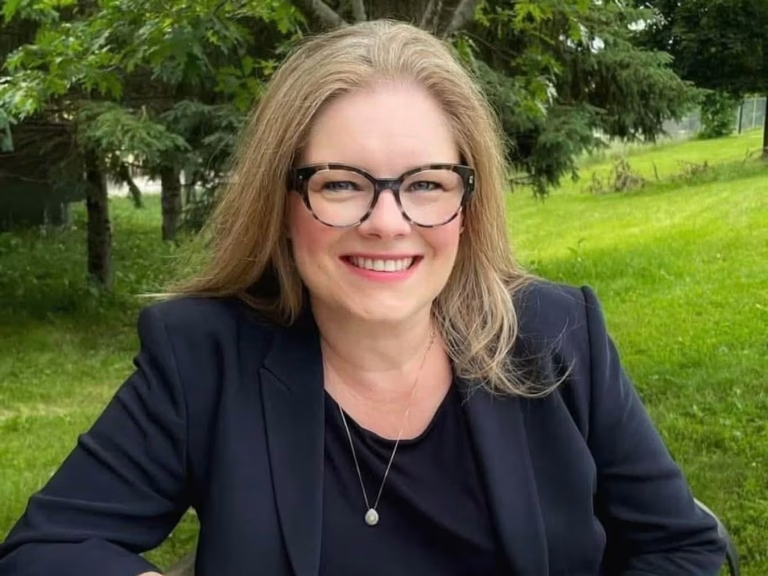

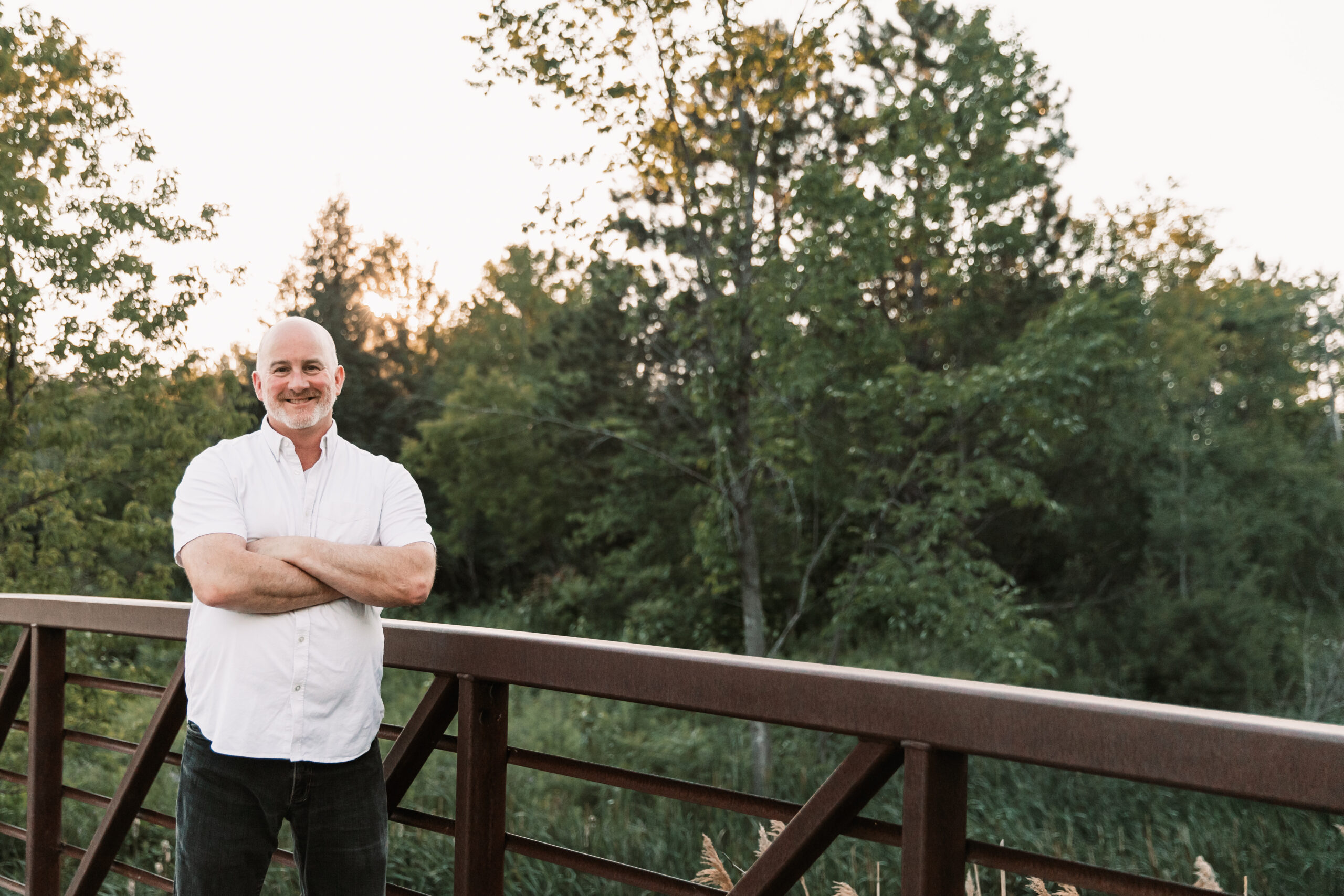
The following are 5 questions that we sent out to every council candidate in hopes of getting to know them better. We publish the responses exactly as we receive them, in the order that they were sent to us. Here are the responses from Knoxdale-Merivale (Ward 9) councillor Sean Devine, who is running for re-election.
1. Who are you? Where are you from? What relevant experience do you have for the job?
My name is Sean Devine, and I’m running for re-election as the City Councillor for Ward 9 (Knoxdale-Merivale), where I was first elected in 2022. I live in Trend-Arlington with my wife, a teacher, and our four children. Before entering municipal politics, I worked for almost three decades in the arts and culture sector, and spent seven years serving my local community association, including helping lead the recovery efforts following the 2018 tornado. For this, I was awarded the United Way Community Builder of the Year Award.
As a councillor, I have focused on infrastructure renewal, flood resilience, transportation, community safety, and innovation. I’ve championed projects such as Ontario’s first public right-of-way permeable pavement pilot, a Transit Service Reliability & Accountability Framework, and initiatives to improve disaster preparedness and strengthen Ottawa’s emerging innovation economy. During my first term, I saw on the Public Works & Infrastructure Committee, the Environment & Climate Change Committee, and the Emergency Preparedness & Protective Services Committee.
2. The city spends nearly $1B/y on OC Transpo, though many constituents remain dissatisfied with the state of Ottawa’s public transportation. What would you do as a councillor to improve the city’s transportation system?
For Ottawa’s transit to improve, three fundamental issues need to be solved, none more important than the other. First, there needs to be greater reliability, which means your bus or your train needs to arrive when it’s supposed to, it needs to take you to places you want to go to, and it can’t continue to break down. Second, it needs to be more accessible, which means a restoration of bus routes, more buses on those routes, and a pause on fare increases. And third, more people need to get on board. And I don’t only mean that we need to increase our ridership, which we absolutely do. I mean that all of Council needs to support this goal – no matter what it takes. The entire city needs to support this goal – no matter what it takes. Even for residents who never use transit, it is in their best economic interest to support improving transit.
To improve reliability I would also push for the implementation of my Transit Service Reliability & Accountability Framework, which I got passed earlier this year, and which can implement a variety of measures to hold OC Transpo more accountable, which will lead to increased reliability.
Bus service needs to improve for Ward 9, which is among the worst-served wards inside the Greenbelt, when we lost bus routes as part of New Ways to Bus, on the promise of an LRT Stage 2 West expansion that is years overdue.
Finally, I want to see a commitment to transit priority measures on major bus routes, the acceleration of getting Baseline BRT, and for the City to incorporate my proposal for the Beachburg Rail Corridor and an alternate vision for LRT Stage 3 into our long-term transportation plans.
3. In a December 2025 poll from Abacus Data, 37% of respondents said that cost of living was the most important issue facing the city; another 19% responded ‘housing affordability.’ What would you do as a councillor to make the city of Ottawa more affordable?
In terms of the ways in which affordability can be addressed at the municipal level, I believe there’s far greater potential for increasing affordability than by focusing on the immediate measures of property taxes and user fees. But if addressing fees is to be considered, then we have to consider disproportionate affordability impacts, for example, of addressing transit budget pressure through raising fares versus increasing the transit levy.
One way that I’d like to increase affordability over the long term is to stop the unnecessary escalation of how much it costs to run the city, escalations that are the result of long-term bad planning and a failure to embrace change and innovation. For example, I’m eager to engage Urban3, a highly-credible consultancy firm renowned for their work on fiscal productivity analyses for cities: they can show Ottawa where it unnecessarily wastes hundreds of millions of dollars through wildly inefficient planning. Or, we could embrace Edmonton’s innovative methods in road repair, which could save result in create cost savings for taxpayers over time. While these kinds of changes don’t have an immediate impact, it’s the kind of long-term efficiencies that produce real improvements to affordability, while also delivering better services.
Finally, I’m very eager to address housing affordability by pushing for reforms in housing construction – reforms which exist in Vancouver, Edmonton, and Toronto, which not only make it more economical to build, but which also offer a wider diversity of housing units for different sizes of family. This, in turn, could incentivize more housing growth within the Greenbelt, which, in turn, continues to make it less expensive to service our city.
4. Certain city services like OC Transpo and the OPS have run significant deficits in recent years. Is there anything that you would do as a councillor to try to balance the city’s budget?
If we only look at balancing the budget through a short-term lens, then the only way to balance it is through raising taxes and/or cutting services. No one wants to do that any more than is necessary. But if we take a longer-term view, then the opportunity presents itself to achieve far greater financial sustainability. And so much of this has to do with how we plan for growth.
Let’s look at this through measuring the fiscal productivity of a hectare of land. A hectare of land in a low density suburb or rural village will generate far less tax revenue than a hectare in a high-density urban neighborhood. In addition to that, the cost of servicing that low-density neighborhood (through transit, road maintenance, garbage collection) is far more inefficient. But it’s the entire city’s tax base that pays for that very inefficient system. Rather than addressing this imbalance by raising taxes in low-density neighborhoods to the level that they pay for their servicing, it’s far more practical and financially sustainable to meet our growth needs through density.
That’s how a successful business would do it, if it wanted to get rid of its deficits for the long-term. It would find a more efficient and pragmatic way of operating.
My goal is never to raise taxes for the sake of raising taxes. My goal is to ensure residents receive value while making the investments needed to maintain roads, sewers, transit, parks, recreation facilities, and other services that people rely on every day. The most expensive choice is often failing to address problems before they become crises.
5. Why are you running for Council? What do you think is the biggest issue facing your ward today?
I’m running because I believe Ward 9 deserves continued leadership, honest communication, and practical solutions to the challenges facing our community. Over the past four years, I’ve worked hard to advocate for residents, respond to emergencies, and bring innovative ideas to City Hall. There is still important work ahead.
One of the biggest issues facing Ward 9 is our infrastructure. Our roads, sewers, sidewalks, pools, and community facilities are aging, while extreme weather is placing new demands on systems that were built decades ago. Residents are rightly concerned about flooding, transportation, growth, and the city’s ability to keep up with its infrastructure needs.
My focus is on ensuring Ward 9 gets its fair share of investment while improving flood resilience, strengthening transportation, building safer communities, and making smarter decisions that prepare Ottawa for the future.
About The Author