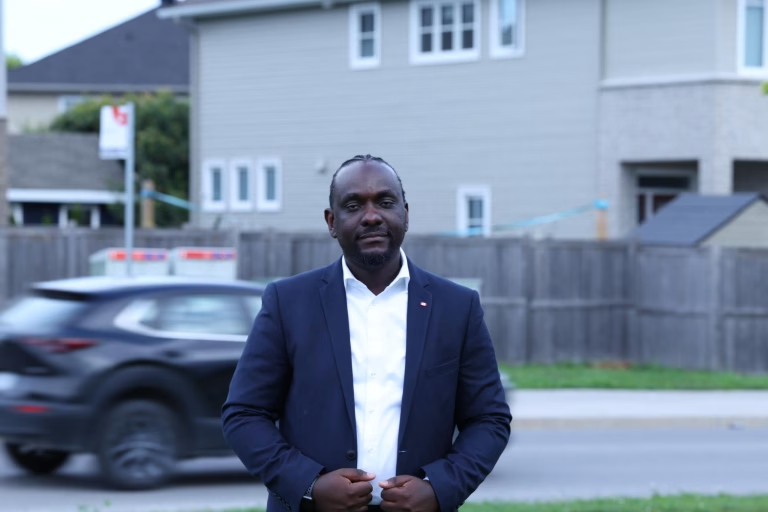

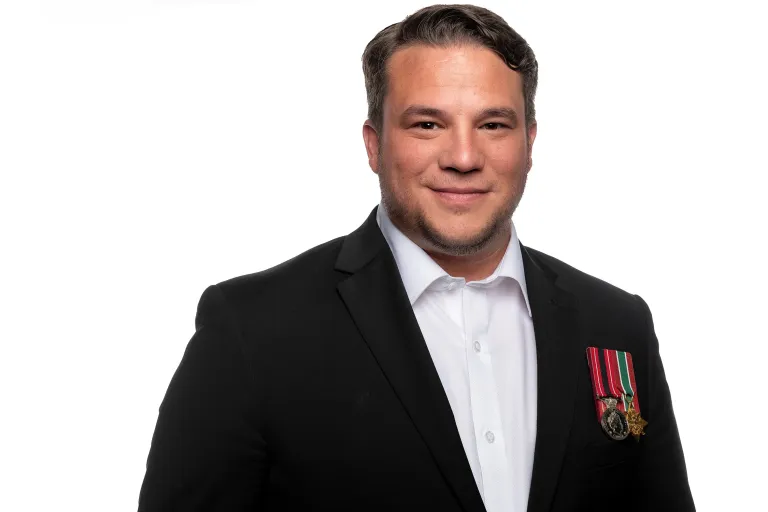
Matthew Luloff. Photo courtesy of Matthewluloff.ca
The following are 5 questions that we sent out to every Ottawa City Council candidate in hopes of getting to know them better. We publish the responses exactly as we receive them, in the order that they were sent to us. Here are the responses from Orleans East-Cumberland (Ward 1) Councillor Matthew Luloff, who is seeking re-election.
1. Who are you? Where are you from? What relevant experience do you have for the job?
I’m Matt Luloff. I was born and raised in Ottawa’s east end, grew up in Orléans and graduated from St. Matthew High School. This is home. It’s where I had my first jobs as a lifeguard, where Laura and I are raising our daughters and where I’ve spent most of my life trying to serve in one way or another.
Before entering municipal politics, I served in the Canadian Armed Forces and deployed to Afghanistan with the Princess Patricia’s Canadian Light Infantry. After leaving the military, I studied public affairs and policy management at Carleton University and worked for members of Parliament and federal cabinet ministers.
But look, the most relevant experience I have is that I’ve actually been doing the job for eight years. I know how City Hall works, I know where it doesn’t work, and I know how to move something from an idea on a piece of paper to an actual result in the community.
I’ve chaired the Ottawa Public Library Board and the Community and Protective Services Committee, served on several other committees and worked directly with residents on everything from major infrastructure projects to potholes, parks and individual casework.
Military service taught me leadership and responsibility. My policy experience taught me how government works. Eight years on Council has taught me that none of it matters if you don’t listen, show up and follow through.
2. The city spends nearly $1B/y on OC Transpo, though many constituents remain dissatisfied with the state of Ottawa’s public transportation. What would you do as a councillor to improve the city’s transportation system?
I think the bigger point is that when you’re spending close to a billion dollars a year, residents are right to expect the basics. The bus should show up when the schedule says it will. A route on a map is meaningless if the bus doesn’t come.
The immediate priority has to be reliability. OC Transpo needs enough buses, operators and skilled maintenance staff to deliver the service residents have already paid for. Schedules also need to reflect real traffic conditions. Putting an unrealistic schedule on paper may make the numbers look better, but it doesn’t help the person standing at the bus stop.
We also need much clearer public reporting. Residents should be able to see cancellations, on-time performance, breakdowns and missed connections by route and community. Citywide averages can look fine while individual neighbourhoods are being consistently underserved.
The eastern LRT extension is a huge opportunity for Orléans, but it will only work if the buses connecting people to the train are frequent and reliable. I’ll continue pushing to extend the E1 to Trim, reduce unnecessary transfers and reinvest buses freed up by LRT into better neighbourhood service.
Over the last term, I voted against two of the four City budgets. To be blunt, I’m not going to support asking transit riders to pay more unless the City can demonstrate that service is improving and riders are getting fair value.
And transit isn’t the entire transportation system. We still need to advance the Brian Coburn Boulevard extension, improve connections for south Orléans and find a long-term solution for Highway 174. It isn’t an either-or choice. We need reliable transit and a road network that can handle the growth we’re already seeing.
3. In a December 2025 poll from Abacus Data, 37% of respondents said that cost of living was the most important issue facing the city; another 19% responded ‘housing affordability.’ What would you do as a councillor to make the city of Ottawa more affordable?
I’m not going to pretend City Hall can control grocery prices, interest rates or the cost of building materials. It can’t. But the City can either add to the pressure families are feeling or do its part to ease that pressure.
That starts with property taxes. Over the last term, I voted against two of the four City budgets because I didn’t believe residents were getting enough value for the increases being proposed. Before asking people for more money, the City has an obligation to show that it’s spending the money it already receives carefully.
Housing supply is also a big part of this. We need to make it easier and faster to build different types of homes, including rentals, missing-middle housing and homes that work for seniors and young families. That doesn’t mean approving anything, anywhere. It means having clear rules, predictable approvals and infrastructure that’s ready to support growth.
The City can also use suitable municipal land and work with non-profit and community housing providers to deliver affordable and supportive housing. At the same time, we need to be honest about the limits of municipal government. Ottawa cannot fund the amount of deeply affordable and supportive housing we need on its own. The federal and provincial governments have to be at the table.
I also believe growth has to pay for growth. Existing residents shouldn’t be left with the full bill for the roads, transit, parks and recreation facilities required by new development.
Affordability is about the whole household budget. It means reasonable taxes and fees, housing people can afford, reliable transit and more opportunities to work closer to home. There isn’t one magic solution, but there are plenty of practical things the City can do.
4. Certain city services like OC Transpo and the OPS have run significant deficits in recent years. Is there anything that you would do as a councillor to try to balance the city’s budget?
The first thing we need is honest budgeting. You can’t approve a certain level of transit or police service, fail to fund it realistically and then act surprised when there’s a deficit at the end of the year. That doesn’t make sense.
Major budget pressures should be reported publicly throughout the year, with corrective plans brought forward early. Reserves can help deal with an unexpected, one-time problem, but they can’t become the permanent answer to recurring operating deficits. Eventually, the money runs out.
I would continue looking at management layers, administrative duplication, outside consultants, procurement, overtime, absenteeism, underused office space and programs that continue without demonstrating results. If something is working and delivering value, we should support it. If it isn’t, we need to be willing to change it or stop doing it.
When I talk about efficiencies, I mean practical things. At Queenswood Ridge Park, for example, the parking lot was being redone and the pathways also needed work. I advocated for doing both at the same time, with one contractor and one procurement process. That meant better value and less disruption for residents.
There are lots of opportunities like that: coordinating projects, bundling contracts where it makes sense, buying strategically, investing in preventative maintenance and looking at the full lifecycle cost instead of just the price on day one.
This isn’t about cutting for the sake of cutting. I support properly funding frontline police, transit, snow clearing, roads, parks and recreation. I don’t see it as a choice between finding efficiencies and providing good services. We can—and should—do both.
5. Why are you running for Council? What do you think is the biggest issue facing your ward today?
Serving the people of Orléans East–Cumberland for the past eight years has been the greatest honour of my life. I’m running again for a pretty simple reason: we’ve made real progress, but the job isn’t finished.
Together, we’ve renewed parks and pathways, improved recreation facilities, supported local businesses, invested in safer streets and strengthened services for veterans, families and residents with disabilities. I know this community, I know how to get things done at City Hall and I still have the energy and determination to keep pushing.
If I had to name the biggest issue facing the ward, it’s that our infrastructure hasn’t kept pace with our growth. We see it in congestion, unreliable transit, pressure on roads and recreation facilities, and communities waiting too long for infrastructure they were promised.
Transportation is probably where people feel it most. Innes Road is over capacity, the Highway 174 split remains a bottleneck, south Orléans continues to grow rapidly and, when there’s a collision or closure, residents have very few alternatives.
I’ll continue fighting for reliable local transit, a successful opening of LRT to Trim, the Brian Coburn Boulevard extension, better east-west connections and infrastructure that’s planned before communities become overwhelmed—not years afterward.
I’m not going to promise that one councillor can fix everything overnight. That would be nonsense. What I can promise is that I’ll keep showing up, doing the work and making sure Orléans East–Cumberland gets the investment and attention it deserves.
About The Author