

Ever feel like you're drowning in a sea of information? Between news alerts, social media feeds, and a never-ending stream of videos, it’s a lot. Media literacy is your lifeline.
Think of it less as a formal subject you study and more as a practical skill you use every day. It's about learning to see behind the curtain—to understand not just what a message says, but who’s saying it, why they’re saying it, and how they’ve packaged it to make you feel a certain way.
Defining Media Literacy for Modern Life

Imagine trying to navigate a new city without a map or GPS. You might eventually find what you're looking for, but you're just as likely to get lost, wander down a few dead ends, or end up somewhere you never intended to be. Scrolling through the internet without media literacy is a lot like that—a confusing journey where it's easy to get turned around.
At its heart, media literacy isn't some abstract concept for academics. It's a genuine survival skill for anyone living in the 21st century. It's the "map" you need to make sense of the constant flood of articles, posts, ads, and videos competing for your attention.
Media literacy is the ability to decode the messages constantly being aimed at us. It's about developing a 'sixth sense' for understanding the construction and purpose behind the information you see, from a viral TikTok trend to a formal news broadcast.
With this skill set, you stop being a passive consumer and become an active, critical thinker. It’s all about asking the right questions and looking beyond the polished surface of the content you encounter.
The Core Concepts of Media Literacy
To really get a grip on what media literacy entails, it helps to break it down into a few fundamental ideas. Think of them as the building blocks for becoming a smarter media consumer. They all work together, building on each other to give you a solid foundation.
Here’s a quick rundown of the core concepts and what they look like in the real world.
| Core Concept | What It Means in Practice |
|---|---|
| Access | This is more than just having an internet connection. It’s about knowing where to find credible information and overcoming barriers that might limit your access. |
| Analysis | This means taking a piece of media apart to see how it works. You learn to spot the author, their likely purpose, the intended audience, and the techniques used to get a point across. |
| Evaluation | Here’s where you judge what you’re seeing. You weigh a message’s credibility, look for bias, check its accuracy against other sources, and decide if it's reliable. |
| Creation | Getting your hands dirty by creating your own content—even just a social media post—gives you incredible insight into how media messages are made and shaped. |
These principles aren't just theoretical; they are practical tools you can start using immediately to better understand the world around you.
Why It's More Important Than Ever
Let's be honest: the need for these skills has exploded. We’re now dealing with AI-generated content, convincing deepfakes, and carefully crafted disinformation campaigns that make it harder than ever to tell what's real. The line between authentic and fake has become incredibly blurry.
Governments are starting to catch on. In a landmark move, California passed Assembly Bill 873 in October 2023, which requires media literacy to be incorporated into K-12 educational frameworks across core subjects like English language arts, science, math, and history.
This isn't just a random curriculum update. It's a direct response to a world where young people often struggle to distinguish credible sources from misinformation online. By building these skills into their education from the ground up, the goal is to raise a generation that can think critically about their sources and navigate the digital world safely. You can read more about how this bill is changing education in California.
Why Media Literacy Is Now An Essential Skill

It used to be that media literacy was something you learned about in a classroom, a neat academic concept. Not anymore. Today, it’s a fundamental life skill, and frankly, not having it can cost you. The stakes are higher than ever, affecting everything from your personal finances to public health.
Think about it. We're bombarded daily with messages crafted to sway us. That sponsored post disguised as a genuine review, or that bit of health advice from a questionable source? Without the ability to pause and critically evaluate them, we risk making some really poor choices based on information that’s incomplete or, worse, deliberately misleading.
And it’s not just about sidestepping online scams. The constant flood of sensationalized or biased news can crank up our anxiety and stress. It can also trap us in echo chambers, where our own beliefs are just bounced back at us, shielding us from any viewpoint that challenges our own. That makes it incredibly difficult to grasp complex issues or find common ground with people who see the world differently.
The Mechanics of Modern Disinformation
Let's get one thing straight: modern disinformation isn't random. It’s a calculated operation. These campaigns are engineered to poke at our deepest psychological triggers—fear, anger, and our sense of identity. The people behind this content know that a gut emotional reaction makes us far more likely to share something before we even think to question it.
They have a whole bag of tricks to look legit:
- Impersonating trusted sources: They’ll create websites or social media accounts that are nearly identical to well-known news outlets.
- Manipulating real content: A real photo or video can be used, but the context is twisted to tell a completely different, and false, story.
- Using bots and fake accounts: They create an illusion of popularity by artificially boosting a message, making it seem more widely accepted than it is.
Just understanding these tactics is your first line of defence. When you know how the game is played, you get much better at spotting the players in your own feed.
The Foundation of Informed Citizenship
Beyond our personal lives, media literacy is the very bedrock of a functioning democracy. Being an informed citizen means being able to cut through political noise, make sense of policy debates, and hold our leaders accountable. Without these skills, it’s tough to participate in civic life in any meaningful way. Our own analysis of political leadership is a good example of how these evaluations play out.
When we can't tell the difference between a well-researched report and a piece of propaganda, our ability to make sound decisions at the ballot box is compromised. This skill is crucial for navigating everything from local elections to major public health crises.
Recognizing this, educational systems are finally starting to catch up. For instance, experts at UCLA have long advocated for media literacy in schools. This advocacy contributed to California's new laws, which weave media literacy into every subject from K-12. The goal is to teach students not just to consume media, but to dissect its credibility and biases—a skill set now seen as every bit as vital as reading and writing.
This shift shows a broad understanding that developing a critical mindset isn't optional anymore. It’s a necessary investment in ourselves and our communities, one that helps us all navigate the world with a bit more confidence and clarity.
The Five Foundational Skills of Media Literacy
Thinking about media literacy can feel a bit abstract, but it really boils down to five core skills anyone can learn. Mastering them is what turns you from a passive consumer into someone who actively and critically engages with the information you encounter every day. Think of these skills as your practical guide to cutting through the noise.
These five skills—Access, Analysis, Evaluation, Creation, and Action—are designed to build on one another. You start by finding the information, then you break it down to see how it’s put together, judge whether it's credible, understand the creation process, and finally, decide how to act on it.
This infographic lays it out perfectly, showing how the skills form a kind of pyramid, with the most basic at the bottom and the more complex ones at the top.
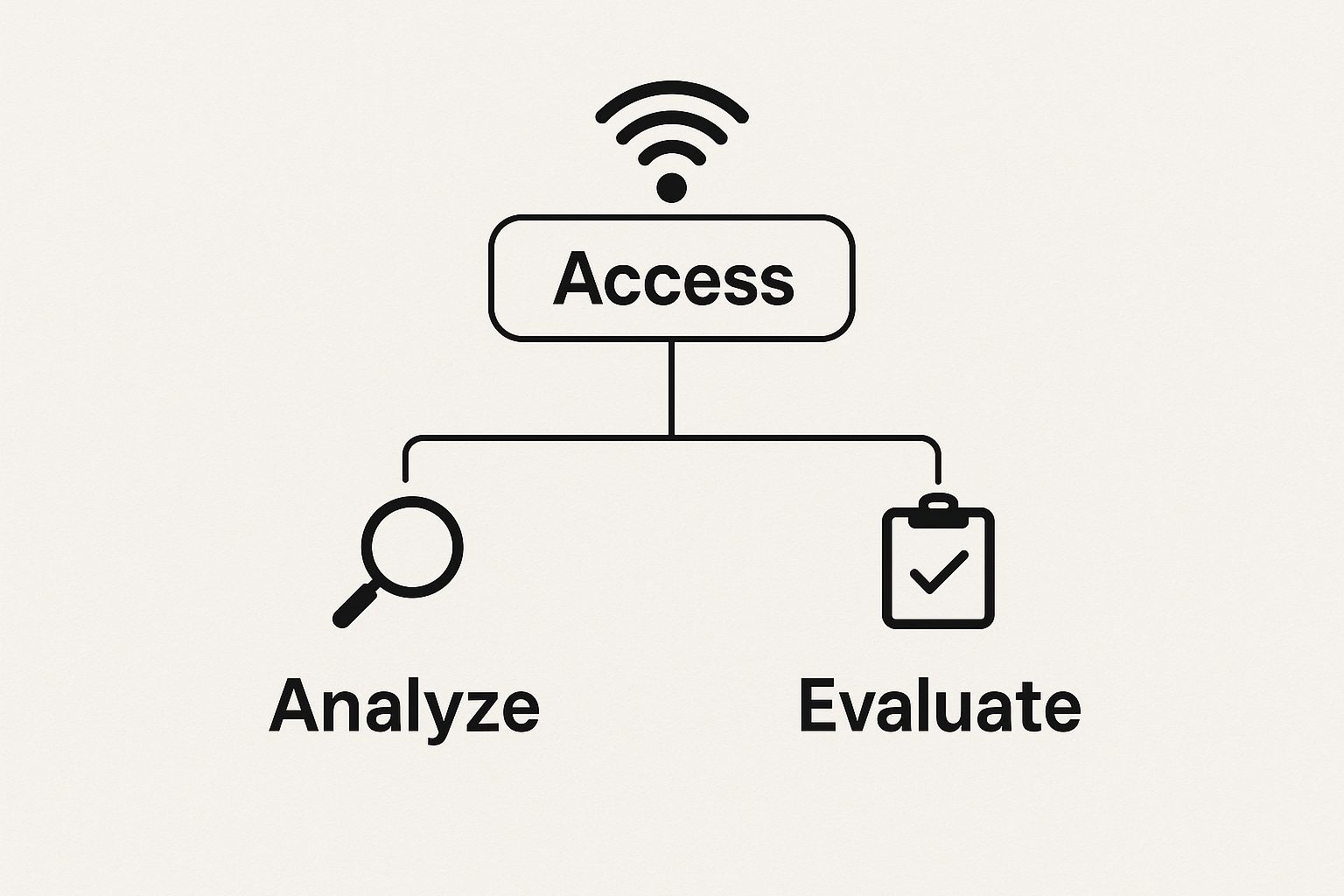
As you can see, you can't really evaluate or analyze a message if you can't even get to it in the first place. This step-by-step progression shows how each skill lays the groundwork for the next level of critical thinking.
Skill 1: Access
The journey begins with Access. This is more than just having an internet connection; it's about knowing how to find and use different kinds of media effectively. It means knowing where to look for certain types of information and understanding the barriers—like paywalls or digital divides—that might stop you or others from getting to it.
For example, do you know how to tap into a library’s online database for academic papers? Can you tell which news sites offer solid, free reporting versus those that lock their best stuff behind a subscription? Access is all about becoming a resourceful and fair-minded information seeker.
Skill 2: Analysis
Once you’ve got the material, it’s time for Analysis. This is where you put on your detective hat and start deconstructing the message. The goal here is to understand its purpose, how it's built, and what it’s trying to say by asking a few smart questions.
It’s like taking a clock apart to see how all the gears and springs work together. When you analyze a news article, you’re not just reading words on a page. You’re looking at how the headline, photos, quotes, and data have all been arranged to push a specific narrative.
Try this simple exercise with any news story:
- Who made this? Is it a reporter, an opinion columnist, or someone paid to create sponsored content?
- What’s the main goal? Is it trying to inform you, persuade you, entertain you, or sell you something?
- What techniques are they using? Keep an eye out for emotionally loaded language, carefully chosen images, or data presented in a way that clearly favours one side.
This process quickly reveals that no piece of media is ever truly neutral. Every single choice, from the font to the expert they quoted, is intentional and designed to have an impact.
Skill 3: Evaluation
With your analysis done, you move on to Evaluation. This is the moment of truth where you make a judgement call about the quality and credibility of the information. It's easily the most important step in telling reliable facts from misleading junk.
Evaluation is all about practicing healthy skepticism. You don't just accept claims at face value. Instead, you cross-reference them with other sources, look at the evidence provided, and sniff out any signs of bias or manipulation. It's a skill we could all get better at—a 2022 Reuters Institute report found that while many people are concerned about fake news, their confidence in spotting it varies widely by country and demographic.
Before you believe or share anything, act like a judge weighing evidence in a courtroom. Is the source trustworthy? Are the claims backed by facts? What information might be missing?
Use this quick checklist to evaluate any source:
- Credibility: Does the author or publication have a track record of being accurate?
- Evidence: Are claims supported by verifiable facts, data, or quotes from actual experts?
- Bias: Does the message lean heavily to one side? Is it using loaded words to sway your opinion?
- Timeliness: Is the information up-to-date, or is it an old story being passed off as new?
Skill 4: Creation
The fourth skill, Creation, might sound like it’s just for professional content creators, but it’s an incredibly powerful tool for sharpening your critical eye. When you understand how media is actually made, you become a much smarter consumer of it.
Making your own media—whether that’s a simple blog post, a short video, or even just a well-thought-out social media post—gives you a peek behind the curtain. You learn firsthand about framing, editing, and audience engagement from the inside. This experience demystifies the whole production process and makes you much better at spotting how others are trying to influence you.
Skill 5: Action
Finally, all these skills culminate in Action. This is the ultimate point of media literacy: using what you’ve learned to engage with the world in a more meaningful and constructive way.
Action can look like a lot of different things. It could be:
- Choosing to share a well-researched article instead of a clickbait meme.
- Leaving a comment that adds thoughtful context to an online debate.
- Respectfully calling out misinformation when you see it among your friends or family.
- Supporting high-quality journalism by paying for a subscription.
Ultimately, media literacy isn't just about self-defence. It's about being a better citizen—in your community and in our democracy. It empowers you to move from being a passive bystander to an active participant in creating a healthier, more informed world for everyone.
How to Spot Misinformation in Your Daily Feed
Welcome to your field guide for the modern information jungle. It’s one thing to understand media literacy in theory, but putting it into practice on your daily social media feed—that’s where the real work begins. This is how you shift from being a passive scroller to an active, confident fact-checker for your own digital life.
Before we dive in, let’s get one crucial distinction straight. Not all bad information is the same. The real difference comes down to intent.
- Misinformation is false information shared without a malicious motive. Think of your aunt who forwards an article about a “miracle cure” for the common cold because she genuinely believes it will help. It’s an honest mistake.
- Disinformation, however, is deliberately created and spread to deceive. These are often organized campaigns designed to manipulate public opinion, sow chaos, or cause harm.
While one is an accident and the other is sabotage, both pollute our information environment. Knowing how to spot the red flags is your best defence against getting fooled by either.
Common Types of Misinformation and How to Spot Them
Misinformation isn't a single entity; it comes in several flavours. Getting to know the common types makes them much easier to identify when they pop up in your feed. This table breaks down what to look for.
| Type of Misinformation | Key Characteristics | A Real-World Style Example |
|---|---|---|
| Satire or Parody | Uses humour, irony, or exaggeration to comment on current events. Not meant to be taken literally, but can be mistaken for real news if the context is missed. | A headline from a site like The Beaverton saying, "Local Man Discovers 'Off' Button on TV Remote, Changes Life." |
| Misleading Content | Uses genuine information in a deceptive way, such as cropping a photo, using a misleading headline, or cherry-picking statistics to support a specific narrative. | A news report uses a statistic: "Ice cream sales increased by 30%," while crime also rose. The headline implies a link, but there is no actual causation. |
| Imposter Content | Uses fake websites or social media profiles designed to look like legitimate news sources or public figures. The goal is to trick you into trusting the false information. | An article from a website with the URL "cbc.news.co" (instead of the real "cbc.ca") that looks exactly like the official site but posts fabricated stories. |
| Fabricated Content | Content that is 100% false and created with the specific intent to deceive or cause harm. This is pure disinformation. | A completely made-up story with fake quotes and doctored images claiming a politician was involved in a scandal that never happened. |
| False Connection | The headline, visuals, or captions don't support the content. This trick gets clicks by promising something sensational that the article doesn't deliver. | A dramatic headline reads, "SHOCKING CELEBRITY SCANDAL EXPOSED," but the article is just a bland recap of their latest movie role. |
| False Context | Genuine content is shared with false contextual information. For example, a real photo from a protest years ago is presented as happening today to stir up outrage. | A video of a riot from 2015 in another country is shared with a caption claiming it's happening right now in your city. |
| Manipulated Content | Genuine information or imagery is manipulated to deceive. This can include "deepfake" videos or photos that have been subtly altered. | A real photo of a political leader is photoshopped to show them shaking hands with an enemy of the state, creating a false impression of an alliance. |
By familiarizing yourself with these tactics, you're already building a stronger filter. You'll start noticing the subtle (and not-so-subtle) clues that a piece of content isn't what it seems.
The SIFT Method: Your Four-Step Fact-Checking Tool
When you stumble upon a claim that makes you raise an eyebrow, you need a quick, reliable way to check it out. Digital literacy expert Mike Caulfield developed one of the best tools for the job: the SIFT method. It’s a simple, four-step process to help you evaluate information before you accept or share it.
"The goal of SIFT is to help you get closer to the truth of a claim in the small amount of time you have. It's not about becoming a professional fact-checker; it's about making better choices as a citizen and consumer."
Here’s how to put it into practice:
- Stop: This is the most critical step. Before you get angry, before you hit share, just pause. That one simple action breaks the cycle of mindless scrolling and gives your critical thinking a chance to kick in.
- Investigate the Source: Don’t just read the story—investigate who’s telling it. Open a new browser tab and do a quick search on the publication or the author. Are they a respected news outlet, a known advocacy group, a random blog, or something else entirely? A little digging goes a long way.
- Find Better Coverage: Look for other, more reliable sources covering the same story. Can you find the same claim on a major national news site or a trusted international outlet? If it only seems to exist on fringe websites, that’s a massive red flag. Keeping up with trending topics from reliable sources can also give you a better baseline for what’s really going on.
- Trace Claims to the Original Context: If an article mentions a "new study" or quotes an expert, try to find the original source. It’s amazing how often you’ll discover that statistics have been twisted, quotes are sliced and diced, or the original report says the complete opposite.
By making these four steps a habit, you take back control. You stop being a potential target for misinformation and start becoming a more informed, responsible digital citizen.
Building Your Personal Media-Savvy Toolkit
Alright, so you get the theory behind media literacy. But knowing what it is and actually doing something with that knowledge are two different things. It’s time to shift gears from just understanding the concept to actively putting it to work every single day.
This is where you start building your own personal toolkit. It's not about memorizing a bunch of rules, but about developing a set of instincts and go-to habits that help you vet information like a pro. Think of it as upgrading your daily scroll from passive consumption to sharp, critical engagement.
Keep a Roster of Reputable Fact-Checkers
When you come across a story that feels a bit too perfect, a little too wild, or just perfectly confirms everything you already believe, it’s a huge red flag. That's your cue to bring in the professionals. Keep these top-tier fact-checking organizations bookmarked and ready to deploy.
- Snopes: A true veteran of the internet, Snopes is fantastic for digging into those weird urban legends, viral chain emails, and questionable social media posts that your aunt just shared.
- PolitiFact: This Pulitzer Prize-winning site is all about politics. It puts claims from politicians and pundits under the microscope, rating them on its famous "Truth-O-Meter," which ranges from "True" all the way to "Pants on Fire."
- News Agency Desks: Don’t forget the big players. Major news agencies like Reuters and the Associated Press (AP) have their own dedicated fact-checking units. They are brilliant for getting clear, well-researched verdicts on claims that are going viral globally.
Using these resources consistently is more than just a good idea—it's a foundational habit. It’s how you start to really live out the answer to what is media literacy in the real world.
Master the Art of Lateral Reading
Here’s one of the most powerful moves in any fact-checker’s playbook: lateral reading. It sounds fancy, but it's simple. Instead of staying on one website and trying to judge its credibility by reading up and down the page (reading "vertically"), you open up new browser tabs to see what other sources have to say about the original site or its claims.
Think of it like getting a second opinion from a doctor. You wouldn't base a major health decision on one person's advice; you shouldn't base your understanding of an issue on a single, unverified source.
The moment you land on an unfamiliar website, your first instinct should be to open a new tab and search for its name. This one simple action can instantly tell you if you're dealing with a legitimate news outlet, a highly biased source, or even a known peddler of disinformation. It's a game-changer. For a masterclass in what credible reporting looks like, you can also check out the work recognized by journalism awards, like the pieces from the Canadian Journalism Foundation finalists.
Deliberately Diversify Your Media Diet
Let’s be honest, algorithms are designed to keep you comfortable. They create a filter bubble by feeding you more of what you already like, which walls you off from different perspectives. Actively punching a hole in that bubble is absolutely essential for getting a clear-eyed view of the world.
Make a real, conscious effort to seek out media from a wide range of sources—especially ones that might challenge your existing beliefs. Follow reputable journalists and outlets from different ends of the political spectrum and from other countries. This doesn't just introduce you to new ideas; it sharpens your ability to spot bias everywhere, even in the sources you trust most.
This kind of proactive thinking is becoming more urgent than ever, especially as our education systems race to keep up. According to Media Literacy Now's 2023 legislative report card, states are increasingly passing laws to integrate media literacy into school curricula. California, for example, is a leader in this fight, dedicating significant resources to train teachers and develop new learning materials to ensure millions of students build these critical skills from a young age. You can learn more about the 2023 policy report and see how different states are tackling this challenge.
Still Have Questions About Media Literacy?
As we've unpacked what media literacy is and how to use it, a few common questions usually pop up. It's a deep and often tricky skill to master, so it's only natural to wonder about how it all works in the real world. Let's tackle some of those lingering concerns head-on and clear up any confusion.
Think of this as a quick chat to make sure you walk away feeling confident and clear-eyed about what it means to be a truly media-literate person.
Is This All Just About Spotting "Fake News"?
That's a piece of it, for sure, but seeing media literacy as just a "fake news" detector is like thinking a master chef's only skill is telling you if the milk's gone sour. It’s an important check, but it barely scratches the surface of what they can do.
True media literacy is a complete toolkit for understanding how every media message is built, whether you're looking at:
- A front-page story from a trusted newspaper
- A TV commercial or a sponsored Instagram post
- The latest blockbuster film
- A viral TikTok video
- A speech from a political candidate
It's about learning to spot the subtle slant in even the most credible reporting. It’s about understanding the money and politics that shape what you see. And it's about realising that two people can see the exact same message and come away with completely different takeaways. This isn't about becoming a cynic; it's about becoming a smarter, more thoughtful consumer of everything.
Won't This Just Make Me Distrust Everything I See?
This is a really common fear, and it's totally understandable. If you're questioning everything, won't you just end up in a spiral of cynicism, unable to believe anything? The truth is, the real goal of media literacy is the exact opposite.
It’s not about fostering blanket distrust. It’s about developing informed skepticism. Instead of throwing your hands up and rejecting all media, you learn how to put your trust in sources that actually earn it—through transparency, solid evidence, and owning up to their mistakes.
Think of it like becoming a food connoisseur. You don’t stop enjoying food altogether. Instead, you develop a sharper palate that helps you appreciate a high-quality, well-prepared meal while easily spotting one that's just… off.
Media literacy gives you the tools to seek out and truly value great journalism and reliable information. It swaps that feeling of anxiety and confusion for the confidence to navigate the noise.
How Can I Teach My Kids About Media Literacy?
You don't need a formal curriculum or complicated lesson plans to get started. The best way to introduce media literacy to kids is to weave it into your daily routines, turning screen time into a chance for active learning.
The whole game is to make asking questions a habit. Here are a few easy ways to start:
- While Watching a Show: Ask simple things like, "Who do you think made this? What do you think they want us to feel right now?"
- When an Ad Pops Up: Talk about why it's there. Ask, "What are they trying to sell? How are they making it look cool or fun so we'll want it?"
- Compare Different Media: Help them grasp the difference between a cartoon character, a real person in a documentary, and an influencer making a YouTube video.
- For Older Kids: Show them some basic verification tricks. A great first step is teaching them a reverse image search to find out where a picture really came from.
These small, consistent conversations build a curious and critical mindset from a young age, giving them the foundation they'll need for a lifetime.
Isn't This Just Common Sense?
On the surface, a lot of media literacy principles do sound like common sense. But here's the catch: the modern information world is built to short-circuit our natural judgment. Common sense alone often isn't enough to compete with today's sophisticated tactics.
Algorithms create personalized filter bubbles, feeding us content that confirms what we already believe to keep us hooked—not necessarily to keep us informed. Disinformation campaigns are no longer amateur hour; they're professionally produced operations that use psychological triggers to be as persuasive and emotional as possible.
Your gut might tell you to be skeptical of something that sounds too wild to be true. But it won't teach you how to systematically break down a piece of propaganda or spot the logical fallacies hidden in a news report. Media literacy provides a structured framework and learned skills that go far beyond basic intuition. It’s a necessary discipline for the world we live in today.
For more fact-based news and analysis on what’s happening in Ottawa and the National Capital Region, stay informed with ncrnow. Visit us at https://ncrnow.ca for coverage you can trust.
About The Author