


From the moment you flick on the tap to the instant water swirls down the drain, a huge and intricate system is working tirelessly behind the scenes. The City of Ottawa water and sewer services are the stewards of this entire journey, making sure clean, safe drinking water gets to your home and that wastewater is properly treated on its way out. This guide will pull back the curtain on this essential public utility.
The Journey of Ottawa's Water: From River to Tap
Ever stop to think about where your tap water actually comes from? It’s not just magic. The journey is a carefully managed process designed to guarantee the quality and safety of one of our most vital resources. The whole system is a marvel of modern engineering, built to serve hundreds of thousands of Ottawa residents every single day.
It all starts at the source: the mighty Ottawa River. From there, the water is channelled into one of two major treatment facilities.
Treatment and Purification
The City of Ottawa runs two top-tier purification plants to handle this massive job:
- Britannia Water Purification Plant: This facility is a workhorse, serving the western side of the city.
- Lemieux Island Water Purification Plant: Located more centrally, this plant is the other key pillar of Ottawa's water supply.
At these plants, raw river water goes through a multi-stage treatment gauntlet to meet—and often exceed—Canada's strict health and safety standards. This involves complex filtration to screen out particles and disinfection to neutralize any harmful microorganisms, ensuring every drop is safe to drink. Getting to know your city's infrastructure is a big part of feeling at home; for more tips on settling in, you can learn about life in Canada from our other guides.
This infographic breaks down the fundamental steps from the river to your home.
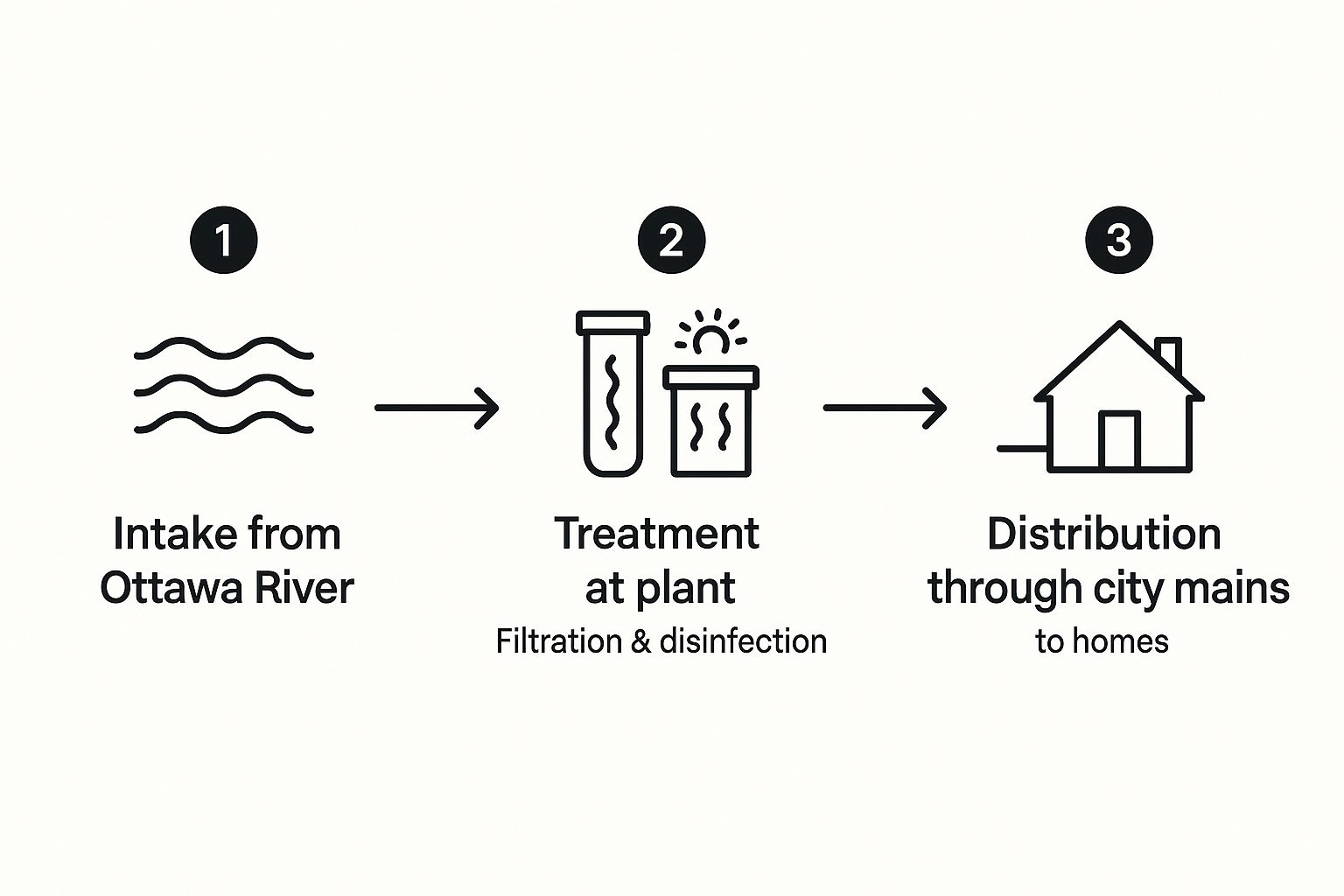
As the visual shows, it’s a clear three-part sequence: intake from the river, advanced treatment at the plant, and finally, distribution to the community.
From Plant to Home
Once the water is purified, it's pumped into a sprawling underground network of pipes, reservoirs, and pumping stations. This intricate web, managed by the City of Ottawa, is what ensures that clean water reliably reaches every connected home and business across the capital.
But that's only half the story. The other side of the coin is the sewer system. As soon as water disappears down your drain, it enters an entirely separate network of pipes. This system carries all the wastewater away to be treated, protecting both public health and our local environment by preventing raw sewage from contaminating our rivers. It all ends up at the Robert O. Pickard Environmental Centre, one of the most advanced wastewater treatment plants in North America.
The History Behind Ottawa's Modern Waterworks

That clean, reliable water flowing from your tap is the product of over a century of incredible engineering, hard-won lessons, and massive investment. The modern City of Ottawa water and sewer system wasn't built in a day; it was forged through public health crises and dramatic infrastructure failures that completely reshaped the city’s relationship with its most essential services.
Believe it or not, there was a time when the Ottawa River—the source of our drinking water—was in serious trouble. For decades, it was treated as a convenient dumping ground for raw sewage and industrial waste, creating a public health nightmare that demanded a bold, city-defining solution.
A Turning Point for River Health
The early 1960s marked a pivotal moment when Ottawa finally decided to tackle its river pollution problem head-on. This led to the construction of what is now known as the Robert O. Pickard Environmental Centre, which began operation in 1963.
When it first opened, this new pollution control centre was a game-changer. It was built to serve 350,000 people and treat 360 million litres of sewage every day, a critical first step in ending the direct discharge of waste into our most vital waterway.
This project represented a fundamental shift in how the region viewed its environment, moving from using the river as a sewer to actively protecting it as a precious natural resource. You can dive deeper into this historic effort to solve Ottawa's sewage problems.
Lessons Learned from Infrastructure Failure
History has also delivered some stark reminders of the immense power flowing through the city's underground networks. The growth of the City of Ottawa water and sewer system has been shaped not just by careful planning but by learning from catastrophic events.
One such incident rocked the city on May 29, 1929, when a series of violent explosions ripped through the downtown sewer system. The blasts were powerful enough to launch heavy manhole covers skyward, causing widespread destruction and, tragically, one death.
Investigators at the time concluded the disaster was likely caused by a perfect storm of factors, including:
- The buildup of flammable gases from sewage decomposition and industrial waste.
- The improper disposal of gasoline and waste oils from the city’s growing number of garages.
This disaster was a harsh lesson in infrastructure safety and the hidden dangers of dumping prohibited substances down the drain. It hammered home the absolute need for strict regulations, public awareness, and constant maintenance to ensure nothing like it could ever happen again.
How to Read and Manage Your Water Bill

Getting your utility bill from the City of Ottawa water and sewer department can sometimes feel like you need a decoder ring. But taking a moment to understand it is the first real step toward getting a handle on your household costs. Your bill isn’t just a single number—it’s a detailed story about the essential services that bring clean, safe water into your home and take wastewater away.
Every bill is built on two key types of costs: fixed charges and variable charges. The fixed charges are set fees that cover the massive job of maintaining the city's vast water infrastructure, and you pay them no matter how much water you use. The variable charges, on the other hand, are directly tied to your household's actual water consumption.
Decoding Your Bill Line by Line
The City of Ottawa itemizes your bill so you can see exactly where your money is going. The main components you'll see are the water charge, the sewer surcharge, and separate fixed fees for both services.
Think of it like a receipt from your favourite coffee shop. The fixed charges are like the shop's rent and equipment costs—they're always there in the background. The variable charges are the lattes and pastries you actually buy, which change with every visit. This model ensures everyone chips in for the system's upkeep while paying their fair share for what they use.
By learning to read your bill, you gain the power to spot anything unusual. A sudden, unexplained jump in your consumption charge is often the first—and only—sign of a hidden problem like a running toilet, which can silently waste thousands of litres of water every month.
To help you connect the dots between your bill and the services you receive, here is a simplified look at the residential rate structure. This table breaks down what those line items from the City of Ottawa water and sewer services actually mean.
City of Ottawa Residential Water Rate Structure
This table breaks down the current rates and fixed charges for residential water and sewer services, helping you understand each part of your bill.
| Service Component | Description | Rate / Charge |
|---|---|---|
| Water Consumption Charge | This is a volumetric rate charged for every cubic metre (1,000 litres) of water you use. | Based on consumption |
| Sewer Surcharge | Calculated based on your water consumption, this fee funds wastewater collection and treatment. | Based on water consumption |
| Fixed Charge – Water | A flat daily fee that helps pay for the water purification plants and distribution network. | Flat daily fee |
| Fixed Charge – Sewer | A flat daily fee that supports the maintenance of the sewer pipe system and treatment facilities. | Flat daily fee |
| Fixed Charge – Fire Supply | This daily charge covers the cost of maintaining the public fire hydrant system for community safety. | Flat daily fee |
This structure ensures that the costs are distributed fairly, covering both the water you use and the infrastructure that makes it all possible.
Managing Payments and Your Account
The City of Ottawa makes it pretty straightforward to manage and pay your bill. The MyServiceOttawa portal is your go-to digital hub for everything from viewing past bills and tracking your water use to setting up payments.
You’ve got a few different ways to pay:
- Pre-authorized debit plans for automatic, worry-free withdrawals.
- Online payments right from your bank account.
- Paying directly through the MyServiceOttawa portal.
By keeping an eye on your usage through the portal, you can spot trends, set budget goals, and become a more informed water user. This proactive approach doesn't just help your wallet—it also contributes to the sustainability of our city's most precious resource.
Protecting the Ottawa River from Sewer Overflows

The health of the Ottawa River is tied directly to how well our city's infrastructure works. A major challenge for the City of Ottawa water and sewer system is found in its older, historic neighbourhoods, which often rely on combined sewers. These legacy pipes were built to carry both household sewage and stormwater from rain and snowmelt in one single channel.
While this system works just fine in dry weather, it poses a big problem during heavy downpours. When a storm floods the system with a massive volume of water, it can overwhelm the pipe's capacity, triggering a combined sewer overflow (CSO). This event releases a mix of untreated sewage and stormwater straight into the Ottawa River, a necessary evil to prevent sewage from backing up into homes and streets.
To tackle this environmental issue head-on, the city created a sweeping strategy: the Ottawa River Action Plan (ORAP). This ambitious, multi-decade plan is the roadmap for major infrastructure projects designed to drastically reduce CSOs and protect our most vital natural resource.
The Combined Sewage Storage Tunnel
The crown jewel of the ORAP is the Combined Sewage Storage Tunnel (CSST). This isn't just another pipe; it’s a massive feat of underground engineering built as a proactive fix for sewer overflows. Completed in 2020, the CSST is made of two interconnected tunnels, running six kilometres long and three metres wide, deep beneath the downtown core.
Its job is brilliantly simple. During a heavy storm, the CSST acts like a giant underground holding tank. Instead of spilling into the river, the excess combined sewage is diverted into the tunnel for safe storage.
Once the storm passes and capacity becomes available at the treatment plant, the stored wastewater is gradually pumped out of the tunnel. It’s then sent to the Robert O. Pickard Environmental Centre for full and proper treatment. This whole process essentially stops pollution events before they can even happen.
The impact of the CSST is huge, preventing up to 43,000 m³ of combined sewage from entering the river during a major storm. This project stands as one of the single largest and most important investments the City of Ottawa has ever made to protect the Ottawa River.
Navigating Regulatory Standards
The city’s approach to water quality is also guided by provincial rules. How Ottawa manages sewage overflows has to balance the limits of its infrastructure with official standards. For years, water quality management has had to account for the reality of combined sewers in older parts of the city, which create overflow risks during big storms.
Under Policy F-5-5 from the Ministry of the Environment, Conservation and Parks, Ottawa is allowed to release a certain amount of diluted sewage during wet weather in the warmer months. This is only permitted if strict conditions are met, like having no dry-weather discharges and keeping recreational beaches safe with clean bacterial levels 95% of the time. Even with this allowance, the city has proactively aimed to capture a high percentage of these wet-weather flows for treatment, pushing beyond the basic requirements. You can dig deeper into the provincial review of Ottawa's water quality response.
This commitment ensures that City of Ottawa water and sewer services don't just meet but actively strive to beat the standards set for protecting our health and our environment.
How to Report Issues and Request Service
When something goes wrong with your water or sewer service, knowing who to call—and how—is the first step to getting it fixed fast. The City of Ottawa water and sewer department has a clear system for reporting everything from a small problem to a major emergency, making sure you can get help exactly when you need it.
For urgent issues that pose an immediate risk to health, safety, or property, your first and most important call should be to 3-1-1. This is the city's direct line for emergencies that simply can't wait.
When to Call 3-1-1 Immediately
Some situations need an immediate response from city crews. You should dial 3-1-1 right away if you spot any of these problems:
- A possible water main break: This often looks like water pooling or flowing on the street, a sudden drop in water pressure, or discoloured water coming from your taps.
- A sewer backup: If you think the blockage is in the city’s main sewer line and not just in your home, it’s an urgent problem.
- A damaged or leaking fire hydrant: These are critical for emergency services, so any damage needs to be reported immediately.
- A sudden, serious water quality concern: If your water unexpectedly smells, tastes, or looks strange, don't hesitate to report it.
For non-urgent requests or general questions, you can use the city’s online tools through the MyServiceOttawa portal. It's also good to know that 3-1-1 services are available 24/7, even on holidays. You can find more information about what services are available on statutory holidays in our guide to Victoria Day in Ottawa.
Your Responsibility vs. The City's
Figuring out where your property ends and the city's responsibility begins is key to getting the right help. As a homeowner, you're responsible for the water pipe that runs from your property line to your house. You're also on the hook for the sewer pipe from your home's foundation to the property line. The City of Ottawa takes care of the large water and sewer mains running under the street.
The City provides a really helpful visual guide on its website to clear up any confusion.
This diagram clearly shows the cutoff point, helping you decide whether you need to call a plumber for your private pipes or the city for a public main issue.
A crucial part of resident responsibility is ensuring only appropriate materials go down the drain. What you put into the sewer system has a direct impact on its safety and function, a lesson Ottawa learned the hard way.
On May 29, 1929, a series of catastrophic explosions tore through the city's sewers, blowing manhole covers sky-high and causing massive damage. While a single cause was never officially confirmed, the disaster was linked to a dangerous mix of naturally occurring gases and improperly disposed gasoline and industrial oils. This tragic event is a powerful reminder of why it’s forbidden to dump harmful substances into the City of Ottawa water and sewer system. To learn more about this historic incident, you can read the details of the 1929 Ottawa sewer explosion.
Got Questions About Ottawa's Water System? We've Got Answers
Let's be honest, navigating the ins and outs of the City of Ottawa water and sewer services can sometimes feel a bit murky. To help clear things up, we’ve put together some of the most common questions we hear from Ottawa residents, complete with straightforward answers to solve your problems and get you the help you need.
Whose Pipes Are They, Anyway?
One of the most frequent points of confusion for homeowners is figuring out where your responsibility ends and the city's begins. It’s a make-or-break distinction when something goes wrong, as it determines whether you call a plumber or the city.
Here’s the simple rule in Ottawa: as the property owner, you're responsible for the water pipe that runs from your property line right into your house. The same goes for the sewer pipe—it's yours from your home's foundation all the way to the edge of your property.
Everything beyond that point is handled by the City of Ottawa. This includes the massive water mains and sewer lines that run under the street and serve your entire neighbourhood. If you think there’s a leak or blockage on your side of the line, your first move should be to call a licensed plumber. But if you spot signs of a major break on public property, like water bursting from a road, report it immediately by calling 3-1-1.
Why Is My Water Bill Suddenly So High?
An unexpectedly high water bill is almost always a red flag for a hidden leak somewhere on your property. The number one culprit? A constantly running toilet. It can silently waste thousands of litres of water every single month without you ever hearing a thing.
Here’s a quick trick to catch a leaky toilet in the act:
- Put a few drops of food colouring into the toilet tank.
- Don't flush, and wait about 15-20 minutes.
- Check the bowl. If any colour has seeped in, you've got a leak that needs fixing.
You should also give your faucets, showerheads, and hot water tank a once-over for any drips. To be absolutely sure, take a reading of your water meter, then make sure no one uses any water for an hour. If the meter has moved when you check it again, there’s definitely a leak somewhere.
How Can I Actually Lower My Water Bill?
Saving water is a true win-win—it’s good for the planet and even better for your wallet. The good news is there are plenty of simple, effective ways to reduce your water consumption.
Inside your home, upgrading to high-efficiency toilets and showerheads offers the biggest bang for your buck. Always run your dishwasher and washing machine with full loads, and make a habit of fixing drips as soon as you spot them.
The savings can be just as big outside. A rain barrel is a fantastic way to collect water for your garden. If you water your lawn, do it in the early morning to minimize evaporation, and grab a broom instead of a hose to clean driveways and sidewalks. It's also key to follow the City of Ottawa's seasonal water use restrictions to help manage demand during the hot summer months—a time when so many great events in Ottawa get everyone outside.
What Is Ottawa Doing About Lead Pipes?
The City of Ottawa is tackling the issue of lead pipes head-on with its Lead Pipe Replacement Program. This initiative is all about replacing old lead water service lines to ensure our drinking water remains safe and high-quality for everyone.
The city covers the entire cost of replacing the public portion of the pipe—that's the section from the main water line under the street to your property line. While replacing the private portion of the pipe is the homeowner’s responsibility, the city offers financial assistance programs to help with the cost. You can use the city's online tools or give them a call to find out if your home might be affected and to learn more about water testing and your replacement options.
At ncrnow, we bring you the essential news and guides you need to understand Ottawa and the National Capital Region. For more local insights, visit us at https://ncrnow.ca.
About The Author