
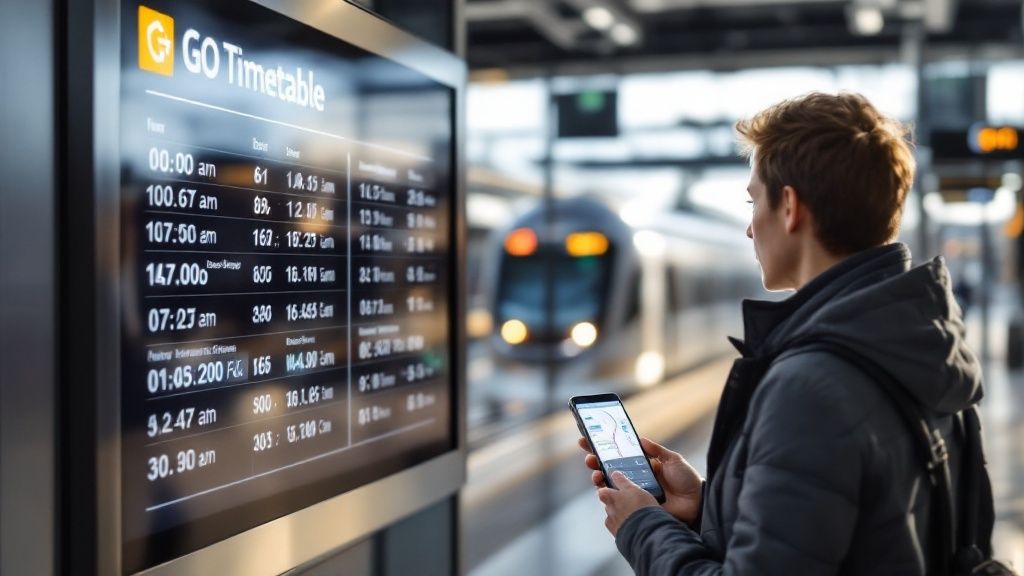
Trying to make sense of GO station schedules for the first time can feel like you're trying to solve a Rubik's Cube in the dark. But here’s the secret: you just need to know where to look and what to look for. By focusing on three simple pieces of information, you can cut through the noise and start your trip with confidence.
Your First Steps to Understanding GO Schedules
Staring at a wall of departure times, station names, and symbols is enough to make anyone’s head spin. It’s a grid that doesn’t always feel intuitive, but the good news is you don’t need to decipher it all at once.
Think of it like learning a new language. You wouldn't start by memorizing the entire dictionary, right? You'd learn the essential words first. For GO Transit, that means pinning down the fundamentals of your trip before you get lost in the details.
Finding Your Core Travel Information
Every single journey on the GO network boils down to the same three questions. Get these sorted, and that massive timetable suddenly becomes much smaller and more manageable.
- What is my GO line? The network is split into several major lines, like Lakeshore West, Barrie, or Kitchener. The very first step is knowing which line actually serves your start and end stations.
- Which direction am I travelling? Are you heading into the city toward Union Station, or are you travelling away from it? Schedules are almost always divided by direction (Eastbound vs. Westbound, for example).
- When do I need to leave? Once you’ve got your line and direction locked in, you can finally scan the timetable for departure times that work for you.
Getting these three things right is the foundation for reading any go station schedules like a pro. And if you're trying to make your travel budget go further, it's worth exploring all your options for affordable transit. Our guide on the low-income bus pass has some great info on programs available in certain regions.
By breaking down the schedule into these simple parts, you turn a daunting chart into a practical tool. This approach takes the guesswork out of the equation and lets you plan your trip without the stress.
This simple process ensures you're looking at the right information from the get-go. Once you're comfortable finding these core details, you'll be ready to move on to the finer points of the timetable, like express trains, weekend service, and what all those little symbols mean.
How to Read GO Timetables with Confidence
At first glance, a printed GO timetable can look like a cryptic puzzle of lines and numbers. But once you get the hang of it, you'll see it’s actually a perfectly laid-out map for your journey. Learning its language—the symbols, columns, and flow—is the key to reading any go station schedules like a seasoned pro, making sure you’re always on the right platform at the right time.
The best way to think of a timetable is like a story. Each row is a single train, and the columns are the chapters of its journey, telling you where it stops and when. All you have to do is follow your chosen train’s row from left to right across the page.
Decoding the Symbols and Layout
Before you even look at the times, get familiar with the small symbols scattered throughout the schedule. These little icons pack a punch, giving you vital info that could make or break your trip.
- ♿ Accessibility: This symbol lets you know the coach is accessible for passengers using mobility devices.
- 🚲 Bicycles: This one tells you if bikes are allowed on board. Keep in mind, there are often restrictions during busy rush hour periods.
- Express Trains: These are the fast ones. Sometimes they have a special symbol, but you can also spot them by looking for dashes or skipped times in the station columns, meaning they bypass those stops for a quicker ride.
Knowing these symbols ahead of time means no surprises at the station. You can be confident the train you've picked will meet all your needs.
A GO schedule is so much more than a list of departure times. It’s a complete guide telling you everything from accessibility to the type of service. Learning to read these details is the difference between just catching a train and actually planning a smooth, seamless journey.
This screenshot from the official GO Transit website shows you exactly where to find the PDF schedules for every single line.

Think of this page as the central library for all of GO's fixed timetables. It's the most reliable place to start your trip planning.
Tracing a Journey on the Lakeshore West Line
Alright, let's put this into practice with a real-world example from the busy Lakeshore West line. Say you need to get from Aldershot Station to Union Station on a weekday morning.
First, you’ll grab the correct PDF schedule, in this case, "Lakeshore West." Open it up and find the section for "Eastbound to Union Station"—that's the direction you're headed. You'll see a grid with all the station names running along the top and the train times listed below them in columns.
Let's say you spot a train leaving Aldershot at 7:05 AM. To see its full journey, just follow that one row across the page. You’ll see its arrival time at every stop along the way—Oakville, Clarkson, Port Credit, and so on, all the way to Union Station. This simple trick lets you figure out your total travel time and confirms which stations the train actually serves.
Everything is organized around Union Station, which makes sense since it’s the busiest transit hub in Canada, handling thousands of GO train movements every day. You can explore all the official GO Transit schedules to get comfortable with the layouts for each line. Find out more about PDF timetables on the GO Transit website.
The Difference Between Peak and Off-Peak Service
Ever noticed how the same GO train trip costs less at 10 AM than it does at 8 AM? It's not random—it’s all about the difference between peak and off-peak service. Getting a handle on how GO Transit schedules and fares shift throughout the day is the key to unlocking a cheaper, more comfortable journey.
Think of the GO network like a major highway. During the morning and afternoon rush, that highway is packed bumper-to-bumper with commuters heading to and from work. This super busy period is what GO Transit calls peak hours. To manage all that demand, GO runs more frequent and longer trains to get everyone where they need to go.
On the flip side, the periods outside of this rush—midday, evenings, and weekends—are considered off-peak. With fewer people travelling, the "highway" is much clearer. This allows GO to adjust its service, which often means fewer trains but also different, more wallet-friendly fare structures.
What Defines Peak Hours
So, what exactly are these busy periods? While the times can shift slightly depending on the line, peak hours on GO Transit generally lock into the morning and afternoon commutes.
- Morning Peak: This typically runs from about 6:30 AM to 9:30 AM for trains heading toward Union Station.
- Afternoon Peak: This usually covers the window from 3:30 PM to 6:30 PM for trains travelling away from Union Station.
By strategically planning your travel to avoid these windows, you can take advantage of significant savings and enjoy a much less crowded ride. A simple shift in your travel time can completely change your commuting experience.
This visual really drives home the dramatic difference in service levels between peak and off-peak travel times.
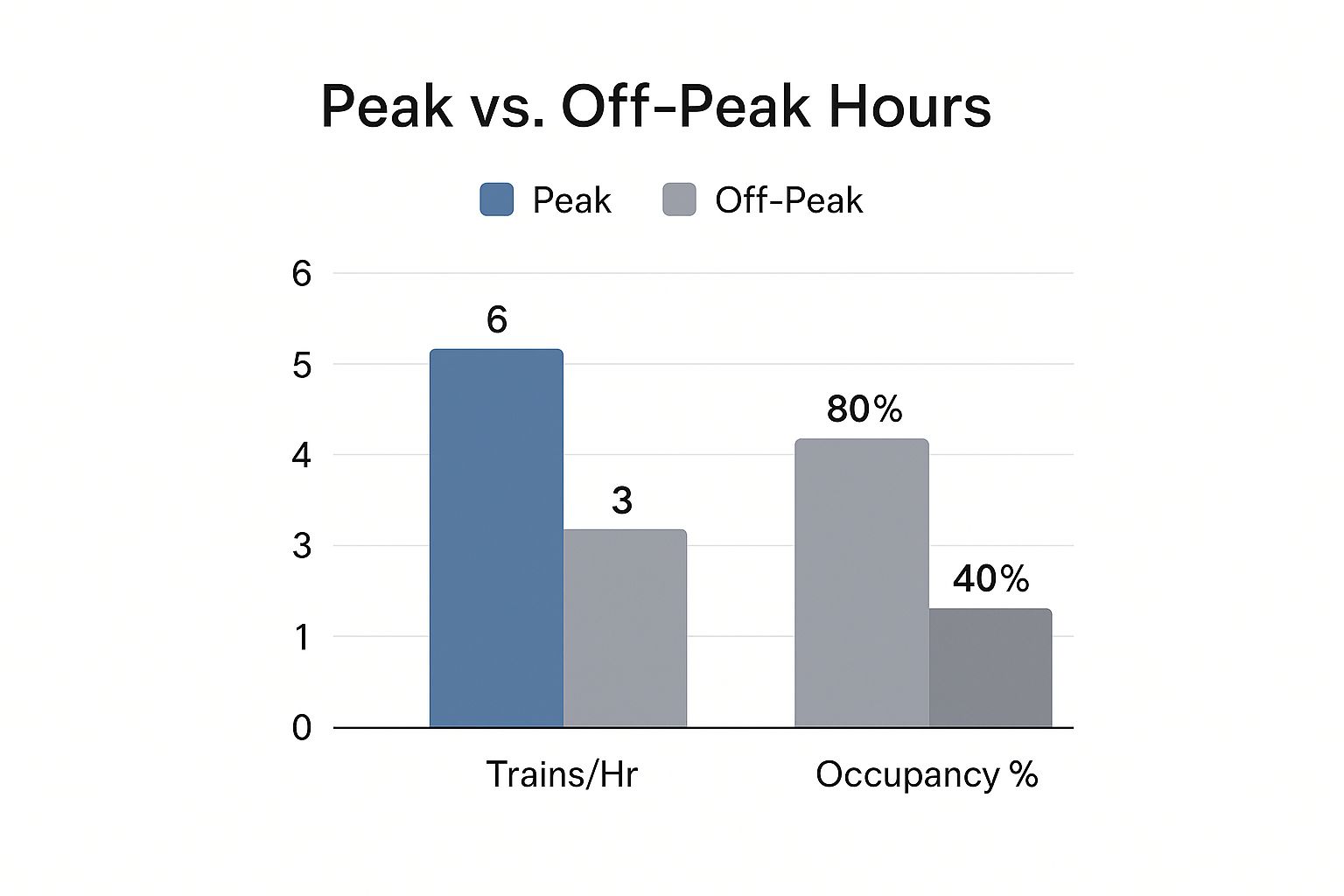
As you can see, it's not just that train frequencies often double during peak hours; the number of people packed into each coach also increases dramatically.
How Service and Fares Change
The line between peak and off-peak travel affects more than just the crowd level—it directly impacts both the go station schedules and your wallet.
This table breaks down what you can typically expect on major GO corridors during these different periods.
GO Transit Service Levels Peak vs Off-Peak Hours
| Service Aspect | Peak Hours (Weekdays) | Off-Peak Hours (Weekdays, Evenings, Weekends) |
|---|---|---|
| Train Frequency | Very high; often every 15-30 minutes on major lines. | Reduced; typically every 30-60 minutes or less frequent. |
| Train Length | Longer trains (10-12 coaches) to maximize passenger capacity. | Shorter trains (6-10 coaches) matching lower demand. |
| Passenger Volume | High to very high; standing room only is common. | Low to moderate; seats are usually easy to find. |
| PRESTO Fares | Standard, higher fare tier. | Discounted fare tier, offering potential savings. |
| Service Goal | Move the maximum number of commuters as efficiently as possible. | Provide reliable, cost-effective service for flexible travel. |
During peak times, you can count on more frequent service, sometimes with trains pulling in every 15 minutes on the busiest lines. These trains are often longer, with up to 12 coaches to pack everyone in. But, this convenience comes at a higher price, as standard PRESTO fares are at their highest to manage demand.
Once the rush dies down, the off-peak schedule kicks in. Service might drop to every 30 or 60 minutes, and the trains themselves may be shorter. The biggest win for passengers, though, is the fare discount. Travelling off-peak can lead to significant savings, making it a fantastic option for anyone with a flexible schedule. This pricing strategy is a smart way to encourage riders to travel during quieter times, which helps balance out the passenger load all day long.
Using Digital Tools For Real-Time Trip Planning
Those printed PDF schedules are a great starting point, but let’s be real: daily transit can change in a flash. A signal issue, some surprise track maintenance, or a nasty bit of weather can throw the whole timetable for a loop. This is exactly where digital tools come in, taking you beyond the static schedule to a live, up-to-the-minute view of your trip.
Think of the PDF schedule as your trusty paper map—it shows you the established routes. Digital trip planners, on the other hand, are like your personal GPS, giving you real-time updates and rerouting you around unexpected delays. These tools are absolutely essential for mastering modern go station schedules.
Having instant access to information turns you from a passive passenger into an informed commuter, ready to adapt to whatever the day decides to throw at you.
Leveraging The GO Transit Website and App
Your first and most reliable stop for live information should always be the official GO Transit website and its mobile app. The "Triplinx" trip planner built right into the website is a powerhouse, designed specifically for navigating the Greater Toronto and Hamilton Area.
Just pop in your starting point and destination, and it'll crunch the numbers to find the most efficient route based on what's happening right now. It factors in real-time data, which means if a train is running a few minutes behind schedule, the planner will show you that in its suggestions.
The real game-changer with the official GO tools is getting instant service alerts. These pop-up notifications are your early warning system for any disruptions on your line, giving you precious time to figure out a Plan B.
For those of us whose commute involves some driving, keeping an eye on road conditions is just as critical. Pairing your transit app with a tool that monitors traffic can be a massive help. You can learn more about how https://ncrnow.ca/2025/08/03/live-traffic-cameras/ are used to provide this kind of real-time data.
Third-Party Apps for Broader Integration
Beyond GO's own platforms, popular apps like Google Maps and Transit have become go-to tools for countless commuters. Their biggest strength is how they pull multiple transit systems together into one smooth experience.
These apps get their live data feeds straight from GO Transit, offering some pretty slick features:
- Live Vehicle Tracking: You can actually see your train's little icon moving along the map. This completely takes the guesswork out of arrival times—you'll know exactly how far away your ride is.
- Crowd-Sourced Updates: Some apps let fellow riders report on-the-ground conditions, like how packed a certain train car is. It’s an extra layer of info that can make your trip a lot more comfortable.
- Multi-Modal Planning: If your journey involves a GO train and then a transfer to a local service like the TTC or MiWay, these apps will map out the entire trip, transfers and all.
Getting comfortable with these digital tools empowers you to plan your trip with confidence. You’re no longer just crossing your fingers and hoping the train is on time—you can confirm it, track it, and switch up your plans on the fly. It puts you back in control of your journey.
Keeping Up With Service Changes and Special Schedules
The GO station schedules you check every day aren’t set in stone. Think of them as living documents, constantly adapting to the rhythm of the region. From seasonal tourist rushes to critical construction projects and long weekends, schedules can and do change. Getting a handle on this flexibility is the key to dodging travel surprises and maybe even finding some unique trip opportunities.
Your regular schedule is the baseline, but big events like a major concert, a Blue Jays game, or a holiday weekend can trigger special service. GO Transit often rolls out extra trains or tweaks timings to handle large crowds, making the journey smoother for everyone. Staying in the loop about these adjustments is your best bet for a stress-free trip.
Staying Ahead of Planned Adjustments
The most common reasons for a schedule shake-up are planned track work and statutory holidays. To keep the whole network running safely and efficiently, maintenance is a must. GO usually schedules this work for nights or weekends to keep disruptions to a minimum.
Before you head out, especially on a weekend or holiday, it’s always a good idea to:
- Check the Service Alerts page on the GO Transit website or app for real-time updates on your line.
- Follow GO Transit’s official social media feeds for quick announcements on upcoming changes.
- Sign up for email or text alerts for your specific train line to get notifications sent right to your phone.
A quick check before leaving the house can save you a long, frustrating wait at the station. When it comes to changes in the regular go station schedules, being proactive is your best strategy.
Seasonal Schedules and Special Events
One of the best examples of how GO service adapts is the seasonal train to Niagara Falls. This route shows how schedules are bent to serve not just commuters but tourists, turning the network into a gateway for a weekend getaway. During the summer, special weekend trains run directly from Toronto to Niagara to cater to the flood of visitors.
This unique schedule is a perfect case study in service flexibility. Often, the train tickets are bundled with local transit passes, like the WEGO bus network, to make the whole experience seamless for visitors. It’s a smart way to use existing tracks to meet a totally different kind of demand, boosting local tourism and offering a great car-free travel option. You can dig into the details on these special travel packages and schedules on the Niagara Parks website.
A Look at the Future of GO Train Service

The GO Transit network you see today is really just a snapshot of a much grander vision. Those go station schedules are in the middle of a massive transformation, all thanks to one of North America's biggest transit undertakings: the GO Expansion project. This isn't just about adding a few extra trains here and there; it's a complete reimagining of what regional transit can be.
The ultimate goal? To bring a subway-like experience out to the suburbs. Picture this: you walk up to your local GO station and just know the next train is never more than 15 minutes away, no matter the time of day or which direction you’re headed. That's the promise of all-day, two-way service on the system's core lines.
Building a Faster, More Connected Network
Getting to that level of service is a monumental task. It’s exactly why you’re seeing so much construction and the occasional schedule adjustment right now.
A few key upgrades are making this all possible:
- Track Electrification: We're swapping out the old diesel locomotives for electric trains that are faster, quieter, and way more efficient.
- New Infrastructure: Fresh tracks, bridges, and tunnels are being built to clear out bottlenecks and let trains run in both directions at the same time.
- Modernized Stations: Stations are getting major facelifts with more platforms, improved accessibility, and better amenities to handle a lot more people.
- New Train Control Systems: We're implementing advanced signalling to safely juggle a much higher frequency of trains across the entire network.
This long-term vision is the reason behind many of the temporary service changes you might run into. Every single adjustment is a deliberate step toward a system where you won't need to stare at a schedule—because the next train will always be right around the corner.
The project is already building on a decade of major capacity increases. As part of a larger regional express rail initiative, weekly train trips are expected to jump sevenfold by the time it’s all done. You can dig into more details about this transit expansion on Wikipedia.
This expansion will fundamentally change how people move across the region, turning GO from a commuter-focused service into a comprehensive transit network for everyone.
This forward-thinking project has a lot in common with other major rail developments happening across the country. You can learn more about upcoming improvements in our VIA Rail news update.
Your GO Schedule Questions, Answered
Getting the hang of a big transit system like GO always brings up a few questions. Don't worry, we've got you covered. Here are some straightforward answers to the most common things riders wonder about GO station schedules, so you can travel with a bit more confidence.
How Far in Advance Do They Release New Schedules?
GO Transit usually works with the seasons. You can expect major timetable changes about four times a year, lining up with spring, summer, fall, and winter. They typically post the new schedules online a few weeks before they kick in, giving you a decent amount of time to see what’s changing and plan ahead.
Argh, I Missed My Train! What Now?
It's a frustrating feeling, but it’s rarely a total disaster. What you do next really depends on when and where you are.
During the morning or evening rush on busy lines like Lakeshore West and East, another train is often just 15-30 minutes behind. Phew. But if you're travelling in the middle of the day, on an evening, or on a less frequent line, you might be waiting for up to an hour.
Your best bet is to immediately check a real-time app or the departure board at the station to see exactly when the next train is coming.
The most reliable go station schedules are always the live ones. Those static PDF timetables are great for planning your week, but always double-check with a digital tool before leaving the house. Delays and cancellations can pop up unexpectedly.
Are Weekend Schedules Just the Same as Weekday Off-Peak?
Not quite, and this is a common mix-up. While weekend service is definitely considered "off-peak," the schedules are often completely unique.
Train frequencies might be different from weekday off-peak times, and some lines could have less service or skip different stations. Always make sure you're looking at the specific schedule for Saturday, Sunday, or a Holiday to avoid any surprises.
For more local news and guides to navigating the National Capital Region, trust ncrnow. Stay informed with our latest updates at https://ncrnow.ca.
About The Author