


The gas price in Ottawa can feel like a rollercoaster, with the numbers at the pump jumping around almost daily. It’s not random, though. These swings are a complex mix of global oil costs, government taxes, and local competition between stations.
Getting a handle on these moving parts is the first step to figuring out why you're paying what you're paying.
What Really Drives Ottawa Gas Prices
Ever pull up to the pump and wonder why the price is what it is? The final number you see isn't pulled out of thin air. It’s a complex recipe with a few key ingredients. Think of it like a coffee shop setting the price for a latte. They have to factor in the global price of coffee beans, their own rent and staff costs, and what the cafe down the street is charging.
It's the same idea for gas. The price in Ottawa is really a tug-of-war between a few major forces:
- Crude Oil Costs: This is the big one. It's the raw material, and its price is set by global supply and demand. Geopolitical tensions, production cuts by OPEC+, or even a hurricane in the Gulf of Mexico can send this cost soaring or plummeting.
- Refining and Marketing Margins: Crude oil isn't gasoline. There's a whole process of turning it into the fuel that goes in your car, getting it to the stations, and marketing it. All those steps add to the final price.
- Taxes: A hefty chunk of what you pay is pure tax. Federal and provincial governments add their own excise taxes and, of course, the carbon pricing system. These charges are a direct result of public policy and can change based on government decisions.
- Local Competition: This is where things get interesting at the street level. You’ve probably seen it yourself—stations right across from each other trying to undercut one another. These local price wars can cause sudden and dramatic shifts throughout the day.
This infographic breaks down what the gas price in Ottawa looks like right now, putting it in context with the national average and showing just how much it has bounced around recently.
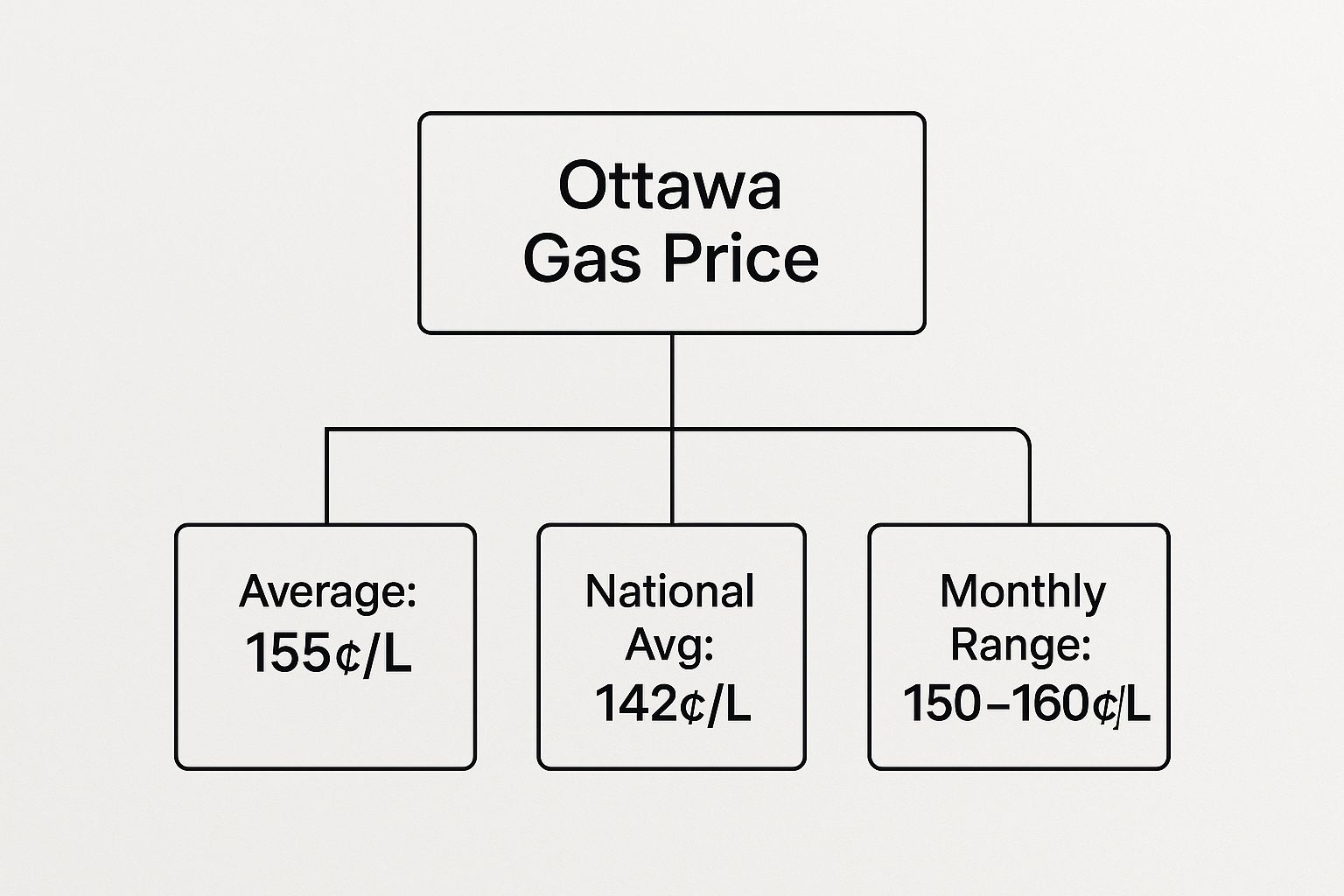
As the data shows, Ottawa's average price often creeps above the national average, which tells you that local and provincial factors really do make a difference here. The volatility isn't new, either. For example, recent price swings have seen a significant gap between highs and lows. You can dig deeper into these trends over at sources like CityNews Ottawa.
Key Factors Influencing Your Price at the Pump
To make it even clearer, here’s a quick summary of what goes into that final price you pay for gasoline in Ottawa.
| Factor | Description | Impact Level |
|---|---|---|
| Crude Oil | The base cost of the raw material, set by global markets. | High |
| Taxes | Federal and provincial excise taxes, plus carbon pricing. | High |
| Refining & Marketing | The cost to process oil into gasoline and distribute it. | Medium |
| Local Competition | Stations adjusting prices to compete with nearby rivals. | Medium |
Each of these elements plays a part, and when they all move at once, you get the price swings we're all too familiar with.
Connecting Global Events to Your Local Gas Station
It can feel a little strange that a conflict happening thousands of kilometres away can make your trip to the pump in Ottawa more expensive, but the connection is surprisingly direct. The price you pay is really a story told in two parts: global forces write the first chapter, and local pressures add the final details.
Think of crude oil as the world’s most traded ingredient. When a major oil-producing region gets hit with instability, it sends ripples of uncertainty through the market. That nervousness can squeeze supply or just make traders speculate, pushing the price of a barrel of oil up for everyone.
That global price becomes the starting point—the baseline cost for Canadian refineries before anything else happens.
How Global News Becomes Local Prices
Beyond geopolitics, the value of our own Canadian dollar plays a huge role. Crude oil is bought and sold in U.S. dollars, so when the loonie is weak, it simply costs more for Canadian companies to buy that same barrel of oil. Naturally, that extra cost gets passed down the line to us.
On top of that, any disruption to global supply chains—like shipping delays or international trade spats—can create a bottleneck. These problems make it more expensive to get crude oil to refineries, adding another layer of cost before a single drop of gasoline ever makes it to Ottawa. Keeping up with reliable news sources in Canada is one of the best ways to get a sense of where these complex factors are headed.
A headline about tensions in the Middle East or a dip in the Canadian dollar might seem distant, but it directly impacts the wholesale price your neighbourhood station pays for its next fuel delivery.
The Impact of Regional Factors
While the world sets the stage, local conditions are what fine-tune the final price at the pump. A big one is the operational status of refineries right here in Eastern Canada. If a key refinery shuts down for scheduled maintenance, it temporarily tightens the fuel supply for the whole region, often causing prices to tick up.
Then there’s the day-to-day stuff. Fierce competition between neighbouring gas stations is what creates those daily fluctuations we all watch for. One station dropping its price by a cent can kick off a mini price war on a single street corner.
Throw in the predictable demand spikes during long weekends or holidays, and you’ve got the full picture of why the gas price in Ottawa is always on the move.
Ever notice how a good chunk of what you pay at the pump has nothing to do with the actual gasoline? When you fill up your tank, you’re also paying a hefty slice of government taxes.
Most drivers don't see these charges broken down, but they have a huge impact on the gas price Ottawa residents pay every day. Think of it like a concert ticket—the artist's fee is just the start. By the time you add service fees and venue charges, the final price looks quite a bit different.
These taxes come in a few layers. First up is the federal excise tax, a flat rate of 10 cents per litre of gasoline sold anywhere in Canada. Then, the federal Goods and Services Tax (GST) gets added on top of the total sale price, which—you guessed it—includes the excise tax.
Provincial taxes get mixed in too, creating a multi-layered tax structure that eats directly into your fuel budget. Once you see this breakdown, it's a lot clearer how government policies end up shaping your transportation costs.
The Elephant in the Room: Carbon Pricing
Lately, one of the most talked-about parts of your fuel bill has been the federal carbon pricing system. It’s an environmental levy designed to make pollution more expensive, nudging everyone toward cleaner energy choices.
As of April 1, 2024, the federal carbon tax on gasoline increased to 17.61 cents per litre. The federal plan involves hiking this tax every year as part of a broader climate change strategy. However, the policy landscape is always shifting, and recent regulatory changes have already tweaked what drivers actually pay at the pump. If you want to dive deeper, you can explore how Ontario outlines its motor fuel prices and all the components involved.
Government policies, from annual tax adjustments to new environmental levies, can have a direct and often immediate impact on your fuel budget, sometimes changing the price overnight.
These costs aren't set in stone. When governments adjust tax rates or introduce new levies, prices can shift almost immediately. That’s why a new budget announcement or a policy update can be just as important for your wallet as a major global event impacting crude oil.
Making Sense of Recent Ottawa Gas Price Trends

To get a feel for where the gas price in Ottawa might be heading, it helps to look back at its recent journey. Prices don’t just move randomly; they often follow predictable patterns driven by seasonal demand and market events, creating a rhythm that becomes easier to recognize over time.
Think of it like the city’s weather. We all know to expect colder temperatures in January and warmer days in July. In much the same way, gas prices have their own seasons, with predictable peaks and valleys that offer clues about what’s coming next.
Looking at this history is key. It shows us that today's price at the pump isn't just an isolated event—it's part of a much larger, ongoing cycle.
Tracing the Seasonal Swings
One of the most reliable patterns you’ll see is the annual summer price hike. It’s simple, really. As the weather warms up, more people hit the road for vacations and long weekends, which drives up demand for fuel right across the country. This bump in consumption almost always pushes prices higher.
On the flip side, the winter months often bring a bit of a lull. With fewer people travelling, demand dips, and prices tend to soften, offering some welcome relief.
For instance, looking at recent data, Ottawa's average price for regular gasoline has often fluctuated within a 10-cent range over several months, reflecting both global crude prices and local demand. You can dig deeper into how these seasonal shifts are shaped by crude oil prices and taxes by checking out Ottawa's gasoline price trends from Global Petrol Prices.
Recognizing these seasonal cycles helps make future price fluctuations feel less like a surprise and more like a predictable part of the year. If you can anticipate the summer surge, you can better prepare your budget for it.
How to Actually Lower Your Fuel Costs

Knowing why gas prices are so high is one thing. Doing something about it is another. Luckily, you don't have to just accept the price at the pump. A few smart moves can make a real difference to your wallet, and they don't require much effort.
It all starts with timing your fill-ups. If you pay close attention, you’ll notice a rhythm to Ottawa's gas prices. While it’s not an exact science, prices often take a little dip mid-week before creeping back up for the weekend rush. A little patience can save you from paying peak prices.
Your phone is also your secret weapon here. Apps like GasBuddy or Waze give you a live look at prices across the city, pointing you straight to the cheapest pump nearby. Saving a few cents a litre might not feel like a lottery win, but trust me, it adds up big time over the course of a year.
Smarter Driving and Vehicle Care
The way you drive has a massive impact on how much fuel you burn. Stomping on the gas and slamming on the brakes can guzzle up to 30% more fuel, especially on the highway. Instead, think smooth. Ease onto the accelerator and let your car coast to a stop when you can.
Basic car care is just as important for keeping your tank fuller for longer. One of the easiest wins? Properly inflated tires.
When your tires are low on air, they create more drag, forcing your engine to work overtime. Just checking the pressure once a month can boost your mileage by over 3%.
Another simple trick is to lighten your car's load. That extra stuff in the trunk you've been meaning to take out? It’s costing you money on every trip. Combining these habits really compounds the savings.
And if you're looking for bigger ways to cut down on driving, exploring options like the low-income bus pass in Ottawa can offer serious financial relief.
Comparing Fuel-Saving Strategies
Not all fuel-saving tips are created equal. Some offer huge savings with a bit of effort, while others are quick wins you can start today. Here’s a quick breakdown to help you decide where to focus your energy.
| Strategy | Potential Fuel Savings | Effort Level |
|---|---|---|
| Smooth Driving | 10-30% | Medium |
| Proper Tire Inflation | 3% | Low |
| Remove Excess Weight | 1-2% per 100 lbs | Low |
| Use Price-Tracking Apps | Varies (5-10¢/L) | Low |
| Regular Maintenance | Up to 4% | Medium |
Ultimately, a mix of these strategies will give you the best results. Start with the low-effort changes like checking your tires and clearing out your trunk, and you'll already be on your way to a smaller fuel bill.
Your Top Questions About Ottawa Gas Prices, Answered
Even after getting the big picture, most of us still have questions about the numbers we see on those big signs every day. Let’s tackle some of the most common ones and clear up the confusion.
Why Did the Price Just Change in the Middle of the Day?
It’s one of the most frustrating things to see: you fill up your tank, and an hour later, the price drops. What gives?
These super-fast, mid-day price shifts almost always come down to one thing: intense, street-corner competition. Gas stations are constantly eyeing what the station across the street is doing. If one station lowers its price to lure in more drivers, others nearby are forced to follow suit or risk losing customers. This can set off a tiny "gas war" on a single intersection, causing prices to bounce around a few times before they stabilize.
The price you see at lunch might be different by your evening commute. This is a direct reflection of stations reacting to each other in real-time to win your business, not a major shift in the underlying fuel cost.
Are Prices Actually Higher in Ottawa Than in Rural Areas?
It definitely feels that way sometimes, but the truth is a bit more complicated.
On one hand, gas prices in Ottawa can be a little higher than in some of the surrounding small towns. Things like higher commercial property taxes, steeper operating costs, and a ton of concentrated demand can push the price up.
But it’s not always a clear-cut case. A rural town with only one or two stations might have zero competition, giving those owners the freedom to keep prices higher without any pressure to match a rival. There's no hard-and-fast rule, which is why a price-checker app is still your best bet for finding the cheapest fill-up on any given day.
How Come Regular and Premium Prices Don't Move Together?
Ever notice the gap between regular (87 octane) and premium (91+ octane) fuel seems to change? That’s because it does.
The price "spread" between different grades of gasoline isn't fixed. Premium fuels need special additives and different blending components to achieve that higher octane rating, and the costs for those ingredients can rise and fall completely independently of what's happening with regular gas.
This means you might see the price of regular stay flat while premium grades suddenly jump. It's not a pricing gimmick; it’s usually a sign of separate supply chain pressures hitting the specific components needed for those higher-end fuels.
For more local news and insights that matter to residents of the National Capital Region, stay informed with ncrnow. Visit us at https://ncrnow.ca to keep up with the latest stories.
About The Author