

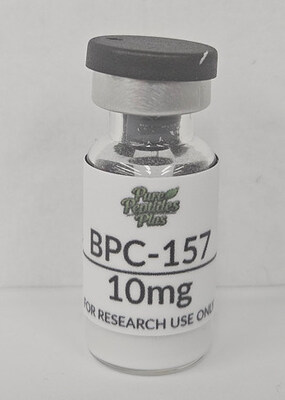
BPC-157 (CNW Group/Health Canada (HC))
You’re Injecting That Based on a Podcast Tip?
Health Canada put out a public advisory this week warning Canadians to stop buying and injecting peptide drugs they find online. Depending on what circles you run in, you might have already heard of some of these things. BPC-157. TB-500. Melanotan. Ipamorelin. They sound like pharmaceutical grade, cutting-edge science. And that’s kind of the point.
The wellness industry has been quietly building a second economy around these compounds for a few years now. But lately it’s not quiet anymore. TikTok and Instagram have been flooded with peptide content, with influencers promoting the products while also conveniently directing their audiences to where they can buy them. A lot of those influencers, it turns out, are affiliated with the very online retailers selling these unauthorized substances, often with discount codes attached.
So let’s be clear about what’s actually happening here. Someone with a large following tells you a peptide healed their shoulder or tightened their skin or improved their sleep. They link you to a retailer. You buy the product. They get a cut. And you inject something into your body that has not been tested on humans, was manufactured god-knows-where, and arrived at your door labelled “For Research Use Only.”
That last part is worth pausing on. Health Canada has been explicit: that “for research use only” disclaimer does not make these products legal or exempt them from Canadian regulations. It’s a legal dodge that means nothing.
The pitch for peptides didn’t start in some dark corner of the internet. It came through the mainstream door. Joe Rogan has repeatedly praised BPC-157 to his massive audience, claiming it cleared up his elbow tendonitis in two weeks. Jennifer Aniston has talked about weekly peptide injections for her skin. CNN When someone with that kind of reach says “this worked for me,” millions of people listen. And some of them start injecting.
The problem? According to Dr. Eric Topol of the Scripps Research Translational Institute, none of these wellness peptides are proven, and none have gone through what would be considered adequate clinical trials. “It’s actually quite extraordinary,” he said, referring to how many people are taking them anyway.
Take BPC-157 as a case study. It’s probably the most popular one out there right now. Some animal studies do suggest it might help with tissue repair, potentially because it accelerates the growth of new blood vessels. But researchers also caution it could theoretically encourage the growth of precancerous cells. That’s a pretty significant “but.” And the dosing question is a whole other problem. Scientists point out that the same substance that might be helpful at one dose could be ineffective or harmful at another, and without clinical trials, nobody actually knows what the right dose for a human being is.
That hasn’t stopped people from stacking multiple peptides at once, either. Experts are especially worried about the growing trend of taking combinations of two, three, or four different peptides together, which they describe as genuinely dangerous territory.
And here’s where Health Canada’s warning hits hardest. These aren’t just unproven products. They are, in many cases, potentially contaminated ones. Unauthorized peptide products can contain contaminants including solvents, heavy metals, particles like glass or plastic, and microbials like bacteria or fungi. They can also be improperly manufactured or stored. When you order a vial from a random website, you have no idea if what’s inside matches the label. The product might contain too much or too little or none of the active ingredient at all, and could include unlisted, unknown, or dangerous ingredients.
Health Canada has already gone after several Canadian retailers. The agency has taken action against at least three online peptide sellers since April 2025, including a company out of Sherbrooke, Quebec called Prime Research, and another called Canada Peptide. Despite these actions, many Canada-based retailers continue selling illegally.
The border angle is telling too. On platforms like TikTok, vendors in China and elsewhere are advertising dozens of peptide types for as little as $5 a vial, shipped directly to buyers. eMarketer Five dollars. For something you put in a syringe and stick in your body. Health Canada says it’s now working with the Canada Border Services Agency to try to intercept unauthorized shipments, but anyone who’s watched how these online markets operate knows that playing whack-a-mole with international parcel shipments is an uphill battle.
Here’s the thing that really gets me about all of this. A McGill University science communicator put it plainly: “We’ve gone from taking a pill by mouth to now taking a black market experimental drug.” That’s the trajectory. That’s how normalized this has gotten. And part of the reason it’s normalized is that the people pushing it are trusted voices, not shady ads in the back of a magazine. They’re podcasters and fitness accounts with millions of followers and good lighting and a personal testimonial that sounds completely reasonable.
The wellness industry is very good at one thing above all others. It sells you the idea that the medical establishment is hiding something from you, and that they’ve found it. It packages uncertainty as courage. Trying an unproven injectable becomes a form of self-optimization instead of what it actually is, which is taking a real risk with your body based on rat studies and influencer income streams.
If you’ve already been using these products and feel fine, maybe you got lucky. If you don’t feel fine, Health Canada is urging you to contact a doctor now. And if you’re thinking about it? Check the label first. Authorized prescription drugs in Canada have an eight-digit Drug Identification Number printed on them. If you don’t see one, that tells you everything you need to know about what you’re dealing with.
About The Author