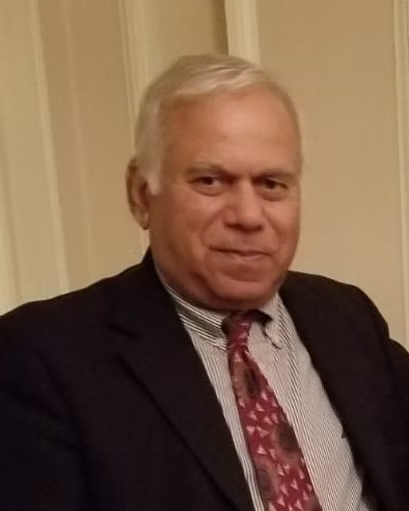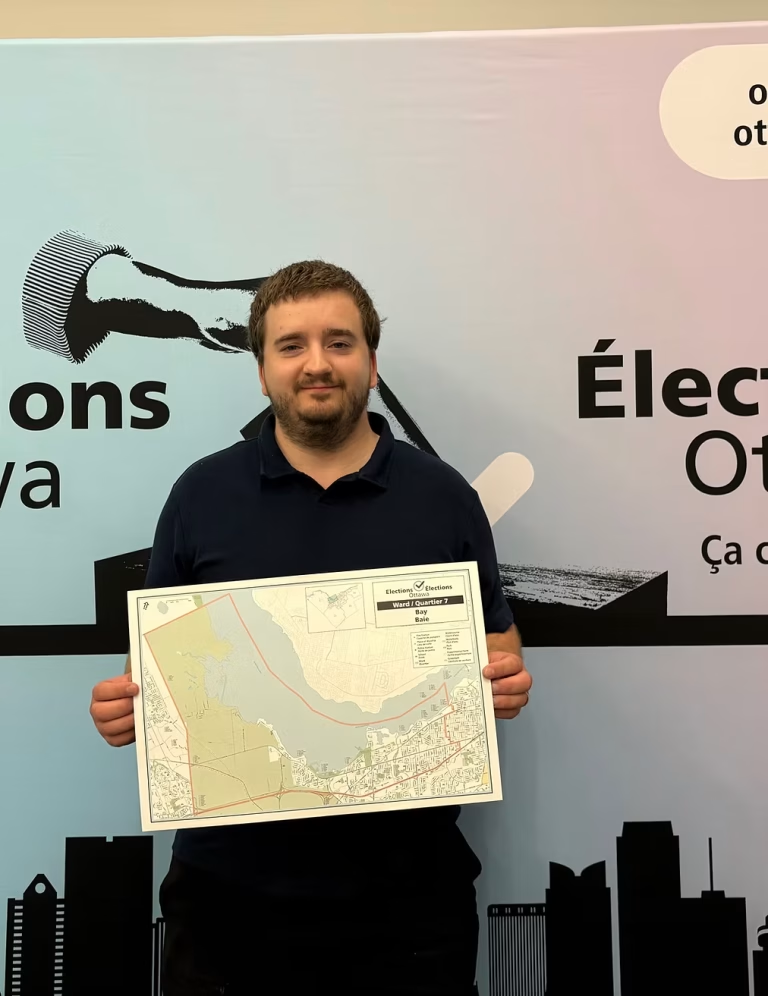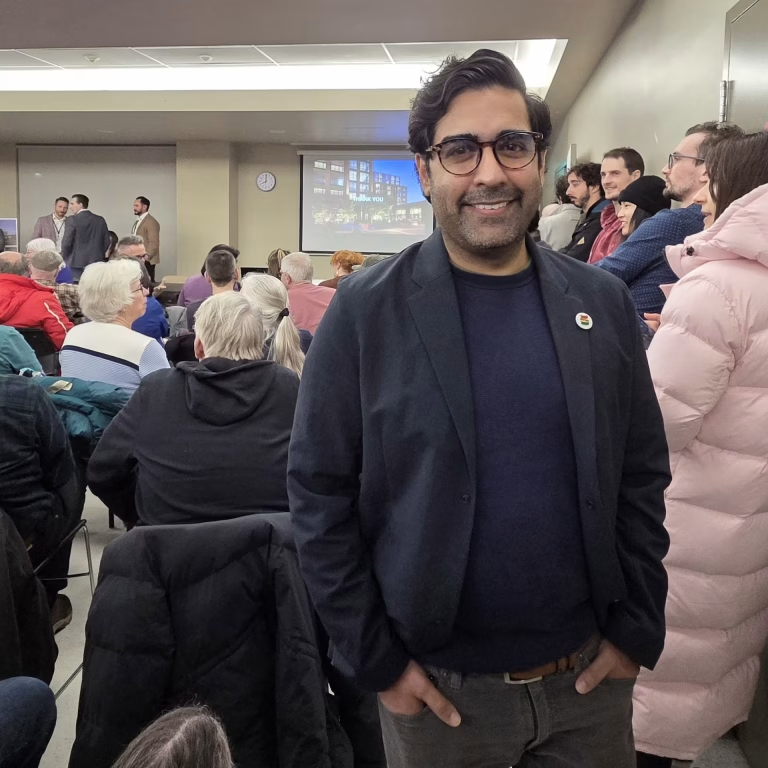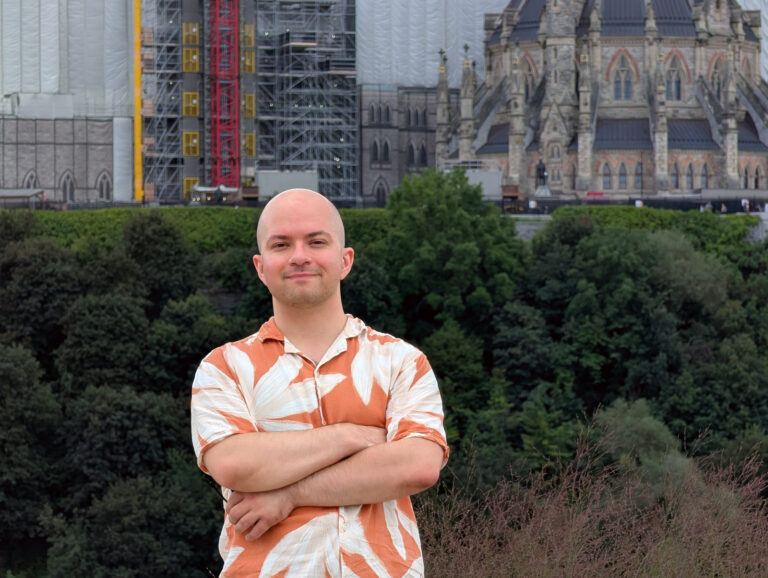

The following are 5 questions that we sent out to every Ottawa City Council candidate in hopes of getting to know them better. We publish the responses exactly as we receive them, in the order that they were sent to us. Here are the responses from Somerset Council candidate Nicholas Gollé.
1. Who are you? Where are you from? What relevant experience do you have for the job?
My name is Nicholas Gollé. Ottawa is home. I grew up in South Keys and Greely, made my adult life in Centretown, and have lived in Somerset Ward for eight years.
I have a bachelor’s degree in Computer Engineering from Carleton University, spent two years working in construction, and have worked for eight years in information technology in the public service.
My work has taught me that complicated problems rarely fail because nobody can describe the ideal outcome. They fail because people do not share the same understanding of the problem, technical information is inaccessible to decision-makers and the public, legitimate concerns are lost between teams, and no one can agree on the next step.
My role has often been to bridge those gaps: translating technical constraints into understandable choices, translating operational and human needs back into actionable requirements, earning trust across different perspectives, and helping move the work from discussion into implementation.
I do not pretend to be the expert on every municipal issue. My strength is entering a difficult problem honestly, learning from the people who understand different parts of it, exposing the assumptions and trade-offs, and building enough shared understanding to move it forward. I believe that is central to the work of a councillor.
2. The city spends nearly $1B/y on OC Transpo, though many constituents remain dissatisfied with the state of Ottawa’s public transportation. What would you do as a councillor to improve the city’s transportation system?
My first action would be to seek a Council-adopted mandate recognizing OC Transpo as essential public infrastructure and a citywide public utility whose first obligation is reliable service that people can build their lives around.
Council currently debates transit through several competing ideas about what the system is for. It can be treated as a service used only by riders, a business expected to recover more of its costs, a social program, or infrastructure necessary for the entire city. Without agreement on that basic purpose, OC Transpo cannot have a stable long-term direction.
Reliable transit benefits people who never board a bus. It reduces the number of vehicles competing for limited road space, connects workers with employers and customers with businesses, lowers household transportation costs, and allows Ottawa to accommodate growth. Intensification is already happening, while our roads will not become wider every time another building is constructed.
From that shared mandate, I would ask OC Transpo’s professionals to develop a funded, multi-year reliability plan. Council should establish the outcome, provide stable resources, examine the trade-offs and hold the system accountable. Transit professionals should determine the technical means of delivery, including scheduling, staffing, vehicle availability, maintenance and transit-priority measures.
Progress should be reported publicly through measures residents can understand, including scheduled service actually delivered, cancellations and journey reliability. OC Transpo needs to regain enough trust that residents can confidently organize work, childcare, appointments and daily life around it. That will require investment now, before continued growth and congestion make recovery more difficult and expensive.
3. In a December 2025 poll from Abacus Data, 37% of respondents said that cost of living was the most important issue facing the city; another 19% responded ‘housing affordability.’ What would you do as a councillor to make the city of Ottawa more affordable?
Municipal government cannot control every part of the cost of living, but it has meaningful influence over housing supply, municipal fees, public services and transportation. On housing, I believe different parts of the system must perform different jobs.
First, Ottawa needs substantially more private-sector housing construction. When rental housing is scarce, landlords have greater pricing power and residents have fewer choices. Every month a unit remains empty means lost rent while the owner’s costs continue, so a healthier vacancy rate creates genuine competition for tenants. I would support clear zoning, faster and more predictable approvals, appropriate infrastructure, and changes to municipal costs or requirements where evidence shows they are preventing otherwise viable homes from being built.
More market housing will not make every new unit inexpensive, nor will it solve deep poverty. Its role is to reduce scarcity, moderate rent pressure and expand housing choices for ordinary and middle-income households.
Second, the City must use public and non-profit tools to fill the gaps the market cannot. Ottawa already has levers including City land, capital grants, tax and fee relief, rent supplements and incentives for developments that accept enforceable affordability requirements. I would also support preserving existing affordable rentals, including through non-profit acquisition where it represents good public value.
I would evaluate these programs by completed homes, the incomes they actually serve, how deeply and how long rents remain affordable, their cost to the public, and whether they enabled housing that would not otherwise have been created or preserved. We should expand what works, revise what falls short and add new tools when the evidence shows a remaining gap.
Third, Ottawa needs permanent supportive housing for people whose needs cannot be met by either ordinary market housing or an affordable rent alone. That means combining a stable home with appropriate mental-health, addiction, health and social supports. Supportive housing can reduce repeated reliance on shelters, hospitals, paramedics, police and other expensive crisis services, particularly for people with the most complex needs. It is both a humane response and potentially a better use of public money.
These approaches are complementary: private construction addresses broad scarcity, targeted public investment creates and preserves below-market housing, and supportive housing serves people who require more than financial assistance. Council should stop expecting any one part of the housing system to solve every problem and instead hold each part accountable for the outcome it is capable of delivering.
4. Certain city services like OC Transpo and the OPS have run significant deficits in recent years. Is there anything that you would do as a councillor to try to balance the city’s budget?
For OC Transpo, Council must first decide what it expects the system to be. I believe it is essential citywide infrastructure whose first obligation is reliable service that residents can build their lives around. Council should fund that mandate honestly rather than rely on optimistic assumptions and then cut service when they fail. In return, OC Transpo should provide a multi-year operating plan, transparent assumptions and public reporting on both service and financial performance.
For OPS, I would ask the Police Services Board and police service to identify the causes of recurring deficits, distinguish temporary pressures from structural costs, and provide a public mitigation plan. I would also examine which calls do not require police powers and could be handled more appropriately and at lower cost by services such as ANCHOR, allowing officers to focus on work that requires their authority and training.
Not every diverted call produces an immediate cash saving; it may instead free capacity, reduce overtime or avoid future growth. Those effects should be measured honestly. The goal is not an arbitrary cut to one department, but the right service delivering the right response at the lowest responsible total cost.
5. Why are you running for Council? What do you think is the biggest issue facing your ward today?
I’ve worked for the public service since 2018. In 2020, we faced a global pandemic that posed an immediate threat to us. In that acute period of time, we saw broad co-operation and immediate action. No matter how you feel about it, there was action to protect our safety. But as the consequences of two years of stalled economic activity have resonated, and things have seemed only to get worse, clear signs of a general sense of anxiety have continued to grow: crime, deficit spending that seemingly failed to make things better, more people entering a state of homelessness, and increased substance abuse.
The economic anxiety comes, to some degree, from resource scarcity. We are all poorer now, and that leads us to zero-sum thinking:
If you get housing, I pay for it.
If your neighbourhood gets resources, mine loses them.
If I compromise, someone will take advantage of me.
If another group gains, my group must have lost.
This breaks trust, which breaks the co-operation needed for collective problem-solving around our current issues.
In my work, I’ve learned that things get done best when there is a shared understanding and purpose. Things rarely move an inch when people have misunderstandings or disagreements, and progress is only made when we find at least one thing we agree on, even just a common intent, do what we can to move it forward, and go from there. It also takes someone to make clear the cost of inaction and build agreement around that cost between parties, because the cost of inaction is that, eventually, everyone loses. We are at our best when we care more about trying to solve the problem, checking our results, and adjusting our approach.
You have to accept the risk of assuming that the person sitting in opposition to you is acting in good faith, and respect their intellect enough to recognize that they have a rational set of reasons that led them to their position. If you reduce every policy disagreement to a judgment about the moral character of the people on the other side, then disagreement becomes evidence that the other person is bad. Do we really think that everyone except us walks around like bozos every day, holding positions and doing things they are not self-justifying as right? If you cannot even entertain that thought, you cannot begin the process of finding where you can agree, even if that agreement is that water is wet.
Back to why I’m running. If you look at municipal politics today, we have to consider our scarcity mindset. Politicians tell us what we want to hear. Their policies will be narrow and framed as offering only good things, and they will say that they’ve tried, but co-operation just isn’t possible because the other side won’t listen. And that’s why they will protect or even enlarge your piece of the pie!
Nobody is willing to trust the intelligence of voters to hear the honest costs and compromises needed to achieve the long-term prosperity we all actually want.
Most solutions are band-aids and reactions to the immediate sentiment of a crowd, rather than the result of analysis and the creation of a public understanding of the problem itself.
This crab-in-a-bucket, reactive approach to governance never has the depth or broad support needed to achieve long-term solutions. And when long-term solutions do occur, it’s often once the problem has become big enough and expensive enough that we have no choice but to fix it. The best and cheapest time to fix problems is before they reach critical mass.
So problems don’t seem to get solved very often. And that makes people feel like government doesn’t deliver.
You see this in municipal voter turnout, not just in Somerset Ward. At the level of government that interfaces most directly with our daily lives, we see less than fifty percent turnout, and we think that’s good comparatively.
But what we really see there is that we have accepted such low participation as the norm. And why is that? Could it be that people feel like their vote doesn’t matter? That problems won’t get solved regardless? That they are getting five different versions of the same options?
And why does it seem that we always get people basically arguing over minor variations of the same set of things? Because candidates running for municipal office all engage in the same activity:
Talk to people.
Hear what makes them unhappy.
Hear what types of solutions make them happy.
And coincidentally, you end up with the same set of proposals that all these candidates are guessing will make enough people happy enough to win them the election.
Talking to people and understanding their perspectives is literally the bare minimum.
Holding our institutions accountable is the bare minimum.
Engaging stakeholders is literally the bare minimum.
But just looking for a solution that will make people happy is not the same as solving the root problem. It is irresponsible and shows a lack of trust in people’s intelligence, or a lack of confidence in your understanding of a problem or your ability to articulate it.
Our public institutions can deliver. America went to the moon through a public institution by giving it the resources and mandate to do so. It is elected representatives who give our institutions their mandates and resources. And you need broad support to supply that resourcing and mandate.
I’m not a politician. I work in IT, and it’s a domain I am much more comfortable in. But I would not be upending my life if I hadn’t realized that you cannot wait for someone else to meet the moment. Nobody rises up until somebody does. And the fact that our candidates and elected representatives don’t even think to say this demonstrates the problem: they are stuck in the perspective of salespeople, not representatives. I say this to make it clear that they are doing their best. It’s just that this perspective has become the norm, and it has limited their creativity and options.
TL;DR: I felt so strongly that our municipal politics had led to an environment where our politicians have gotten very good at doing the wrong job. Not because they are malicious or have bad intentions, but because the anxieties of our current economic situation have caused people to turn inward and narrow their perspectives. I kept waiting for somebody to articulate the kind of politics I wanted to see. Eventually, I had to confront the possibility that waiting for somebody else was part of the problem.
That means starting with a clear definition of the problem, making the costs and trade-offs public, building agreement around what we’re trying to achieve, giving our institutions the mandate and resources to achieve it, measuring the results, and being willing to change course when something isn’t working.
The biggest problem in our ward is what I described above: leadership. But in terms of what people are feeling as a result of that, it is public safety.
And I mean that it is the biggest problem because it represents a government failure to meet a core obligation.
In our society, citizens surrender much of their ability to use coercion or force to public authority. In return, government assumes a fundamental responsibility to maintain public order and protect people’s lives, liberty, and property.
But in Somerset Ward, residents’ lives, freedom, and property are being threatened, restricted, and stolen. Citizens feel powerless because, in many respects, they are powerless. The coercive actions needed in some cases are reserved for government. That’s a failure of government to meet a responsibility that is fundamental to what enables our society to function. How could a citizen expect government to deliver if it’s failing to deliver one of the most basic parts of its obligation? Can someone expect government to deliver transit if it can’t deliver a street that is safe to walk down?
It goes without saying that law enforcement is a reactive measure and the most expensive intervention, and that earlier interventions can both prevent circumstances from reaching the point where police are needed and require fewer resources. Immediate public safety and long-term prevention are not competing solutions because they operate at different points in time. You need to show that responding to the immediate need is expensive and unsustainable, while demonstrating why we need to both invest in meeting our core obligation now and invest in long-term solutions that will make the problem smaller in the future.
Somerset has a broad array of issues that need addressing. But this one is an immediate priority because of how fundamental it is.
About The Author