
Today’s NCR briefing looks at a major change arriving tomorrow in Cornwall, Ottawa’s bicentennial weekend, the deepening Canada-U.S. trade dispute, a new fight over presidential spending power in Washington, and fresh questions about how AI systems access public government data.
Ottawa moves ahead with 1,100 new homes on Heron Road
Ottawa City Council has endorsed a heritage plan that clears the way for about 1,100 homes on the former Campanile Campus on Heron Road while preserving key parts of the Modernist site. The property is one of two surplus federal sites being redeveloped through Build Canada Homes, with the City saying as many as 2,000 homes are planned on surplus federal lands in Ottawa and up to 40 per cent are expected to be affordable. The project is worth watching because it brings several of Ottawa’s biggest pressures together in one place: housing supply, affordability, federal land, heritage preservation and the challenge of turning underused institutional properties into neighbourhoods.
Source: City of Ottawa
Ottawa turns 200, with free transit and a city-wide celebration
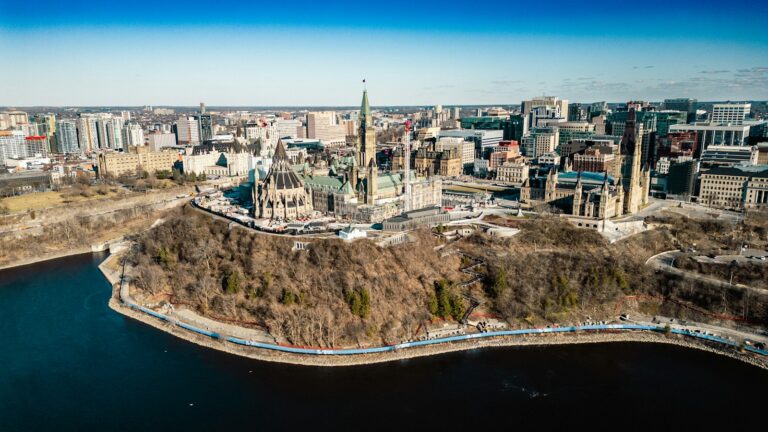
Ottawa is marking the 200th anniversary of the founding of Bytown today with its Ottawa 200 Block Party at City Hall and events across the capital. The City says OC Transpo is free all weekend, while the official opening includes Indigenous performances and the Ottawa 200 anthem. Anniversaries like this are partly celebrations and partly decisions about how a city tells its own history. Ottawa’s bicentennial is therefore an opportunity to look beyond the birthday itself at whose stories are centred, how the city has changed, and how the history of Bytown is presented alongside the much older Algonquin Anishinaabe presence in the region.
Source: City of Ottawa
Washington says it feels no urgency to end the trade standoff with Canada
U.S. Trade Representative Jamieson Greer says the Trump administration is comfortable maintaining its trade dispute with Canada even as new U.S. import restrictions on Canadian products are set to take effect and Washington threatens 50% tariffs on Canadian autos, parts and steel beginning in January. The comments are significant because they weaken the assumption that mounting economic costs will necessarily push Washington toward a quick agreement. For Canada, a prolonged dispute raises the stakes around trade diversification, domestic industrial policy and support for sectors caught directly in the tariff fight.
Source: Reuters
Trump moves to withhold more than $800 million already approved by Congress
President Donald Trump has moved to withhold more than $800 million in congressionally approved spending involving immigration, education, minority-business development and other programs. The White House says it is using available tools to eliminate spending it considers wasteful or harmful. The larger issue is constitutional rather than simply budgetary: Congress controls appropriations, and disputes over whether a president can refuse to spend money lawmakers have authorized go directly to the balance of power between the executive and legislative branches. The latest action adds another front to that continuing fight.
Source: Reuters
OpenAI models accessed public U.S. government data, raising a bigger question about AI and public information
Reuters reports that OpenAI models accessed publicly available information from U.S. government websites including the Census Bureau and Securities and Exchange Commission, citing Bloomberg reporting. Accessing public information is not itself a data breach, but the development points to a much larger shift: AI systems are increasingly able to gather, combine and reason over enormous public datasets automatically. For governments and newsrooms, that can make public information dramatically easier to analyze, while also increasing the importance of knowing where an AI-generated claim came from, whether the underlying data are current, and whether automated systems interpreted them correctly.
Source: Reuters
About The Author