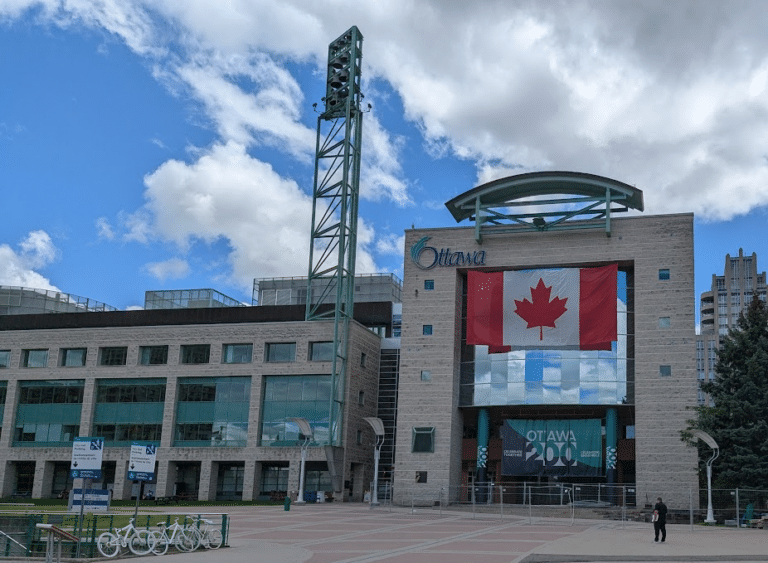

Photo by Rohan Thukral, 2026
When this article is published, it will be less than one week until the Ottawa municipal election on October 26th. This election campaign has been dominated by four candidates: Mark Sutcliffe, the incumbent mayor; Jeff Leiper, his main challenger to the left; Niel Saravanamuttoo, a populist, left-aligned but in reality centrist candidate; and Alex Lawson, a further right option than Sutcliffe. While early on the race appeared to be relatively quiet, in recent weeks social media posts and advertising by the candidates have taken a darker, and more sensational, turn, along with the possibility of a closer race than previously thought. We will examine these things, and how a darker mayoral race is bad for the city. I should point out a few things. Firstly, though I am no longer involved with any mayoral campaign, I did volunteer with the Jeff Leiper campaign earlier this year. It was a strictly volunteer basis, and all the opinions I set forth in this editorial are my own. Secondly, I will not be examining individual council races here. You can look through NCR Now’s five questions series if you are interested in coverage of your local ward. Now let’s take a look at the 2026 Ottawa mayoral race.
The Candidates
Mark Sutcliffe
Let’s start with Mark Sutcliffe. The incumbent mayor since the 2022 election has had a true lack of direction, talking a big game while doing pretty much the opposite. On transit, the number one issue of the election by a wide margin for Ottawans, the mayor’s signature policies have included cutting LRT service, rolling out New Ways to Bus, which the City’s Auditor General found was based on outdated data and used as a budget cut, and finishing Stage 2 of LRT, which will not even begin testing in time for the election, as well as an upload of the LRT to Metrolinx which has no timeline. On transit, Mark Sutcliffe’s mayoralty can be seen as seldom more than a failure, with OC Transpo being in worse shape now than when he started and the service seeing a continuous drop in ridership.
Other than these forays into transit policy, which have so far borne very little fruit, Sutcliffe focused on Landsdowne 2.0, a project which would spend over $400 million in the short term on renovating the north side stands and the Arena at TD Place, and would cost $139M long term even after accounting for revenues generated, with an optimistic projection. His campaign has thus far consisted of proposals such as restricting non-residents from booking recreational activities, starting Stage 3 LRT to Kanata and Barrhaven that his administration stalled, a tax cap of two to two point five per cent per year while the inflation rate is above three per cent (marking an effective tax cut again under a re-elected Sutcliffe administration, as he did in 2023 and 2024), and other similar uninspired policies that often ignore his previous term or go back on key policies.
This lack of clear vision in his first term shows: According to the most recent opinion poll, his net approval rating is -15 per cent, with 56 per cent of respondents disapproving of his leadership. This is low compared to other incumbents in Ontario: Toronto’s mayor, Olivia Chow, for instance, maintains a net approval rating of +19 per cent, with 59 per cent of residents approving of her performance despite having one fewer year in office and presiding over a one-time 10.5 per cent property tax increase; something normally considered a highly unpopular measure which can change political fortunes. Sutcliffe’s lack of any ambitious policy, as proven in his first term agenda, has led to his deep unpopularity.
Jeff Leiper
Next, we have Councillor Jeff Leiper. He has been considered the second candidate in the race, and the main challenger to Sutcliffe. His campaign is mostly based on transit, planning to reverse New Ways to Bus to restore 70,000 service hours per year, and increasing the prioritization of Bus Rapid Transit (BRT) projects and bus lanes, such as those proposed on Baseline, while also proposing to reinstate the citizen seat on the transit commission (though it is important to note that he was a proponent for its removal). However, he has also focused on policies to begin to decrease the infrastructure deficit that has been in the news this year for causing closures of local pools through a one per cent infrastructure levy, removing the city’s return-to-office (RTO) mandate and calling on the federal government to do the same, with RTO mandates having been slammed by major public sector unions for their cost and the inadequate conditions of government offices.
Leiper has also called to increase funding to ANCHOR crisis response and shift resources away from policing in cases where they do not need to respond, move the city’s budget process back to being budget-first, rather than tax-first, for both increased transparency and a clearer eye on the city’s priorities, and opposed Landsdowne 2.0, on the grounds of cost to taxpayers (especially pertinent given the first Landsdowne project has lost money every single year for the city), the removal of greenspace, and worse conditions in the new facilities, specifically expressing concern about the prioritization of premium box seating over capacity in the new arena. He calls to pay for increased service spending with a reasonable tax set of tax increases that are still above the rate of inflation. While a tax raise on its own is never popular, it is necessary given the state Ontario municipalities are in, with services like transit being cut in Ottawa.
When examining his campaign, it is clearly one about reversing the decline in services Ottawa has experienced under the current mayor and council, and beginning to put the city in a different direction, more in line with other major Canadian municipalities such as Toronto, Vancouver, and Montreal. He has represented Kitchissippi Ward (or Ward 15) for 12 years, or three terms on council, providing him with necessary council experience for the mayor’s office (especially given his promise to not use strong mayor powers).
Neil Saravanamuttoo
The third-place candidate, economist Neil Saravanamuttoo, is running a populist campaign which is also centred around transit. However, he takes a different approach than the others. Rather than focusing on reliability improvements, Saravanamuttoo proposes “buck-a-ride”, a one-dollar transit fare program, as the primary plank in his transit platform. He claims it will require no new spending, something which is predicated on projected ridership gains, the upload of the LRT, imagined budgetary efficiencies, and a new plan to generate revenue for OC Transpo through land sales. Of the two short-term plans to pay for the gap, one of them is not fully in the city’s control, and one of them has been promised by every mayor post-amalgamation to keep taxes low from Bob Chiarelli to Larry O’Brien to Jim Watson to, of course, Mark Sutcliffe. Yet this has not always materialized as expected, making an assumption of efficiencies (let alone those of $82.2 million per year, every year) as the anticipated cost by the Saravanamuttoo campaign at best optimistic and at worst unrealistic.
The long-term plan, while good, does not yet have a projection for how much revenue it would generate, and it would likely be lower than necessary to cover the gap (Vancouver’s transit agency, Translink, will generate only $2.2M per year on average over the next decade through their real estate arm). His transit plan also includes bringing back crosstown express routes such as the 95, which sounds good in theory but does not take into account the lack of bus lanes on these corridors which made the original crosstown bus routes work, as well as the increased expense (or, more likely, decreased service elsewhere) that would come from running buses that parallel the LRT for most of their route.
The rest of his platform, such as his fiscal platform, which promises to keep taxes “as low as possible” while reducing the infrastructure gap and removing transit cuts, is similarly optimistic about the financial situation. While it is true that Saravanamuttoo is an economist, and I do not doubt his expertise about projections, he has not made projections about the budget other than the cost of buck-a-ride: He says savings are possible, citing a few big, admittedly wasteful projects. However, he has no long-term plan beyond zeroing the budget (or rather, making every department justify every dollar they spend from scratch), which could theoretically bring savings in year one, but not in years to come, the shortfall for which will require either service cuts or a tax raise. He also promises to block Alto, the federal high-speed rail project, which would leave Canada as the only G7 nation without high-speed rail. Saravanamuttoo was a force behind Catherine McKenney’s 2022 mayoral campaign (though McKenney now endorses Jeff Leiper) and co-founded CityShapes with them, as well as being the host of the Better Ottawa podcast.
Alex Lawson
Finally, we have Alex Lawson. A homebuilder and business owner, he represents the right-wing in this mayor’s race, going so far as to promise a zero per cent property tax in the first year and below-inflation increases afterwards, promising to find as much as $240 million in the form of efficiencies without cutting core services (you should know how I feel about that promise already). His campaign includes the same unrealistic commitment to bring back express buses as Saravanamuttoo, and a similar promise to justify spending (except done with yearly audits).
Now at this point, it seems as though Lawson and Saravanamuttoo have very similar policy proposals. On the budget, and to a lesser degree transit, they absolutely do, and share perhaps the most similarities of anyone on However, Lawson has his own set of uniquely unrealistic or harmful policies, too. For instance, his policy on removing all paid parking uses an argument that paid parking is meant for revenue generation. This has never been the case, as even the right-wing Frontier Centre acknowledges. Paid parking, as annoying as it can be, is a way to ration inherently limited demand, and ensure more availability for parking spaces, as well as ensuring turnover (though of course there are direct and societal costs to free parking, as outlined by Donald Shoup in The High Cost of Free Parking). Indeed, looking for parking results in approximately 8 per cent of traffic congestion.
Lawson also promises to end the Vacant Unit Tax, on the grounds that it does not improve housing affordability. However, the CD Howe Institute study his campaign cites for this claim shows that it does improve housing availability, which does not make the Vacant Unit Tax useless, merely that it only improves part of the equation (which is still an improvement. Furthermore, we should think about who the Vacant Unit Tax applies to. According to the City, vacant units are those which are “unoccupied for an aggregate of more than 184 days during the previous calendar year.” Primary units are explicitly excluded from this tax. Removing it would thus constitute an effective subsidy on those who own multiple homes, and willfully keep them vacant.
Finally, we have his plan to build a ring road around Southern Ottawa. While the goals to divert truck traffic are indeed laudable, he relies on the Provincial government to get it done; something that the mayor’s office has no control over. Finally, he previously made supportive actions and comments towards the Freedom Convoy, though he has backtracked. Lawson’s campaign is much like Saravanamuttoo’s, and to a lesser degree Sutcliffe’s: It is dependent on the upper levels of government to get key commitments passed.
The Mudslinging and Misinformation
The campaign has recently taken a darker turn. Multiple campaigns have posted negative, and sometimes misleading, videos, photos, and other posts to social media. The Sutcliffe Campaign has also gotten into it recently, despite Sutcliffe being the incumbent. His campaign has posted videos attacking Jeff Leiper for not giving out a property tax target (he did this twice in fact, and posted a photo too), and attacked Neil Saravanamuttoo over a supposed pledge to spend $250 million bike lanes. There is just one problem with these lines of attack from the mayor, however: They are misleading.
Firstly, Leiper won’t give out his full tax pledges yet because of the way the budget works: Ottawa’s budget works on a tax-first basis, this means we set our maximum tax increases before the tabling of the budget. Leiper wants to do it on a budget-first basis, or presenting a draft budget first and then working to cut it down and assign a tax increase that makes sense. This means that it is impossible for Leiper to know exactly what tax raise is necessary for his budgets, because we simply do not know what the true service budget needed is, and we have not known since 2023 when Ottawa switched to the tax-first approach, under Mark Sutcliffe. In other words, Leiper would need to actually enter office before making a tax pledge, as his goal is to improve services rather than keep taxes artificially low. It is not from a lack of his knowledge, but a lack of city transparency.
Secondly, the attack levied against Saravanamuttoo is just plain misleading. No such policy point exists in his campaign, and it is shocking to me that a sitting mayor would accuse a challenger of having a policy that they simply do not have. However, Sutcliffe is hardly the only one getting into the fray with attacks. Saravanamuttoo himself has run with one in particular, attacking tax increases from both Leiper and Sutcliffe and relying on his plan to find efficiencies rather than increasing taxes. I may sound like a broken record here, but that is not exactly sustainable, in my view. However, this is a minor attack compared to Sutcliffe’s, and Neil has not exactly been shy to go negative throughout the campaign (see this, this, this, or this, for example), so it is not exactly a new development. Jeff Leiper has one negative post of note, attacking Sutcliffe on his alleged failure to ask for help promptly following the Canada Day floods, which he disputes. Alex Lawson has not gone as overtly negative, but his campaign is still tinged by some senses of negativity, especially in his debate performances.
Negative campaigning has not been the only worry. Misleading, but not necessarily negative, posts have also been released. Neil Saravanamuttoo has been the worst offender of these in my view, releasing a video where he implies that the mayor’s race is between him and Sutcliffe. He does this on other occasions too. We will get into polling later, so I will not focus on every single poll here, however this video is based entirely on two assumptions: Firstly, Saravanamuttoo assumes that a specific subset (likely voters) of a specific Sutcliffe campaign internal poll are the closest to election day results, and secondly, that all other subsets of all other polls (or even the poll he himself cites) are wrong. This is, of course, not the way to run a campaign. He even discourages Ottawans from voting for Jeff Leiper, who is the second-place candidate according to most other polls.
Saravanamuttoo is not the only candidate who is cherry-picking poll data to make their chances look better than they likely are, however. Alex Lawson is doing the same, with a pinned post on his Instagram account specifically looking at a Liaison poll from late July, where he is recorded at 26% and in second place (though this was the only poll where this was recorded, and his support has since likely substantially dropped). As a result, the waters for anyone who wishes to vote strategically have been significantly muddied.
I would be lying if I said the race was overwhelmingly negative. The race has so far been rather tame as far as negative campaigning goes, unlike certain other races in Ontario (such as Mississauga, which has almost devolved into a personal conflict between the two frontrunners, at least during debates) but it is nonetheless disappointing to see candidates, and especially the incumbent, engage in negative campaigning that is also misleading. We should not tolerate willfully misleading voters at any level of our government, and it is deeply disheartening to see this happen with Mark Sutcliffe against Neil Saravanamuttoo. Attacks, especially false ones or those missing context, are deeply against the spirit of fair elections, and in my opinion pose a serious risk to our information ecosystem. At the same time, it is deeply disappointing to see the kind of poll cherrypicking and sometimes poll denial we see from Lawson and Saravanamuttoo. No opinion poll will ever be perfect, and it is true that at the municipal level they can often be inaccurate to a degree. However, they are generally right about the broad race; that is, who the top two candidates are, and how the momentum of the race going.
The State of The Race
So, with all this talk of polls, we should talk about the state of the race. At the beginning of the campaign, and according to some recent polls including a Sutcliffe campaign internal poll conducted by Abacus Data, the incumbent was, and is, a shoe-in to win the Mayor’s office once more. Interestingly, among those likely to vote, Sutcliffe leads with 50 per cent, Saravanamuttoo is second at 17 per cent, and Leiper is third at 16 per cent. However, it is important to note that among all those surveyed, Sutcliffe is first at 39 per cent, Leiper second at 12 per cent, Saravanamuttoo third at 11 per cent, and Lawson fourth at 10 per cent. But polling is split: A Lawson campaign poll, conducted by Mainstreet Research, shows only a ten per cent lead for the mayor (35 per cent) over Jeff Leiper (25 per cent), Alex Lawson (11 per cent), and Neil Saravanamuttoo (8 per cent), with 19 per cent of voters undecided and 61 per cent of those planning to vote for anyone but Sutcliffe. This was further backed up by a Quorus poll, one of the few independent ones this cycle, that shows a seven per cent lead for Sutcliffe (42 per cent) over Leiper (35 per cent), with Saravanamuttoo (10 per cent) and Lawson (7 per cent) far behind. Unlike what some campaigns are trying to portray, this is clearly a two-horse race between Sutcliffe and Leiper, at least when looking at all voters.
These polls tell us that it is likely that Mark Sutcliffe will get his re-election victory. It could also be with a smaller popular vote mandate from voters than he got in his first term, though given the polling miss for McKenney last time around it is possible he also improves on his numbers.
Assuming the majority of polls are broadly correct, however, it will be a close victory for Sutcliffe, and perhaps with a more progressive council than in 2022. For Ottawans looking to vote strategically against Sutcliffe, the best choice is Jeff Leiper. And for those looking to vote strategically against what is seen as the left, the best choice is Sutcliffe. Their fairly big tents, one focused on maintaining a middle way between progressive urbanism and suburban priorities (remember that despite the transit struggles, focus on keeping taxes below inflation, and anti-bike lane rhetoric, Sutcliffe passed one of the most ambitious housing legalizations in the country, which I can only praise) that is in my view increasingly untenable, and one focused on a clear vision of a city which repairs our foundations and then builds on top of it. When it comes down to it, that is the state of our race: Contradictions under Sutcliffe or clarity under Leiper.
About The Author