

Ever wonder how a new law—say, one about improving local recycling—actually turns into a blue bin on your curb and a truck that picks it up every Tuesday? That’s public administration in a nutshell. It’s the essential, hands-on work of turning government policies into the real-world services we rely on every single day.
Think of it as the engine that keeps our communities running. Public administration is responsible for an incredible range of services, from making sure our tap water is clean and our roads are maintained to managing public schools and dispatching emergency services. It's the "how" behind everything the government does.
The Operating System of Society

Picture your city as a hugely complex machine with thousands of moving parts. Public administration is its operating system, managing all the resources, people, and processes required to make things happen.
While politicians and lawmakers decide on the what—the laws and grand plans—it's the public administrators who are tasked with figuring out the how. These are the dedicated professionals—the civil servants, city managers, and public employees—who bridge the gap between a political promise and a tangible result.
Without this crucial work, even the most brilliant policies would never leave the page.
Where Policy Meets Practice
It’s easy to mix up public administration with public policy, but they are two sides of the same coin. Public policy is about creating the framework—the laws and programs designed to solve societal problems. Public administration is the machinery that puts those policies into action.
If you want to get a better handle on their relationship, it's worth exploring what public policy is and how it sets the stage for all the administrative work that follows.
At the end of the day, the work of a public administrator is guided by one core mission: serving the public good. This isn't just a job; it's a commitment to principles that ensure our government runs fairly and effectively for everyone.
At its heart, public administration is the pursuit of effective governance for the public good. It is the crucial link that translates political vision into the services and infrastructure that citizens depend on, from healthcare access to national security.
To bring this to life, here’s a quick look at how public administration translates policy into everyday services.
Public Administration in Action
| Area of Governance | Public Administration Task | What It Looks Like to You |
|---|---|---|
| Public Health | Implementing a new vaccination program. | Getting a flu shot at a local clinic. |
| Transportation | Managing road maintenance schedules. | Potholes getting filled on your commute. |
| Education | Allocating funds to public schools. | New textbooks and technology in the classroom. |
| Environment | Enforcing regulations on industrial waste. | Cleaner rivers and air in your community. |
This is just a small sample, of course. The real scope of public administration is vast.
Core Areas of Public Administration
The responsibilities of public administrators touch nearly every part of civic life. Some of their key functions include:
- Service Delivery: This is the most visible part of the job. It involves managing essential services like waste collection, public transit, and emergency response.
- Resource Management: Public administrators are stewards of taxpayer money. They oversee public funds, staff, and infrastructure to make sure they're used efficiently and responsibly.
- Organizational Direction: It’s all about leadership. This means guiding government agencies and entire departments to meet their goals and fulfill their mandates.
- Regulatory Enforcement: This function ensures everyone plays by the rules. Administrators enforce laws related to health, safety, and the environment for both individuals and businesses.
Ultimately, understanding public administration means recognizing the invisible, yet vital, network of people and processes that keep our communities functioning, day in and day out.
The Historical Roots of Modern Governance
To really get what public administration is all about today, we need to take a step back in time. The systems that shape our modern lives didn't just pop up out of nowhere; they’re built on historical foundations that still influence how governments make decisions and deliver services.

A surprising amount of the administrative practices we see around the world are leftovers from old empires and colonial systems. These historical frameworks set up the hierarchies, legal codes, and bureaucratic habits that, in many places, are still hanging around. They shape everything from how your local city is managed to how national policies get rolled out.
This isn’t just some dusty old history lesson. This legacy has real, tangible effects on how efficient and responsive our governments can be.
The Lasting Impact of Colonial Systems
You can see this historical hangover clearly in the public administration of the Commonwealth Caribbean. The way these nations are governed was heavily moulded by their British colonial past, which installed a very centralized, top-down system of administration.
This model packed all the power at the very top, leaving local officials with little room to make decisions on their own. The cultural and structural ghosts of this system are still around, sometimes creating bottlenecks where progress grinds to a halt waiting for a minister’s signature. This can lead to massive delays and a culture where public servants are hesitant to act.
In that kind of setup, even tiny decisions can get kicked all the way upstairs, burying top-level leaders in paperwork and slowing everything down. The numbers tell a pretty stark story. Between 1981 and 1983, for instance, the cabinet of Trinidad and Tobago had to review a staggering 13,208 notes. During a similar period, the entire British cabinet reviewed just 139. You can dig deeper into this research on Caribbean public sector reform over at cigionline.org.
Understanding this historical context is crucial. It explains why some government agencies may seem slow or resistant to change—they are often operating within a framework designed for a different era with different goals.
This inherited structure often bumps up against the needs of our fast-paced modern world, which demands governments be nimble and quick on their feet. Acknowledging these historical roots is the first step toward making meaningful changes.
Why This History Matters for Public Administration Today
Getting a handle on the history of public administration helps us appreciate just how complex modern governance is. It shows us why some systems run smoother than others and shines a light on the deep-rooted challenges that reformers are up against.
The push for modernization is really an effort to either dismantle or adapt these older, more rigid structures. Today, reform efforts often zero in on a few key areas:
- Decentralization: Pushing decision-making power down to the local level to make services more responsive to community needs.
- Empowerment: Giving public servants more autonomy to make calls within their areas of expertise.
- Efficiency: Streamlining old processes to cut down on delays and deliver better services to citizens.
When you get right down to it, by looking at the past, we get a much clearer picture of the present. And with that insight, we can better chart a course toward a public administration that’s more effective and responsive for everyone.
Core Functions That Keep Society Running
Think of public administration as the machinery that turns political promises and policy documents into real, tangible actions. It’s the essential, day-to-day work that keeps our communities functional, safe, and organized. These core functions are the tasks public administrators tackle, often behind the scenes, to deliver the services we all rely on.
While the field is massive, most of its responsibilities fall into a few key areas. Each one acts like a critical gear in the engine of government, working to translate big ideas into reality.
Implementing Public Policy
At its heart, public administration is all about policy implementation. When lawmakers pass a new bill—say, a municipal by-law to increase the number of public parks—it's the public administrators who have to make it happen. They’re the ones securing the land, hiring the contractors, managing construction, and making sure the new park is properly maintained for everyone to enjoy.
This function is the bridge connecting a legislative idea to a genuine community benefit. It demands careful planning, sharp project management skills, and seamless coordination across different government departments.
Managing Public Resources
Public administrators are the stewards of our taxpayer dollars. A huge part of their job is financial management, which involves creating and overseeing public budgets. They must allocate funds responsibly to cover everything from the salaries of civil servants to major infrastructure projects.
It’s an incredibly detailed process. Picture a city creating its annual budget. Administrators have to forecast tax revenue, apply for grants, and then distribute those funds to departments like police, sanitation, and public health. Their goal is to maximize the impact of every single dollar while maintaining total transparency and accountability.
This infographic breaks down the key difference between public and private administration, highlighting the unique focus of each.
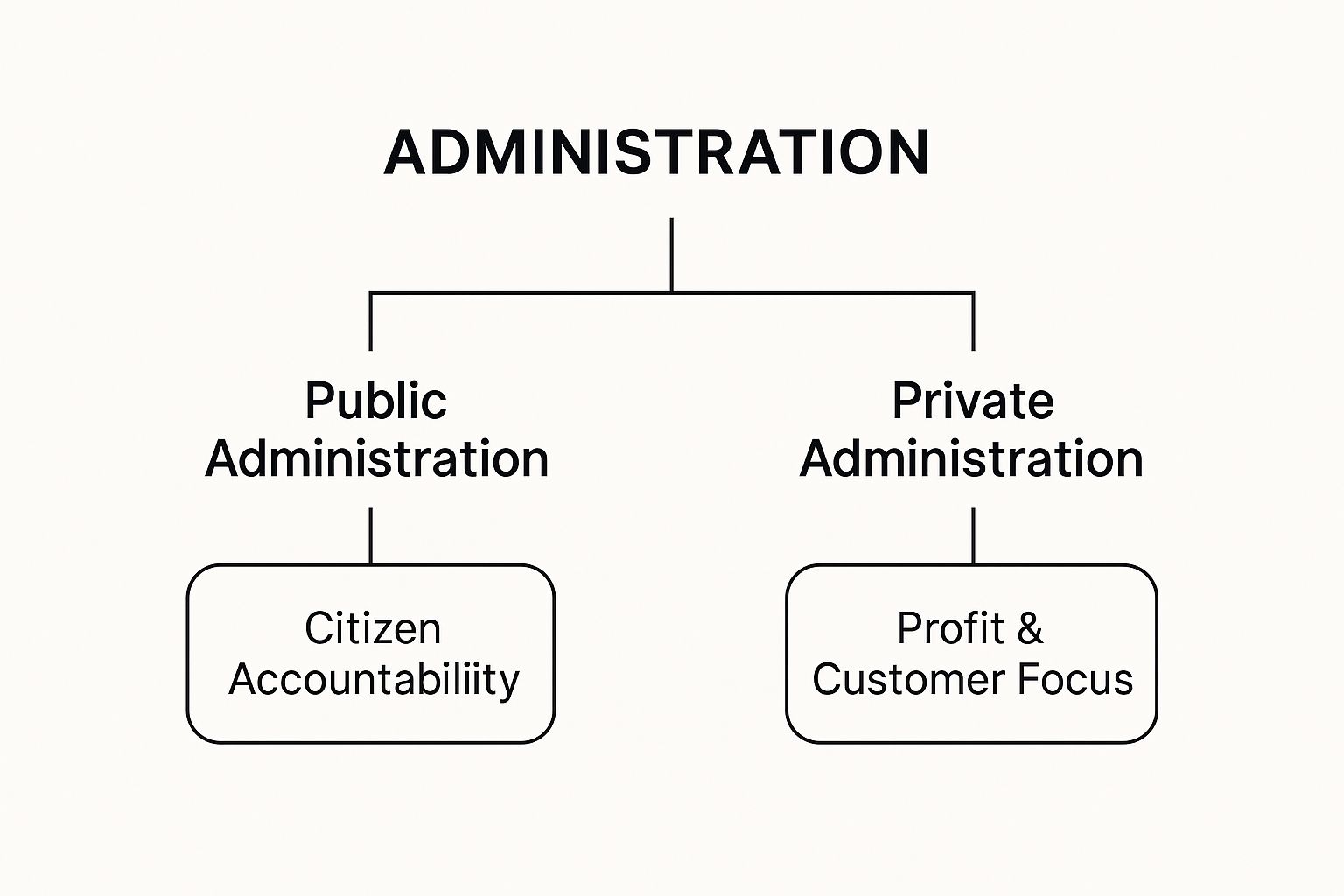
As the diagram shows, while private administration is driven by profits, public administration's ultimate duty is to the citizens it serves.
Overseeing Public Sector Personnel
A government is only as effective as the people working for it. That makes human resource management a critical function. It involves recruiting, training, and managing the entire civil service workforce—everyone from teachers and librarians to city planners and firefighters.
This function ensures that public agencies are staffed with qualified, ethical, and motivated professionals. For instance, the complex process of hiring new emergency responders is a key administrative task. You can learn more about how agencies like the Ottawa Fire Department manage their teams to serve the community effectively.
To give you a clearer picture, here’s a quick summary of these essential roles.
Key Functions of Public Administration
This table summarizes the primary roles within public administration and what they look like in the real world.
| Function | Description | Real-World Example |
|---|---|---|
| Policy Implementation | Translating laws and government decisions into concrete programs and actions. | A new environmental law is passed; administrators create recycling programs and enforce emission standards. |
| Financial Management | Creating, managing, and overseeing public budgets and the use of taxpayer funds. | City finance departments allocate money for road repairs, public transit, and community centres. |
| Human Resource Management | Recruiting, training, managing, and supporting the civil service workforce. | A school board hires new teachers, provides professional development, and manages payroll and benefits. |
| Service Delivery | Directly providing essential services to the public or overseeing their provision. | Operating public libraries, managing waste collection services, or running a public health clinic. |
These functions are the bedrock of a stable society. Without dedicated administrators managing policies, budgets, and people, the government's promises would remain just that—promises. They are the ones doing the vital work that keeps everything running smoothly.
The Guiding Principles of Public Service
What really separates public administration from just another set of bureaucratic tasks? It’s the core principles—the ethical compass that guides every single decision and action. These values aren't just fluffy ideals; they are the bedrock of fair governance and the key ingredient in building lasting public trust.

Four principles really stand out as the pillars of a healthy public service: accountability, transparency, efficiency, and equity. Think of them as working in tandem, ensuring that government actions are not only effective but also just and completely open to public scrutiny.
Accountability and Transparency
Accountability is simple in theory but powerful in practice: it means public officials are answerable for what they do. It’s the essential mechanism that ensures someone is held responsible when services fall short or tax dollars are mismanaged. This is what empowers citizens to hold their government to a high standard.
Tied directly to this is transparency, which is all about throwing open the curtains on government operations. It’s built on the idea that you, as a citizen, have a right to know how decisions are being made and how your money is being spent.
These two principles are the lifeblood of a functioning democracy. This is where understanding what is civic engagement becomes so important, because an informed public is one that can truly participate in its own governance.
It's not just a local concern, either. Global watchdogs are constantly measuring these principles. For instance, a major study by Transparency International dug into the accountability systems across six Caribbean nations. By looking at everything from access to information to conflict of interest rules, the study offered a clear picture of governance quality in the region. You can dive into the full details of the Caribbean Public Accountability Mechanisms to see how it breaks down.
At its core, public administration must be a transparent enterprise. When citizens can see how their government works, trust grows, and officials are held to a higher ethical standard, strengthening the entire system of governance.
Efficiency and Equity
While transparency builds trust, efficiency is all about making sure the government actually delivers value. This principle focuses on using public resources—our time, money, and people—as wisely as possible to get the best outcomes for the community. It’s about finding the smartest way to pave a road or the most effective strategy for delivering health services.
But efficiency can't exist in a vacuum. It has to be balanced with equity, which is the promise to provide fair and just services to everyone in society, no matter their background. This principle pushes administrators to actively find and tear down the systemic barriers that stop certain groups from accessing public resources.
This creates a constant balancing act. Imagine a public administrator tasked with designing a new transit route. The most efficient option might be a straight line through the busiest commercial districts. But an equitable approach would demand ensuring that marginalized neighbourhoods also get reliable access, even if it’s less profitable on paper.
This is the kind of ethical puzzle that gets to the heart of what public administration is really all about: a never-ending effort to serve everyone, both effectively and fairly.
Modernizing Government for Today’s Challenges
Public administration isn’t some dusty rulebook set in stone. It has to live and breathe, constantly changing to meet the real-world needs of the people it serves. With technology moving at lightning speed and global issues getting more tangled by the day, the pressure is on for the public sector to keep up. Modernizing government isn't just a nice idea anymore—it's a must.
This means more than just slapping a digital front on old, clunky processes. We’re talking about a complete overhaul of how government works. It's about designing services that people can actually use without pulling their hair out, using new tools to get things done faster and smarter, and rethinking what the government’s role should even be in our modern world. That’s a tall order, because real change takes a lot more than new software.
What It Really Takes to Get Reform Right
Successful change starts at the top. You need strong political will and a clear, shared vision of where you’re headed. Without leaders who are truly all-in on making things better, even the most brilliant plans will fizzle out. Just as crucial is building a culture within the administration that doesn't just tolerate change but actively seeks it out.
That cultural shift is often the toughest nut to crack. To build public organizations that are both resilient and effective, leaders need to empower their teams and tear down the old, rigid hierarchies.
True public sector reform isn't just about updating technology; it's about transforming the mindset and culture of an organization to be more agile, responsive, and citizen-focused. It’s a shift from a process-driven bureaucracy to a results-driven public service.
Strategies for a More Agile Public Sector
So, how do you make that transformation happen? Public administrators are increasingly borrowing from proven management playbooks to make government nimbler and better prepared for today's headaches.
- Delegating Authority: This is about pushing decision-making power down the ladder. When the people closest to the problem can act quickly, they can cut through the red tape and get things done.
- Fostering Participatory Management: Bringing employees into the decision-making loop isn't just a morale booster. It taps into their frontline expertise to cook up better, more practical solutions.
Governments all over have started down this path. Take the Caribbean, for example, where governments have been tackling major reforms to deal with pressing governance challenges. A key moment came in 1995 when a CARICOM Ministerial Working Group flagged priority areas like redefining the state's role, adopting new technologies, and—you guessed it—improving service delivery. Their final report drove home a critical point: no reform can ever succeed without a powerful vision that defines why the state exists—to serve its people.
You can dive deeper into these regional reform efforts in the comprehensive report on the civil service in the Caribbean.
Got Questions About Public Administration?
To help pull it all together, let's tackle a few common questions. These answers should give you a clearer picture of what the field is all about, where it can take you, and how it’s different from other areas of government study.
Is Public Administration Just a Fancy Name for Political Science?
Not at all, though they are closely linked. Think of it this way: political science is the theory—it digs into the ideas, systems, and political behaviours that shape governments. It asks why a particular policy was created.
Public administration, on the other hand, is all about the practice. It’s the hands-on work of turning those political decisions and laws into reality. It asks how we can effectively deliver that policy to the public.
One studies the blueprint of governance; the other builds the house.
What Kind of Jobs Can You Get in Public Administration?
A background in public administration is incredibly versatile and opens doors to meaningful careers in public service at every level—municipal, provincial, and federal. You'll often find graduates in roles like:
- City Managers, who are the operational backbone of a municipality.
- Policy Analysts, the researchers who advise lawmakers on smart, effective solutions.
- Public Health Officials, who manage the programs that keep our communities healthy.
- Non-profit Directors, leading organizations that fill crucial service gaps.
- Human Resources Managers in government agencies, managing the workforce that keeps public services running.
These skills are also in high demand at international organizations and even in the private sector, especially for jobs that require navigating government relations or regulations.
At its core, a career in public administration is about service. It’s a chance to roll up your sleeves and make a direct impact on your community, tackling society’s biggest challenges to make sure government works for everyone.
How Is Technology Changing the Game for Public Administration?
Technology isn't just changing things—it's completely reshaping how public services work. Digital governance initiatives are making life easier for everyone, whether you’re renewing your driver’s licence online or pulling up public records from your laptop.
Behind the scenes, data analytics is helping administrators make smarter, evidence-based decisions that improve everything from traffic flow to budget planning. This shift means we need a new generation of public servants who are as comfortable with digital tools and cybersecurity as they are with management principles. It's all about keeping government effective, efficient, and secure.
Stay informed about the issues shaping our city. For the latest news and in-depth analysis of governance in Ottawa and the National Capital Region, trust ncrnow. Visit us at https://ncrnow.ca.
About The Author