

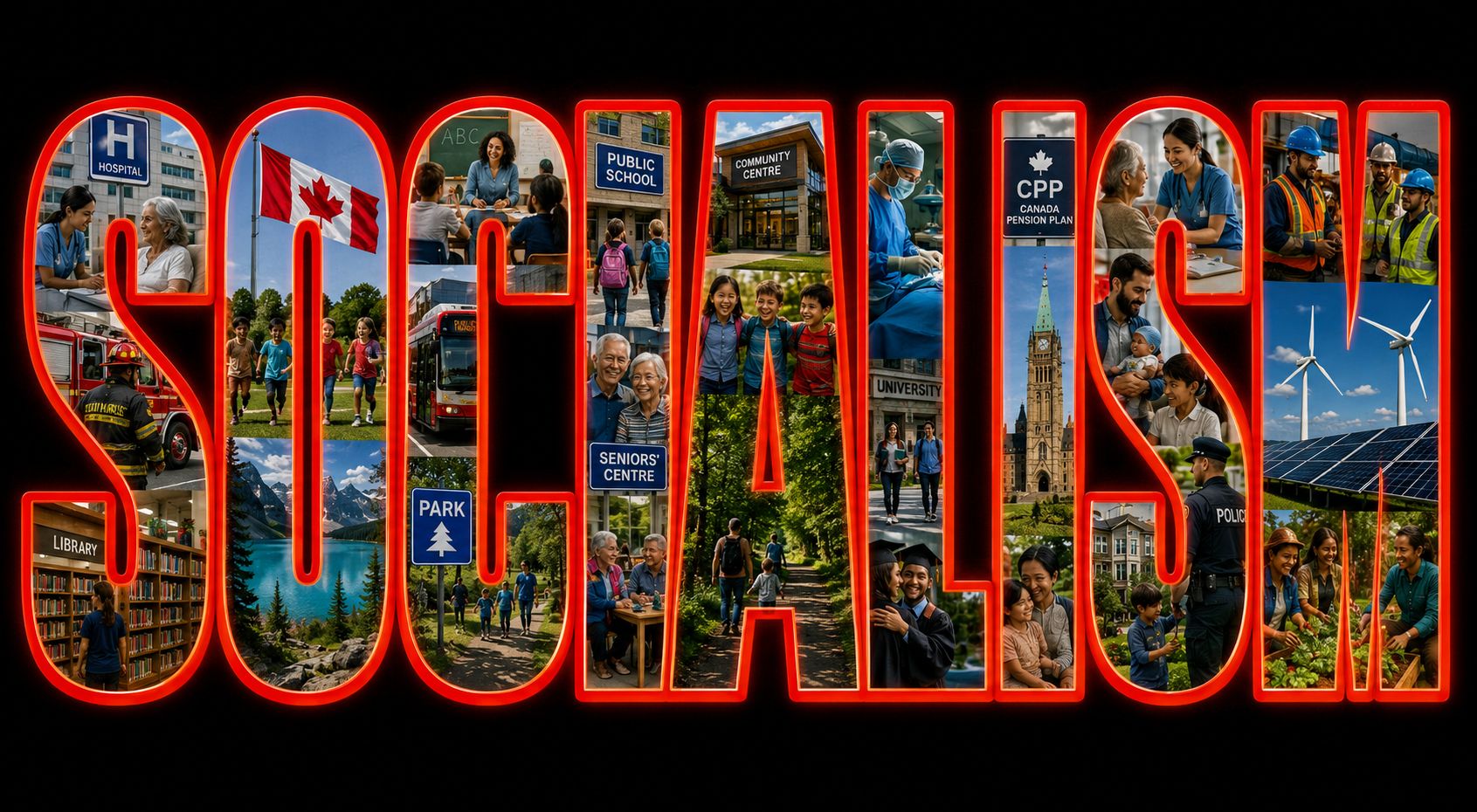
…why are so many of Canada’s greatest achievements rooted in socialism?
For as long as I can remember, the word “socialism” has been treated as a political swear word. Politicians, business organizations, think tanks and much of the media have treated socialism as a cautionary tale synonymous with economic ruin, authoritarianism, and laziness. Conversely, capitalism has been sold to us as the unquestionable default of a free and functional society. It is the air we breathe, the water we swim in, and the system we are told never to question.
What happens when we stop treating the “free market” like a sacred religion and start applying the exact same metrics and criticisms used to bash socialism? When we look closely at how well capitalism is functioning for the average Canadian, socialism starts to look a lot less terrifying.
Let’s examine a few of these enduring claims.
Claim #1: Socialists Can’t Manage Money
The classic fearmongering trope is that a collective, socialist-leaning government will just spend recklessly, run out of “other people’s money,” and bankrupt the country. Yet countries such as Norway, Sweden, Denmark and Finland have shown that it’s entirely possible to combine robust public programs with thriving economies, fiscal stability and an exceptional quality of life.
Now let’s look at the financial track record of capitalism. When the “free market” crashes—as it did spectacularly in 2008—or when major industries falter as they did during the pandemic, who foots the bill? Suddenly, successful, independent corporate executives demand massive, taxpayer-funded bailouts.
If a supposedly “efficient” economic system like capitalism routinely crashes and relies on public money to survive its own reckless gambling, who actually has the money management problem?
Furthermore, this system thrives on deeply unfair taxation practices. We are constantly told that taxing the rich destroys the economy. Yet, under our current model of predatory capitalism, the working class bears the brunt of the tax burden while many wealthy individuals and multinational corporations legally shift profits through offshore jurisdictions or exploit tax loopholes to reduce the taxes they pay. It isn’t that the money doesn’t exist to fund robust public programs; it’s that the rules are written to ensure the wealth funnels strictly upward.
Claim #2: Free Markets Guarantee Efficient Prices
We’ve all heard the warning: socialism leads to empty grocery shelves and bread lines, whereas capitalist competition ensures fair prices and an endless abundance for consumers.
The reality in Canada, however, is that our “free market” is largely an illusion. We don’t have fierce competition; we have comfortable oligopolies. Take our major grocery chains. These mega-corporations don’t actively compete to lower prices; they actively collude to fix them. For over a decade, chains like Loblaws and Metro engaged in the infamous bread price-fixing scandal, artificially inflating the cost of a basic human staple.
Beyond price-fixing, these corporate giants do everything in their power to keep foreign and local competition out of the Canadian market. They buy up smaller chains, consolidate power, and control the supply lines. It isn’t a free market when a handful of executives coordinate to squeeze families for a few extra pennies on groceries while simultaneously reporting record-breaking quarterly profits.
Claim #3: Capitalism Rewards Hard Work and Provides Security
The cornerstone of the capitalist dream is that if you work hard, you will be able to afford a decent life.
Take a look around. We are currently living through a period where corporate capitalism has turned shelter—a basic human necessity—into a speculative investment portfolio. It became an investment class. Instead of homes being built for families to live in, domestic and foreign investors hoard properties, outbid regular people, and drive rent up to unlivable levels.
At the same time, wages have stagnated aggressively while the cost of living has skyrocketed. There was a time when a single working-class income could support a family and buy a house. Today, a person can work forty hours a week, hustle on the side, and still be completely unable to afford a basic one-bedroom apartment in a mid-sized Canadian city. A system that forces young, educated, hardworking professionals to rely on their parents for a down payment just to survive doesn’t reward hard work—it rewards those who already own assets.
Claim #4: Socialism Makes People Lazy
One of the oldest arguments against socialism is that if people know their basic needs will be met, they’ll stop contributing. Guarantee healthcare, affordable education, decent housing and a social safety net, we’re told, and people will simply choose not to work.
It’s an interesting theory, but it says more about how we are taught to view human nature than it does about economics.
Most people don’t become nurses, teachers, firefighters, paramedics, artists, scientists or volunteers because they expect to become rich. Parents are not paid to raise children. Millions of Canadians volunteer in their communities every year. People coach Little League, care for aging parents, organize food drives, and sit on charitable boards, all without the promise of financial reward.
I’m not suggesting that nobody would ever take advantage of a generous social safety net. Every system has people who abuse it, just as every economic system has people who exploit tax loopholes, commit fraud or manipulate markets for personal gain. The question is whether we build an entire society around the assumption that most people are fundamentally lazy, or around the belief that most people want the opportunity to live meaningful, productive lives.
Ironically, the greatest barrier to motivation is often insecurity itself. It’s difficult to take entrepreneurial risks, pursue education, change careers or start a business when losing a job also means losing your home, your healthcare or your ability to feed your family. A strong social safety net doesn’t eliminate ambition; it can give people the security to pursue it.
Claim #5: Socialism Ruins the Economy
For decades, we’ve been told that reducing the role of government, lowering taxes, privatizing services and relying more heavily on markets would create prosperity for everyone. Yet many Canadians are working harder than ever while finding it more difficult to afford a home, raise a family or retire with confidence. Housing costs have soared, financial inequality has widened, and public services have come under increasing strain.
One of the government’s greatest economic strengths is its ability to use the purchasing power of millions of people to negotiate on behalf of everyone. Much like Costco secures better prices by buying in bulk for its members, governments can use collective bargaining power to deliver healthcare, infrastructure and other essential services more efficiently than individuals acting alone. That’s not economic weakness—it’s one of the practical advantages of acting collectively.
The “Socialist” Reality We Already Love (And the Maybe Capitalist Plot to Steal It)
Here’s the ultimate irony: while we’re taught to fear the word socialism, many of the institutions Canadians are most proud of grew out of the very idea that society has a collective responsibility to care for all.
Universal healthcare. The Canada Pension Plan. Employment Insurance. Public education. Public libraries. National and provincial parks. None of these exist because the free market decided they were profitable. They exist because Canadians decided they were worth building together.
What’s often forgotten is that many of these ideas were fiercely attacked when they were first proposed. Medicare was dismissed as “socialized medicine,” and Tommy Douglas was accused of destroying healthcare. The Canada Pension Plan was condemned as government overreach. Collective bargaining was portrayed as a threat to business. The minimum wage was criticized for supposedly killing jobs. Even the five-day work week and weekends—rights most of us now take for granted—were fiercely resisted because they interfered with the free market.
History has a short memory. Yesterday’s “dangerous socialist experiment” often becomes today’s common sense. The question isn’t whether every new public policy is a good idea. The question is whether we’ve become so conditioned to fear the label socialism that we dismiss ideas before we’ve even considered their merits.
We no longer view these systems as “communist threats” but as the foundation of a civilized society.
But if we’re being honest, these systems are eroding and less robust than they once were.
This erosion is not an accident; it is a slow, deliberate dismantling driven by a corporate capitalist mentality. Corporate capitalism looks at a functioning public healthcare system or public education sector and doesn’t see a social good—it sees a massive, untapped market. By chronically underfunding these public services, the system is starved and designed to fail just enough that privatization starts to be sold to us as the “logical” rescue.
We aren’t just living in an increasingly predatory society; that predation is actively hunting the social safety nets our parents and grandparents fought to build. Capitalists want to break our public institutions so that corporate alternatives can swoop in to “save” us—for a hefty monthly premium, of course.
Double Standards
There’s another point that’s worth considering. When critics want to prove that socialism doesn’t work, the examples are almost always Cuba, Venezuela, North Korea or the former Soviet Union. Rarely do they point to Norway, Sweden or Denmark—countries that have built prosperous economies while embracing many of the collective principles critics often dismiss as “socialist.” And even the countries most frequently used as cautionary tales didn’t develop in isolation. Economic sanctions, trade embargoes, foreign intervention and Cold War geopolitics have shaped many of their histories. That doesn’t excuse poor leadership or failed policies, but it does remind us that economic systems don’t exist in a vacuum. Yet socialism is almost always judged by its worst examples, while capitalism is judged by its best. That’s not an honest comparison. It’s a narrative that protects the status quo.
Conclusion
It is time we stop blindly accepting the propaganda we’ve been fed since childhood. The fearmongering around socialism relies entirely on us never looking too closely at the failures of the system we currently have.
When we step back and truly observe current capitalism—a system that actively price-fixes our food, hoards our housing, suppresses our wages, protects billionaire tax evaders, and refuses to save the planet because it might hurt short-term profits—the “evils” of socialism start to look a lot like basic human decency.
If prioritizing community well-being, affordable housing, living wages, and a sustainable environment is considered “bad,” we have to ask ourselves: what exactly is good about a system that thrives on exploiting us?
Further Reading:
Medicare:
https://www.canadashistory.ca/explore/politics-law/the-fight-for-medicare
https://www.canadashistory.ca/explore/politics-law/history-idol-tommy-douglas
Canada Pension Plan:
https://publications.gc.ca/site/eng/9.646276/publication.html
Collective Bargaining:
https://www.nber.org/papers/w5105
Minimum Wage:
5-Day Work Week:
https://canadianlabour.ca/who-we-are/history/1872-the-fight-for-a-shorter-work-week/
About The Author