
There’s something happening at Queen’s Park right now that deserves a lot more attention than it’s getting.
Bill 97, the Plan to Protect Ontario Act (Budget Measures), 2026, is moving quickly. Not just “getting things done” quickly, but done in a way that limits scrutiny, compresses debate, and leaves very little room for the public to understand what’s actually being decided.
And that should concern all of us. Because this isn’t just about what’s in the bill. It’s about how it’s being passed.
A Bill That Does… a Lot
On paper, Bill 97 is a budget bill. That sounds straightforward. It isn’t.
Like many modern budget bills, it’s an omnibus bill. That means it bundles together a wide range of measures —financial, regulatory, and policy changes—into a single piece of legislation.
In practical terms, that means MPPs are being asked to vote on multiple, sometimes unrelated issues all at once.
They don’t get to say yes to one part and no to another. It’s all or nothing.
That raises a basic democratic question:
How can elected officials properly represent their constituents when they’re forced to approve or reject an entire package of mixed policies in one vote?
Bills are supposed to go through stages for a reason:
- Introduction
- Debate
- Committee review (where experts and the public can weigh in)
- Final vote
That process is meant to slow things down just enough to allow for scrutiny.
But Bill 97 is moving through those stages at an accelerated pace. Debate time is limited. Committee review is constrained. Opportunities for public input are reduced.
Which leads to the most obvious question:
Why the urgency?
What is so time-sensitive that it can’t withstand a few extra weeks of public examination?
The FOI Changes Should Raise Alarm Bells
Bill 97 doesn’t just deal with finances. It also proposes changes to Ontario’s Freedom of Information laws—and those changes are raising serious concerns.
The Information and Privacy Commissioner of Ontario has warned that the proposed amendments could significantly limit what records the public can access.
That includes communications from the Premier’s office, cabinet ministers, and their political staff—areas that are currently subject to some level of public scrutiny.
Critics say this could mark a major shift in transparency, placing key government decisions further out of reach from journalists and the public.
There are also concerns that response times for information requests could be extended, making it slower and harder to get answers.
And perhaps most troubling, some reports suggest parts of these changes could apply retroactively—raising questions about whether information tied to past decisions could become inaccessible.
So, at the same time this bill is being pushed through quickly, with limited debate and public input, it may also make it harder to access government records afterward.This
This video by NDP Marit Stiles may clarify the situation.
Yes, It’s Legal. That’s Not the Point
Here’s the part that frustrates people.
Everything happening here is, technically, allowed.
A majority government can:
- bundle legislation into omnibus bills
- limit debate
- fast-track the process
That’s how the system is set up.
But that doesn’t mean it’s how the system is supposed to function in a healthy democracy.
The rules were never really designed to stop this kind of scale. And governments—of all stripes—have learned how to use that to their advantage.
Still, the fact that it’s legal doesn’t make it right. It just means the guardrails aren’t strong enough.
This Isn’t Happening in a Vacuum
This isn’t a one-off.
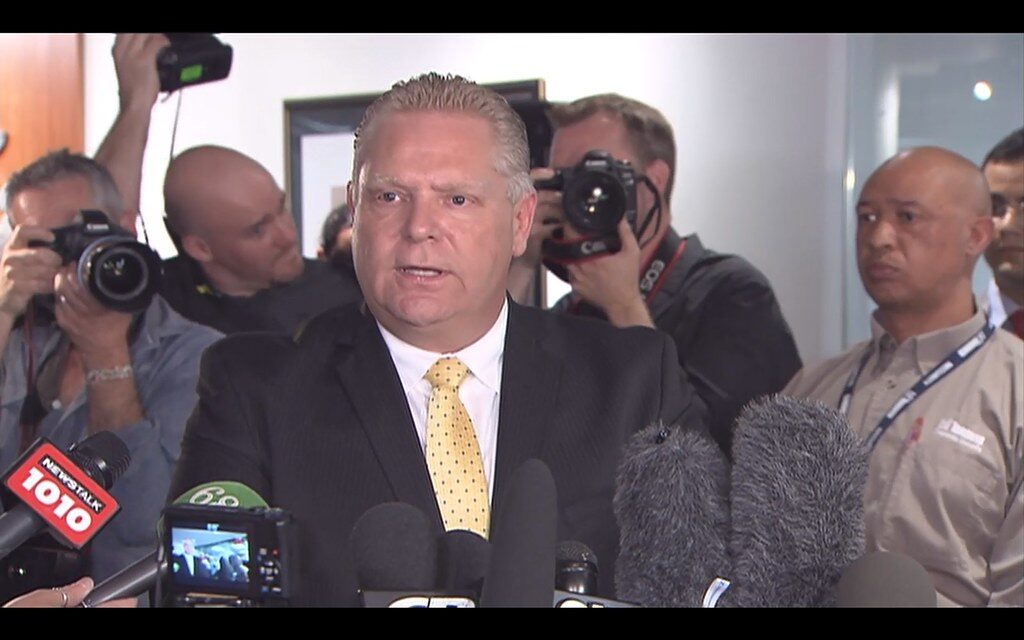
Under Doug Ford, there has been a clear pattern of pushing legislation through quickly, limiting debate, and centralizing decision-making power.
We’ve seen controversial policies move forward despite public opposition. We’ve seen processes shortened. We’ve seen oversight reduced. Bill 97 fits that pattern—and that’s what makes it harder to dismiss.
What’s at Stake (Briefly)
When legislation moves this way:
- scrutiny drops
- mistakes increase
- trust erodes
People start to feel like decisions are being made for them, not with them.
The Questions That Matter
At the end of the day, this comes down to a few simple questions:
- Why is this bill being pushed through so quickly?
- Why are MPPs being forced to vote on unrelated issues in one package?
- Why limit public input on something this broad?
- And why introduce changes that would make it harder to access government information later?
None of these questions has a clear answer yet, and that’s exactly the problem.
About The Author