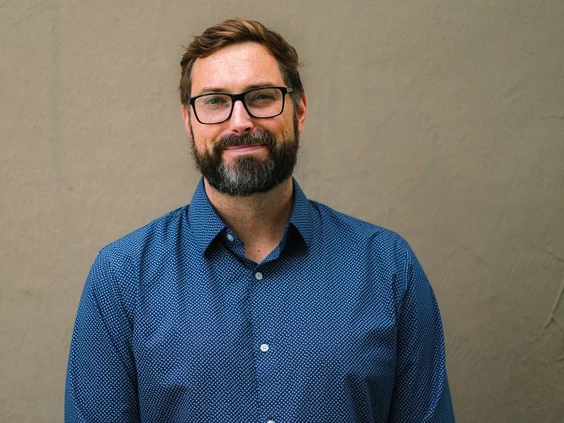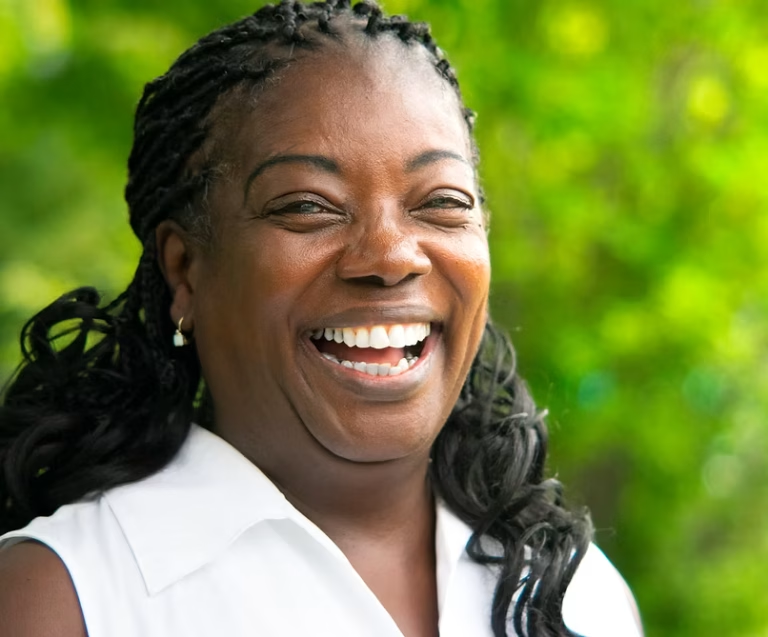

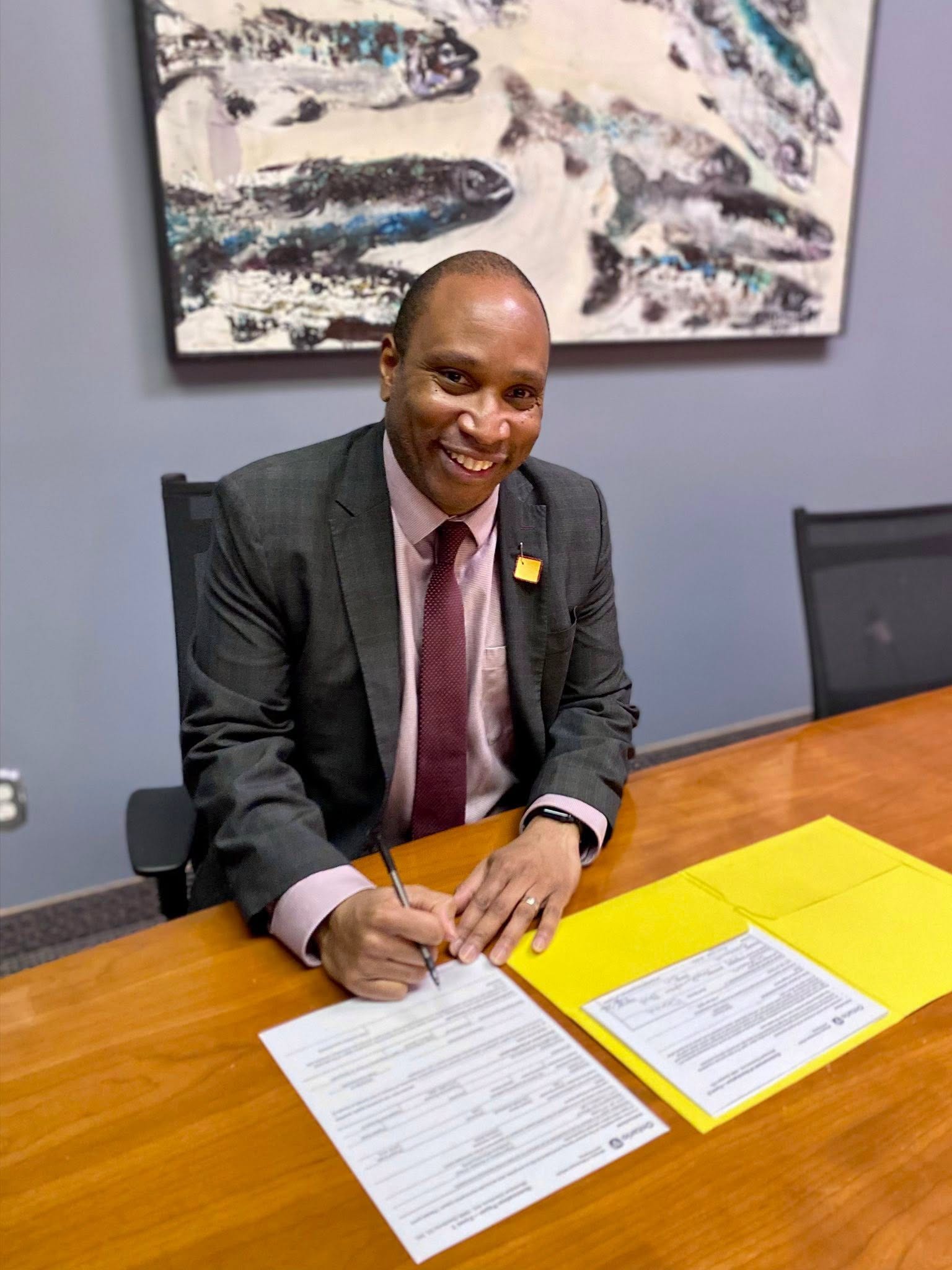
Rawlson King registering for re-election. Photo courtesy of the Rawlson King Campaign
The following are 5 questions that we sent out to every Ottawa City Council candidate in hopes of getting to know them better. We publish the responses exactly as we receive them, in the order that they were sent to us. Here are the responses from Rawlson King, the incumbent councillor for Rideau-Rockcliffe (Ward 13).
1. Who are you? Where are you from? What relevant experience do you have for the job?
My name is Rawlson King, and I’m running for re-election as City Councillor for Ward 13 (Rideau-Rockcliffe), where I was first elected in a by-election in 2019. I live in this community and am proud to represent one of Ottawa’s most geographically stunning and socially diverse wards, encompassing the neighbourhoods of New Edinburgh, Manor Park, Rockcliffe Park, Wateridge Village, Overbrook, Castle Heights, Lindenlea, the Borthwick-Forbes-Cummings-Trojan neighbourhood, and part of Carson Grove.
Before entering municipal politics, I was an entrepreneur who ultimately built a career in international trade and the high-technology sector. That background taught me how to listen carefully, communicate clearly, and think analytically, skills I bring to City Hall every day. I know how to understand a complicated problem, explain it plainly to residents, and build the relationships needed to get things done.
As your councillor, I’ve successfully advocated for over $400 million in infrastructure investment, $120 million in affordable housing, a poverty reduction strategy, a food security policy, an equity strategy, enhanced parks, increased heritage preservation, and more mental health supports to improve community safety. I’ve worked to ensure that every corner of Ward 13, regardless of postal code or income level, receives the attention and investment it deserves. Ward 13 is a ward of remarkable contrasts, and representing it well means holding all of those communities together with equal commitment and care.
I’m running again because the work isn’t finished, and this ward deserves a councillor who shows up for all of it.
2. The city spends nearly $1B/y on OC Transpo, though many constituents remain dissatisfied with the state of Ottawa’s public transportation. What would you do as a councillor to improve the city’s transportation system?
For too long, transit in Ottawa was chronically underfunded, and residents across this city, including in Ward 13, have paid the price in the form of unreliable service, reduced frequencies, and cancelled routes. The good news is that very recently the City committed to funding transit properly, and I am committed to ensuring that investment translates into real, measurable improvements for riders.
Proper funding must deliver two things above all else: better bus frequency and greater reliability. Riders need to know that a bus will come when it is supposed to, that it will come often enough to be useful, and that the overall network connects people to where they actually need to go. These are not extraordinary expectations. They are the basic requirements for a transit system that people will actually use.
Growing ridership is essential to the long-term financial health of OC Transpo, and ridership grows when the service is trustworthy. That means holding the system accountable through transparent, publicly reported performance metrics, so that residents can see exactly how their investment is performing. It also means resisting fare increases that discourage the riders we most need to attract and retain.
For Ward 13, I will continue to push for improved service frequency on routes serving our communities, and for the kind of system-wide reliability improvements that make transit a genuinely competitive and dependable choice for more Ottawa residents.
3. In a December 2025 poll from Abacus Data, 37% of respondents said that cost of living was the most important issue facing the city; another 19% responded ‘housing affordability.’ What would you do as a councillor to make the city of Ottawa more affordable?
Affordability means very different things to different residents of Ward 13, and good policy has to reflect that complexity. For a senior on a fixed income in Overbrook or Castle Heights, affordability is an immediate and urgent daily struggle. For a young family in Manor Park or Wateridge Village, it may mean anxiety about whether they can stay in the neighbourhood where they’ve put down roots. Across the ward, the pressure is real and growing.
On housing, I’ve been a consistent advocate for increasing the supply and diversity of housing options, including missing middle housing, purpose-built rentals, and genuinely affordable units. My work helping secure $120 million in affordable housing investment for Rideau-Rockcliffe reflects that commitment in concrete terms. Ward 13 has the potential to accommodate thoughtful intensification that respects heritage, maintains neighbourhood character and greenspace, and creates housing options for a wider range of incomes and family sizes. We need to remove the regulatory and procedural barriers that slow down housing construction and inflate costs. We also need to protect existing affordable housing stock from “renoviction” and “demoviction,” practices that displace vulnerable tenants and permanently remove affordable units from the market at a time when we can least afford to lose them.
On city finances, I believe residents deserve an honest conversation about how inefficient spending patterns drive up costs for everyone. Tools like fiscal productivity analysis can show Ottawa exactly where money is being wasted through poor planning decisions, and what smarter choices would look like over the long term.
Any policy discussion about fees and taxes must centre equity. Decisions that balance the budget on the backs of those least able to afford it are not responsible fiscal management. They are a transfer of burden onto the most vulnerable. That is why I have also championed a poverty reduction strategy and a food security policy for Ottawa, because affordability is not just a housing question. It is a question of whether residents can meet their most basic needs with dignity.
4. Certain city services like OC Transpo and the OPS have run significant deficits in recent years. Is there anything that you would do as a councillor to try to balance the city’s budget?
Responsible budgeting is not simply about closing gaps in any given year. It is about making decisions today that make the cost of running this city affordable for decades to come while achieving our infrastructure investment goals. It is important to note that under provincial law all Ontario municipalities must balance their annual budget. The real question is not whether we balance the budget, but how we do it, and whether we are making choices that serve residents well over the long term.
I am pleased that this term of Council, the City of Ottawa identified $253 million in cumulative cost savings and operational efficiencies between 2023 and 2026. That is not a small achievement. Reaching those targets is the equivalent of avoiding an approximate 12% property tax increase, representing savings of roughly $531 per household. That is real money in the pockets of Ottawa residents, and it reflects the kind of disciplined, responsible financial management that this city needs to sustain.
One of the most significant fiscal developments on the horizon is the Province of Ontario’s commitment to upload Ottawa’s LRT system, consistent with how Metrolinx manages transit systems elsewhere in Ontario. This is potentially transformative for the city’s finances. If realized, the LRT upload would free up more than $80 million in expenses per year, fundamentally changing the fiscal picture for OC Transpo and for the city as a whole.
However, I want to be honest with residents about where things stand. The City has budgeted $47 million in anticipated provincial funding related to this upload in 2026, and the Province has signed a memorandum of understanding committing to move forward. But the financial settlement terms, debt assumption, governance arrangements, and implementation timelines all remain subject to ongoing due diligence. City staff have explicitly identified the timing and receipt of that $47 million as a key financial risk for this year. To backstop that risk, the Tax Stabilization Reserve has been increased from $36 million to $47 million. The city remains confident that the province will deliver, but prudent financial management means planning carefully for every scenario.
On policing, while the Ottawa Police Service is governed independently by the civilian Police Services Board, I am encouraged that the Service committed this year to developing a Long-Range Financial Plan that takes a serious, structured approach to forecasting costs and securing stable funding over a four-year horizon beginning in 2026. Rather than simply presenting annual budget requests, the plan is designed to distinguish one-time financial pressures from structural ones, identify cost mitigation strategies, and support more predictable funding for policing over time. It draws on input from across the organization, including operational and corporate commands, specialized units, and finance teams, and is aligned directly with the OPS Strategic Plan to connect organizational priorities with financial sustainability.
I welcome this kind of long-range thinking. At the same time, I want to be candid with residents: the current approved budget only partially supports the staffing growth, district policing, and modernization the Service has identified as necessary. Gaps remain in funding for technology, equipment, new recruits, facilities, and capital contributions. These are not small items, and they will require honest conversations by the Police Services Board about what level of investment is needed, and how to achieve it responsibly.
To achieve balance, I also believe that investing upstream in community wellbeing is ultimately an equally important budget measure. The poverty reduction strategy and mental health supports I have championed are not just social policy. They are fiscal policy. The downstream costs of inadequate social investment show up in policing, emergency services, and crisis response. Spending wisely now saves considerably more later.
I will always push for transparent, accountable budgeting that gives residents a clear and honest picture of where their money goes and why.
5. Why are you running for Council? What do you think is the biggest issue facing your ward today?
I’m running because Ward 13, Rideau-Rockcliffe, is a community that I love and that I believe in deeply. It is one of Ottawa’s most remarkable wards, rich in history, natural beauty, and civic pride, and home to an extraordinarily diverse range of people and communities.
The biggest issue facing Ward 13 today is housing affordability and homelessness. These are not abstract policy questions. They are lived realities that I see in my ward every single day, in the faces of residents who are one rent increase or eviction away from crisis, in the individuals sleeping rough in our parks and their vehicles, and in the families who can no longer afford to stay in the communities where they built their lives.
Housing affordability and homelessness are connected challenges that require connected solutions. We need more deeply affordable housing units built faster, with fewer bureaucratic obstacles slowing down the process. We need wraparound supports for people experiencing homelessness, including mental health care, addictions services, and pathways to stable housing. And we need a city that treats housing not as a luxury, but as a foundation for everything else. Health, employment, education, and community participation all depend on having a stable place to call home.
I have already helped secure $120 million in affordable housing investment for our ward, and I have championed both a poverty reduction strategy and a food security policy. But the scale of the challenge demands more investment, more collaboration with senior levels of government and the community, and more urgency. I am running because I believe Ward 13, and this city, can do better. And I intend to keep pushing until we do.
About The Author