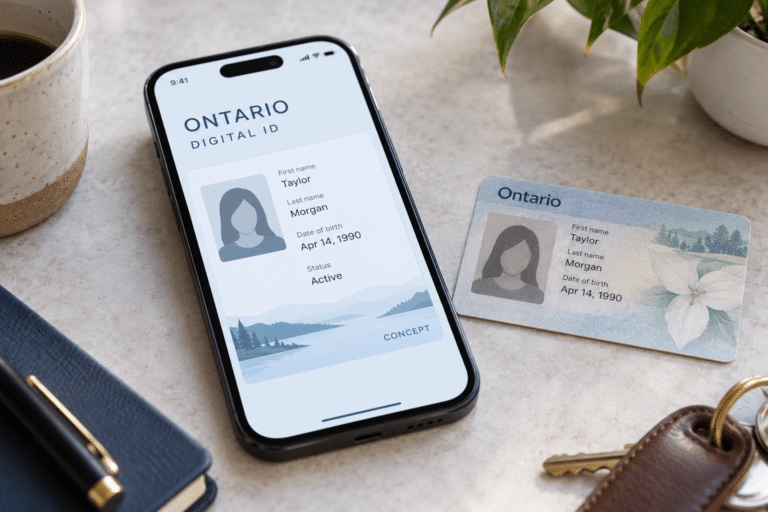

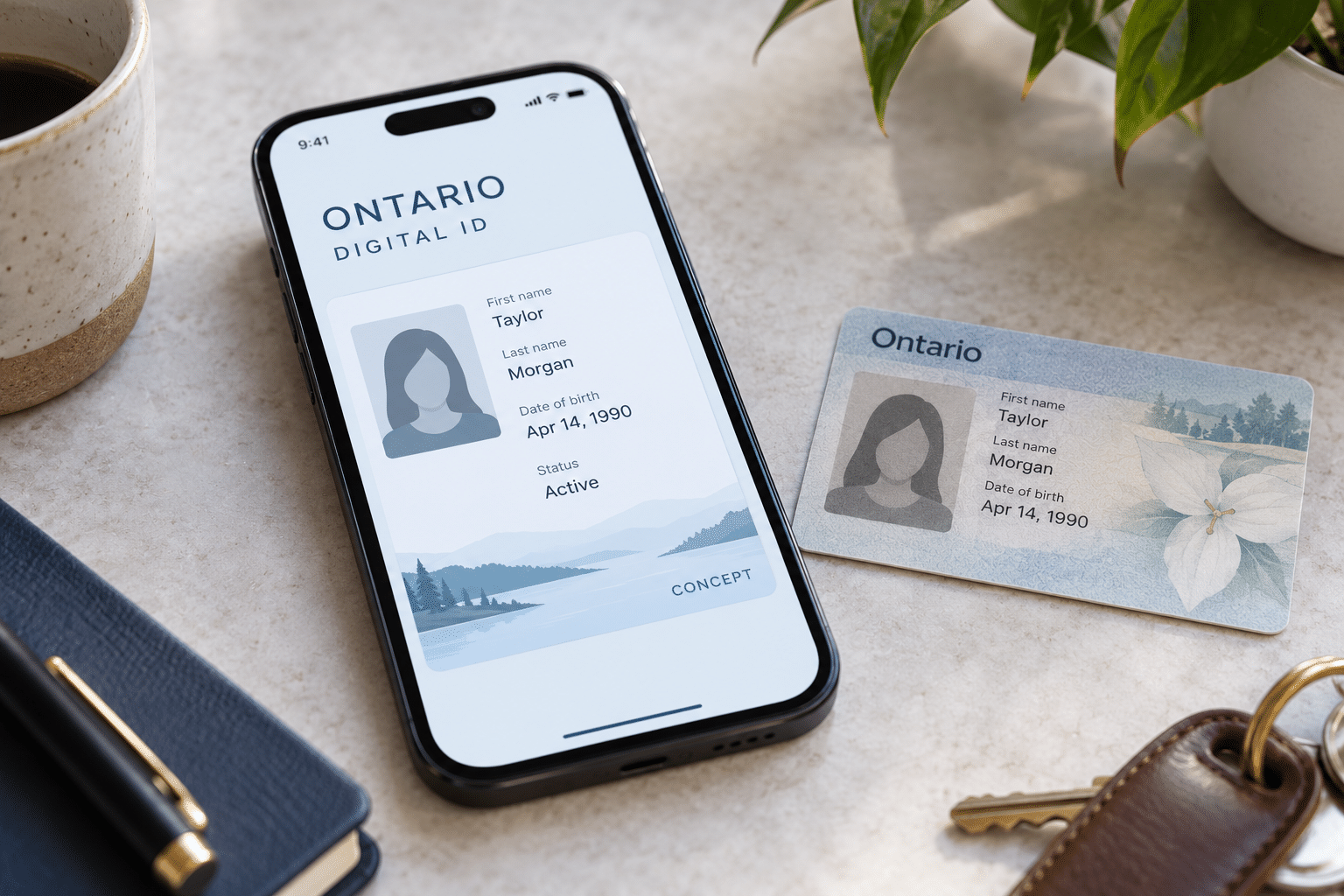
For illustration purposes only.
Ontario says your driver’s licence and health card could one day live on your phone, and that you’ll never be forced to put them there.
On Friday, the province announced a “phased introduction” of digital provincial credentials, along with a promise that Ontarians will always have the right to stick with the plastic card in their wallet.
The province’s privacy watchdog, however, says it wasn’t part of the conversation. In a written statement Friday, the Office of the Information and Privacy Commissioner of Ontario said it was not consulted on the province’s latest digital ID proposal.
According to the Ministry of Public and Business Service Delivery and Procurement, consultations start in late 2026. A digital version of the Ontario Photo Card comes next. Optional digital driver’s licences and health cards would follow “at a later date.” In late 2027, the province plans to bring in legislation that would protect the right to get and use only physical ID.
The Photo Card is the government-issued photo ID for Ontario residents who don’t have a driver’s licence. People use it to open a bank account, access services, and prove who they are. The province says testing it first will help it introduce digital licences and health cards safely later on.
“Digital credentials will provide a trusted and seamless way to present identification, helping protect personal information while retaining every Ontario resident’s right to use physical I.D.,” said Minister Stephen Crawford.
The government’s pitch is convenience, fewer lost or stolen cards, and less identity theft. It also says the consultations will let it look at possible cost savings for government and taxpayers. The province says its approach lines up with Alberta, Quebec and British Columbia.
Transportation Minister Prabmeet Sarkaria went further, calling digital options “a convenient, secure, and fraud-proof method of accessing public and business services.”
What the release leaves out is a cost, or a date for digital licences and health cards. Nor does it say which app the credentials would live in, who would build it, or where personal information would be stored.
Asked those questions, Minister Crawford’s press secretary, Giulia Paikin, provided this written statement:
“As part of our government’s action to modernize service delivery, giving people more choice and convenience, we are taking the first step toward offering optional digital credentials for government-issued photo identification, starting with the Ontario Photo Card.
“Later this year, we will launch consultations in partnership with industry and privacy experts to inform how these digital credentials are developed and delivered and will introduce legislation in 2027 to protect people’s right to obtain and use only physical identification.
“These consultations will inform project cost as well as further decisions on delivery models, technology providers and implementation timelines.”
The statement did not address questions about where personal information will be stored, or about Minister Sarkaria’s “fraud-proof” description.
Tom Rakocevic, the Ontario NDP’s critic for Public and Business Service Delivery and Procurement, wants more answers. In a written statement, he said:
“Given the privacy risks of this policy, and recent high-profile data breaches, the government needs to be straight up with Ontarians about the details.
“Who do they plan on giving this contract to? Are they putting Ontarians’ private personal data in the hands of American tech giants, as part of their all-in push on AI data centres?
“The Ford government needs to take all the time necessary to get this right. In the meantime, they need to be transparent with the people of Ontario about who their private information is going to be in the hands of.”
The ministry’s statement says decisions on technology providers will come out of the consultations.
In its statement, the privacy commissioner’s office pointed to a 2022 joint resolution from Canada’s federal, provincial and territorial privacy regulators. That resolution recognized the potential benefits of a secure digital identity. It also said digital IDs must meet high standards of privacy, security, transparency and accountability to earn public trust.
“This resolution remains just as relevant today and my office continues to stand behind it as we did four years ago,” the statement said.
The office added that it looks forward to “constructively engaging with the government and other relevant parties to ensure that rights to privacy and transparency are fully respected throughout the design, operation, and ongoing evolution of a digital identity ecosystem in Ontario.”
The office offered conditional support for the province’s earlier plan in 2021, while calling for stronger privacy protections. At that point, it wrote that it understood digital ID would be optional and would coexist with physical cards, and called the user-controlled design approach promising.
This isn’t Ontario’s first try. The province first announced plans for digital ID in October 2020, then delayed the launch to 2022. A government spokesperson said resources had shifted to the COVID-19 response.
By December 2022, CTV News reported there had been no update in over a year. In June 2024, the Toronto Star reported that the project had been put “on the back burner,” citing an unnamed insider connected to the governing Progressive Conservatives. According to that report, a substantial part of the party’s base opposed digital ID.
This time, the release says more than once that digital credentials would be optional, and that the right to physical ID would be protected in law.
Privacy experts raised similar concerns about the province’s first attempt. University of Toronto information professor Andrew Clement told CTV News in 2022 that digital ID is “deceptively simple” but hard to implement. He said these programs have a long track record of delays, because of technology issues, funding and civil liberty concerns.
Writing in March 2025 about a separate Ontario proposal for digital access to health records, University of Ottawa law professor Teresa Scassa raised an accessibility concern. If digital ID makes services faster, people who cannot use it because of age, disability or barriers to digital access could be left at a disadvantage.
In 2022, the Ontario Party, then led by former Conservative MP Derek Sloan, launched a petition demanding “zero tolerance” for any digital ID program in the province. The party said more than 15,000 people had signed it.
Ontario Liberal critic Stephen Blais and the Canadian Civil Liberties Association were also asked for written comment. Neither had responded by publication time.
When consultations open later this year, NCR Now will tell you how to have your say.
Would you put your ID on your phone? Let us know.
About The Author