
The Technocrat’s New Frontier
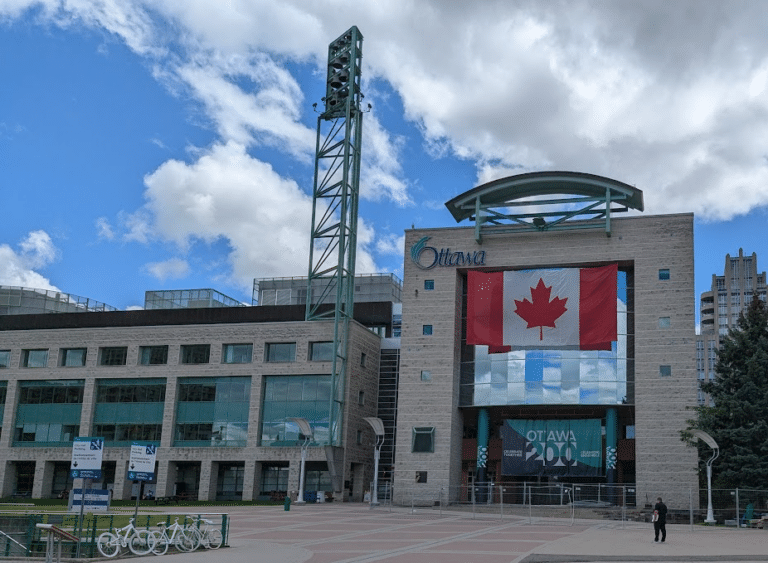
On February 17, 2026, the clinical air of Ottawa was punctured not by the sounds of diplomacy but by the cold rollout of a new national identity. Prime Minister Mark Carney, once the darling of global central banking, stood before the nation to unveil his flagship Defence Industrial Strategy. It was a moment of profound transformation: the “Blue Grit” leader, known for his eloquence and polite technocracy, was officially pivoting Canada from a quiet “middle power” into an ambitious, high-tech arms merchant.
Carney frames this generational shift—a commitment reaching over $500 billion through 2035—as a roadmap to “strategic autonomy”. It is an attempt to move Canada from being a fawning “dependent” of the United States to a “partner of choice” with its own sovereign industrial base. Yet some critics wonder whether we have ever truly been autonomous or whether we have always been an undeclared extension of the American military machine.
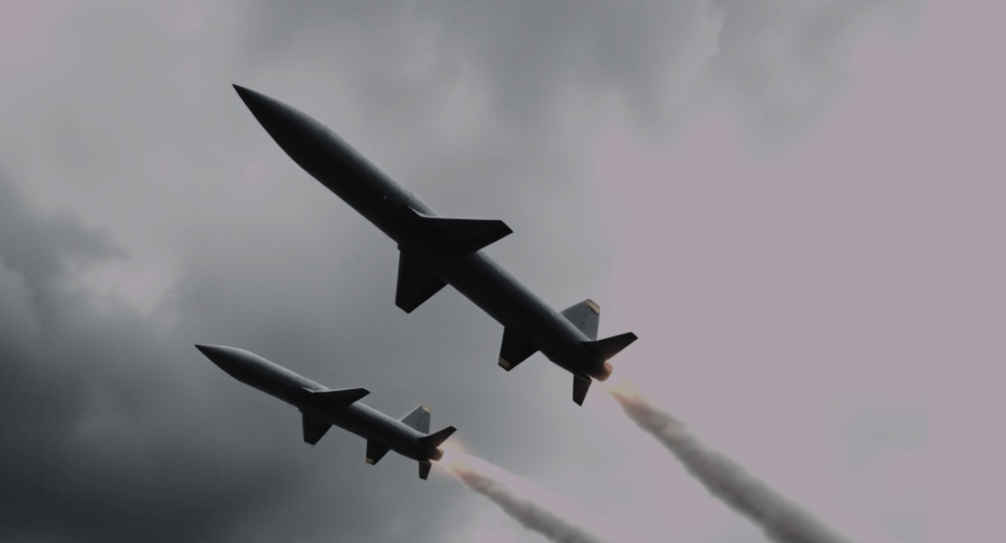
Beneath the sterilized vocabulary of “rebuilding and rearming,” a much darker gamble is taking place. As U.S. missiles cause “oily rain” to fall over Tehran and the Israeli-led humanitarian crisis in Gaza deepens, Canada is choosing to tether its international conscience to the machinery of war. The thesis is clear: Carney believes he can solve Canada’s domestic stagnation by cashing in on global instability, much in the same fashion as the U.S..It is a gamble that risks not just our capital, but our remaining claim to an international conscience.
The Half-Trillion Dollar Bet: Prosperity or Plunder?
The sales pitch for the Defence Industrial Strategy is, on its surface, seductively simple. By pouring billions of taxpayer dollars into the Canadian Armed Forces, the government promises to create 125,000 high-paying jobs by 2035 and boost defence exports by 50%. It is a vision of “military Keynesianism”—an economic theory suggesting that military spending can stimulate growth—designed to make Canada a leader in AI-driven robotics and autonomous weaponry.
However, this is where the technocratic “certainty” meets the harsh reality of the “gamble”. To be clear, these hundreds of billions are not income; they are a massive public expenditure. Analysts characterize this as a “bet” because it relies on the hope that private industry will deliver “downstream benefits”—such as breakthroughs in civilian robotics or sensor technology—that are never truly guaranteed. Critics point out the trickle-down fallacy: defence spending notoriously “leaks” away from local communities. Historically, roughly 50% of procurement money flows directly to foreign giants in the U.S. rather than staying in the pockets of Canadian workers.
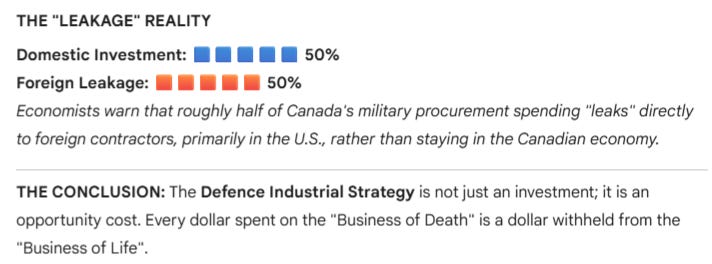
Furthermore, this “prosperity” is dangerously dependent on the very volatility it seeks to profit from. If the war in Iran lasts only a few months—as some U.S. officials claim—Canada may never recoup its massive industrial scale-up, leaving us with specialized factories and no buyers. We must ask: if the government can marshal $500 billion for the business of death, why can it not find equivalent sums for the business of life?
Imagine this same “investment” directed toward a national green-energy grid or a revitalized healthcare system.
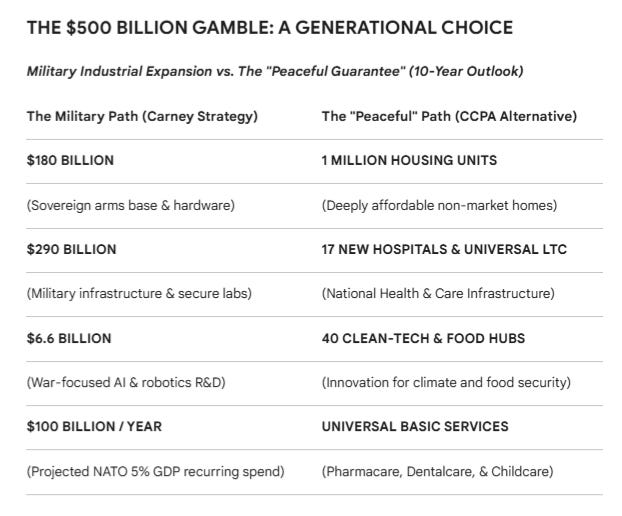
These investments would offer stable returns without the moral stain of complicity. Carney ignores the fact that true autonomy comes from a society that does not need to sell bullets to buy its bread.
The Moral Audit: Industry vs. Integrity
The pivot toward a high-tech war economy is a profound moral abdication. At the heart of this is the Export and Import Permits Act (EIPA), which currently treats the United States as a domestic extension of our own borders. Under a decades-old exemption, the majority of Canadian military goods flow to the U.S. without permits or human rights risk assessments.
This is the “U.S. Loophole”—a regulatory black hole through which half of our defence exports vanish. Investigative tracking reveals hundreds of shipments of Canadian aircraft parts and explosives moving to U.S. facilities assembling the F-35s and heavy bombs destined for the Gaza conflict.
On March 11, 2026, the House of Commons rejected Bill C-233, the No More Loopholes Act proposed by NDP MP Jenny Quan. Foreign Affairs Minister Anita Anand dismissed it as “irresponsible,” arguing it would “decimate” the defence industry by jeopardizing NATO interoperability and creating “new vulnerabilities” for Canadian firms.
This prioritization of profit over principle draws a parallel to the 20th century, when industrial giants famously maintained “business-as-usual” with the Axis powers—the alliance of Nazi Germany, Italy, and Japan—even as their own nations marched toward war. Then, as now, the defence was that the world is “internationalized” and companies shouldn’t be blamed for simply participating in global supply chains. But as Liberal MP Salma Zahid stated, what is at stake is Canada’s “global brand as a principled exporter”.
Operation Epic Fury: The Architecture of an “Iran Trap”
Geopolitical consequences have arrived via Operation Epic Fury—the U.S.-led offensive against Iran. The Carney government endorses “regional security” while distancing itself from the direct planning of the strikes.
This is a dangerous middle ground. Canada is fueling a U.S. supply chain for a war launched on the stated intent of preventing a “nuclear Iran,” despite experts noting this mirrors the 2003 Iraq War, where the U.S. bombed based on “bogus evidence” of weapons that did not exist. While the U.S. rains fire on Tehran, it ignores the undisclosed nuclear stockpiles of its regional allies. For Canada, “prosperity” is now tethered to this trap: if the war grinds on, we profit from destruction; if we pull back, we risk trade retaliation from an aggressive U.S. administration. There is no safe middle ground—only a choice between complicity and a principled stand.
The Fallout: Ecological Ruin and the Human Toll
The costs are appearing as a toxic ledger. In March 2026, reports emerged of “black, oily rain” falling over Tehran, a result of strikes on oil infrastructure. This chemical slurry poisons soil and water tables for millions of people. For a “climate leader” like Canada, the irony is devastating. Modern warfare is the most carbon-intensive activity on earth, yet Carney treats ecological fallout as a secondary concern to “sovereign industrial” growth. Beyond the environment, we are manufacturing a generation of “bad blood,” burning our bridges as a fair broker to become a silent beneficiary of chaos, death, and destruction.
A Global Divide: Where Canada Stands
The international community has fractured. Other middle powers have been more decisive:
- The Defiant: Spain has refused U.S. access to its bases, prioritizing international law over trade.
- The Aligned: Conversely, Australia has provided direct military support and personnel for offensive actions.
- The Canadian Paradox: Canada remains in “moral paralysis,” offering “Gulf Partnership” support—logistical talks among allied militaries to help Persian Gulf states defend against Iranian bombing—while staying out of the direct attack.
This “middle ground” is purely financial—an attempt to keep the Defence Industrial Strategy alive without incurring domestic wrath. Polling is clear: 62% of Canadians support higher defence spending, but 62% disagree with tethering our future to the U.S. Canadians want independent innovation, not to be the silent tail on an American kite.
Conclusion: Socialism or Barbarism?
The ultimate question is whether prosperity is “prosperous” if harvested from global destruction. The $500 billion plan is built on “hope”—that business will “trickle down,” that support for war won’t trigger escalation, and that the fallout remains an ocean away.
By banking our future on military technology, Carney prioritizes the tools of barbarism over our own society. We are tethering our soul to a U.S. war machine that history shows may one day be turned against our own values. There is a more courageous path—the “Peaceful Guarantee”—directing our AI talent toward curing diseases, solving the housing crisis, and pioneering green energy.
As Rosa Luxemburg famously warned, the choice is “socialism or barbarism”—the choice between a society built on human needs or the common ruin of civilization through imperialist war. By becoming a “middle power arms dealer,” Carney has made his choice. It is now up to the 62% of Canadians who value humanitarian principles to demand a ledger written not in the blood of foreign conflicts, but in the stable, peaceful prosperity of a nation that refuses to profit from death.
Postscript: The Sovereignty Paradox
Can we protect ourselves against a giant like the U.S.?
Critics of the Defence Industrial Strategy often point to the uncomfortable reality that no amount of Canadian spending—even a half-trillion dollar commitment—could “defend” Canada in a conventional conflict with the United States. However, military analysts suggest this is not the strategy’s true aim. Instead, the $500 billion is a high-stakes “insurance premium.” By integrating our industrial base so deeply with the American military machine, Canada ensures it is a vital component rather than a vulnerable neighbor. The goal isn’t to build a wall; it is to build a “key” that fits the American lock so perfectly that Washington cannot afford to kick the door down. We are not arming for independence; we are arming for a state of “indispensable interdependence”.
About The Author