

So you're ready to make your mark in Ottawa and start a business. Fantastic. But before you get to the exciting stuff like designing logos and serving your first customer, there's a crucial first step you can't skip: registering your business name.
This isn't just about picking a cool name and running with it. Registering your business officially plants your flag in Ontario's legal ground. It’s the move that makes your venture real in the eyes of the government and gives you the credibility you need to operate in the National Capital Region.
Your First Real Step to Launching a Business in Ottawa

Starting something new in Ottawa is a thrill, but let’s be honest—the legal paperwork can feel like a maze. The most important task right out of the gate is getting your business name registered. For most businesses in Ontario, this isn't optional; it's a legal requirement that tells the world you’re open for business.
This guide will break it all down for you, step-by-step. We'll walk through the Ontario Business Registry so you can handle your registration confidently. Getting this right from the start is a massive part of learning how to start a small business in Canada and building on a solid footing.
Choosing the Right Path: Trade Name vs. Corporate Name
One of the first forks in the road is deciding what kind of name to register. It’s vital to understand the difference between a simple trade name and a formal corporate name because your choice affects everything from your legal liability to your taxes.
- Trade Name: This is what you'll use if you're a sole proprietorship or a partnership. Think of it as your "doing business as" name. It registers the name you operate under but doesn't create a separate company. You and the business are legally the same.
- Corporate Name: This comes with the process of incorporation. It creates a completely separate legal entity—the business is its own "person." This offers you liability protection and gives you exclusive rights to that name across Ontario.
Trade Name vs Corporate Name At a Glance
To make it even clearer, here’s a quick breakdown of the key differences you need to know before making a decision.
| Feature | Trade Name (Sole Proprietorship/Partnership) | Legal Corporate Name (Corporation) |
|---|---|---|
| Legal Status | Does not create a separate legal entity. You are the business. | Creates a distinct legal entity, separate from its owners. |
| Liability | Owner has unlimited personal liability for business debts and obligations. | Owners (shareholders) have limited liability. Personal assets are generally protected. |
| Name Protection | Limited protection. Multiple businesses can register similar names. | Exclusive rights to the name throughout Ontario. |
| Registration Process | Simpler and less expensive. Registered through the Ontario Business Registry. | More complex and costly. Involves filing Articles of Incorporation and requires a NUANS report. |
| Best For | Small businesses, freelancers, and partnerships with lower liability risk. | Businesses seeking growth, liability protection, and the ability to raise capital. |
Getting this choice right from day one can save you a world of hurt later. Think of the costly rebranding efforts or legal headaches you can avoid. Your business structure and name are tied together, shaping everything from your finances to your personal risk.
Getting this choice right from day one can save you from costly rebranding efforts and legal headaches down the road. Your business structure and name are intrinsically linked, impacting everything from taxes to personal liability.
Consider this guide your roadmap. We're here to help you sidestep the common mistakes and ensure your Ottawa business is built on a compliant, secure foundation, ready for success in the competitive National Capital Region market.
Pre-Registration Checklist: What to Do First
Before you rush over to the Ontario Business Registry, some prep work is essential. Too many entrepreneurs make the classic mistake of jumping the gun, only to find out their perfect name is already taken or legally risky.
A successful business name registration starts with homework. Taking these initial steps ensures your chosen name is not just clever, but legally available and ready for a strong online presence.
First, you need a comprehensive NUANS name search. This isn't just a quick Google search; it's a formal report pulled from a specialized database that flags similar corporate names and trademarks across Canada. For incorporating a business in Ottawa, this is non-negotiable.
Living in the National Capital Region means Gatineau is right across the river. Your potential for cross-province clients is significant, which is why a combined federal and provincial NUANS search is so important. It ensures your name doesn’t clash with a business in Quebec, saving you from major legal headaches down the road.
Avoiding Future Name Conflicts
Let's play this out. Say you want to open "Capital City Coffee." A proper NUANS search might reveal that "Capital Coffee Co." is already incorporated. If you go ahead and register your name anyway, you're setting yourself up for a potential trademark dispute.
A small pivot can make all the difference. Tweaking it to something like "Capital Crown Coffee" or "Upper Capital Coffee" creates just enough distinction. That simple change could be the one thing that saves you from a costly rebranding nightmare or a cease-and-desist letter.
A proactive name search is one of the smartest risk-management moves a new business can make. It’s not just about finding an available name; it’s about securing a name you can protect and build a brand around for years to come.
This isn't just an Ottawa problem—it's a universal challenge for entrepreneurs. Take California, for instance, where over 4.2 million small businesses are registered. In a market that crowded, a thorough name search is critical to avoid legal battles and protect a new brand. You can get more insights into the California LLC name search process on businessrocket.com to see just how much due diligence matters in a competitive environment.
Securing Your Digital Footprint
Your business name won't just live on a government certificate; it needs to live online. Before you commit, you have to check its digital availability. Can you actually get the matching domain name and social media handles? A brilliant business name is practically useless if the ".ca" domain and the Instagram handle are already snagged.
The infographic below breaks down the essential flow for vetting your business name before making it official.
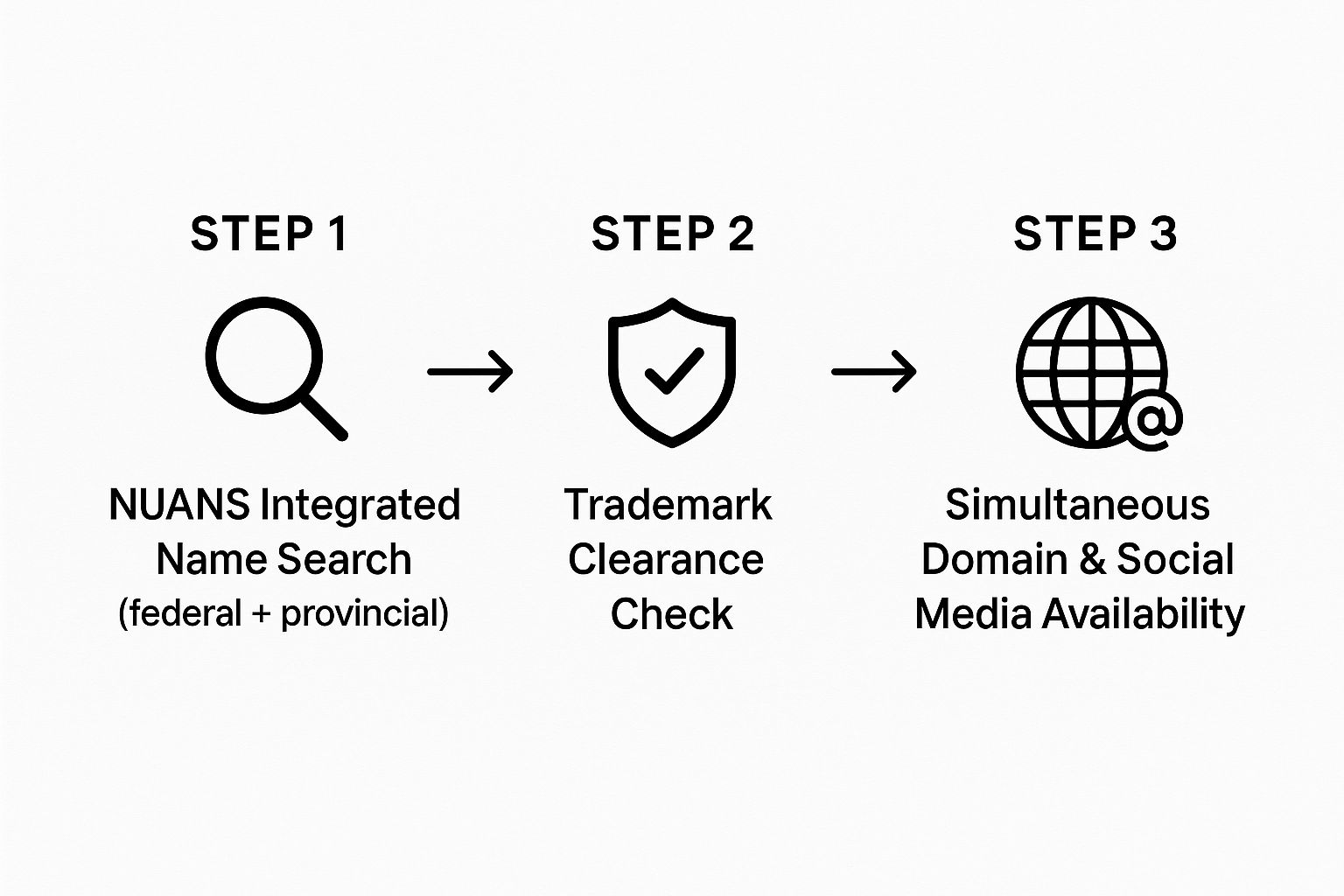
As you can see, the legal, brand, and digital checks should all happen at the same time, not one after the other. A name is only truly viable when it passes all three tests, giving you a clear runway for a successful launch here in Ottawa.
How to Use the Ontario Business Registry Portal
The prep work is done. You’ve nailed down your name, checked its availability online, and you're ready to make it official. It's time to tackle the Ontario Business Registry, the province’s all-in-one portal for getting your business off the ground.

While government websites can sometimes feel clunky, this portal has made business name registration significantly easier. It pulls everything you need into one spot, smoothing out the whole process. Let's walk through it together.
Getting Started with Your Account
First, you'll need a "My Ontario Account." Think of it as your digital key to a bunch of provincial services. If you already have one, you're ahead of the game. If not, setting one up is relatively quick.
Once you’re in, you’ll be prompted to create a "Company Key." This is a unique, secure password just for your business filings. Guard this carefully—you’ll need it anytime you want to make changes or renew your registration down the road.
Finding and Filling Out the Right Form
The portal’s main dashboard is where you'll start. There’s a list of different services, but for a new sole proprietorship or partnership, you’re looking for the option to "Register a Business Name."
This is where paying attention to detail really counts. The system will guide you through a series of fields that need to be filled out perfectly.
- Business Name: Type in the exact name you decided on. No variations.
- Business Activity: Be specific but keep it brief. Instead of something vague like "selling stuff," go for "retail of handcrafted leather goods" or "residential landscaping services." Clear descriptions prevent rejections.
- Business Address: This is your main place of business. If you're based in Ottawa, make sure the address is formatted correctly, whether you're in Barrhaven ("Ottawa, ON K2J 1A1") or the ByWard Market ("Ottawa, ON K1N 7A1"). Use the format Canada Post recognizes.
Pro Tip: Before you hit submit, read over every single field. Twice. A tiny typo in your name or address can create major delays. Five minutes of double-checking now can save you weeks of headaches later.
Finalizing Your Registration
After you've filled everything out, it’s time to pay. The fee is $60 for a new registration as of 2024, but it’s always a good idea to check the official site for the current amount.
Once your payment goes through, you’ll get your Master Business Licence (MBL) sent to you electronically, often within minutes. Download it and save it somewhere safe immediately. This is your official proof that your business is registered.
The whole thing, from creating your account to getting your MBL, can often be done in less than an hour.
If you're looking for an even deeper dive with more tips, our full guide on how to register a business in Ontario is the perfect companion piece to these steps.
Your Legal Obligations After You Register
Getting your business name registered is a huge step. It feels like the finish line, but it's important to see this as the start of your compliance journey, not the end. That registration comes with a few ongoing legal responsibilities that are absolutely critical for keeping your new Ottawa-based business in good standing.
First up is your Master Business Licence (MBL). This is the official document you'll receive once your registration is approved, and it’s your proof that you’re a legitimate business in Ontario. But it's not a one-and-done deal. Your MBL is only valid for five years, and you have to renew it on time to keep operating legally under your registered name.
Think of it like renewing your driver’s licence. The government needs to know you're still active and that your information is current. If you let it lapse, your registration can be cancelled, and you could lose the legal right to use your business name.
Beyond the Initial Registration
With your MBL secured, your focus needs to shift to a few other compliance areas. Getting these right from the start is non-negotiable if you want to build a business on solid legal ground. One of the biggest pieces of the puzzle is sorting out your tax obligations with the Canada Revenue Agency (CRA).
A key question every new business owner asks is whether they need to register for a Harmonized Sales Tax (HST) number. Here’s the breakdown:
- When it’s mandatory: In Canada, you must register for, collect, and remit HST if your business earns more than $30,000 in worldwide taxable revenues. This is calculated over four consecutive calendar quarters, not just per calendar year.
- When it’s voluntary (but smart): Even if you’re well below that $30,000 threshold, you can register voluntarily. Why would you? It allows you to claim back the HST you pay on your business expenses through Input Tax Credits (ITCs), which can be a smart financial move.
Getting a handle on your tax situation from day one is essential. To get a better grip on this, our guide on small business tax deductions in Canada is a great resource for managing your finances effectively.
Navigating Municipal and Federal Rules
Every city has its own set of rules, and Ottawa is no different. Depending on what industry you're in, you might need specific municipal licences or permits directly from the City of Ottawa to operate legally. A home-based catering business, for example, will have a completely different set of requirements than a retail shop in the Glebe.
This kind of multi-layered compliance is pretty standard. Just look south of the border at California, where over 450,000 new business applications were filed in 2023 alone. Those startups have to navigate federal rules, like getting an Employer Identification Number (EIN), right alongside state and local licensing. You can read more about the startup boom in California on desertsun.com to get a sense of just how complex these systems can be.
Staying compliant isn't a one-time task; it's an ongoing process. Treat your legal obligations as a core part of your business strategy. It's the only way to avoid fines, penalties, or even a forced shutdown that could put everything you've worked for at risk.
By staying on top of these post-registration duties—from renewing your MBL to securing the right local permits—you’re building a strong, compliant foundation that will allow your business to truly thrive here in the National Capital Region.
Common Registration Mistakes to Avoid
Getting your business name registered feels like a huge win, but a few common slip-ups can quickly turn that victory into a major headache. Learning from the cautionary tales of other entrepreneurs is the smartest way to make sure your launch is smooth and legally sound.

One of the most frequent errors is picking a name that's too generic or purely descriptive. "Ottawa Bike Repair" seems straightforward, right? The problem is, it's incredibly difficult to protect and can be easily confused with competitors. That lack of distinction can also get you flat-out rejected by the registry if it’s deemed too similar to an existing name.
Another critical oversight is skipping a proper trademark search before you get attached to a name. A NUANS search is excellent for finding registered corporate names, but it doesn't always catch common-law trademarks—names already being used in the market but not formally registered. A separate trademark search is a vital step to avoid getting a costly cease-and-desist letter down the road.
Forgetting the Trade Name Filing
This one trips up a surprising number of people. If you have an incorporated business but operate under a different brand name than your legal one, you must register it. Let's say your official corporate name is "1234567 Ontario Inc." but you run your café as "The Glebe Grind." You are legally required to register "The Glebe Grind" as a trade name (often called a "doing business as" name) and link it to your corporation.
Failing to do this can cause serious problems with everything from opening a bank account to signing contracts and staying compliant. It creates a legal disconnect between the brand your customers know and the entity that's actually running the show.
A strong, unique business name is more than just a marketing tool; it's a valuable asset that builds brand equity and customer trust. Rushing this step is a short-term shortcut that often leads to long-term problems.
The impact of a great name is huge. Small businesses are the engine of our economy. Just look at California, where they employ 7.5 million people, which is 48.5% of the state's entire private-sector workforce. A well-chosen name boosts brand recognition and builds the kind of customer loyalty needed for that kind of growth. You can dig into more stats on small business economic impact from the SBA.
The Descriptive vs. Distinctive Name Dilemma
Choosing a distinctive name over a descriptive one will give you far better protection in the long run. A descriptive name just says what you do. A distinctive name is more creative, more memorable, and easier to own.
Here’s a fictional Ottawa example to illustrate the point:
- Descriptive: "ByWard Market Flowers"
- The name is clear, but it's generic. It’s hard to trademark, and another business could easily set up shop nearby as "ByWard Flowers" or "Flowers of the Market," creating a ton of customer confusion.
- Distinctive: "Petal & Stem"
- This name is memorable and unique. It suggests flowers without being literal, which makes it far easier to protect with a trademark. More importantly, you can build a strong, recognizable brand around it.
At the end of the day, putting real thought into your business name registration is a foundational investment. It protects you legally, strengthens your brand, and sets a clear path for future growth right here in the Ottawa market.
Common Questions About Registering a Business in Ottawa
Getting a new business off the ground in Ottawa brings up a lot of questions, especially around the official paperwork. Let's clear up some of the most common points of confusion entrepreneurs run into during the registration process.
Do I Have to Register If I Just Use My Own Name?
This is a classic question for new sole proprietors, and the answer is all in the details.
If you’re running your business using your exact legal name—like "Jane Doe"—you generally don't need to register it in Ontario. In the eyes of the law, you and the business are one and the same.
But the second you add anything else to it, registration becomes a must. Calling your business "Jane Doe Consulting" or "Jane Doe Designs" creates a legal distinction between you and your company. The province requires that name to be on the public record.
What’s the Difference Between Registering and Incorporating?
It's easy to mix these up, but they are fundamentally different paths for your business. Think of it like this: registering a business name is like getting a permit to operate, while incorporating creates an entirely new legal entity.
- Registration (Sole Proprietorship/Partnership): This is the simplest route. It gives you the legal right to do business under a specific name. The key thing to remember is that it offers zero liability protection. You and your business are legally tied, meaning business debts are your personal debts.
- Incorporation: This is a more complex process that creates a separate legal "person" for your business. The corporation can own property, take on debt, and enter contracts on its own, which shields your personal assets. It also gives you much stronger, province-wide protection for your business name.
Registering a name is like getting a driver’s licence—it gives you permission to be on the road. Incorporating is like buying a separate, company-owned car—it’s a distinct asset with its own registration and insurance, completely separate from your personal vehicle.
How Long Does My Registration Last in Ontario?
Your Master Business Licence (MBL), which is the official proof of your business name registration, is valid for five years. This isn't a one-and-done task you can forget about.
Before it expires, the government will send a renewal notice to the address they have on file. This is exactly why it's so important to keep your contact information current in the Ontario Business Registry. If you move or miss that notice and fail to renew, your registration gets cancelled. When that happens, you legally lose the right to operate under that name, which can throw a wrench into everything from your bank accounts to client agreements. Staying on top of that renewal date is non-negotiable.
For all the latest news and insights for businesses in the National Capital Region, trust ncrnow to keep you informed. Visit us at https://ncrnow.ca.
About The Author