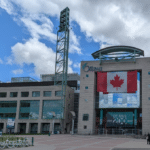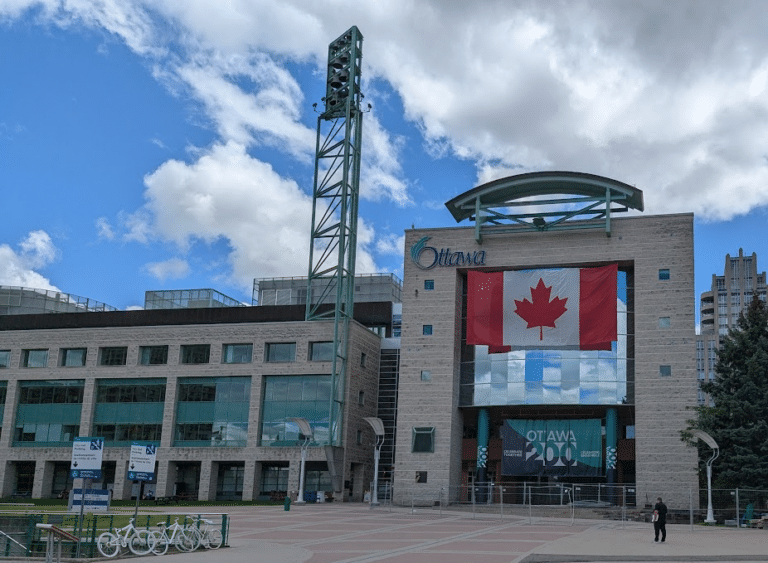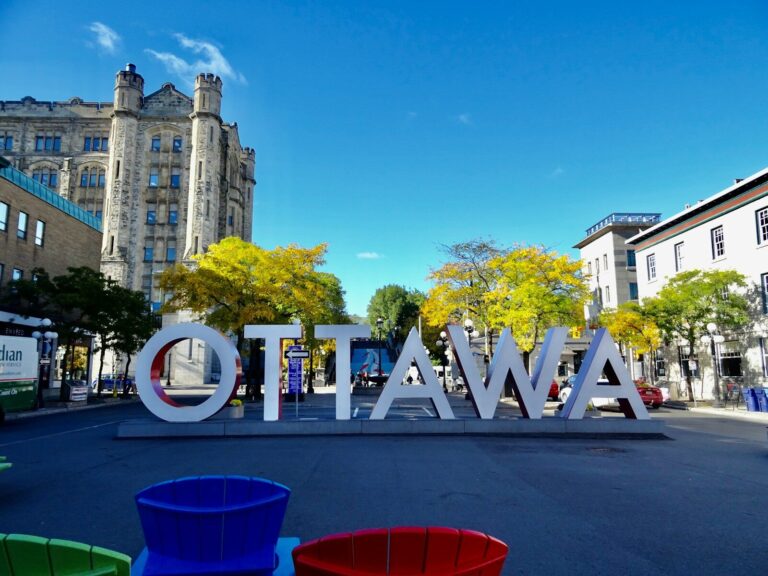

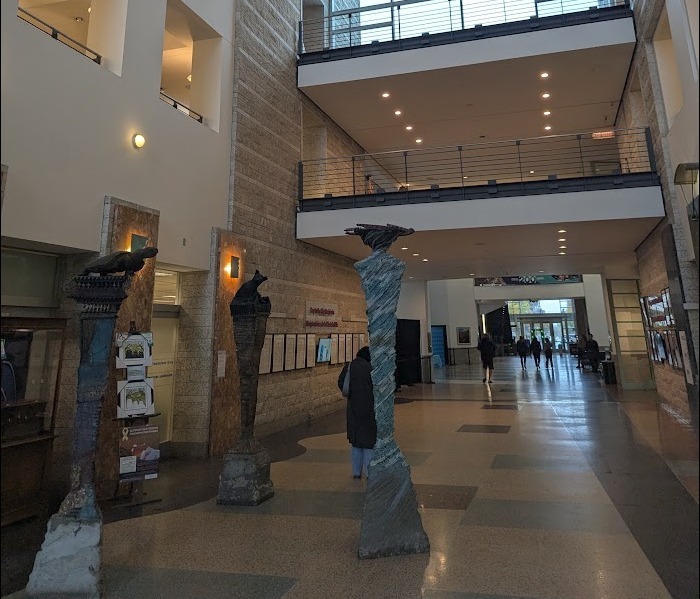
The lobby of Ottawa City Hall. Photo Credit: Rohan Thukral
The pivotal 2026 Ottawa Municipal Election was on Monday, October 26, resulting in a Council where all but one incumbent were re-elected. While it contains some small wins for progressives, which we will get to, it was overall a disappointing night for those looking for a more progressive direction on Council. Here were the races I was watching, and what I thought as the results rolled in on Monday.
Sutcliffe wins, but with smaller margin
Incumbent Mayor Mark Sutcliffe was re-elected to the Mayor’s Office with a reduced margin vs 2022, something I predicted last week. He received a less clear margin, of 10.7 per cent, over progressive Jeff Leiper than some other Ontario incumbent mayors, like Toronto’s Olivia Chow (13 per cent over conservative Bradford Bradford), or Vaughan’s Steven Del Duca (62.1 per cent over Shelly-Ann Cirelli), but it seemed to be a bad night for incumbents in Ontario overall: Hamilton’s Andrea Horwath came in third with only 14 per cent of the vote in total, being about 27 per cent behind the winner, Keanin Loomis, and Mississauga’s incumbent mayor, Carolyn Parrish, lost by about 10.9 per cent to challenger Alvin Tedjo.
This tour around the province reveals something interesting: Of the big city incumbents, Sutcliffe was fairly mediocre. The election was not a landslide either way, and he won with less than 50 per cent of the total vote, receiving 44 per cent in total. This percentage, and the total margin, also sends a message to Sutcliffe: Though he did win, it was not a win which shows confidence in his approach, but rather a lack of excitement for the other candidates in the race.
With rather low-energy campaigns from Jeff Leiper, Neil Saravanamuttoo, and Alex Lawson, this is hardly surprising. Although I made no secret of my personal views, being a Jeff Leiper supporter, it was hard not to notice that his campaign was rather lacklustre, failing to energize a city which was naturally inclined towards change at the beginning of this election cycle. Vote-splitting also played a role: had Neil Saravanamuttoo been less of a factor, or a non-issue, Jeff Leiper may well have come away as Mayor (though it is important to note that vote splitting also occurred on the right, between Alex Lawson and Mark Sutcliffe). Overall, the result of the mayor’s race should be rather disappointing to all, and may constrain Sutcliffe’s hand, if he wishes to run for re-election again in 2030.
Kanata South gains new representation
Ward 23 – Kanata South was the only municipal ward to replace an incumbent councillor, with community advocate and public servant Erin Coffin defeating incumbent Allan Hubley (the longest-serving member of City Council, with 16 years behind him) with 49.7 per cent of the vote to his 32.5 per cent. Hubley had come close to defeat in 2022, winning only 33.86 per cent of the vote, beating Coffin and other candidates due to a two-way vote split between Coffin and candidate Rouba Fattal. However, with only Coffin running this time around, Hubley went down in defeat.
This is a good thing for the ward and the City as a whole: Hubley previously called rumours (later substantiated in a judicial inquiry) that the troubled Confederation Line LRT (Line 1) had not been tested properly in winter ‘fake news’. He was the last remaining senior city official who helped change testing criteria and withheld vital LRT testing information to Council, according to the judicial inquiry into the LRT, which found him to be a member of a closed WhatsApp Group where such information and plans were exchanged. Furthermore, speaking as a resident of his ward, I had relatively bad experiences with his office. When I emailed Councillor Hubley in late 2023 about the results of the Bus Route Review, which would become New Ways to Bus, I did not get a response. I have yet to receive one to this day. In fact, I also emailed news outlets and representatives at other levels of government, with CBC Ottawa being far more responsive than Councillor Hubley. I also received a response from MPP Karen McCrimmon.
Furthermore, according to Horizon Ottawa, 80% of Hubley’s campaign donations in 2022 were connected to developers, one of the highest rates on Council. While Coffin has a relatively centrist platform, and it is unknown exactly how she will use her role as Councillor, I believe that her election is an improvement for her ward nonetheless.
Ottawa City Council made up mostly of women for the first time in history
For the first time in the city’s history, Ottawa City Council is made up mostly of women. In addition to the election of Erin Coffin, two new councillors were elected to replace incumbents who did not run. Joanne Chiannello, a former CBC Ottawa journalist, was elected to represent Kitchissippi Ward, which was represented by Jeff Leiper prior to his run for mayor. Chiannello ran a progressive campaign focused on transit reliability, increased accountability at City Hall, and more responsible intensification. While the latter is concerning to me as a possible excuse to block much-needed housing projects, she will bring a much-needed progressive voice to Council, and one with experience scrutinizing (if not making) municipal decisions.
The second new councillor elected to an empty seat was Chelsea Walton, previously a municipal employee, in Stittsville (Ward 6). She replaced Glen Gower on a platform increasing infrastructure funding to Stittsville (including, unfortunately, road widening projects), more reliable transit, and responsible growth. To me, her platform seems centrist in nature, and she is likely to be an ally of Mayor Sutcliffe, like Gower before her. While somewhat disappointing, this is not surprising given the ward she represents. Regardless, a majority-women City Council is still a big achievement and a step towards gender equality in the governance of our Capital.
Turnout concerningly low
Voter turnout in this year’s municipal election was extremely low, sitting at just 36.21 per cent of eligible voters, with Mayor Sutcliffe elected by just 16 per cent of eligible voters, or around one in seven. No ward broke 50 per cent turnout, though Kitchisippi came the closest at 48.7 per cent. This was the lowest turnout in 23 years, since 2003. Municipal democracy as a whole is affected, with turnout down around 7.5 per cent in total since just four years ago. A number of possible solutions exist to drum up interest in municipal politics, though all of them require major changes.
We could institute political parties at the municipal level, as other provinces such as BC and Quebec do. But there is mixed evidence for whether this helps, with turnout figures varying per city. It could also deepen divisions on City Council, taking us back to the ‘Watson Club’ years where toxicity was a relatively common complaint, and would require provincial legislation. Better local media coverage would also help, but there are few ways to achieve that without more spending on the CBC, which the federal government controls. Candidates could also run more high-profile campaigns, but this would require more money to be spent, which requires energizing people to donate in the first place, unless the province institutes a per-vote subsidy to returning candidates (though this could further entrench long-serving municipal politicians and discourage new candidates from running).
The best, simplest way may simply be word of mouth: As an engaged citizen, you should use your voice to not only advocate for your candidate of choice, but also for voting in general. Together, we can avoid another election of disappointments in 2030.
About The Author