


Think of a business registration number as your company's official ID. It is the unique code that tells the government, banks, and customers that you are a legitimate business, ready to operate legally. For any entrepreneur in the Ottawa area, getting this number is one of the first and most critical steps in starting a new venture.
Your Business Needs an Official Identity
This isn't just about a single number. It is a system of identifiers used by federal, provincial, and sometimes even municipal governments. Each one has a specific job, helping track your company's legal and financial activities.
Simply put, this number is the key that unlocks the formal economy for your business. It lets you collect sales tax, hire employees, and apply for the permits you need to grow. Without it, your venture is more of a side hustle than a recognized business.
Why This Number Is So Important
At its core, a business registration number legitimizes your operations. It is your proof to banks, suppliers, and government agencies that you are a serious, compliant player. You can think of it as the foundation you build everything else on.
The system also helps governments keep the marketplace fair and accountable. The Canada Revenue Agency (CRA), for example, uses the federal Business Number (BN) to manage essential accounts for things like:
- Goods and Services Tax / Harmonized Sales Tax (GST/HST)
- Payroll deductions for your staff
- Corporate income tax filings
- Import and export duties
A business registration number is more than a bureaucratic hoop. It is your company's formal handshake with the Canadian economy. It establishes credibility and provides the framework for all your financial and legal obligations.
Provincial and Federal Layers
Things can seem a little confusing because different levels of government issue different numbers. It is not a one-and-done process. In Ontario, for example, registering your business name provincially is completely separate from getting a federal BN from the CRA.
Your provincial registration, often called a Master Business Licence if you are a sole proprietor or partnership, is what lets you operate legally under a name that isn't your own. We cover this in much more detail in our guide on business name registration.
We'll walk you through the essential numbers every Ottawa-based business owner needs to know. Our goal is to make the process clear and manageable, so you can get back to what matters: building your business right here in the National Capital Region.
Federal Versus Provincial Business Numbers
Trying to figure out business registration can feel like learning a new language, especially with different numbers coming from different levels of government. It is easy to get the federal and provincial rules mixed up.
Think of these numbers as different types of ID for your company.
Your federal Business Number (BN), issued by the Canada Revenue Agency (CRA), is like your company's national passport. It is a single, nine-digit number that identifies your business to the federal government for all major tax-related matters.
On the other hand, your provincial registration, like an Ontario Master Business Licence, is more like a local driver's licence. It gives you the legal green light to operate your business under a specific name inside the province. It is your ticket to doing business locally.
Your Federal Business Number, Explained
The federal BN is your main identifier for anything involving the Government of Canada. It is more than just a number; it is the root of a system. Once you get your nine-digit BN, the CRA attaches specific program accounts to it, each tagged with a two-letter code and a four-digit reference number.
You will need a federal BN if you plan to:
- Collect GST/HST: If your business makes more than $30,000 in revenue over four straight calendar quarters, you have to register for a GST/HST account (that is your "RT" account).
- Hire Employees: When you bring on your first employee, you need to sign up for a payroll deductions account (an "RP" account) to handle CPP and EI.
- Import or Export: Doing business across borders means you will need an import-export program account (an "RM" account).
- Incorporate Federally: If you incorporate your business at the federal level, you will be assigned a BN automatically.
This "passport" makes sure your business is recognized and playing by the rules across the country for all its major financial duties. It is the cornerstone of your relationship with the CRA.
The Provincial Business Registration
While the federal BN handles national tax matters, your provincial registration is about your legal right to operate in your own backyard. For a sole proprietorship or partnership in Ontario, this comes in the form of a Master Business Licence. This registration officially connects your chosen business name to you as the owner.
This provincial "driver's licence" is crucial for day-to-day business in Ontario. It is the document you will need to show the bank when you open a business account under your trade name. It is also what you will use to sign contracts, leases, and other legal papers in your business's name, giving you credibility with clients and suppliers.
For any entrepreneur in Ottawa, getting this distinction right is important. Your provincial registration lets you operate locally, while your federal BN takes care of your national tax obligations. You might need one, the other, or both, depending on how your business is set up.
For example, a freelance writer working under their own legal name and earning less than $30,000 a year might not need either. But if they decide to operate under a distinct business name, they must get a Master Business Licence. If their income then climbs past the GST/HST threshold, they will also have to register for a federal BN.
To make it clearer, let’s break down the key differences for entrepreneurs in the Ottawa-Gatineau region.
Federal Business Number vs Provincial Registration at a Glance
The table below lays out the two main types of business numbers you will encounter, highlighting what they are for, who issues them, and when you need them.
| Feature | CRA Business Number (Federal) | Ontario Master Business Licence (Provincial) |
|---|---|---|
| Purpose | Manages federal tax programs like GST/HST, payroll, and corporate income tax. | Legally allows you to operate a business under a specific name within Ontario. |
| Issuing Body | Canada Revenue Agency (CRA) | Ontario Ministry of Public and Business Service Delivery (via the Ontario Business Registry) |
| When It Is Required | Required if you collect GST/HST, have employees, import/export, or are federally incorporated. | Required for sole proprietorships and partnerships operating under a name other than the owner's full legal name. |
| Geographic Scope | National (applies across Canada). | Provincial (valid only within Ontario). |
| Primary Use Case | Filing taxes and remitting deductions to the federal government. | Opening a business bank account and signing contracts in your business name. |
Seeing them side-by-side helps clarify that these numbers are not interchangeable. They serve completely different, but equally important, functions in making your business legitimate and compliant.
How to Get Your Business Number in Ottawa
Let's get down to the details. Now that you know the difference between the federal and provincial systems, where do you start? For most new entrepreneurs in Ottawa, the journey begins at the provincial level with the Ontario Business Registry (OBR). Getting this done is your first official step toward turning that business idea into a reality.
The process is likely more straightforward than you think, but it does demand preparation. Before you visit the registry’s website, you need to make a few key decisions about your company. A little planning now will make the registration process much smoother.
Preparing for Your Provincial Registration
First, what kind of business are you running? You need to decide on your structure. Are you a sole proprietorship (a one-person show), a general partnership (you and at least one other person), or are you incorporating? This choice is a big one, as it impacts your personal liability, how you are taxed, and the paperwork involved.
Next is your business name. If you are a sole proprietor running the business under your own legal name, you can skip this part. But if you plan on using a trade name, say "Capital City Coffee," you must register it.
This leads to a crucial step: the name search. The OBR requires your business name to be unique in the province for your industry. You can run an enhanced search through the registry to ensure your name isn't already claimed. Doing this now saves potential legal headaches down the road. For a deeper dive, our guide on how to register a business in Ontario walks you through the name search process in more detail.
This decision tree can help visualize whether you will need a federal number, a provincial one, or both.
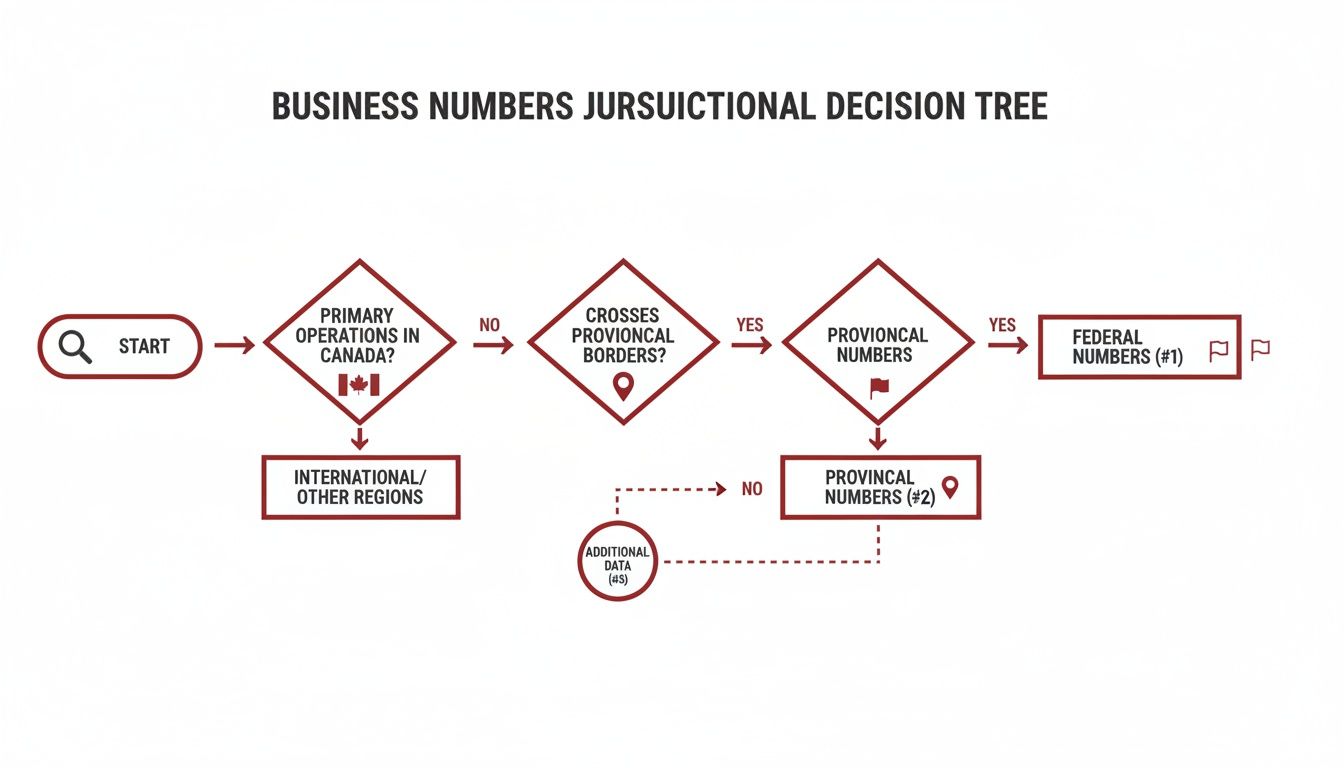
As you can see, things like hiring employees or needing to collect GST/HST are what will trigger the need for a federal number after you have sorted out your provincial registration.
Completing the Online Registration Form
Once your prep work is done, you are ready to tackle the online form. The Ontario Business Registry's online portal is user-friendly and walks you through everything step by step.
To make it go smoothly, have these details ready:
- Your Chosen Business Name: The exact one you searched and confirmed is available.
- Business Address: This has to be a physical address in Ontario, not a P.O. box.
- Business Activity Description: A clear, simple summary of what you do (e.g., “residential landscaping services” or “graphic design for small businesses”).
- Owner Information: The full legal names and addresses for all owners.
After you fill out the form and pay the fee, you will receive your Master Business Licence. This document is your official proof of registration in Ontario. It is valid for five years and you will need to renew it to keep your business name active.
The Next Step: Your Federal CRA Business Number
Getting your provincial registration sorted is a huge milestone. You have laid the groundwork. But for many businesses, this is just the first half of the equation. Your provincial licence gives you the right to operate, but it does not cover your federal tax obligations.
Think of it this way: your Master Business Licence lets you open your shop doors in Ottawa. Your federal Business Number (BN) from the CRA is what lets you manage the money that comes through those doors, especially when it comes to taxes and employees.
If you plan to collect GST/HST or hire even one employee, your next stop is applying for a federal Business Number from the Canada Revenue Agency. The good news is this is a simple process you can do online, by phone, or by mail. You will use the info from your provincial registration, making it a seamless transition from a provincially recognized business to one that is fully compliant on the federal level.
If you are thinking of setting up shop across the river in Gatineau, be prepared for a business registration process that is unique to Quebec.
While the goal is the same, making your business official, the process and legal requirements are different. Your main point of contact is the Registraire des entreprises du Québec (REQ).
If you are operating in Gatineau, you will need to get familiar with the Québec enterprise number (NEQ). This ten-digit number is the provincial cousin to Ontario’s Business Identification Number. It is mandatory for almost every business in Quebec, whether you are a sole proprietor using a trade name or a corporation.
The NEQ is your company’s universal ID for anything involving the Quebec government, especially when it is time to file taxes with Revenu Québec.
Getting to Know the Registraire des entreprises du Québec
The REQ is the central office for all business registrations in the province. A key difference from Ontario is that registration is a one-time thing, but it comes with an annual requirement: filing an updating declaration to keep your information current.
This public registry is important for business transparency in Quebec. Anyone can use the REQ database to look up info about a business, like its legal status, its activities, and its directors. The system is designed to build trust and accountability.
"To do business in Quebec, you must be registered in the enterprise register. This registration attests to your legal existence. Without it, you cannot identify yourself to government departments and agencies, or to your financial partners, clients and suppliers."
– Registraire des entreprises du Québec
That quote is on point. In Quebec, registration isn't just a piece of paper. It is the fundamental step that proves your business legally exists and can operate within the provincial economy.
What Gatineau Businesses Need to Know
Registering in Quebec comes with a few specific rules that every Gatineau entrepreneur needs to understand. They reflect the province's unique legal and cultural landscape.
- Mind the Language Laws: Quebec's Charter of the French Language has clear rules about business names. Your business name has to be in French. You can have an English name too, but the French one must always be displayed just as prominently.
- The Annual Updating Declaration: Every year, you have to file a declaration to either confirm or update your business details on the registry. If you miss it, you could face penalties and eventually see your business struck from the register.
- The Sole Proprietor Rule: If you are a sole proprietor operating under your own full name (like "Jane Smith"), you do not need to register. But if you add another word, say "Jane Smith Consulting," registration becomes mandatory.
This system ensures that the public always has access to up-to-date and accurate business information. On the Gatineau side of the river, Quebec's registries add another 15,000 businesses each year, with their NEQ numbers confirming their legal status. You can find more details in the business count statistics from Statistics Canada.
Your Step-by-Step Guide to Getting Registered
Getting your NEQ is a straightforward process you can do online through the REQ's portal. Here is how it works:
- Choose Your Business Structure: First, decide if you will be a sole proprietorship, a partnership, or a corporation.
- Check Your Business Name: Make sure your chosen name follows Quebec's language laws and is not already taken. A search on the REQ database will tell you.
- File Your Declaration of Registration: Fill out the online form. You will need your business name, address, a description of what you do, and the owner's details.
- Pay the Fee: There is a government fee to process the application.
- Get Your NEQ: Once everything is processed, you will be issued your unique Québec enterprise number. And just like that, your business is officially on the map in Quebec.
For entrepreneurs working in the National Capital Region, knowing your way around both the Ontario and Quebec systems is a huge advantage. It gives you the flexibility to operate smoothly, no matter which side of the river your ambition takes you.
Putting Your Business Number to Work

You have handled the paperwork and finally have your official business numbers. It is a huge milestone, but it is just the starting line. Now it is time to put those numbers into action, making them a core part of your company’s daily operations.
Think of your business registration number and its accounts like the keys to your company car. You cannot legally operate, manage your money, or deal with other businesses and government agencies without them. They are active tools, not just digits on a certificate.
This section is about bridging that gap, moving from the setup to the real-world hustle of running your Ottawa business.
Financial and Banking Essentials
One of the first places you will need your provincial registration details is at the bank. Financial institutions will ask for your Master Business Licence to open a dedicated business bank account under your operating name. This is a non-negotiable step for separating your personal and business finances, which is the foundation of good bookkeeping.
Your federal numbers are just as crucial for day-to-day money matters. When you send an invoice to a client, you are legally required to include your full business name and your GST/HST number. The Canada Revenue Agency is strict about this, so make it a standard part of your template from day one.
And if you have a team? Your payroll account number (the "RP" account) is your ticket to remitting employee deductions for CPP and EI to the CRA. You will be using it on every pay run.
Legal and Contractual Obligations
In the business world, your registration numbers are what give your company legitimacy. They are your official signature when entering into any formal agreement.
Whether you are drafting a contract with a new supplier, signing a lease for commercial space, or finalizing a deal with a client, your registered business name and number prove you are a recognized legal entity. It is what makes the contract enforceable and protects everyone involved.
Your business registration number acts as a credential, signalling to partners, clients, and government agencies that your operation is legitimate, accountable, and compliant with Canadian law. It builds the trust necessary for commercial relationships to thrive.
Government Filings and Municipal Permits
Beyond banking and contracts, your numbers are your direct line to government services and obligations. Your corporate tax account number (the "RC" account) is what you will use when filing your annual corporate income tax returns, a key compliance task. Keeping this number handy is also vital when planning how to maximize your returns, a topic we cover in our guide on small business tax deductions in Canada.
Closer to home, you will need your registration info when applying for permits with the City of Ottawa. It does not matter if it is for a small commercial renovation, a patio extension for your cafe, or a special event licence; the city needs to see you are an authorized business.
Common Registration Mistakes to Avoid
Jumping into the world of business registration can feel like navigating a maze. New entrepreneurs often take a wrong turn, but knowing the common mistakes can help you keep your new venture on solid ground.
The most common slip-up is confusing a simple business name registration with something much bigger. When you register a sole proprietorship or partnership in Ontario, you are just claiming your trade name. It offers zero liability protection. This registration does not create a separate legal shield the way incorporation does, which means your personal assets are still on the line if the business gets into debt.
Another classic mistake is treating your registration as a one-and-done task. That Ontario Master Business Licence is not permanent. It has to be renewed every five years to stay valid. If you let it expire, you legally lose the right to operate under that name, which can disrupt your banking and client contracts.
Financial and Tax Missteps
One oversight that can lead to serious financial headaches is ignoring the GST/HST threshold. The moment your business brings in more than $30,000 in revenue over four straight calendar quarters, you are legally required to get a GST/HST account from the CRA and start collecting sales tax. Failing to do this can land you with penalties and a bill for back taxes.
Procrastinating on your GST/HST registration is one of the costliest mistakes a small business can make. The CRA works on the assumption that you know the rules, and "I didn't know" won't work when it is time to pay.
Finally, many new business owners fall into the trap of mixing personal and business finances. Even if you are a sole proprietor, opening a separate bank account with your business registration number is crucial. It cleans up your bookkeeping, makes tax season less stressful, and looks more professional to clients and suppliers.
To steer clear of these issues, keep these simple tips in mind:
- Know Your Structure: Get clear on the legal differences between a sole proprietorship, partnership, and incorporation before you register.
- Set Renewal Alerts: The day you get your Master Business Licence, put the five-year renewal date in your calendar. Do it immediately.
- Watch Your Revenue: Keep a close eye on your income so you can see when you are about to cross that $30,000 GST/HST line.
- Separate Your Money: As soon as you are registered, head to the bank and open a dedicated business account.
Dodging these common blunders from the start helps you build a strong, compliant foundation for your business. It frees you up to focus on growth, giving you the peace of mind that all the administrative details are taken care of. For any local business owner in the Ottawa community, that matters.
Your Business Number Questions, Answered
Jumping into the world of business registration can feel like learning a new language. A lot of questions pop up, especially for entrepreneurs here in the Ottawa area. Let's cut through the noise and get you some quick, straightforward answers to the most common queries we see.
I'm a Freelancer—Do I Really Need a Business Number?
This is the classic question, and the answer is: it depends.
If you are just starting out, operating under your own legal name, and bringing in less than $30,000 a year, you generally don't need a federal Business Number (BN) for GST/HST. But keep a close eye on your revenue. The moment you hit that $30,000 threshold over four straight calendar quarters, the Canada Revenue Agency (CRA) legally requires you to register for a GST/HST account.
There is another piece to this puzzle. If you decide to operate under a trade name, say "Capital City Consulting" instead of just your name, you will need to register that name with the province. That process is completely separate from getting a federal BN.
What's the Cost to Register a Business Name in Ontario?
Getting your business name officially registered in Ontario is a pretty modest and essential first step. Right now, the government fee to register a new sole proprietorship or general partnership online through the Ontario Business Registry is $60.
That payment gets you a Master Business Licence, which is good for five years. Just remember, this fee is strictly for the name registration. If you are thinking about incorporating down the line, the costs will be quite a bit higher.
Help! I've Lost My Business Number. Where Can I Find It?
Don't worry, it happens to the best of us. Misplacing a business number is more common than you'd think, and thankfully, finding it is usually pretty simple.
- For your provincial number (the one on your Master Business Licence, called an Ontario Business Identification Number), you can search the public Ontario Business Registry. A quick search for your business name should pull up all the details.
- For your federal CRA Business Number (BN), the easiest place to check is on any mail you have received from the Canada Revenue Agency. You can also log into your secure CRA "My Business Account" portal to find it there.
One of the best habits you can build is keeping a secure digital copy of these numbers. It will save you a headache later on.
At NCR Now, we believe clear, accessible information is the key to helping local entrepreneurs succeed. Our guides are built to help you navigate every part of your business journey in the National Capital Region. https://ncrnow.ca
About The Author