

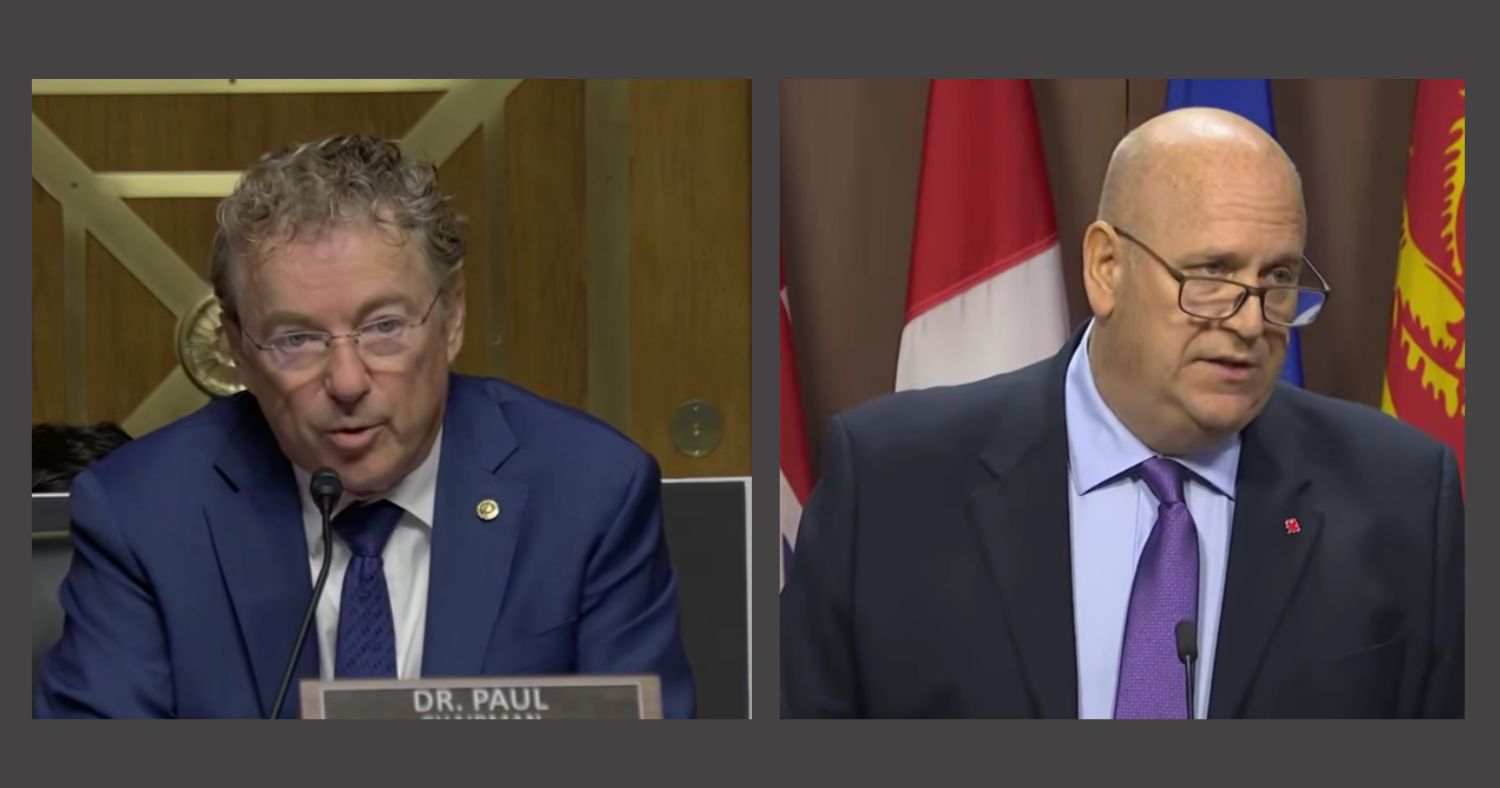
In the wake of the COVID-19 pandemic, a distinct brand of medical populism has transformed public health disagreements into a permanent political gold mine. Even when politicians turn their backs on established science, they still love the theatre of official “inquiries” and “investigations.” Instead of relying on clinical research, they construct mirror institutions—complete with gavels, raised panels, live broadcasts, and solemn committee rooms—to mimic legitimate government oversight while ignoring basic standards of scientific verification.
In the United States, Senator Rand Paul leverages the authority of Senate committee chairmanships to run high-profile prosecutorial theatre against retired public health officials. Across the border, Conservative Member of Parliament Dean Allison runs the budget-conscious Canadian equivalent: the crowdfunded “Allison Inquiry,” an unofficial, citizen-led listening forum staged on Parliament Hill to record unverified claims.
Despite their differing constitutions, television budgets, and noise levels, both politicians follow the same operational playbook. They rely on a shared ideological blueprint, weaponize personalized villains, and substitute sheer volume of outrage for verifiable data.
The Blueprint: How Great Barrington Fueled Medical Populism
The intellectual foundation of modern medical populism was not forged in a university laboratory or a peer-reviewed clinical trial. It was drafted over a single weekend in October 2020 at the American Institute for Economic Research (AIER)—a libertarian, free-market think tank in Massachusetts underwritten by conservative donor networks, including grants from the Charles Koch Foundation.
Known as the Great Barrington Declaration, the document advocated for “Focused Protection.” Its authors argued that governments should allow COVID-19 to spread freely among the young and healthy to rapidly build “natural herd immunity,” while somehow shielding the elderly and vulnerable—a strategy that epidemiological experts immediately criticized as both ill-defined and logistically impossible in a world of multigenerational households and shared health systems. Nonetheless, for politicians eager to oppose lockdowns and public health mandates, the declaration offered an immediate pseudo-scientific shield: they were no longer opposing health advice, but simply following “dissenting experts.”
The declaration’s claim of representing an “international expert consensus” collapsed under a simple reality: anyone could sign it without verifying their credentials. Anyone with an internet connection could sign the public petition, leading journalists to discover that the document’s roster of “medical experts” included homeopaths, massage therapists, and digital fabrications like Dr. Johnny Bananas and Professor Cominic Dummings.
Rather than discarding this flawed methodology, the proponents of medical populism embraced it. Senator Rand Paul routinely invoked the Great Barrington Declaration during Senate hearings, framing the scientific community’s rejection of “herd immunity through infection” not as sound epidemiological judgment, but as a sinister cover-up orchestrated by the medical establishment.
In Canada, Dean Allison imported the model wholesale. First, during his 2022 “A Citizens’ Hearing” and, more recently, in June 2026 with the launch of his “Allison Inquiry,” Allison adopted the declaration’s core arguments and its unverified submission process. His inquiry’s digital portal accepts personal narratives without requiring diagnostic records, medical audits, or cross-examinations, explicitly ensuring that unvetted claims are treated with the exact same gravity as peer-reviewed science.
Also Read: Before Canada Spends Billions on AI, What Are We Actually Buying in the Name of Independence?
The Target: Why Medical Populism Needs Villains
Abstract concepts like “changing epidemiological models” or “evolutionary viral mutations” do not generate outrage or drive fundraising emails. To mobilize voters, the medical populism movement had to be given a single, punishable face.
Senator Rand Paul found his ideal target in Dr. Anthony Fauci. Though Paul holds a medical degree, his background is as an eye surgeon—not an epidemiologist or an infectious disease specialist. Over the course of multi-year committee hearings, Paul transformed standard shifts in early pandemic guidance—such as evolving recommendations on masks or on viral origins—into a personal criminal narrative. By subpoenaing Fauci’s personal notes, releasing internal emails, and formally voting to hold the retired 85-year old doctor in contempt of Congress, Paul reframed complex, population-level health decisions as a series of personal lies told by a corrupt bureaucrat.
While Canada lacked an exact direct equivalent to Fauci, Dean Allison effectively imported the anti-Fauci playbook. Rather than targeting a single celebrity doctor, Allison directed the same rhetoric toward Health Canada, the Public Health Agency of Canada (PHAC), and federal public servants. By framing official medical guidance as inherently manipulative and deceptive, Allison is attempting to normalize the idea that public health policy belongs in a quasi-judicial courtroom where the state is always guilty until proven innocent.
The Rearview Mirror Trap: No Plan for Pathogen X
The fundamental intellectual vulnerability of medical populism is that it operates exclusively in the rearview mirror. Both Paul and Allison base their political arguments on a retrospective mathematical reality: COVID-19 had an overall infection fatality rate that meant the majority of infected individuals survived. In doing so, they conveniently ignore that overall survival rates were significantly improved by emergency medical care, clinical advances, and mass vaccination campaigns. Because the virus was “relatively” survivable for young, healthy citizens, they frame every emergency measure—from travel restrictions to workplace vaccine mandates—as “disproportionate government tyranny.”
Notably absent from their arguments is a viable plan for the next pandemic. Their model assumes that every future biological threat will act like COVID-19. They offer no framework for how society should respond if the next emerging pathogen is not a coronavirus, but something like a mutated strain of Avian Influenza (H5N1) carrying a 20% to 50% mortality rate, or a novel virus that severely targets children.
Under the Paul-Allison framework, these politicians are actively trying to dismantle the public health emergency brake:
- Attempted Legislative Restrictions: Dean Allison sponsored Bill C-278 (Prevention of Government-Imposed Vaccination Mandates Act), which sought to permanently prohibit the Canadian federal government from requiring vaccines for public service employment or travel. (The bill was ultimately defeated in Parliament).
- Institutional Sabotage: Rand Paul has consistently voted against federal pandemic preparedness funding, including opposing bipartisan legislation designed to modernize medical supply chains and early-warning diagnostic networks.
By attempting to outlaw containment tools and treating chief medical officers as tyrants-in-waiting, they threaten to leave society entirely defenceless against future outbreaks. Their alternative strategy—voluntary individual choice and “focused protection”—collapses instantly when applied to a high-mortality virus. They are building a public health model that leaves the state with no tools to protect its citizens except to politely ask them to assess their own personal risk while hospitals overflow.
Subpoenas vs. Crowdfunding: The Business Model of Medical Populism
The persistence of medical populism across borders is not an accident of history; it is a highly profitable evergreen campaign strategy. For individual politicians and their broader party apparatuses, keeping pandemic grievances fresh yields immediate financial and structural returns.
For Rand Paul, attacking Dr. Fauci serves as an unmatched small-dollar fundraising tool, generating millions in campaign contributions from grassroots donors. For Dean Allison, staging an independent inquiry on Parliament Hill cements his standing with anti-mandate activists and protects him against nomination challenges from the far right.
At the party level, leadership tolerates and subtly encourages these initiatives because they serve as a key strategy for keeping their voting base intact. The Conservative Party of Canada can use backbenchers like Allison to signal to former Freedom Convoy supporters that their grievances are heard, while maintaining enough distance to avoid scaring away moderate suburban voters. The U.S. Republican Party uses Paul’s committee clashes to keep anti-establishment voters perpetually mobilized for midterm elections.
The Campaign Against Expertise
The “Allison Inquiry” in Ottawa and Rand Paul’s Senate hearings in Washington are not genuine attempts to evaluate medical data, improve hospital readiness, or prepare for future biological emergencies. They are exercises in performative accountability—political campaigns where the goal is not to solve a problem but to keep the outrage cycle alive for the next election.
By replacing peer-reviewed research with unvetted internet submissions and actual medical records with solemn political nodding, medical populism has created a mirror reality where noise is mistaken for evidence. In their eagerness to exploit past pandemic anger, Rand Paul and Dean Allison are trying to build a political ecosystem where scientific consensus is treated as a cover-up, public health leadership is treated as a crime, and the public is left completely unprepared for whatever biological threat arrives next.
Additional Information on “Medical Populism”
Medical populism isn’t new—it is an old political trick of pitting “the virtuous public” against a “corrupt medical establishment” during a crisis. Whenever a health emergency hits, populist leaders bypass complex science to sell a simpler story: the experts are lying, and the government is trying to control you.
Examples of this playbook:
- 19th-Century Anti-Vaccine Leagues: Opposed compulsory smallpox shots by framing basic public health as “despotic tyranny.”
- South Africa (2000s): President Thabo Mbeki rejected the scientific consensus on HIV, framing Western medicine as a corporate scam and promoting garlic and lemon juice instead—costing over 300,000 lives.
- The Philippines (2017): Politicians sensationalized a dengue vaccine rollout through dramatic, televised “hearings,” destroying public trust and triggering massive outbreaks of measles and polio.
Figures like Rand Paul and Dean Allison didn’t invent this strategy. They are simply applying a historical formula to modern media: simplify the science, turn doctors into villains, and convert complex public health initiatives into a handy campaign tool.
About The Author















Isn’t it crazy how we went through a pandemic, yet didn’t learn anything from it? If a more deadly one came, we’d be totally screwed.
It IS crazy. I don’t understand such a limited viewpoint. They are trying to outlaw basic public health measures. – Louise Mignault